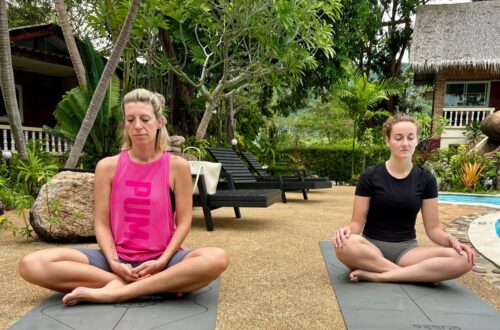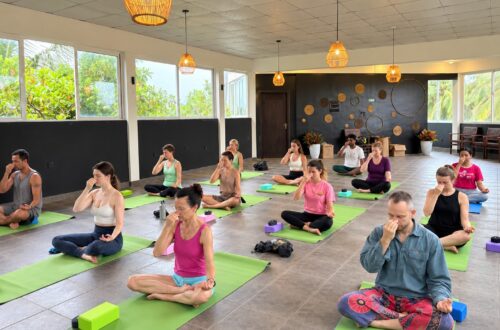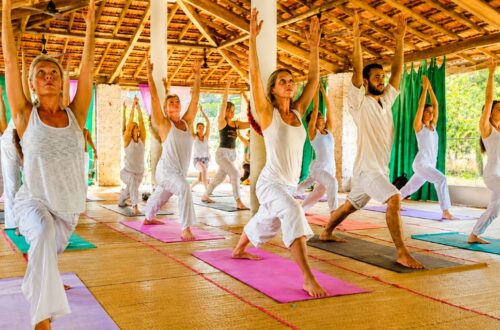
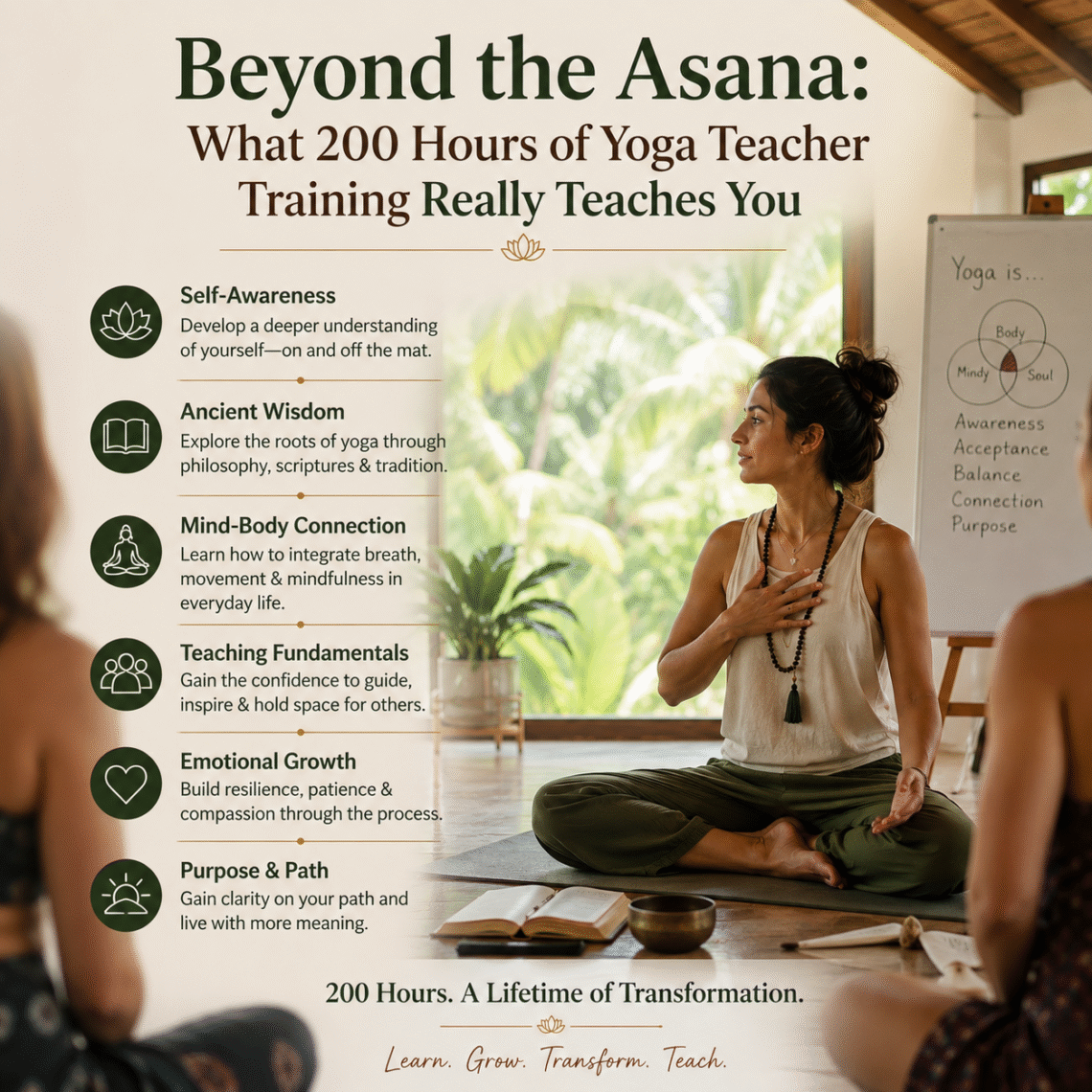
What 200 Hours of Yoga TTC Really Teach, 200 Hour Yoga TTC in Arambol Goa gives you the time and structure to explore that transition in depth.
It is not simply a longer yoga retreat, and it is not just a certificate at the end of a course. At its best, 200 hours create a period of concentrated study in which asana, pranayama, meditation, yoga philosophy, anatomy, alignment and teaching methodology begin to connect.
At Diksha Yoga School, this journey takes place at The Lotus Sutra in Arambol, Goa, where students step away from their usual routines and immerse themselves in the practice and study of yoga.
But the most important part of the journey is not the number of hours.
Table of Contents
It is what happens inside those hours.
200 Hours Is Not About Learning More Poses
A common misconception about a 200-hour yoga teacher training is that you simply learn a larger collection of asanas.
That is only a small part of the journey.
You begin learning to look at an asana differently.
Instead of asking only:
“How do I perform this posture?”
you begin asking:
“What is this posture asking from the body?”
“How can I explain it clearly?”
“What might a beginner find difficult?”
“What alternatives could I offer?”
“How does the breath support the movement?”
“When should I encourage a student to go deeper—and when should I ask them to stop?”
These questions mark an important change.
You are beginning to think like a teacher.
And learning to think like a teacher takes considerably more than memorizing posture names.
What Does a 200-Hour Yoga Teacher Training Actually Teach You?
A comprehensive 200-hour yoga teacher training in Goa should give you an opportunity to explore yoga from several connected perspectives.
At Diksha Yoga School, the learning journey is built around the traditional foundations of yoga while developing the practical skills required to communicate and teach those principles in a contemporary classroom.
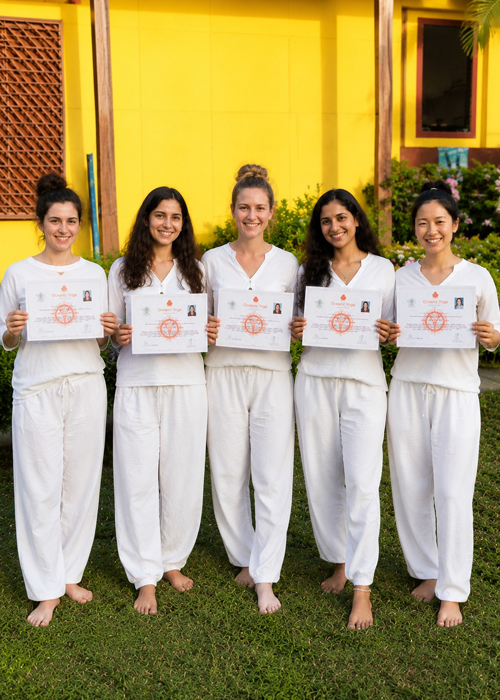
Your study may bring together:
- Hatha Yoga
- Vinyasa Flow
- Ashtanga foundations
- Pranayama
- Meditation
- Yoga Philosophy
- Anatomy and Alignment
- Teaching Methodology
- Sequencing
- Demonstration and verbal cueing
- Practical teaching
- Observation and feedback
The important word here is connection.
Anatomy should inform your understanding of asana.
Breath should become part of your movement awareness.
Philosophy should have relevance beyond a classroom discussion.
Teaching methodology should help you communicate what you have actually experienced through practice.
And your personal practice should continue informing the way you teach.
The goal is not to collect subjects.
The goal is to connect them.
Why 200 Hours Can Change Your Relationship With Yoga
One of the most valuable things a longer teacher training provides is time.
Time to repeat.
Time to observe.
Time to question.
Time to make mistakes.
Time to receive feedback.
Time to return to something you thought you understood and discover another layer.
That matters because yoga is not a subject that can be understood entirely through a single explanation.
You may learn about alignment in one class and understand it differently six weeks later after experiencing it repeatedly in your own body.
You may study a philosophical concept in the morning and recognize its relevance in an ordinary situation later that day.
You may teach a sequence for the first time and realize that something which looked perfect on paper doesn’t work as well with real students.
That is learning.
Experience turns information into understanding.
A 200-Hour Training Is Also a Test of Your Own Practice
Teacher training is not only about what you learn from your teachers.
It also reveals how you relate to yourself.
Can you continue practicing when you are tired?
Can you accept that your body has limitations?
Can you listen when someone gives you feedback?
Can you admit that you don’t know something?
Can you remain curious when you think you already understand?
Can you teach without needing to prove that you are the most advanced person in the room?
These questions can be uncomfortable.
But they are important.
Because eventually, your students will not only learn from the instructions you give them.
They will also experience the way you show up.
Your patience.
Your attention.
Your confidence.
Your humility.
Your ability to listen.
These qualities are not learned from an asana manual.
They develop through practice.
What 16+ Years of Teaching Have Shown Me
By Yogini Manisha, Founder & Lead Teacher, Diksha Yoga School
“After more than 16 years of teaching yoga, one thing I have learned is that the students who become meaningful teachers are not necessarily the ones who can perform the most advanced postures.”
What matters much more is their willingness to observe, listen and continue learning.
Over the years, I have worked with students from different countries, backgrounds and levels of experience. I have seen people arrive with tremendous physical ability but very little confidence in communicating with others.
I have also watched students who initially doubted themselves gradually discover that they had something very valuable to offer.
That has shaped the way I approach teacher training.
I don’t believe a teacher is created by simply learning more poses.
A teacher develops when knowledge begins to become understanding, and understanding begins to become responsible teaching.
That means learning to see the person in front of you—not simply the posture they are performing.
It means understanding that the most flexible student is not automatically the best practitioner.
It means recognizing that a beginner may need a completely different explanation from an experienced practitioner.
And it means having the humility to say:
“I don’t know yet.”
Because a yoga teacher should never stop being a student.
The Difference Between Knowing Yoga and Teaching Yoga
This is one of the biggest transitions students experience during a 200-hour yoga teacher training.
You can know how to perform a posture without knowing how to teach it.
You can understand a sequence without knowing how to explain it.
You can have years of personal practice without knowing how to work with a complete beginner.
Teaching requires another layer of awareness.
You have to think about:
What does my student need right now?
Not:
What can I demonstrate right now?
That distinction is fundamental.
A teacher’s job is not to impress the room.
A teacher’s job is to serve the learning of the student.
And that is one of the principles we want students to carry with them long after they leave our 200-hour yoga teacher training in Goa.
You Do Not Need to Be Perfect to Begin
Many students arrive at teacher training with a hidden fear:
“What if I’m not good enough?”
Perhaps they are not flexible enough.
Perhaps they don’t know enough Sanskrit.
Perhaps they have never taught a class.
Perhaps they feel nervous speaking in front of other people.
Perhaps they compare themselves with students who have practiced for many more years.
These concerns are understandable.
But you do not need to arrive as a finished teacher.
You arrive as a student.
The training is where you practice becoming a teacher.
You will make mistakes.
You will receive feedback.
You will teach again.
You will refine your instructions.
You will discover your strengths.
You will also discover areas where you need more work.
That is not a weakness in the process.
That is the process.
Why Goa—and Why Arambol?
A teacher training requires concentration.
You are studying the body.
You are studying the breath.
You are studying the mind.
You are learning to teach.
Having an environment that allows you to step away from your normal responsibilities can make that immersion meaningful.
Our 200-hour yoga teacher training in Goa takes place at The Lotus Sutra in Arambol, close to Arambol Beach.
The surroundings offer space to slow down between training sessions, reflect on what you have learned and experience a different rhythm from everyday life.
But we don’t believe a beautiful location should be the main reason to choose a yoga school.
The location can support your experience.
The teachers and education shape it.
So when you compare yoga teacher training programs in Goa, look beyond photographs.
Ask who is teaching.
Ask about their experience.
Ask what you will actually study.
Ask how much teaching practice you receive.
Ask whether you will receive personal feedback.
And ask whether the school’s approach to yoga matches what you genuinely want to learn.
More Than a Certificate
At the end of 200 hours, you may receive a certificate.
That is an important milestone.
But it should not be the destination.
The real outcome should be something you can carry into your practice and eventually into your teaching.
You should leave with:
- a stronger personal practice
- deeper understanding of traditional yoga
- greater awareness of the body and breath
- a foundation in teaching methodology
- experience creating and teaching sequences
- improved communication skills
- greater confidence
- respect for the responsibility of teaching
- and, perhaps most importantly, a desire to keep learning
Because 200 hours cannot make you an expert in yoga.
No honest school should promise that.
What 200 hours can do is give you a strong foundation from which your education can continue.
Your Journey Does Not Begin When You Feel Ready
You may be reading this because you have been thinking about a 200-hour yoga teacher training in Goa for months.
Maybe you have practiced for years.
Maybe you are relatively new but feel strongly drawn toward yoga.
Maybe you are considering teaching professionally.
Or maybe you simply feel that your current practice has reached a point where you want to understand more deeply.
You do not need to know exactly where the journey will take you.
You need a willingness to begin.
At Diksha Yoga School, we want those 200 hours to be more than time spent completing a curriculum.
We want them to become a period in which you practice deeply, question honestly, learn responsibly and begin discovering your own voice as a teacher.
Because the real journey is not:
Student → Certificate → Teacher.
It is more like:
Practice → Understanding → Experience → Teaching → Reflection → Continued Learning.
And that journey does not end when you leave Goa.
It begins with what you choose to do with the 200 hours.
Part 2 — What 16+ Years of Teaching Have Taught Me About Becoming a Yoga Teacher
By Yogini Manisha, Founder & Lead Teacher, Diksha Yoga School
After more than 16 years of teaching yoga, I have learned that the students who become the most meaningful teachers are not necessarily the ones who can perform the most advanced postures.
Some arrive with exceptional flexibility.
Some have practiced yoga for many years.
Others begin their teacher training feeling uncertain about their own bodies and wondering whether they are ready to teach anyone else.
Over time, I have seen something much more important than physical ability determine how a student develops as a teacher:
their willingness to observe, listen, learn and remain humble.
A yoga teacher is not simply someone who knows many asanas.
A yoga teacher learns how to see another person.
That distinction is at the heart of a meaningful 200-hour yoga teacher training in Goa.
The Biggest Mistake New Teachers Make
One of the most common things I see with new teachers is that they try to show everything they know.
After completing a teacher-training course, students are understandably excited.
They have learned new asanas.
They have studied pranayama.
They have discovered yoga philosophy.
They have practiced sequencing.
They want to share all of it.
But a student does not need everything you know.
They need what is appropriate for them at that moment.
A beginner may need three simple instructions rather than ten technical cues.
A student who is struggling may need a modification rather than encouragement to go deeper.
Someone who already has a strong practice may need a completely different challenge.
This is why teaching yoga is not about demonstrating how much knowledge you have accumulated.
It is about knowing what knowledge to share, when to share it and how to communicate it.
What Students Struggle With Is Not Always What You Expect
When you teach students from different backgrounds, you quickly discover that there is no such thing as an “average” yoga student.
One person may struggle with flexibility.
Another may struggle with balance.
Someone else may have excellent physical ability but find it difficult to slow down.
Another student may understand movement easily but feel nervous speaking or practicing in front of others.
And sometimes the biggest challenge is not physical at all.
It may be confidence.
It may be concentration.
It may be the fear of making a mistake.
As teachers, we need to learn to recognize these differences.
This is why observation is such an important part of teacher development.
Before correcting someone, look at them.
Before giving another instruction, listen.
Before assuming they need more, ask yourself whether they might actually need less.
That is a skill that develops through experience.
Flexibility Does Not Make You a Better Teacher
I want new teachers to understand this very clearly:
You do not need an extremely flexible body to become a good yoga teacher.
Yoga is not a competition in physical range.
I have seen practitioners who could perform advanced asanas beautifully but struggled to explain a simple movement to someone else.
I have also seen students who were not naturally flexible become thoughtful teachers because they understood patience, modification and the importance of respecting individual differences.
Your student’s body is not supposed to become a copy of yours.
Their practice belongs to them.
Your responsibility is to help them understand their practice more clearly and safely.
That requires knowledge of alignment and anatomy, but it also requires something less technical:
respect for individual bodies.
Why Some Advanced Practitioners Struggle With Beginners
This can be one of the most surprising lessons in a 200-hour yoga teacher training.
Being an advanced practitioner and being a good beginner teacher are not automatically the same thing.
When you have practiced for years, certain movements become automatic.
You no longer think about where your feet go.
You don’t have to consciously remember how to breathe through a familiar transition.
You may not remember what it felt like when someone first said:
“Turn your toes slightly outward.”
For a beginner, that instruction may be completely new.
This is why experienced practitioners sometimes need to learn how to become beginners again.
You have to remember what it feels like not to know.
That memory creates empathy.
And empathy makes teaching better.
What Makes Someone Naturally Good at Teaching?
There are qualities I look for that have very little to do with physical ability.
A good teacher tends to be curious.
They notice when a student looks confused.
They are willing to explain something differently.
They don’t become frustrated when someone needs more time.
They can receive feedback without becoming defensive.
They don’t pretend to know everything.
And they understand that their role is not to make students dependent on them.
Their role is to help students become more aware and capable in their own practice.
These qualities cannot simply be memorized from a textbook.
They develop through practice, teaching, reflection and real interaction with students.
That is why practical teaching is such an important part of a serious 200-hour yoga teacher training.
What Teaching International Students Has Taught Me
Teaching students from different countries has also changed the way I teach.
People arrive with different cultural backgrounds, different expectations and different relationships with yoga.
Some have practiced for many years.
Some are encountering traditional yoga for the first time.
Some communicate very confidently.
Others need more time before they feel comfortable asking a question.
This has taught me something simple:
Good communication is not just about speaking clearly.
It is about checking whether the other person has actually understood.
Sometimes you need to demonstrate.
Sometimes you need simpler language.
Sometimes you need to repeat yourself.
Sometimes you need to stop explaining and let the student experience the practice.
Teaching is a conversation, even when only one person is speaking.
The Teacher You Become Begins With the Student You Are
This is perhaps the most important lesson I want students to carry into a 200-hour yoga teacher training in Goa.
Before you can guide someone else, you need to become comfortable being guided yourself.
You need to experience correction.
You need to discover your own limitations.
You need to learn how to receive feedback.
You need to become comfortable saying:
“I don’t know.”
And then:
“Let me learn.”
That attitude is not a weakness.
It is one of the foundations of good teaching.
A certificate can confirm that you completed your training.
It cannot confirm that you have finished learning.
What I Hope My Students Take Into Their Teaching
If I could give one message to every student preparing to become a yoga teacher, it would be this:
Do not try to become another teacher. Become a more aware version of yourself.
Learn from your teachers.
Respect the tradition.
Study seriously.
Practice consistently.
But don’t simply copy someone else’s voice, personality or teaching style.
Over time, your own teaching voice should develop.
It may be quieter.
It may be more energetic.
It may be highly technical.
It may be deeply philosophical.
It may change as you gain experience.
That is okay.
Authentic teaching does not mean inventing your own version of yoga.
It means understanding what you have been taught deeply enough to communicate it honestly and responsibly.
After 16+ Years, I Still Consider Myself a Student
This may sound strange after teaching for so many years.
But I believe it is essential.
Yoga is too vast to finish studying.
Every student teaches you something.
Every class reveals something.
Every year of practice changes your understanding.
And every time you think you have understood something completely, another question appears.
That is not a problem.
That is the beauty of yoga.
A good 200-hour yoga teacher training should not leave you thinking:
“Now I know everything.”
It should leave you thinking:
“Now I have a stronger foundation—and I want to keep learning.”
That is the kind of teacher I hope our students become.
Not perfect teachers.
Not teachers who know everything.
But teachers who observe, listen, practice, question, adapt and continue growing.
And perhaps that is the real transformation of 200 hours.
You begin the course wanting to learn how to teach yoga.
You leave understanding that to teach yoga well, you must remain a student of yoga yourself.
Part 3 — When Yoga Becomes More Than Asana
For many students, the physical practice is the doorway into yoga.
You learn to move with your breath.
You become stronger.
You develop greater mobility.
You begin to notice your body in ways you may never have noticed before.
But during a 200-hour yoga teacher training, the question gradually becomes deeper:
What happens when yoga is no longer only about the body?
This is where the practice begins to expand.
You start exploring pranayama, meditation, philosophy, anatomy and the subtler dimensions of awareness. You begin to understand that an asana is not an isolated shape. It is part of a larger practice involving breath, attention, intention and awareness.
And this is one of the reasons a 200-hour training can feel so different from attending regular yoga classes.
Asana Is the Beginning, Not the Entire Journey
Asana is often the first thing people associate with yoga.
And understandably so.
It is visible.
You can photograph it.
You can feel yourself becoming stronger or more mobile.
But traditional yoga offers a much broader landscape.
During your training, you begin asking questions beyond:
“How do I get into the pose?”
You start exploring:
“How do I stay present while I am in the pose?”
“What is happening with my breath?”
“What does this practice teach me about effort and ease?”
“How can I help another person experience this without turning yoga into performance?”
That shift is important for anyone pursuing a 200-hour yoga teacher training in Goa.
Because when you eventually stand in front of a class, you are not simply teaching shapes.
You are helping students develop a relationship with their body, breath and awareness.
Pranayama: When You Begin to Understand the Breath
Most of us breathe all day without consciously thinking about it.
Yet the breath can change dramatically depending on what is happening inside us.
When we are anxious, the breath may become different.
When we are relaxed, it may naturally slow.
When we concentrate, we may unconsciously hold it.
When we move, it changes again.
Pranayama gives you the opportunity to study this relationship more consciously.
In a structured 200-hour yoga teacher training, pranayama should not be treated as a few breathing exercises added to the end of an asana class.
You begin learning the techniques, their purpose, appropriate preparation and the importance of teaching them responsibly.
Practices such as Nadi Shodhana, Kapalabhati, Bhastrika and Ujjayi can introduce different ways of working with the breath, while the study of bandhas can deepen your understanding of traditional yogic practice.
But the most important lesson is not simply learning the names of techniques.
It is learning to observe the breath.
And eventually, learning how to guide another person to observe theirs.
Meditation: Learning to Stop Doing
For people who are comfortable with physical movement, meditation can sometimes be unexpectedly challenging.
In asana, there is something to do.
You move.
You stretch.
You balance.
You strengthen.
Meditation asks something different.
Can you simply observe?
Can you sit with your breath without constantly trying to change it?
Can you notice thoughts without immediately following them?
Can you remain present when the mind becomes restless?
These are not always comfortable questions.
But they are valuable ones.
For a future teacher, meditation can also change the way you enter a classroom.
A teacher who is constantly rushing may create a very different atmosphere from a teacher who has learned how to become genuinely present.
The practice begins before the first instruction is spoken.
Philosophy: The Part of Yoga That Follows You Home
Yoga philosophy can sometimes feel abstract when you first encounter it.
You may read a concept and wonder:
“How does this relate to my life?”
Then something happens.
You have an argument.
You become attached to an outcome.
You feel frustrated because something didn’t happen the way you wanted.
You compare yourself with someone else.
And suddenly, a philosophical teaching you discussed during training feels much less theoretical.
This is where philosophy becomes interesting.
It begins moving from the page into your experience.
Studying classical teachings such as the Yoga Sutras of Patanjali, the Bhagavad Gita and the Hatha Yoga Pradipika can give students a deeper context for understanding the tradition they are practicing.
The purpose is not simply to memorize texts for an examination.
It is to begin asking:
How does this teaching change the way I practice?
How does it change the way I teach?
How might it change the way I live?
That is when philosophy becomes part of yoga rather than simply another subject on the timetable.
Anatomy Changes the Way You Look at the Body
There is another important shift during a 200-hour yoga teacher training.
You begin to understand that every student is different.
Two people can perform the same asana and have completely different experiences.
Their bone structure may differ.
Their mobility may differ.
Their previous injuries or physical history may differ.
Their strength and stability may differ.
Their proportions may differ.
This is why anatomy and alignment matter.
Not so that you can turn every class into a medical lecture.
But so that you can develop a more intelligent understanding of movement.
Instead of thinking:
“Everyone should look exactly like this.”
you begin thinking:
“What is an appropriate and conscious way for this student to experience the posture?”
That is a much more useful question for a teacher.
The Connection Between Anatomy and Compassion
Anatomy can make you more knowledgeable.
But it can also make you more compassionate.
When you understand that bodies are genuinely different, you become less likely to judge a student because they cannot achieve a particular shape.
You stop assuming that lack of flexibility means lack of effort.
You become more comfortable offering variations.
You become more attentive to discomfort.
And you begin understanding that a student’s practice does not have to look like yours to be meaningful.
This is an important lesson for anyone who wants to teach yoga professionally.
Teaching Becomes More Than Giving Instructions
As your understanding develops, teaching methodology begins to connect everything together.
You may know what an asana is.
You may understand its alignment.
You may know its Sanskrit name.
You may understand its relationship to the breath.
But can you explain it to someone who has never practiced it before?
That is another skill.
You learn to think about:
- verbal cues
- demonstrations
- sequencing
- transitions
- pacing
- voice modulation
- class structure
- student observation
- modifications
- appropriate progression
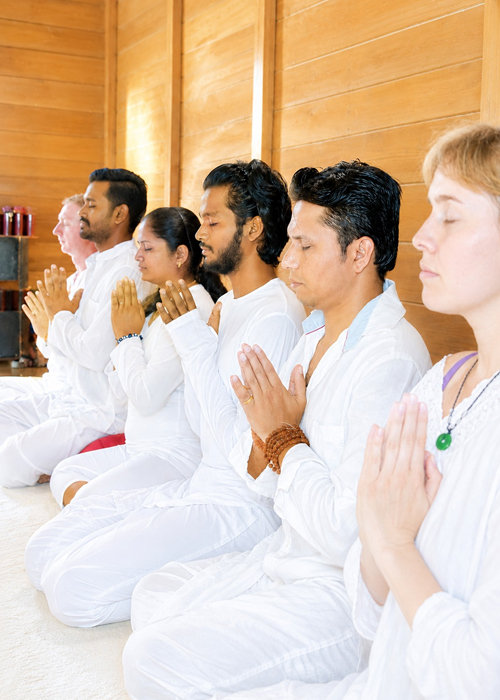
And then comes the part that no textbook can fully prepare you for:
standing in front of real students and teaching.
That is where theory becomes experience.
The 200-Hour Journey Connects the Pieces
This is perhaps the biggest difference between studying individual yoga subjects and completing a comprehensive teacher-training journey.
At first, everything can feel separate.
Asana.
Anatomy.
Pranayama.
Meditation.
Philosophy.
Teaching methodology.
But gradually, the connections become clearer.
Anatomy influences how you teach asana.
Pranayama influences how you structure practice.
Meditation influences how you understand awareness.
Philosophy influences how you approach teaching.
Teaching experience changes how you understand your own practice.
And your personal practice gives meaning to everything else.
The pieces begin becoming one practice.
That is what makes 200 hours valuable.
Not simply the number of subjects you study.
But the opportunity to see how those subjects relate to one another.
Beyond the Asana
A person can practice yoga for years and still primarily think of yoga as physical exercise.
There is nothing wrong with beginning there.
But teacher training invites you to go further.
To explore the breath.
To explore the mind.
To explore philosophy.
To understand the body.
To question your habits.
To observe your reactions.
To learn how to communicate.
And eventually, to understand that teaching yoga is not about putting yourself at the center of the room.
It is about helping someone else become more aware of themselves.
That is the point where yoga teaching becomes more than demonstrating asana.
And that is where the real journey of a 200-hour yoga teacher training begins.
Part 4 — The Moment You Stop Practicing Like a Student and Start Thinking Like a Teacher
There is a point during a 200-hour yoga teacher training when the way you look at a yoga class begins to change.
At first, you are mainly concerned with your own practice.
You are thinking about your alignment.
Your breath.
Your balance.
Your transitions.
Then something subtle happens.
You begin looking around the room.
You notice that one student is struggling with a transition.
Another is moving too quickly.
Someone else has stopped breathing naturally.
A beginner is looking at the person beside them because they are unsure what to do.
And suddenly you are no longer thinking only:
“How do I practice this?”
You are thinking:
“How would I teach this?”
That is a major turning point.
Knowing an Asana Is Not the Same as Knowing How to Teach It
You might be able to demonstrate Trikonasana beautifully.
But can you explain it to someone who has never practiced it?
Can you give instructions without overwhelming them?
Can you notice when their front knee is moving in an unsafe direction?
Can you offer an appropriate variation?
Can you explain the purpose of the posture without turning the class into a lecture?
Can you help the student understand what they should actually feel?
These are different skills.
And they are developed through practice, observation and feedback.
This is why a serious 200-hour yoga teacher training in Goa should give students opportunities to teach—not simply opportunities to watch experienced teachers.
You need to stand at the front of the room.
You need to speak.
You need to demonstrate.
You need to make mistakes.
And then you need to try again.
Your First Teaching Practice May Feel Uncomfortable
Let’s be honest.
Standing in front of your classmates and teaching your first sequence can be intimidating.
You may suddenly forget an instruction you knew perfectly well five minutes earlier.
You may speak too quickly.
You may realize that your carefully prepared sequence has too many transitions.
You may become so focused on remembering what comes next that you stop observing the students in front of you.
That is normal.
The first teaching practice is not supposed to prove that you are already a finished teacher.
It is supposed to show you where you need to grow.
And this is one of the reasons feedback is so valuable.
A teacher trainer can tell you:
- where your instructions were unclear
- where your sequencing could improve
- whether your pacing worked
- whether your voice was audible
- where students needed more explanation
- when a modification would have helped
- and where you were actually doing very well
Without feedback, it is difficult to see your own teaching objectively.
From Memorizing a Sequence to Understanding Why It Works
A beginner teacher may think:
“I need to memorize the sequence.”
A developing teacher begins asking:
“Why does this sequence work?”
That is a much deeper question.
Why does one posture come before another?
What preparation does the body need?
Where should intensity build?
Where should the practice slow down?
How does the breath influence the transitions?
What is the intention of the class?
And perhaps most importantly:
Is this sequence appropriate for the students actually standing in front of me?
This is where sequencing becomes more than remembering a list of postures.
You begin to understand structure, progression and purpose.
The Student in Front of You Is More Important Than Your Perfect Plan
This can be difficult for new teachers.
You prepare a beautiful class.
You have planned every posture.
You know exactly what you want to say.
Then the class begins.
And the students are different from what you imagined.
Perhaps the group is less experienced.
Perhaps someone is moving more slowly.
Perhaps the energy of the room is completely different from what you expected.
A good teacher learns to adapt.
Your sequence is a plan.
It is not a prison.
Teaching requires enough knowledge to know when to follow your plan and enough awareness to know when to change it.
That is one of the differences between simply leading a sequence and actually teaching yoga.
Learning to See Different Bodies
A 200-hour training also changes the way you see physical practice.
You begin to understand that two people can perform the same asana while experiencing it completely differently.
Their anatomy is different.
Their mobility is different.
Their strength is different.
Their previous experience is different.
Their confidence is different.
Their reasons for practicing may be different.
This is why alignment should not become a rigid attempt to make every student look identical.
Instead, anatomy and alignment can help you ask better questions:
What is appropriate for this person?
What modification might support them?
Is this student creating unnecessary strain?
Could a prop or variation make the practice more accessible?
Does this student understand what I am asking?
That is where technical knowledge becomes practical teaching wisdom.
The Teacher’s Voice Is More Than Sound
Something else changes when you begin teaching: your relationship with your voice.
You discover that speaking too quickly can make even a simple instruction difficult to follow.
You learn that silence can sometimes be more powerful than another cue.
You discover that your tone affects the atmosphere of the room.
You learn to speak clearly without shouting.
You learn when to demonstrate and when to let students explore.
And gradually, you begin developing something that cannot be copied from another teacher:
your own teaching voice.
It may take time.
Your first classes may sound different from the teacher you eventually become.
That is okay.
A genuine teaching voice develops through experience.
Teaching Is Also Learning to Hold Space
A yoga teacher does more than provide physical instructions.
They create an environment in which students can practice.
That means learning how to make people feel welcome.
A beginner should not feel embarrassed because they cannot perform an advanced posture.
A student should feel comfortable modifying a practice when necessary.
Someone who needs to rest should not feel that they are failing.
A teacher should be able to create a class where effort and self-awareness can exist together.
This is particularly important in an international yoga classroom, where students may come from very different cultures and previous experiences.
Good teaching makes room for those differences.
What 200 Hours Gives You That a Shorter Training May Not
A shorter immersion can introduce you to yoga teaching.
A longer 200-hour yoga teacher training gives you more opportunity to repeat, apply and refine what you are learning.
| Learning Stage | What Happens |
| Learn | You are introduced to a concept |
| Practice | You experience it yourself |
| Teach | You try communicating it to others |
| Receive Feedback | You discover what needs improvement |
| Reflect | You understand what worked and what didn’t |
| Repeat | You develop greater confidence and clarity |
That cycle is extremely important.
Learn → Practice → Teach → Receive Feedback → Reflect → Teach Again
This is how information gradually becomes skill.
And skill is what you need when you eventually stand in front of your own students.
You Don’t Become a Teacher When You Receive the Certificate
The certificate marks the completion of your formal training.
But becoming a teacher is a process.
Your first class teaches you something.
Your tenth class teaches you something else.
Your hundredth class will probably reveal things your first class could not.
You will meet students who challenge your assumptions.
You will encounter questions you cannot immediately answer.
You will discover new areas of study.
You will continue developing your sequencing.
You will become more comfortable with silence.
Your voice will change.
Your teaching will change.
And hopefully, you will change with it.
That is why we encourage students at Diksha Yoga School to see a 200-hour yoga teacher training in Goa not as the final step in their education, but as a strong foundation for a longer journey.
From Performing Yoga to Serving the Student
Perhaps the most important transformation is this:
At the beginning, you may want to become a teacher because you love yoga.
That is a beautiful reason to begin.
But eventually, teaching becomes less about your relationship with yoga and more about your responsibility toward the student.
You stop asking:
“How can I show them what I can do?”
And start asking:
“How can I help them understand?”
That is the moment the role begins to change.
You are no longer simply performing yoga.
You are learning to serve the practice through your teaching.
And that is one of the most important lessons the 200-hour journey can give you.
Part 5 — Anatomy, Alignment & the Responsibility of Teaching Another Person
One of the biggest changes that happens during a 200-hour yoga teacher training is that you stop looking at the human body only from the outside.
You begin to understand that every student who comes to your class brings a different body with them.
Different proportions.
Different mobility.
Different strength.
Different movement history.
Different habits.
And sometimes, different fears.
This is why learning anatomy and alignment is not simply about making your own asana practice more precise.
For a future yoga teacher, it is about developing the ability to observe without assuming.
Your Body Is Not Your Student’s Body
This sounds obvious.
But it is one of the most important lessons a new teacher can learn.
You may find a particular posture easy.
Your student may not.
You may naturally have good hip mobility.
Another student may have a completely different range of motion.
You may feel comfortable sitting in a particular meditation posture.
Someone else may need support.
None of this means that one student is “better” at yoga than another.
It means that bodies are different.
And good teaching respects those differences.
Instead of asking:
“Why can’t my student do this?”
a thoughtful teacher learns to ask:
“What does this student’s body need right now?”
That small change in language can represent a major change in teaching philosophy.
Anatomy Should Make You More Intelligent, Not More Fearful
When students first study anatomy, it can sometimes feel overwhelming.
There are muscles to remember.
Joints.
Planes of movement.
Range of motion.
Alignment principles.
Movement patterns.
But anatomy is not meant to turn a yoga class into a medical lecture.
Its practical purpose is much simpler:
to help you understand movement more intelligently.
You begin to understand why two students may experience the same posture differently.
You begin to recognize that a posture’s visual appearance does not tell you everything about what is happening internally.
And you become more comfortable offering appropriate variations rather than forcing everyone toward one ideal shape.
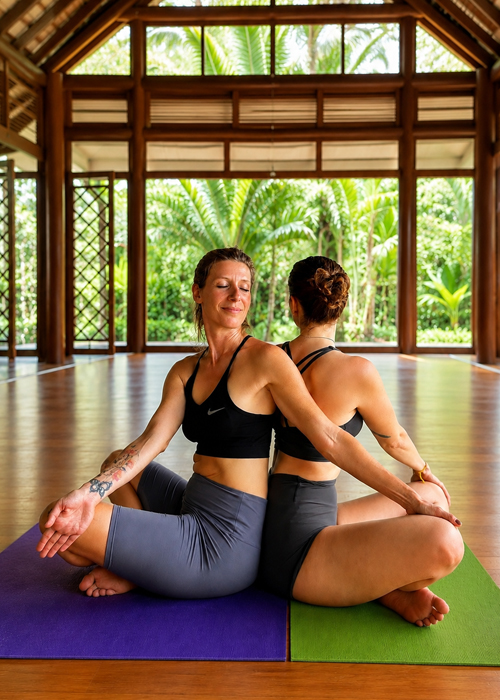
The “Perfect Pose” Does Not Exist in the Way You Think
A photograph can show you what an asana looks like.
It cannot tell you whether the posture is appropriate for the person performing it.
That is an important distinction.
As a developing teacher, you may begin with an image in your mind of what a posture “should” look like.
With more experience, you begin to understand that alignment is not simply about reproducing a photograph.
It is about helping a student find an appropriate relationship between:
stability, mobility, breath, awareness and intention.
Sometimes that means using a modification.
Sometimes it means using a prop.
Sometimes it means reducing the range of movement.
Sometimes it means choosing another posture entirely.
And sometimes the best instruction is:
“Don’t go any further.”
Knowing when to say that is part of responsible teaching.
Learning to Observe Before You Adjust
Physical adjustments can be useful when taught appropriately and with clear boundaries, but a teacher should never assume that touching a student is automatically necessary.
Observation comes first.
Look at the posture.
Listen to the student’s breath.
Notice their movement.
Pay attention to their expression and response.
And, where appropriate, communicate with them.
A teacher who immediately tries to “fix” every student may actually be missing what the student is experiencing.
The goal is not to control the student’s body.
The goal is to support the student’s awareness.
That distinction is especially important when you begin teaching professionally.
Alignment Is Not About Making Everyone Look the Same
Imagine ten people practicing the same asana.
You may see ten different bodies.
Ten different ranges of motion.
Ten different proportions.
Ten different ways of expressing the posture.
That does not automatically mean nine of them are doing it incorrectly.
It means yoga is being practiced by human beings.
This is why a good 200-hour yoga teacher training in Goa should help students develop principles of observation rather than simply giving them a fixed visual model to reproduce.
You learn to look for what matters.
You learn to distinguish between useful effort and unnecessary strain.
You learn to offer options.
And you learn that a student’s deepest expression of a posture may look completely different from yours.
This Is Where Teaching Becomes a Responsibility
Once you begin teaching another person, your knowledge affects someone else’s experience.
That creates responsibility.
You need to understand the limits of your knowledge.
You should not present yourself as an expert in areas outside your training.
You need to recognize when a student may require guidance beyond your scope.
And you need to remain willing to continue learning.
This is one of the reasons we do not believe that completing a 200-hour yoga teacher training means you have finished learning about the human body.
It means you have developed a foundation.
From there, your education continues.
What We Want Students to Understand About Anatomy
At Diksha Yoga School, the purpose of studying anatomy and alignment is not to make students memorize hundreds of anatomical terms and then repeat them in class.
We want students to develop a more thoughtful relationship with movement.
To ask:
What am I seeing?
What is the student experiencing?
What might be an appropriate variation?
Is my instruction helping?
Am I asking the student to move beyond what is appropriate for them?
These questions are much more useful than trying to make everyone achieve the same shape.
Because eventually, when you teach your own class, there will not be a textbook body standing in front of you.
There will be real people.
And teaching real people requires adaptability.
From Anatomy to Compassion
This is perhaps one of the most beautiful things anatomy can teach us.
The more you understand individual differences, the less interested you become in comparison.
You begin to understand that a student’s inability to perform a particular posture does not mean they are not trying.
Their body may simply have a different starting point.
And once you understand that, your teaching can become more compassionate.
You stop asking:
“Why can’t they do it?”
and start asking:
“How can I help them practice meaningfully from where they are?”
That is a much more useful question.
The Teacher’s Responsibility Goes Beyond the Yoga Mat
A 200-hour yoga teacher training should give you confidence.
But it should also give you humility.
Confidence says:
“I can guide this practice.”
Humility says:
“I know the limits of what I know.”
You need both.
A teacher who lacks confidence may struggle to guide a class.
A teacher without humility may create unnecessary risk.
The balance between the two is part of becoming a responsible yoga teacher.
And this is why we want students to leave their training not believing they have mastered the human body, but understanding enough to continue studying it with respect.
The Real Skill Is Learning to See
Eventually, anatomy becomes more than muscles and joints.
Alignment becomes more than angles.
Teaching becomes more than instructions.
You begin to see the person.
You notice when they need challenge.
You notice when they need patience.
You recognize when a modification could help.
You become more comfortable with differences.
And you stop trying to make every student fit into one definition of what yoga should look like.
That is when technical knowledge begins turning into teaching wisdom.
And it is one of the most important transitions you can experience during a 200-hour yoga teacher training in Goa.
Because your students will not come to you as diagrams in an anatomy textbook.
They will come as individual human beings.
Your responsibility is to teach the person—not just the posture.
Part 6 — The Breath, the Mind & the Deeper Practice of Yoga
Asana may be what first brings many people to yoga.
But as your practice matures, you begin to discover that the body is only one doorway.
The breath becomes another.
Then the mind.
Then awareness itself.
This is one of the reasons a 200-hour yoga teacher training in Goa can be such a significant step for a practitioner who wants to move beyond physical practice and understand yoga more completely.
You are no longer simply asking:
“How can I improve my posture?”
You begin asking:
“What is happening to my breath?”
“What is happening to my attention?”
“Why does my state of mind change during practice?”
And eventually:
“How can I help another student experience this with awareness?”
Pranayama Is More Than Breathing Exercises
We breathe continuously, but most of the time we don’t consciously observe how we breathe.
During yoga practice, however, the breath can become a powerful source of information.
It can tell you when you are rushing.
It can reveal tension.
It can change with effort.
It can become quieter as concentration deepens.
Pranayama gives you a systematic way to explore that relationship.
Within a comprehensive 200-hour yoga teacher training, students can study traditional practices such as:
- Nadi Shodhana
- Ujjayi
- Kapalabhati
- Bhastrika
- Sheetali
- Sheetkari
- and foundational bandha practices
But learning the names and techniques is only the beginning.
A responsible teacher also needs to understand how a practice is introduced, when it is appropriate, how students respond and when a practice should be modified or avoided.
That is why pranayama should be approached with the same respect as asana.
It is a practice—not a performance.
Learning to Listen to the Breath
One of the first things you may notice during intensive training is that your breath is not the same every day.
Some mornings it feels open.
Some mornings it feels restricted.
Sometimes your mind is restless.
Sometimes concentration comes easily.
The practice teaches you to notice these changes rather than immediately judging them.
That awareness can become an important teaching skill.
When you eventually guide a class, you begin to notice more than whether students are performing the movement correctly.
You may notice:
Are they holding their breath?
Are they rushing through the movement?
Does the breath remain comfortable?
Are they becoming overly strained?
The breath can become one of the teacher’s most useful guides.
Meditation: Learning to Observe Instead of Control
Meditation can be one of the most challenging parts of teacher training precisely because there is nowhere to hide.
During an asana practice, there is always movement.
During meditation, you may simply sit.
And then you notice the mind.
Thoughts.
Plans.
Memories.
Restlessness.
Boredom.
Anticipation.
Judgment.
The practice is not necessarily about making all of those things disappear.
It is about developing the ability to observe without immediately reacting.
That can take patience.
And it can change the way you teach.
A teacher who has experienced their own restless mind may be more understanding when a student struggles to sit quietly.
A teacher who understands that concentration develops gradually is less likely to demand instant stillness from a beginner.
Again, personal practice becomes teaching experience.
Philosophy Gives the Practice Context
A 200-hour yoga teacher training should not treat philosophy as something you memorize simply because it appears in an examination.
The deeper value of philosophy is what happens when the teachings begin to interact with your own life.
You may study ideas from Patanjali’s Yoga Sutras, explore the Bhagavad Gita, or study teachings from the Hatha Yoga Pradipika.
Initially, these may feel like ancient concepts from another time.
Then you encounter attachment.
Frustration.
Comparison.
Fear.
Ego.
Discipline.
Change.
And suddenly, the philosophy becomes personal.
You begin seeing why these teachings have remained relevant to practitioners for generations.
When Philosophy Leaves the Classroom
Imagine that you have spent the morning studying the idea of non-attachment.
Later that day, something doesn’t go according to your plan.
Perhaps your teaching practice doesn’t work.
Perhaps someone gives you criticism.
Perhaps another student performs something you have been struggling with.
Now the philosophical idea has a place to live.
You can observe your reaction.
You can question it.
You can practice differently.
That is when philosophy becomes more than information.
It becomes practice.
And that is the kind of relationship with yoga philosophy we want students to develop.
The Subtle Side of Yoga
As your understanding develops, you may also become more interested in the subtler aspects of yoga.
Traditional yoga speaks about prana, nadis, chakras, bandhas and energetic awareness.
These concepts can be approached with curiosity while respecting their traditional context.
They don’t need to be turned into exaggerated promises.
They don’t need to be marketed as magical solutions.
They can simply be studied as part of the traditional framework through which generations of yogic practitioners have understood the relationship between body, breath, mind and consciousness.
For a serious student, that context matters.
It allows you to explore traditional teachings without losing discernment.
The Teacher’s Own State Matters
There is another lesson that often becomes clearer during teacher training:
A class is influenced by the teacher’s state of presence.
You can have the perfect sequence.
You can know every Sanskrit name.
You can prepare beautiful instructions.
But if you are distracted, impatient or constantly trying to prove yourself, students can feel it.
Teaching begins before the first posture.
It begins with how you arrive in the room.
Are you present?
Are you listening?
Are you rushing?
Are you comfortable with silence?
Can you adapt?
Can you remain calm when something unexpected happens?
These qualities are difficult to teach through theory alone.
They develop through your own practice.
From Breath Awareness to Teaching Awareness
This is where the different parts of a 200-hour yoga teacher training in Goa begin to connect.
You study asana.
Then you study the breath.
Then meditation.
Then philosophy.
Then anatomy.
Then teaching methodology.
At first, they can seem like separate subjects.
Gradually, they start influencing each other.
Your understanding of anatomy changes how you teach movement.
Your understanding of pranayama changes how you use breath in sequencing.
Your meditation practice changes how you hold space.
Your study of philosophy changes how you think about your responsibility as a teacher.
Your teaching experience changes how you understand your own practice.
The subjects stop being separate.
They begin becoming yoga.
You Don’t Have to Teach Everything You Learn
This is particularly important for new teachers.
A 200-hour training may introduce you to many practices.
That does not mean you should immediately teach every practice you have learned.
A responsible teacher understands the difference between:
“I have experienced this.”
and
“I am ready and appropriately trained to teach this.”
That distinction protects both the student and the teacher.
Continue studying.
Stay within your scope.
Seek further education when you need it.
And never let enthusiasm replace preparation.
The Deeper Purpose of a 200-Hour Journey
Eventually, the question changes again.
You began your training wanting to become a better practitioner.
Then you wanted to understand how to teach.
Now you may begin to understand something even deeper:
Teaching yoga is not simply about transferring information.
It is about helping another person develop awareness.
Sometimes that happens through an asana.
Sometimes through the breath.
Sometimes through meditation.
Sometimes through a philosophical question.
And sometimes through something as simple as giving a student permission to slow down.
That is why going beyond the asana matters.
Because the more deeply you understand yoga, the less you need to reduce it to a collection of poses.
And the more you understand your role as a teacher, the more you realize that your job is not to put yourself at the center of the student’s practice.
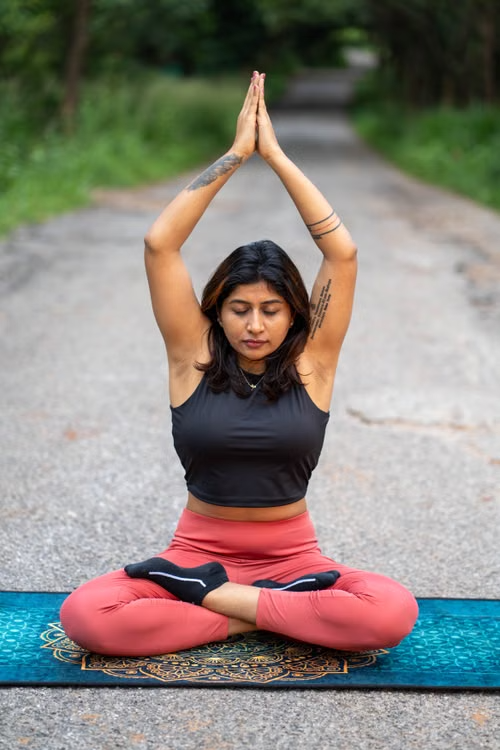
Your job is to help the student become more aware of themselves.
That is the deeper responsibility—and the deeper privilege—of becoming a yoga teacher.
Part 7 — From Knowing Yoga to Knowing How to Teach Yoga
There is a difference between knowing yoga and knowing how to teach yoga.
It is one of the most important distinctions you will discover during a 200-hour yoga teacher training in Goa.
You can practice yoga for years and still find your first teaching experience surprisingly difficult.
You may know exactly how to perform a posture.
But when you stand in front of another person, you suddenly have to think about much more:
What should I say first?
How much information is too much?
Should I demonstrate or explain?
Is the student ready for the next step?
What if they don’t understand my instruction?
How do I change my plan without losing the structure of the class?
This is where personal practice begins becoming teaching practice.
Yoga Teacher Is Not a Demonstrator
One of the easiest mistakes for a new teacher is to confuse demonstrating yoga with teaching yoga.
A demonstration shows a student what something looks like.
Teaching helps them understand how to experience it for themselves.
That difference is enormous.
You might perform a beautiful Warrior II.
But your student may need to understand:
- where to place their feet
- how to distribute their weight
- what to do with their back leg
- how to position their arms
- how to coordinate the breath
- what sensations are appropriate
- and when to modify
You cannot simply perform the posture and expect the student to understand all of that.
You have to communicate.
And communication is a skill in itself.
Learning to Use Fewer Words More Effectively
New teachers often speak too much.
It is understandable.
You are nervous.
You want to make sure the student understands.
So you give another instruction.
And another.
And another.
Soon the student is trying to remember six things at once.
With experience, you begin to discover that clarity is often more valuable than quantity.
One precise instruction can be more useful than five complicated ones.
For example, instead of continuously describing every detail of a posture, you might give one clear action, allow the student to move, observe what happens and then offer the next appropriate cue.
Teaching becomes a conversation between:
your instruction → the student’s response → your observation → your next instruction.
That is much more dynamic than simply reading out a sequence.
Learning to Teach Different Levels
A 200-hour yoga teacher training should prepare you for the reality that students rarely arrive at exactly the same level.
You may have a beginner in the same room as someone who has practiced for years.
One student may understand your cue immediately.
Another may need a demonstration.
Someone may want a more challenging variation.
Another may need a simpler option.
This is why sequencing and modifications are so important.
A good teacher does not create one practice and expect every body to fit into it.
Instead, they learn how to create choices within a coherent practice.
That might mean offering:
A foundational variation.
The main expression of the posture.
A more challenging option for experienced practitioners.
This allows students to practice together without requiring everyone to do exactly the same thing.
Sequencing Is About More Than Putting Poses Together
One of the biggest skills you develop during a 200-hour yoga teacher training is learning how to create a class that has a logical progression.
A sequence should have a reason.
Why are you starting here?
Why are you introducing this movement now?
What needs to be prepared before the more demanding posture?
Where should intensity build?
Where should it soften?
How does the practice conclude?
These questions change the way you plan a class.
Instead of creating a list of your favorite postures, you begin creating a journey.
The student should be able to move through the practice without constantly wondering:
“Why are we doing this now?”
The Difference Between a Sequence and a Class
A sequence is a collection of movements.
A class is an experience.
That distinction is important.
A technically impressive sequence can still create a poor class if the pacing is wrong, the instructions are unclear or the level doesn’t match the students.
A simple sequence can create a beautiful class when it is taught with awareness.
This is why teaching methodology matters.
You are learning not only what to teach, but how to create an environment in which the teaching can actually be received.
Your Voice, Timing and Presence Matter
Teaching yoga is partly about what you say.
But it is also about how you say it.
Students respond to tone.
They respond to pace.
They respond to confidence.
They notice when a teacher is rushing.
They notice when instructions are uncertain.
They also notice when a teacher is genuinely present.
You don’t need to develop a dramatic “yoga teacher voice.”
You need to develop a voice that is:
clear, calm, audible and authentic to you.
That takes practice.
And the best place to develop it is not by imagining yourself teaching.
It is by actually teaching.
Why Feedback Is So Important
One of the most valuable parts of practical teacher training is receiving feedback.
You teach.
Someone watches.
You receive observations.
You reflect.
Then you teach again.
Perhaps your instructions were too complicated.
Perhaps your pacing was too fast.
Perhaps your sequence was excellent but your transitions needed work.
Perhaps you were so focused on remembering the next posture that you stopped observing the students.
These are useful discoveries.
Without feedback, you may continue repeating the same habits without realizing them.
With thoughtful feedback, mistakes become part of your education.
The goal is not to avoid mistakes.
The goal is to learn from them quickly and responsibly.
Teaching Practice Builds a Different Kind of Confidence
There is a difference between believing:
“I know enough to teach.”
and actually standing in front of a group and teaching.
The second experience changes you.
Your first class may be uncomfortable.
Your second may feel slightly easier.
After several teaching practices, you begin to understand your rhythm.
You learn where to pause.
You become more comfortable observing while speaking.
You start trusting your preparation.
And slowly, confidence becomes less about trying to appear knowledgeable.
It becomes:
“I know how to guide this class, and I know what to do when something changes.”
That is much stronger confidence.
The Teacher Must Learn to Adapt
No matter how carefully you plan your class, real students will always teach you something unexpected.
Maybe the group needs more time in a particular preparation.
Maybe the energy is lower than you expected.
Maybe students are struggling with a transition.
Maybe one person needs a modification.
Maybe the sequence you planned is simply not appropriate for the room.
A good teacher can adapt without losing the intention of the practice.
This is one of the reasons experience matters.
You gradually develop the ability to make decisions in the moment.
That is difficult to learn through theory alone.
Teaching Is a Responsibility, Not a Performance
When you teach another person’s practice, you have a responsibility to be honest about what you know.
You don’t need to pretend to be an expert in everything.
You don’t need to answer every question immediately.
Sometimes the most professional response is:
“I’m not certain. Let me check that and come back to you.”
That kind of honesty builds trust.
A teacher who is willing to keep learning is more valuable than a teacher who feels the need to appear all-knowing.
This is one of the principles we want to reinforce throughout our 200-hour yoga teacher training in Goa.
Confidence without humility can become ego.
Humility without confidence can become hesitation.
A developing teacher needs both.
From Your First Teaching Practice to Your Own Teaching Voice
You may begin your training by copying the way your teacher speaks.
That is natural.
You learn through observation.
But eventually, something changes.
You stop trying to sound like someone else.
You begin finding your own rhythm.
Your own language.
Your own way of explaining.
Your own understanding of what makes a meaningful class.
This is not about rejecting what you learned.
It is about digesting it deeply enough to make it your own.
That is when teaching becomes authentic.
The Real Transition
The journey from practitioner to teacher is not:
Learn 200 hours → Receive certificate → Become teacher.
It is more like:
Practice → Study → Observe → Teach → Receive feedback → Reflect → Adapt → Teach again.
That cycle continues long after your training ends.
And perhaps that is the most valuable thing a 200-hour yoga teacher training in Goa can give you.
Not the illusion that you have finished learning.
But the foundation, confidence and self-awareness to continue learning through teaching.
Because eventually, your students will not care how many poses you know.
They will care whether you can help them feel:
safe, understood, supported and inspired to practice.
And that is where knowing yoga becomes knowing how to teach yoga.
Part 8 — Why 200 Hours Is Different: Depth, Repetition and Real Teaching Experience
A 200-hour yoga teacher training in Goa is not simply a longer version of a short yoga course.
The real difference is the opportunity to go deeper.
You have enough time to encounter a concept, practice it, question it, teach it, receive feedback and return to it with a different understanding.
That repetition matters.
Because the first time you hear something, you may understand the words.
The second time, you may understand the idea.
But after practicing it yourself and teaching it to someone else, you may finally begin to understand why it matters.
That is where a 200-hour journey becomes different.
More Time Does Not Automatically Mean More Learning
Simply adding hours to a timetable does not create a better teacher.
What matters is how those hours are used.
A meaningful 200-hour program should create opportunities for students to move through different stages of learning:
Learn
You are introduced to a new concept.
Experience
You practice it yourself.
Observe
You begin noticing how it works in your own body and mind.
Teach
You attempt to communicate it to another person.
Receive Feedback
You discover what worked and what needs improvement.
Reflect
You think about what you could do differently.
Practice Again
You return with a deeper understanding.
This cycle is one of the most valuable parts of teacher education.
Learn → Practice → Teach → Reflect → Improve
And then you do it again.
Why Repetition Matters in Yoga Teacher Training
Imagine learning how to sequence a class.
The first time you create one, you may focus primarily on remembering the postures.
After several attempts, you begin thinking about transitions.
Later, you start considering preparation.
Then you notice pacing.
Eventually, you begin thinking about the experience of the person actually taking your class.
The information has not necessarily changed.
Your understanding of it has.
That is what repetition can do.
It takes knowledge from something you can describe and gradually turns it into something you can apply.
A 200-Hour Training Gives You Time to Make Mistakes
This may sound strange, but mistakes are an important part of learning to teach.
Your first sequence may be too complicated.
Your instructions may be unclear.
You may forget the next posture.
You may speak too quickly.
You may spend too much time explaining one movement.
You may realize that a sequence which looked excellent on paper doesn’t work well with real students.
That is valuable information.
You would rather discover these things during supervised training, when you have experienced teachers and classmates who can give you feedback, than discover everything for the first time after you begin teaching professionally.
The training environment gives you somewhere to practice.
Somewhere to get it wrong.
And somewhere to try again.
What You Study Matters—but So Does How You Connect It
A strong 200-hour yoga teacher training should not feel like a collection of unrelated subjects.
Instead, different areas of study should gradually begin supporting one another.
For example:
Asana + Anatomy
You understand not only how a posture looks, but how different bodies may experience it.
Asana + Pranayama
You begin coordinating movement and breath rather than treating them as separate practices.
Philosophy + Practice
You explore how yogic teachings can relate to your own decisions, habits and relationships.
Meditation + Teaching
You develop greater awareness of your own state and learn how presence influences the classroom.
Teaching Methodology + Experience
You move from knowing how a class should be structured to actually learning how to guide one.
This integration is what makes the training feel like a complete yoga education rather than a list of subjects.
From Curriculum to Real-World Teaching
At some point, the timetable stops being the most important thing.
You have learned the theory.
Now you have to use it.
You stand in front of another person.
You give an instruction.
They move.
You observe.
Something doesn’t quite work.
You adjust.
They try again.
Suddenly, anatomy makes more sense.
Sequencing makes more sense.
Communication makes more sense.
You begin to understand why your teacher emphasized certain details.
This is one of the most valuable transitions in a 200-hour yoga teacher training in Goa:
Theory becomes experience.
You Learn to Teach the Student You Actually Have
One of the biggest differences between practicing alone and teaching a group is unpredictability.
When you practice alone, you know your body.
You know your limitations.
You know what feels comfortable.
When you teach, you may have ten or twenty different experiences in front of you.
One student may need more challenge.
Another may need a simpler variation.
Someone may be very flexible but lack stability.
Someone else may be strong but have limited mobility.
One student may love detailed anatomical explanations.
Another may learn better by watching a demonstration.
There is no single formula.
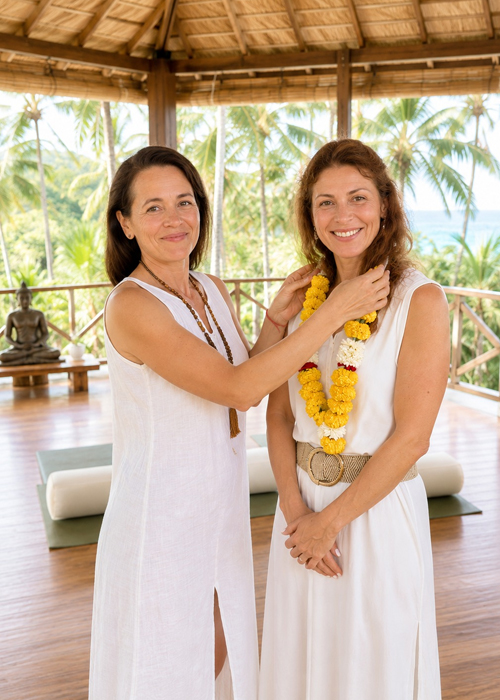
A good teacher learns to adapt without losing the purpose of the practice.
Why Small Details Become Important
As your teaching develops, you start noticing things that you may have overlooked as a student.
The way a teacher introduces a posture.
The amount of time they give students to respond.
Whether their voice remains calm.
Whether they demonstrate before asking students to move.
Whether they offer a modification before someone struggles.
Whether they allow silence.
These details may seem small.
But together, they shape the student’s experience.
That is why teaching methodology is not simply about learning how to speak in front of a group.
It is about learning how to create a learning environment.
The Responsibility Behind the Certificate
A 200-hour certification can be an important milestone.
But certification should never be confused with mastery.
Completing your training does not mean you know every body.
It does not mean you can answer every question.
It does not mean every advanced posture belongs in your classes.
And it certainly does not mean your education has finished.
Instead, your training should help you understand:
What do I know?
What don’t I know?
What can I responsibly teach?
Where do I need further education?
That awareness is part of professional maturity.
What Makes the 200-Hour Journey Worth It?
If you are considering a 200-hour yoga teacher training in Goa, don’t choose a program only because it has the right number of hours.
Ask what those hours actually contain.
Will you practice teaching?
Will someone observe you?
Will you receive feedback?
Will you study anatomy?
Will you explore pranayama and meditation?
Will philosophy be treated as meaningful study rather than simply an examination subject?
Will you have enough time to develop your own practice?
Will the teachers know you as an individual?
These questions are often more important than the number printed on the certificate.
Your 200 Hours Should Create a Foundation
At Diksha Yoga School, we see the 200-hour journey as a foundation for continued growth, not a claim of mastery.
You may leave with the confidence to begin teaching.
But you should also leave with enough humility to know that teaching will continue to teach you.
Your students will challenge you.
Your own practice will change.
Your understanding of yoga will deepen.
You may discover areas you want to study further.
And that is a positive outcome.
Because the goal is not to produce teachers who believe they have reached the end.
The goal is to help develop teachers who are ready to take the next step.
The 200-Hour Difference
A shorter training may introduce you to the possibility of teaching.
A comprehensive 200-hour journey gives you more room to develop that possibility into a foundation.
You learn.
You practice.
You teach.
You make mistakes.
You receive feedback.
You improve.
And somewhere in that cycle, you begin to notice a change.
You are no longer asking only:
“What should I teach?”
You are beginning to ask:
“What does this group need?”
That is a much more important question.
Because the moment you begin teaching for the needs of the student rather than for the sake of demonstrating your own knowledge, you are beginning to understand what it really means to be a yoga teacher.
Part 9 — How to Choose the Right 200-Hour Yoga Teacher Training in Goa
Choosing a 200-hour yoga teacher training in Goa is a significant decision.
You are not only choosing a course.
You are choosing the teachers you will learn from, the people you will practice with, the environment in which you will spend several weeks, and the teaching philosophy that may influence the way you approach yoga for years afterward.
With so many yoga schools and teacher-training programs available in Goa, it can be tempting to compare only:
Price.
Location.
Accommodation.
Dates.
Number of hours.
These things matter.
But they don’t tell you the whole story.
The more important question is:
“What kind of teacher will this training help me become?”
Don’t Choose a 200-Hour Course by the Certificate Alone
A certificate can mark an important achievement.
But two schools can offer a 200-hour certificate while providing very different educational experiences.
Before booking, look at the substance behind the certificate.
Ask:
- Who are the teachers?
- How long have they been teaching?
- What traditions and methods do they teach?
- How much practical teaching is included?
- Will teachers observe and give you feedback?
- How much anatomy and alignment will you study?
- Are pranayama and meditation taught systematically?
- How deeply is yoga philosophy explored?
- How large are the training groups?
- What exactly is included in the course fee?
- What certification do you receive?
These questions help you evaluate education, rather than simply purchasing a course.
What Should a Strong 200-Hour Curriculum Include?
There is no single curriculum that is perfect for every student.
However, if your goal is to develop a well-rounded foundation for teaching, you should look for a program that brings together several dimensions of yoga.
| Area | What You Should Look For |
| Asana | Strong foundation in posture, alignment and practice |
| Vinyasa | Breath-led movement and thoughtful sequencing |
| Pranayama | Technique, preparation, observation and responsible teaching |
| Meditation | Concentration, awareness and regular practice |
| Philosophy | Understanding yoga beyond physical practice |
| Anatomy | Practical understanding of movement and individual differences |
| Teaching Methodology | Cueing, sequencing, voice, demonstrations and class structure |
| Practical Teaching | Opportunities to teach, receive feedback and improve |
| Self-Practice | Time to develop your own relationship with yoga |
| Reflection | Space to understand how your learning is changing you |
The key is not simply whether these words appear on a website.
Ask how deeply they are actually taught.
Look at the Teacher, Not Just the Course
A curriculum can tell you what a school plans to teach.
The teacher can determine how you experience that teaching.
Before choosing a school, research the people who will actually be guiding you.
What is their experience?
What have they studied?
How long have they been teaching?
Do they continue practicing?
Do they have experience teaching international students?
Do they explain their approach clearly?
Do they appear interested in students as individuals?
At Diksha Yoga School, the teaching approach has been shaped by Yogini Manisha, Founder and Lead Teacher, whose teaching background spans more than 16 years.
That experience has included teaching and mentoring students from different countries and backgrounds.
But experience should not simply be a number on a website.
Its value lies in what has been learned through those years.
How to observe a student.
How to explain something differently.
How to recognize when a student needs less rather than more.
How to adapt a class without losing its purpose.
That practical understanding is one of the things you should look for when comparing yoga teacher training schools in Goa.
Ask How Much You Will Actually Teach
This is one question I would encourage every future teacher to ask before booking.
“How much practical teaching will I do?”
Watching an experienced teacher is useful.
Practicing with your classmates is useful.
Studying theory is essential.
But eventually, you have to stand in front of students and teach.
You need to experience what happens when:
- you forget an instruction
- your sequence takes longer than expected
- students move at different speeds
- someone doesn’t understand your cue
- you become nervous
- you need to modify your plan
- you receive feedback
That is where teaching becomes real.
A program that gives you opportunities to teach, receive feedback and teach again can provide a very different learning experience from one that is primarily lecture-based.
Smaller Groups Can Mean More Personal Learning
Group size is another factor worth asking about.
A large training may offer a lively group atmosphere.
A smaller group can make it easier for a teacher to notice individual students and provide personal feedback.
Neither approach is automatically right for everyone.
But if your priority is developing teaching skills, ask yourself:
Will my teacher actually have time to observe me?
Will they hear my questions?
Will they notice how I teach?
Will they be able to give me specific feedback?
Teacher training is personal.
The more opportunities you have to receive meaningful feedback, the more opportunities you have to improve.
Don’t Choose Goa Instead of Choosing Your Education
Goa is beautiful.
That is one reason people from around the world are drawn here for yoga.
But a beautiful location should support your training—not replace it.
When comparing a 200-hour yoga teacher training in Goa, look beyond:
“How close is it to the beach?”
Ask:
“Who will teach me?”
“What will I actually learn?”
“How will I practice teaching?”
“Will I receive feedback?”
“What happens when I struggle?”
Those answers are much more important to your long-term development as a teacher.
Why We Chose Arambol for Our Training Environment
Our 200-hour yoga teacher training takes place at The Lotus Sutra in Arambol, Goa, close to Arambol Beach.
For students spending an extended period immersed in yoga, the surroundings matter.
You need a place where you can step away from your normal routine.
Where the day has a different rhythm.
Where you have space between sessions to reflect.
Where learning does not feel completely disconnected from the environment around you.
Arambol offers that coastal setting.
But our intention is not to sell the location as the main attraction.
The beach is part of the experience.
The training is the purpose.
That distinction matters.
What About Price?
Price is naturally part of the decision.
But comparing only the headline price can be misleading.
Instead, compare what is actually included.
For example:
| Compare | Questions to Ask |
| Accommodation | How many nights? Private or shared? |
| Meals | How many meals each day? What type of food? |
| Training | How many actual instructional hours? |
| Teaching practice | Is practical teaching included? |
| Study materials | Is a manual provided? |
| Certification | What exactly does the certificate represent? |
| Support | What happens before and after the course? |
| Location | Is the training residential or external accommodation? |
A lower price is not necessarily better value.
A higher price is not necessarily better education.
Look at the complete experience.
Read Reviews Carefully
Reviews can be extremely helpful.
But don’t only look at the star rating.
Read what students actually talk about.
Do they mention the teachers?
Do they describe the learning?
Do they mention personal attention?
Do they talk about how the course changed their practice?
Do they mention practical teaching?
Do they describe the accommodation and food separately from the educational experience?
Try to identify whether the things students value are the same things you are looking for.
And when a school publishes testimonials, look for enough context to understand:
Who wrote it?
What course did they complete?
When did they attend?
The more transparent the information, the easier it is to evaluate.
The Right School Should Not Promise to Make You an Expert
This is one of the simplest tests you can use.
Be cautious of any program that suggests that completing 200 hours automatically makes you an expert in every aspect of yoga.
It doesn’t.
A responsible 200-hour yoga teacher training should give you a strong foundation.
It should help you understand the basics of teaching.
It should develop your confidence.
It should introduce you to the responsibilities of working with students.
But it should also help you recognize where your knowledge ends.
Because the best teachers continue studying.
They attend further training.
They learn from other teachers.
They learn from students.
They continue their personal practice.
A certificate can mark the end of a course. It should never mark the end of learning.
A Simple Test Before You Book
Before committing to any 200-hour yoga teacher training in Goa, ask yourself these five questions:
1. Do I trust the teachers?
2. Does the teaching philosophy match what I want to learn?
3. Will I receive enough practical teaching experience?
4. Will I receive meaningful feedback?
5. Can I see myself learning in this environment?
If the answer to all five is yes, you may have found a training worth exploring further.
Choosing a School Is Really Choosing a Learning Environment
At the end of the day, there is no universal “best” yoga school in Goa.
There is only the school that is right for your goals, expectations and way of learning.
For some students, that may mean a large international group.
For others, it may mean a more personal environment.
Some want a strong physical focus.
Others want philosophy and meditation to play a major role.
Some want to teach professionally.
Others want to deepen their personal practice.
Know what you are looking for first.
Then choose accordingly.
At Diksha Yoga School, our intention is to provide a structured, immersive and student-centered environment where practitioners can develop their practice while learning the responsibilities of teaching.
If that approach resonates with you, the next question becomes much more personal:
What will your life actually look like during those 200 hours?
That is where the journey moves from choosing a course on a website to imagining yourself living the practice in Arambol, Goa.
Part 10 — What Your 200-Hour Yoga Teacher Training in Goa Can Really Feel Like
A 200-hour yoga teacher training in Goa is not simply a course you attend for a few hours each day.
For many students, it becomes a temporary change of lifestyle.
Your normal schedule slows down.
Your priorities become different.
You wake up thinking about practice.
You spend the day studying, moving, breathing, discussing and teaching.
And gradually, yoga stops being something you fit into your schedule.
For a while, yoga becomes the schedule.
That is one of the reasons residential teacher training can feel so different from attending a regular yoga class.
Your Day Begins Before the First Lecture
A typical training day begins with practice.
The early hours can feel different in Goa.
There is less distraction.
The mind is often quieter.
You have not yet filled the day with emails, meetings and everyday responsibilities.
This creates an opportunity to start with yourself.
Your morning may include:
- meditation
- pranayama
- traditional Hatha practice
- Vinyasa Flow
- alignment work
- mantra or other contemplative practices
The purpose is not simply to make the body physically active.
It is to establish awareness before the intellectual part of the day begins.
Then You Start Studying
After practice, the learning moves into another dimension.
You may spend time studying anatomy.
You may explore alignment.
You may discuss sequencing.
You may study yoga philosophy.
You may explore pranayama in greater detail.
You may learn about teaching methodology.
This is where the physical experience from the morning begins connecting with theory.
You may have practiced a posture for years.
Then anatomy gives you a different way of understanding it.
You may have used your breath intuitively.
Then pranayama helps you study it systematically.
You may have heard a philosophical concept before.
Then a discussion makes you question how it applies to your own life.
The classroom and the mat begin teaching each other.
And Then Comes the Part That Makes It Teacher Training
At some point, you stop only learning from the teacher.
You begin teaching your classmates.
This can be one of the most exciting—and sometimes uncomfortable—parts of a 200-hour yoga teacher training.
You stand in front of the group.
You introduce the practice.
You give instructions.
You demonstrate.
You observe.
And suddenly you realize:
Teaching is much harder than it looks.
But that realization is valuable.
Because now you have something real to work with.
Maybe your instructions were too complicated.
Maybe you forgot a transition.
Maybe you spoke too quietly.
Maybe you were so focused on remembering your sequence that you forgot to look at your students.
These are not failures.
They are lessons.
You Learn From the People Training Beside You
One of the less obvious benefits of residential yoga teacher training is the community.
Your classmates may come from different countries, cultures and professional backgrounds.
They may have completely different reasons for joining.
Some may want to teach.
Some may want to deepen their personal practice.
Some may be changing direction in life.
Some may have practiced yoga for years.
Others may be discovering a deeper side of yoga for the first time.
You practice together.
You study together.
You teach each other.
You eat together.
You discuss what you have learned.
And eventually, people who were strangers at the beginning can become an important part of your yoga journey.
The Conversations Between Classes Matter Too
Not every meaningful moment happens during a scheduled lesson.
Sometimes it happens over a meal.
During a walk.
After a meditation.
While discussing something that came up in philosophy class.
Or when another student asks a question you had never considered.
This is one of the beautiful things about immersion.
You are surrounded by people who are thinking about the same questions.
Why yoga?
What does teaching mean?
What kind of teacher do I want to become?
What does my own practice need now?
Those conversations can become part of your education.
Living at The Lotus Sutra in Arambol
Our 200-hour yoga teacher training in Goa takes place at The Lotus Sutra in Arambol, close to Arambol Beach.
For students coming from outside Goa, the environment can provide an important change of pace.
You are away from your normal routines.
You have fewer everyday distractions.
And you have the opportunity to give your attention to the training rather than constantly switching between work, responsibilities and practice.
Arambol also gives you space outside the classroom.
You can walk.
Rest.
Reflect.
Spend time near the sea.
Talk with other students.
Or simply have some quiet time alone.
That balance matters.
An intensive teacher training requires effort.
Rest and reflection are part of learning too.
You Will Have Difficult Days
It is important to be honest about this.
A 200-hour training is not going to feel amazing every single day.
Some days you may feel inspired.
Some days you may feel tired.
Some practices may challenge your body.
Some philosophical discussions may challenge your ideas.
Teaching practice may expose weaknesses you did not know you had.
You may miss home.
You may wonder whether you are capable of teaching.
You may compare yourself with another student.
All of that can happen.
The answer is not to expect the experience to be perfect.
The answer is to stay present through the process.
The Training Can Reveal Things About You
An intensive yoga environment has a way of making certain patterns more visible.
Perhaps you realize that you always rush.
Perhaps you discover that you dislike receiving correction.
Perhaps you notice how much you compare yourself with others.
Perhaps you find that you are more capable than you thought.
Perhaps you become comfortable speaking in front of people for the first time.
Perhaps you discover that you genuinely love teaching.
These discoveries are not separate from yoga.
They are part of the practice.
Because yoga is not only about changing the body.
It can also become a way of observing how you respond to life.
What You Take Home Is More Important Than What You Complete
At the end of the training, there will be a final class.
There may be a closing ceremony.
There may be photographs.
There may be certificates.
There will probably be goodbyes.
But the most important question is not:
“Did I complete 200 hours?”
It is:
“What did those 200 hours change in me?”
Maybe your practice has become more disciplined.
Maybe you understand your body better.
Maybe you have developed confidence.
Maybe you discovered a passion for teaching.
Maybe you found a deeper interest in philosophy.
Maybe you simply learned to slow down.
Whatever your answer is, that is your real outcome.
A Training Ends. The Teaching Journey Doesn’t.
When you leave Arambol, you take your certificate with you.
But you also take something much less visible.
The way you now look at an asana.
The way you listen to your breath.
The way you observe a student.
The questions you ask before planning a class.
The humility to keep learning.
And perhaps the confidence to finally teach your first class.
Your first class after graduation may not be perfect.
It doesn’t need to be.
You will continue learning.
Your students will teach you.
Your own practice will change.
And your understanding of yoga will continue to deepen.
That is why we don’t see a 200-hour yoga teacher training in Goa as the end of the journey.
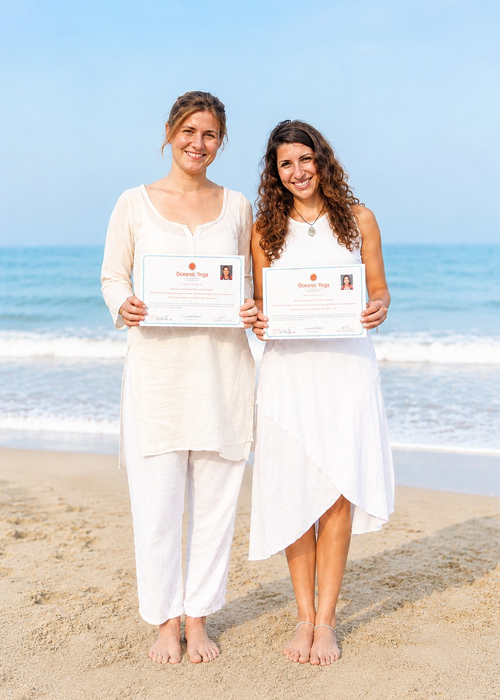
It is the beginning of a new relationship with yoga.
And for many students, that relationship begins long before the final certificate—during one ordinary morning when they step onto the mat and realize:
“I am no longer practicing only for myself. I am learning how to help someone else practice too.”
Part 11 — Is a 200-Hour Yoga Teacher Training Right for You?
Choosing to spend several weeks immersed in yoga is a meaningful decision.
You may be excited about becoming a teacher.
You may want to deepen your personal practice.
You may be looking for a change in direction.
Or perhaps you simply feel that yoga has become important enough in your life that you want to understand it beyond the weekly class.
Whatever brings you here, one question is worth asking honestly:
Is a 200-hour yoga teacher training actually the right next step for me?
There is no single answer for everyone.
And you don’t need to join a teacher training simply because everyone around you seems to be doing one.
The right reason is your own.
You Don’t Have to Want to Teach Immediately
The words “yoga teacher training” can make people think they must already know that they want to teach professionally.
That isn’t necessarily true.
Some students join because they want to become teachers.
Others join because they want to understand their personal practice more deeply.
Some are curious about yoga philosophy.
Some want to explore meditation and pranayama.
Others have practiced for years but feel they have reached a point where they want to study yoga more systematically.
A 200-hour program can be a space to discover what comes next.
You may arrive thinking:
“I want to become a yoga teacher.”
And leave thinking:
“I want to keep studying.”
That can be just as valuable.
Who Can Benefit From a 200-Hour Yoga Teacher Training?
A 200-hour yoga teacher training in Goa may be a good fit if you:
Want to deepen your personal practice
Perhaps you have been attending classes for years but still feel there is much more to understand.
A structured training gives you the opportunity to explore the practice systematically.
Want to explore teaching
If you have started imagining yourself guiding others, 200 hours can provide a foundation in sequencing, communication, observation and practical teaching.
Want to understand yoga beyond asana
If your interest extends to pranayama, meditation, philosophy and the deeper dimensions of yoga, a comprehensive training can give you dedicated time to explore them.
Want an immersive experience
If you learn better when you can step away from your normal routine and focus fully on one subject, a residential training in Goa can provide that immersion.
Want to challenge yourself
Teacher training can take you outside your comfort zone.
You may need to speak in front of others.
You may need to teach.
You may need to examine your own habits.
You may discover that learning is not always comfortable.
That can be part of the value.
What If You Are Not Flexible?
This is one of the most common concerns we hear.
You do not need to be extremely flexible to join a 200-hour yoga teacher training.
Yoga teacher training is not an audition for the most flexible body.
Your physical practice will develop over time, but teaching ability depends on much more than flexibility.
A thoughtful teacher needs to understand:
- observation
- communication
- anatomy
- alignment
- sequencing
- breath
- modifications
- student needs
- and responsible teaching
In fact, experiencing your own limitations can help you understand why students need patience and appropriate variations.
You don’t need to arrive able to do every advanced posture.
You need to arrive willing to learn.
What If You Are a Complete Beginner?
This is where you should look carefully at the specific school’s prerequisites.
Different 200-hour programs may have different expectations regarding previous experience.
Rather than assuming that every course is suitable for every beginner, contact the school and ask honestly about your background.
At Diksha Yoga School, we encourage prospective students to tell us about their previous yoga experience, physical practice and goals before deciding whether the program is appropriate for them.
That conversation is more useful than pretending there is one answer for everyone.
Because the right training should challenge you without putting you in an environment for which you are completely unprepared.
What If You Are Already an Experienced Practitioner?
A 200-hour training can still challenge you.
In fact, experienced practitioners sometimes discover that teaching requires them to rethink things they assumed they already understood.
You may know your own body extremely well.
But can you explain an asana to someone who has never practiced it?
Can you teach without demonstrating every movement yourself?
Can you adapt your instructions to a beginner?
Can you observe another person’s body without comparing it with your own?
Can you accept feedback about your teaching?
These are different skills.
Your previous experience can be an advantage.
But it doesn’t remove the need to become a student again.
Are You Ready to Teach Other People?
You don’t need to know the answer before the training begins.
But you should be willing to explore the responsibility.
Teaching yoga means another person may trust you with their practice.
That means you need to take your education seriously.
You need to understand the limits of your knowledge.
You need to know when to offer a modification.
You need to understand when a student may need support beyond your scope.
And you need to continue learning after the course.
If that responsibility excites you rather than simply the idea of being called a “yoga teacher,” you may be approaching teacher training for the right reasons.
Reasons You Should Not Join a 200-Hour Training
This may sound unusual for a yoga school to say, but it matters.
Don’t join simply because:
Everyone else is doing it.
Don’t join because you think the certificate will automatically make you successful.
Don’t join because you expect 200 hours to make you an expert.
Don’t join only because Goa looks beautiful on Instagram.
And don’t join if you are unwilling to practice, study, receive feedback and participate fully.
A teacher training requires commitment.
It can be physically demanding.
It can be mentally challenging.
And it requires you to be present.
The more honestly you approach that commitment, the more you are likely to receive from it.
What Do You Actually Want From Your Training?
Before booking, take a moment to complete these sentences:
I want to join because…
I hope to understand…
I want to become better at…
I am nervous about…
By the end of the training, I would like to feel…
Your answers can help you decide whether a particular 200-hour yoga teacher training in Goa matches what you are actually looking for.
And when you contact a school, share those answers.
A good conversation before booking can save you from choosing a program that looks right online but doesn’t match your expectations.
The Right Training Should Meet You Where You Are
There is no ideal student.
There is only the student who arrives with their own history, abilities, questions and expectations.
Perhaps you are flexible but inexperienced.
Perhaps you are experienced but nervous about teaching.
Perhaps you are confident physically but new to philosophy.
Perhaps you are curious about everything.
Perhaps you don’t yet know what you are looking for.
That’s okay.
The purpose of teacher training is not to pretend that everyone starts from the same place.
It is to create the conditions for each student to develop from where they actually are.
Your Reason for Coming to Goa Matters
For some students, coming to Goa is a chance to step away from work and responsibilities.
For others, it is a long-awaited personal journey.
And for some, it is the first time they have given themselves enough uninterrupted time to seriously study yoga.
At The Lotus Sutra in Arambol, the environment can become part of that experience.
You have your training.
You have your practice.
You have your classmates.
And you have the coastal surroundings of Arambol when you need space to breathe and reflect.
But whatever your reason for coming, remember:
You are not coming to Goa to escape your life.
You are coming to create space to understand it differently.
So, Is 200 Hours Right for You?
If you are looking for a quick certificate, probably not.
If you want a holiday with a little yoga on the side, probably not.
But if you are willing to dedicate meaningful time to:
practice,
study,
self-observation,
teaching practice,
feedback,
and continued learning—
then a 200-hour yoga teacher training can become a significant chapter in your yoga journey.
You don’t need to know exactly who you will become by the end.
You simply need enough curiosity to find out.
Because sometimes the most important reason to begin a journey is not that you already know the destination.
It is that you can feel there is something more for you to discover.
And perhaps that is exactly why you are considering 200-hour yoga teacher training in Goa.
Part 12 — What You Will Study During 200 Hours of Yoga Teacher Training
A 200-hour yoga teacher training should leave you with more than a collection of techniques.
It should help you understand why you practice, how you teach and how different aspects of yoga connect with one another.
At Diksha Yoga School, our approach brings together traditional yoga practices with practical teaching skills so that students can gradually move from personal experience toward confident, responsible teaching.
The curriculum is not simply about learning more postures.
It is about learning to understand what you are practicing—and eventually, learning how to communicate that understanding to someone else.
Hatha Yoga: Building Your Foundation
Hatha Yoga gives you an important foundation for understanding the relationship between posture, breath and awareness.
Through regular practice, you explore:
- foundational asanas
- alignment
- stability and mobility
- conscious breathing
- transitions
- relaxation
- awareness during practice
The intention is not to rush toward advanced postures.
A strong foundation comes from understanding the basics deeply.
You learn how to enter a posture.
How to maintain it.
How to breathe within it.
How to modify it.
And when it is appropriate to move out.
That foundation becomes useful later when you begin teaching others.
Vinyasa Flow: Learning to Connect Movement and Breath
Vinyasa introduces another dimension of practice.
Rather than treating postures as isolated shapes, you begin exploring how movement can be coordinated with breath.
This also introduces you to the art of sequencing.
You begin asking:
What should come next?
Why?
How should the body be prepared?
Where should the intensity build?
How can the practice eventually settle?
For a future teacher, these questions are essential.
A good Vinyasa class is not simply a collection of difficult postures.
It has intention, rhythm and progression.
Ashtanga Foundations: Discipline and Structure
The foundations of Ashtanga can introduce students to a more structured approach to practice.
You begin to appreciate the relationship between:
breath, movement, focus and consistency.
For some students, this structure creates a useful discipline.
It also teaches an important lesson for future teachers:
Consistency matters.
You cannot build teaching confidence by practicing only when you feel inspired.
A teacher develops through repetition.
Through showing up.
Through doing the work even when the practice feels ordinary.
Pranayama: Developing a Conscious Relationship With Breath
Pranayama forms an important part of a broader yoga education.
During training, students can explore traditional breathing practices such as:
- Nadi Shodhana
- Ujjayi
- Kapalabhati
- Bhastrika
- Sheetali
- Sheetkari
along with foundational bandha practices.
But the goal is not simply to memorize techniques.
You begin learning how to observe the breath, understand the purpose of different practices and approach them responsibly.
For a future teacher, that responsibility matters.
Not every breathing practice is appropriate for every student or every situation.
A good teacher learns to respect the practice rather than treating pranayama as another performance.
Meditation: Developing Awareness
Meditation gives you an opportunity to explore what happens when you stop focusing primarily on physical movement.
You observe.
You concentrate.
You notice the mind.
You return to the practice when attention wanders.
This can develop qualities that are valuable far beyond meditation itself.
Patience.
Presence.
Observation.
Self-awareness.
These qualities can influence the way you eventually teach.
A teacher who understands their own mind may become more patient with the mind of a beginner.
Yoga Philosophy: Understanding the Tradition
A 200-hour yoga teacher training should also help you understand that yoga is more than a physical discipline.
At Diksha Yoga School, the philosophical study can introduce students to important traditional sources and concepts, including:
- Patanjali’s Yoga Sutras
- Bhagavad Gita
- Hatha Yoga Pradipika
- foundational concepts of yogic philosophy
- meditation and concentration
- the broader purpose of yoga practice
The goal is not simply to memorize philosophical terms for an examination.
The deeper question is:
How does this knowledge influence the way I practice and teach?
When philosophy becomes something you reflect upon rather than simply something you memorize, it begins to become part of your experience.
Anatomy and Alignment: Learning to Teach Real Bodies
You will also begin studying the human body from the perspective of yoga practice.
This helps you understand why different students can experience the same posture differently.
You explore topics such as:
- basic anatomy
- movement
- alignment
- stability
- mobility
- individual differences
- appropriate modifications
This knowledge is particularly important when you move from personal practice into teaching.
Your student is not going to have your body.
They may have different proportions.
Different mobility.
Different strengths.
Different limitations.
A good teacher needs enough understanding to work with those differences rather than forcing every student toward the same visual shape.
Teaching Methodology: Turning Knowledge Into Communication
This is where the training begins to come together.
You may know an asana.
You may understand its alignment.
You may know the Sanskrit name.
You may understand its relationship to the breath.
But can you teach it clearly?
Teaching methodology helps you explore skills such as:
- verbal cueing
- demonstrations
- sequencing
- class structure
- voice modulation
- pacing
- transitions
- modifications
- observation
- communication
The difference between knowing something and explaining it to another person is significant.
That is why teaching practice is so important.
Practical Teaching: Where Learning Becomes Real
Eventually, you have to teach.
Not just watch.
Not just take notes.
Not just practice with your eyes closed.
You stand in front of other students.
You guide a sequence.
You observe.
You adjust your instructions.
You receive feedback.
And then you try again.
This is where many students experience one of the biggest changes of teacher training.
They discover that teaching is not about remembering a perfect script.
It is about being present enough to respond to the people in front of you.
From Individual Subjects to One Integrated Practice
At the beginning of a 200-hour yoga teacher training in Goa, the curriculum can seem like many separate subjects.
Hatha.
Vinyasa.
Pranayama.
Anatomy.
Philosophy.
Teaching methodology.
But gradually, the connections become clearer.
Anatomy influences your asana teaching.
Pranayama influences your sequencing.
Meditation influences your presence.
Philosophy influences your understanding of the purpose of practice.
Teaching practice changes the way you understand all of the above.
That integration is one of the most important outcomes of a comprehensive 200-hour yoga teacher training.
You are not simply learning subjects.
You are learning how the pieces fit together.
What You Should Be Able to Take Forward
By the end of the training, the goal should not be that you know everything.
Instead, you should have a stronger foundation from which to continue developing.
You may leave with:
✓ A deeper personal yoga practice
✓ Greater understanding of Hatha and Vinyasa
✓ Foundations in Ashtanga practice
✓ Experience with pranayama and meditation
✓ A stronger understanding of yoga philosophy
✓ Practical anatomy and alignment knowledge
✓ Foundations in sequencing
✓ Experience teaching others
✓ Greater confidence communicating
✓ A clearer understanding of your responsibilities as a teacher
And perhaps the most important outcome:
the understanding that becoming a yoga teacher is a continuing journey.
The Curriculum Is the Map. Your Experience Is the Journey.
A syllabus can tell you what you will study.
It cannot tell you exactly what you will discover.
One student may find philosophy transformative.
Another may discover a completely different relationship with their body.
Someone may discover that they love teaching.
Someone else may realize they want to continue as a dedicated practitioner rather than teach professionally.
There is room for all of these journeys.
At Diksha Yoga School in Arambol, Goa, our intention is to provide the structure, guidance and practice environment—but your experience within those 200 hours will ultimately be your own.
And once you understand what you will study, another question becomes important:
What will these 200 hours actually give you that you can carry into your life and future teaching?
That is where the journey becomes even more personal.
Part 13 — What You Actually Take Home After 200 Hours
A certificate fits into your suitcase.
The things you learn during a 200-hour yoga teacher training in Goa are much harder to pack.
You take home a different relationship with your body.
A greater awareness of your breath.
A deeper understanding of yoga philosophy.
The experience of standing in front of a group and teaching.
The memory of mistakes you made and lessons you learned from them.
And perhaps most importantly, a clearer idea of who you are becoming as a teacher.
The certificate is a milestone.
But the transformation is the real takeaway.
Your Personal Practice May Never Look Quite the Same
Before teacher training, you may practice an asana because you enjoy it.
After studying anatomy, you may understand it differently.
You may notice where you are creating unnecessary tension.
You may become more aware of your breath.
You may recognize when you are forcing a posture simply because you want to achieve a particular shape.
You may begin asking yourself:
“Why am I doing this?”
That question can change a practice completely.
Instead of chasing the deepest version of a posture, you may become more interested in awareness.
Instead of comparing yourself with another practitioner, you may become more interested in your own experience.
Instead of asking how advanced your practice looks, you may begin asking how conscious it feels.
That is a meaningful shift.
You Begin Seeing Other Practitioners Differently
Teacher training can change the way you look at people practicing around you.
You may notice that someone’s body works differently from yours.
You may become less judgmental about flexibility.
You may understand why a student needs a modification.
You may become more patient when someone doesn’t understand an instruction immediately.
And you may begin noticing something that is easy to miss as a student:
Everyone has a different starting point.
That understanding can stay with you long after you leave Goa.
It can influence the way you teach.
But it can also influence the way you treat people outside the yoga room.
You Learn That Confidence Does Not Mean Knowing Everything
One of the most valuable forms of confidence is knowing the boundaries of your knowledge.
A new teacher may initially think:
“I need to have an answer for everything.”
With experience, that can become:
“I need to know how to find the right answer when I don’t have it.”
That is a very different kind of confidence.
You learn to continue studying.
You learn to ask other teachers.
You learn to refer students to appropriate professionals when something falls outside your scope.
You learn that saying “I don’t know” can be more responsible than giving an uncertain answer.
That humility is not a weakness.
It is part of becoming a trustworthy teacher.
You Learn to Listen Before You Teach
Perhaps one of the biggest changes is that you become less focused on what you want to teach.
Instead, you begin thinking about what your students need to learn.
That might mean simplifying your class.
It might mean changing a sequence.
It might mean giving a student more time.
It might mean offering a modification.
It might even mean deciding not to teach something you had planned.
The ability to adapt comes from listening.
And listening is one of the most important skills a teacher can develop.
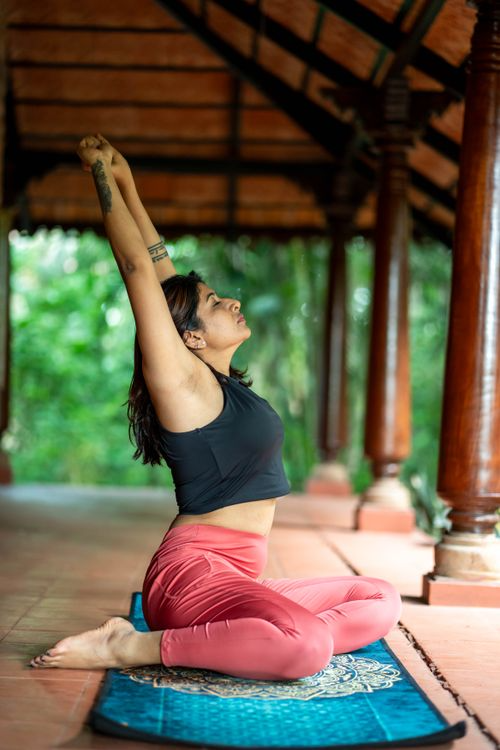
You Discover Your Own Teaching Voice
During your 200-hour yoga teacher training, you may initially sound like the teachers you admire.
That is natural.
We learn through imitation.
But eventually, your own voice begins to emerge.
You discover which words feel natural to you.
You learn how quickly you like to teach.
You become more comfortable with silence.
You discover how you want to explain difficult concepts.
You begin understanding what kind of atmosphere you want to create.
Maybe your teaching becomes gentle.
Maybe it becomes energetic.
Maybe it becomes precise and anatomical.
Maybe philosophy becomes central to the way you teach.
There is no single personality that makes a good yoga teacher.
Authenticity develops when knowledge becomes your own experience.
You May Discover That Teaching Is Not What You Expected
This is another completely valid outcome.
You may enter your training certain that you want to become a professional yoga teacher.
Then discover that you love personal practice more than teaching.
Or perhaps the opposite happens.
You may arrive thinking:
“I don’t think I could ever teach.”
Then you teach your first class and realize:
“I actually love this.”
Teacher training gives you the opportunity to discover that.
And discovering what you don’t want can be just as valuable as discovering what you do.
There is no requirement to follow one particular path after graduation.
Your yoga journey belongs to you.
The People You Meet May Become Part of Your Journey
There is another thing students often remember long after training ends:
the people.
A residential 200-hour yoga teacher training in Goa brings together practitioners who may have travelled thousands of kilometres from completely different parts of the world.
For a period of time, you share something unusual.
You wake up together.
You practice together.
You study together.
You teach each other.
You struggle together.
You celebrate small breakthroughs together.
These friendships can become part of the experience.
And sometimes, years later, you may remember a particular conversation with another student just as clearly as you remember a lesson from the classroom.
What Arambol May Become in Your Memory
There is something special about returning to a place after an intensive experience.
The first time you see Arambol, you may simply see a beach town in Goa.
After several weeks of training, it can become something much more personal.
A place where you practiced before sunrise.
A place where you discussed philosophy.
A place where you taught your first class.
A place where you sat quietly after a difficult day.
A place where you met people who changed your perspective.
At The Lotus Sutra in Arambol, the physical environment becomes part of the memory of the training.
But the important thing is not simply that you studied yoga in Goa.
It is what happened to your understanding of yoga while you were there.
What You Take Home as a Teacher
Ideally, you leave your 200-hour training with more than confidence.
You leave with a foundation.
You may take home:
A stronger personal practice
You understand your own body and breath more consciously.
Teaching experience
You have actually stood in front of students and practiced guiding them.
Communication skills
You have learned to explain rather than simply demonstrate.
Sequencing skills
You understand how to create practices with structure and intention.
Anatomy awareness
You have a stronger foundation for understanding different bodies.
Philosophical understanding
You have explored yoga beyond physical movement.
Greater self-awareness
You have observed your own habits, strengths and challenges.
Humility
You understand that 200 hours are a beginning, not an ending.
What You Should Not Expect to Take Home
You should not expect to leave thinking:
“I am an expert.”
You should not expect to know every posture.
You should not expect to understand every philosophical teaching.
You should not expect to have answers to every student’s question.
And you should not expect your first class to be perfect.
Instead, leave with something more useful:
the ability to keep learning.
Because teaching will continue to educate you.
Every student will show you something.
Every class will reveal something.
Every mistake will give you something to reflect upon.
And your own practice will continue changing.
The Certificate Is the Beginning of the Next Chapter
There is a moment at the end of training when you hold your certificate.
It can feel like the end of something.
And technically, it is.
The course has finished.
But from another perspective, it is the beginning.
Now you have to decide what to do with what you learned.
Will you teach?
Will you continue studying?
Will you deepen your personal practice?
Will you pursue a more advanced training?
Will you combine yoga with another professional path?
There is no single correct answer.
What matters is that your next step comes from understanding rather than pressure.
What 200 Hours Can Really Give You
A 200-hour yoga teacher training cannot give you a finished identity.
It cannot tell you exactly what kind of teacher you will become.
And it cannot complete your education.
What it can give you is something perhaps more valuable:
a foundation.
A foundation to practice from.
A foundation to teach from.
A foundation to question from.
A foundation to continue building upon.
And if those 200 hours leave you with stronger knowledge, greater awareness, more confidence, deeper humility and a genuine desire to keep learning—
then the training has done something meaningful.
You didn’t simply complete 200 hours.
You began building the teacher you may become for years to come.
Part 14 — The 200-Hour Journey Is Also a Journey Into Yourself
There is a part of yoga teacher training that cannot be measured in hours.
It happens quietly.
In the way you begin noticing your thoughts.
In the way you respond when a teacher corrects you.
In the way you react when your body feels tired.
In the way you compare yourself with another student.
In the way you handle standing in front of a group for the first time.
And sometimes, in the way you sit quietly after practice and realize that something inside you has changed.
A 200-hour yoga teacher training in Goa gives you an opportunity to study yoga.
But an immersive experience can also give you something else:
the opportunity to study yourself.
You Begin to Notice Your Patterns
Most of us move through everyday life quickly.
Work needs to be finished.
Messages need replies.
Plans need to be made.
There is always somewhere else to go.
A residential yoga training temporarily changes that rhythm.
You wake up.
You practice.
You study.
You eat.
You teach.
You reflect.
And you repeat.
When the outside noise becomes quieter, some of your internal patterns become easier to notice.
Perhaps you always rush.
Perhaps you become frustrated when something doesn’t go your way.
Perhaps you dislike being corrected.
Perhaps you compare yourself with others.
Perhaps you are much harder on yourself than you realized.
These discoveries can be uncomfortable.
But awareness is often where change begins.
What Happens When You Are No Longer the Best at Something?
This is an interesting part of teacher training.
You may be very good at your profession.
Very confident in your normal environment.
Used to knowing what you are doing.
Then you enter a yoga teacher-training classroom and suddenly become a beginner again.
You don’t know the answer.
You struggle with a posture.
You forget a sequence.
You find philosophy difficult.
You become nervous while teaching.
Someone gives you feedback.
And you have a choice.
You can become defensive.
Or you can become curious.
That choice is part of your education.
Because a good teacher needs to be comfortable being a student.
Learning to Receive Correction
Receiving feedback is not always easy.
Especially when you care deeply about what you are doing.
But teaching requires you to become comfortable hearing:
“This could be clearer.”
“Slow down here.”
“Your students need more preparation.”
“Try explaining that differently.”
None of these statements mean you have failed.
They mean you have something to learn.
The ability to receive feedback without taking it personally is one of the most valuable professional skills you can develop.
And it applies far beyond yoga.
You Learn the Difference Between Effort and Force
Yoga can teach you an important distinction:
Effort is not the same as forcing.
There is a difference between working sincerely and pushing beyond what is appropriate.
You may experience this physically during asana.
You may also experience it mentally.
Perhaps you are trying too hard to remember everything.
Trying too hard to be perfect.
Trying too hard to impress your teacher.
Trying too hard to become “ready.”
Sometimes progress comes from learning when to apply effort—and when to soften.
That is a lesson you can carry into teaching.
Comparison Can Become Another Teacher
Teacher training naturally puts you around other practitioners.
Someone may be more flexible.
Someone may have more teaching experience.
Someone may speak confidently.
Someone may understand philosophy quickly.
Someone may perform a posture you have been working toward for years.
Comparison can appear almost automatically.
But eventually, you have to decide:
Am I here to compete, or am I here to learn?
The answer changes the entire experience.
Your classmate’s strength does not take away from yours.
Their journey is not your measurement.
And your limitations do not make their progress less meaningful.
A yoga teacher who learns to move beyond comparison can help students do the same.
The Quiet Confidence That Develops Over Time
Confidence during teacher training rarely arrives in one dramatic moment.
It usually develops through small experiences.
You teach a sequence successfully.
You answer a student’s question.
You receive positive feedback.
You recover from a mistake.
You notice that your voice is becoming clearer.
You realize you can adapt when something unexpected happens.
One day, you stand in front of the group and notice:
You are no longer terrified.
You are simply teaching.
That is a beautiful kind of confidence because it is built on experience rather than pretending to be fearless.
Yoga Teacher Training Can Change What Success Means
Before training, success may mean achieving a difficult posture.
Later, it may mean understanding your body better.
Then it may mean helping another student understand theirs.
Eventually, success might become something much quieter.
A student leaves your class feeling more comfortable in their own body.
Someone who was nervous finally participates.
A beginner discovers that they don’t have to be flexible to practice yoga.
A student learns how to breathe through a challenging moment.
Those moments may never appear on a certificate.
But they can be some of the most meaningful parts of teaching.
What I Have Seen as a Teacher
By Yogini Manisha, Founder & Lead Teacher
After years of teaching students from different countries and backgrounds, I have learned that transformation rarely looks the same for everyone.
One student may become physically stronger.
Another may become more confident.
Someone may discover a love for philosophy.
Another may finally feel comfortable teaching in front of a group.
Some students arrive already confident and discover humility.
Others arrive uncertain and discover their own voice.
This is one of the reasons I do not believe there is one definition of the “perfect yoga teacher.”
I want students to develop awareness of their own strengths while becoming honest about where they still need to grow.
For me, that is much more meaningful than creating students who simply reproduce what their teacher does.
The tradition should give you roots.
Your experience should help you grow your own branches.
You Don’t Have to Leave Goa With Everything Figured Out
There can be pressure around teacher training.
Students sometimes feel that they should know exactly what they are going to do after graduation.
Teach full-time?
Open a studio?
Travel and teach?
Offer private classes?
Continue studying?
But you don’t have to have the next ten years planned.
Maybe your next step is simply to teach your first class.
Maybe it is to return to your personal practice.
Maybe you want to continue with advanced study.
Maybe you discover another direction entirely.
The value of 200 hours is not that they decide your future for you.
They can help you become more conscious about choosing it.
The Most Important Lesson May Be Simpler Than You Expect
After studying anatomy, philosophy, pranayama, meditation and teaching methodology, you might expect the biggest lesson to be something complicated.

Sometimes it is not.
Sometimes it is simply:
Pay attention.
Pay attention to your body.
Pay attention to your breath.
Pay attention to your students.
Pay attention to your reactions.
Pay attention to what you don’t understand.
Pay attention to when you are forcing.
Pay attention to when you need to pause.
This ability to observe is at the heart of yoga.
And it is also at the heart of teaching.
Your Inner Teacher Is Not a Replacement for Your Teacher
The phrase “inner teacher” can sometimes sound mysterious.
But it does not mean that you stop needing guidance.
It means developing enough awareness to listen inwardly while remaining open to learning from others.
Your teachers give you knowledge.
Your practice gives you experience.
Your students give you perspective.
Your reflection gives you understanding.
Over time, these experiences begin shaping your own judgment.
That is when you begin developing something important:
discernment.
Knowing when to act.
When to pause.
When to challenge.
When to modify.
When to ask for help.
And when to say:
“I need to learn more.”
The Person Who Leaves Is Not Exactly the Person Who Arrived
That is perhaps the quietest transformation of a 200-hour yoga teacher training in Goa.
You may arrive thinking you are coming to learn how to teach yoga.
You leave with a deeper understanding of yourself as a student, practitioner and potential teacher.
You may still have questions.
You may still feel nervous.
You may still have a lot to learn.
But perhaps you now trust yourself enough to continue.
And perhaps that is what a meaningful 200-hour journey should give you.
Not the feeling that you have arrived.
The confidence to keep walking.
Part 15 — What Happens After Your 200-Hour Yoga Teacher Training?
Completing a 200-hour yoga teacher training in Goa can feel like reaching the destination.
You finish the final practice.
You complete your assessment.
You receive your certificate.
You take photographs with the people who shared the journey with you.
And then you wake up the next morning.
There is no training schedule.
No teacher standing at the front of the room.
No one telling you which sequence to practice.
For the first time, the responsibility is yours.
And that can feel both exciting and slightly frightening.
Because the real test of your 200 hours begins when the 200 hours are over.
Your First Class Does Not Need to Be Perfect
One of the biggest fears new teachers have is:
“What if my first class isn’t good enough?”
It probably won’t be perfect.
And that is okay.
Your first class is your first class.
You will learn something from it that you could not have learned by simply imagining yourself teaching.
Perhaps you will speak too quickly.
Perhaps your sequence will be longer than expected.
Perhaps you will discover that your favorite instructions don’t make sense to beginners.
Perhaps you will realize you need to become more comfortable with silence.
Perhaps you will surprise yourself and discover that you actually enjoy teaching.
Whatever happens, teach again.
The second class will be different.
The tenth will be different again.
That is how teaching develops.
Start With What You Know
After completing a 200-hour yoga teacher training, there can be a temptation to teach everything you have learned immediately.
You studied many asanas.
You explored pranayama.
You learned philosophy.
You practiced different styles.
You learned sequencing.
But you do not need to put everything into your first class.
Start with what you understand well.
Build a clear, manageable sequence.
Teach within your level of knowledge.
Observe your students.
And gradually expand.
Depth is more valuable than trying to impress people with how much you know.
Keep Practicing as a Student
One of the easiest things for a new teacher to lose is their own practice.
Teaching takes energy.
Planning takes time.
Students have questions.
Life continues.
And suddenly, you may find yourself teaching yoga without regularly practicing yoga for yourself.
Try not to let that happen.
Your personal practice is not separate from your teaching.
It is one of the things that keeps your teaching alive.
Continue attending classes.
Continue studying.
Continue practicing.
Continue asking questions.
Continue exploring.
Because when you stop being curious as a student, your teaching can become repetitive.
Your Students Will Become Your Teachers
This is something you may understand intellectually during training, but experience differently after graduation.
A student will eventually ask you a question you have never considered.
Someone will respond to a sequence differently from what you expected.
A beginner will struggle with something you thought was simple.
An experienced practitioner will challenge your understanding.
A student will tell you that one particular explanation finally helped them understand something they had struggled with for years.
These experiences will teach you.
Your students will show you where your explanations need improvement.
They will reveal where your assumptions are incomplete.
They will encourage you to keep studying.
Teaching is a two-way relationship.
Continue Your Education
A 200-hour certification gives you a foundation.
It does not need to be the final training you ever take.
You may eventually become interested in:
- advanced Hatha Yoga
- Vinyasa sequencing
- anatomy
- therapeutic applications
- pranayama
- meditation
- yoga philosophy
- Ayurveda
- specialized populations
- prenatal yoga
- children’s yoga
- restorative practices
- advanced teacher training
You don’t need to study everything.
Follow your genuine interests.
Choose further education carefully.
And continue developing your knowledge responsibly.
Your Teaching Style Will Change
Your first classes may look very different from the classes you teach several years later.
That is normal.
At the beginning, you may rely heavily on your training notes.
Then you become more comfortable.
Your language becomes simpler.
Your sequencing becomes more intuitive.
You become better at reading a room.
You learn when to speak and when to remain silent.
You become more comfortable adapting.
And eventually, you may notice that your teaching no longer sounds like a collection of techniques you learned during your 200-hour yoga teacher training in Goa.
It sounds like you.
That is a good sign.
You Don’t Need to Build a Yoga Career Overnight
Another common misconception is that graduation should immediately lead to a full-time teaching career.
It may.
But it doesn’t have to.
You might begin with:
- one class a week
- assisting another teacher
- private sessions
- small group classes
- community classes
- teaching friends or family
- substitute teaching
- online classes
Then you can grow from there.
Give yourself time.
Your teaching ability and your professional career do not have to develop at exactly the same speed.
If You Want to Teach Professionally, Build Trust Slowly
Students have many choices today.
They can find yoga classes almost anywhere.
What makes them return to a particular teacher is rarely just the ability to demonstrate advanced postures.
They return because they feel:
seen.
safe.
understood.
supported.
inspired.
Your reputation will develop through your actual teaching.
Be consistent.
Be honest about your qualifications.
Don’t promise things you cannot deliver.
Continue learning.
Treat students with respect.
And let your teaching speak for itself.
Your Certificate Is Not Your Identity
It is easy to become attached to the label:
“Yoga Teacher.”
But remember that the certificate is evidence of completing a course.
It is not a complete description of who you are.
You are still a practitioner.
Still a student.
Still learning.
Still developing.
And you may eventually discover that your relationship with yoga becomes broader than teaching classes.
Perhaps you teach retreats.
Perhaps you mentor teachers.
Perhaps you integrate yoga into another profession.
Perhaps you simply practice deeply for yourself.
There is no single definition of success.
The Journey From 200 Hours to 2,000 Hours
There is an interesting way to think about teacher development.
Your first 200 hours give you a foundation.
The next hundreds of hours come through experience.
Through teaching.
Through observing.
Through studying.
Through making mistakes.
Through learning from other teachers.
Through working with beginners.
Through working with experienced practitioners.
Through learning how different bodies and personalities respond to your teaching.
You may eventually discover that experience becomes another form of education.
And that is why we encourage students not to rush to become “advanced.”
Stay curious.
Stay humble.
Keep practicing.
What We Hope Happens After You Leave Diksha Yoga School
By Yogini Manisha, Founder & Lead Teacher
When a student completes training with us, I don’t expect them to leave believing they have mastered yoga.
That would be unrealistic.
What I hope is that they leave with enough confidence to begin teaching, enough knowledge to teach responsibly and enough humility to continue learning.
I want them to remember that every student is different.
That the person in front of them matters more than the sequence they prepared.
That a teacher does not need to know everything.
And that the most meaningful teaching often comes from genuine presence rather than trying to impress.
If they continue practicing, continue studying and continue listening to their students, then the 200 hours have done what they were supposed to do.
They have given them a foundation.
The rest is their journey.
Your Next Chapter Can Look Different From Everyone Else’s
Some graduates will begin teaching immediately.
Some will travel.
Some will return to their existing careers.
Some will continue with advanced yoga education.
Some will discover that teaching is not their path.
And some will gradually build a completely new life around yoga.
There is no need to compare.
Your journey after graduation belongs to you.
The important thing is to take what you learned and put it into practice.
Because knowledge that stays in your notebook is only information.
Knowledge that becomes part of how you live and teach becomes experience.
The Real Graduation
Perhaps the most meaningful graduation happens months after the certificate ceremony.
You are standing in front of your own students.
You take a breath.
You look around the room.
You don’t have your teacher beside you.
You don’t have your classmates there to help.
It is simply you, your students and the practice.
And instead of thinking:
“I hope I remember everything I learned.”
you find yourself thinking:
“How can I help these people practice today?”
That is a different kind of confidence.
And perhaps that is when you realise:
The 200-hour training didn’t make you a finished teacher.
It taught you how to begin becoming one.
Part 16 — 200-Hour Yoga Teacher Training in Goa: Questions You Should Ask Before You Book
Choosing a 200-hour yoga teacher training in Goa is not a decision you need to make quickly.
A beautiful website can make a course look appealing.
A low price can make it look like a great deal.
A long list of subjects can make a program appear comprehensive.
But before you make a booking, it is worth asking a few deeper questions.
Because you are not simply choosing where to practice yoga for a few weeks.
You are choosing where, how and with whom you will begin your education as a yoga teacher.
Is a 200-Hour Yoga Teacher Training Worth It?
For the right student, it can be a life-changing investment.
But the value does not come from the number 200 by itself.
It comes from what happens during those hours.
Do you have time to practice?
Do you receive personal guidance?
Do you actually teach?
Do experienced teachers observe you?
Do you receive feedback?
Do you study anatomy, philosophy, pranayama and meditation in a meaningful way?
Do you have enough time to make mistakes and improve?
If the answer is yes, the training can provide a strong foundation for your future practice and teaching.
The certificate is one outcome.
The education is the greater investment.
How Much Yoga Experience Do You Need?
There is no universal answer because requirements differ between schools.
Some programs expect substantial previous experience.
Others are designed to welcome students with less experience.
Before booking a 200-hour yoga teacher training in Goa, check the school’s actual prerequisites rather than relying on assumptions.
If you are unsure, contact the school and explain:
- how long you have practiced
- what styles you have experienced
- whether you have any previous teacher training
- what you hope to achieve
- whether you want to teach professionally
A good school should be willing to have an honest conversation with you before you commit.
Can Beginners Become Yoga Teachers?
Yes, a beginner can begin the journey toward becoming a teacher—but becoming a responsible teacher takes more than completing a course.
If you are relatively new to yoga, you should be prepared for an intensive learning experience.
You will need to practice consistently.
You will study unfamiliar concepts.
You will learn new terminology.
You will eventually teach in front of others.
And you will need to continue developing after graduation.
The important question is not:
“Am I already good enough?”
It is:
“Am I prepared to learn seriously?”
Is 200 Hours Enough to Teach Yoga?
A 200-hour training can provide a foundation for teaching, but it should not be presented as the end of your education.
You will continue learning through:
- personal practice
- teaching experience
- further study
- workshops
- mentorship
- observing other teachers
- working with different students
Your first certification gives you a starting point.
It does not make you an expert in every aspect of yoga.
And that is completely normal.
Every experienced teacher was once a beginner.
What Should Be Included in a Good 200-Hour Yoga TTC?
When comparing 200-hour yoga TTC programs in Goa, look beyond the course title.
A well-rounded program may include:
| Area | Why It Matters |
| Hatha Yoga | Builds a strong traditional foundation |
| Vinyasa Flow | Develops breath-led movement and sequencing |
| Ashtanga Foundations | Introduces discipline and structured practice |
| Pranayama | Develops conscious breath awareness |
| Meditation | Supports concentration and inner awareness |
| Yoga Philosophy | Connects practice with traditional teachings |
| Anatomy & Alignment | Helps you understand different bodies |
| Teaching Methodology | Develops communication and class-management skills |
| Sequencing | Helps you create purposeful classes |
| Practical Teaching | Gives you experience guiding real people |
| Feedback & Assessment | Helps you identify and improve weaknesses |
But don’t stop at the curriculum list.
Ask how these subjects are taught.
There is a major difference between mentioning anatomy in a brochure and giving students enough time to understand how anatomy influences actual teaching.
What About Yoga Alliance Registration?
If certification is important to you, verify the school’s current registration status and the exact credential you will receive directly with the school and the relevant official registry.
Do not choose a course solely because a website displays a registration logo.
Look at the complete picture:
Who teaches?
What is taught?
How much practical experience do students receive?
What support is provided?
What does the certification actually represent?
A credible training should be transparent about these details.
How Important Is the Location?
Location matters—but perhaps not for the reason you initially think.
You may dream about studying yoga beside the sea.
And yes, being in Goa can make the experience memorable.
But imagine two schools:
One has a beautiful location but limited teaching practice.
The other has a strong educational structure, experienced teachers, practical teaching and meaningful feedback.
Which one is likely to influence your development more?
The second.
That is why we encourage students to look at the educational experience first.
Our training takes place at The Lotus Sutra in Arambol, near Arambol Beach.
The coastal environment provides a beautiful setting for an immersive experience.
But the setting is there to support the learning.
It should never replace the learning.
What Makes Diksha Yoga School Different?
At Diksha Yoga School, we want the 200-hour yoga teacher training in Goa to feel personal rather than simply procedural.
Our approach is influenced by Yogini Manisha, Founder and Lead Teacher, and more than 16 years of teaching and mentoring experience.
That experience has shaped an important belief:
Students do not need to become copies of their teachers. They need a strong foundation from which they can develop their own authentic teaching voice.
That means we place importance on:
- personal practice
- traditional yoga foundations
- practical teaching
- observation
- communication
- individual differences
- feedback
- humility
- continued learning
The objective is not to produce teachers who all teach the same class.
It is to help students understand why they are teaching what they are teaching.
What Should You Ask a Yoga School Before Booking?
Before paying a deposit, consider sending the school these questions:
1. Who will teach the course?
Ask about the teachers’ experience and backgrounds.
2. How much practical teaching is included?
Don’t assume “teacher training” automatically means extensive teaching practice.
3. Will I receive individual feedback?
This can make a significant difference to your development.
4. What exactly is included in the price?
Ask about accommodation, meals, training materials, certification and other inclusions.
5. What is the daily schedule like?
A 200-hour course can be intensive.
Knowing what your days will look like helps you prepare realistically.
6. What happens if I struggle?
The answer can tell you a lot about the school’s teaching culture.
7. What are the prerequisites?
Be honest about your experience and ask whether the course is suitable.
8. What certification will I receive?
Ask for the exact wording rather than relying on a marketing headline.
The Questions You Should Ask Yourself
There is another side to choosing a school.
You also need to ask yourself:
Why am I doing this?
Am I willing to practice every day?
Am I comfortable receiving correction?
Am I willing to teach before I feel completely confident?
Am I prepared to study philosophy and anatomy as well as asana?
Am I willing to continue learning after graduation?
If you can answer yes to those questions, you may be ready for the commitment.
Don’t Choose a Teacher Training Only Because It Looks Good on Instagram
This deserves to be said.
Beautiful photographs are wonderful.
Goa is beautiful.
Yoga photographs can be inspiring.
But Instagram cannot show you:
- the quality of teaching
- how feedback is given
- how teachers respond when students struggle
- whether anatomy is taught meaningfully
- whether students receive enough practical teaching
- whether the school genuinely knows its students
Before booking, look beyond the images.
Talk to the school.
Read detailed reviews.
Research the teachers.
Ask questions.
And then make your decision.
Your Choice Should Be About the Teacher You Want to Become
Perhaps the most useful question is not:
“Which is the best 200-hour yoga teacher training in Goa?”
Instead ask:
“Which training environment will help me become the kind of teacher I want to be?”
If you want a strong physical practice, investigate the school’s approach to asana.
If you want traditional depth, explore its philosophy and pranayama teaching.
If you want to teach professionally, investigate practical teaching and feedback.
If personal attention matters to you, ask about group size.
If immersion matters, understand the accommodation and daily structure.
The best program for someone else may not be the best program for you.
Your 200-Hour Journey Should Be a Decision You Feel Good About
Take your time.
Ask questions.
Compare thoughtfully.
Don’t be afraid to contact a school more than once.
And don’t choose based on price alone.
A 200-hour yoga teacher training in Goa is an investment of your time, energy and attention.
Choose a place where you feel that investment is respected.
At Diksha Yoga School, our aim is to give students more than a course schedule.
We want to give them a strong foundation, experienced guidance, practical teaching experience and the space to discover their own relationship with yoga.
At The Lotus Sutra in Arambol, your 200-hour journey can become a period of focused study, practice and reflection.
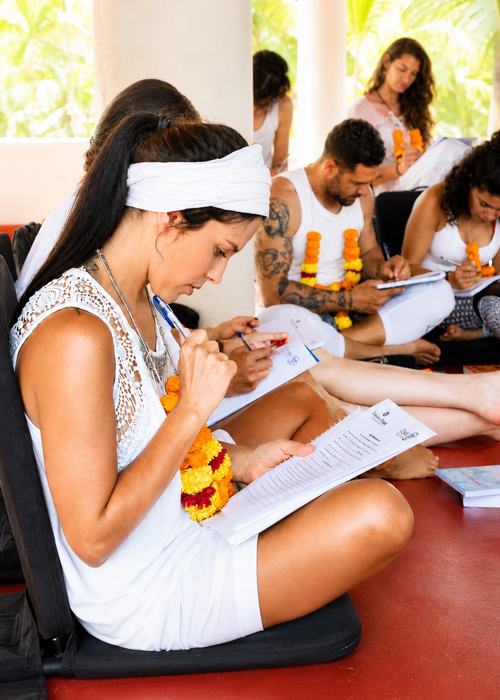
And when the final day arrives, the goal is not for you to say:
“I have finished learning yoga.”
It is for you to say:
“I now know how I want to continue learning.”
Part 17 — Frequently Asked Questions About 200-Hour Yoga Teacher Training in Goa
If you have reached this point, you may already understand that choosing a 200-hour yoga teacher training in Goa is about much more than finding a course with the right number of hours.
You may still have practical questions.
How long is the training?
Do you need previous experience?
What will you study?
Will you actually teach?
What happens after graduation?
And perhaps the most important question:
Is this really the right journey for you?
Here are some of the questions we hear most often.
What is a 200-hour yoga teacher training?
A 200-hour yoga teacher training is an immersive educational program designed to give students a foundation in yoga practice and teaching.
Depending on the school’s curriculum, the training can include Hatha Yoga, Vinyasa Flow, pranayama, meditation, yoga philosophy, anatomy, alignment, sequencing and teaching methodology.
The purpose is not simply to learn more asanas.
It is to develop the knowledge, practical experience and awareness needed to begin teaching responsibly.
At Diksha Yoga School, the training is designed around the connection between personal practice, traditional yoga knowledge and practical teaching skills.
Is a 200-hour yoga teacher training enough to become a yoga teacher?
A 200-hour training can provide a foundation for beginning your teaching journey.
But it is important to understand what that means.
Completing 200 hours does not mean you have mastered yoga or every aspect of teaching.
Your development continues through:
- teaching experience
- personal practice
- further education
- mentorship
- observation
- learning from students
Think of the 200 hours as a foundation rather than a finish line.
Can beginners join a 200-hour yoga teacher training in Goa?
This depends on the individual school’s prerequisites and the student’s circumstances.
If you are relatively new to yoga, don’t simply assume that every 200-hour program will be suitable.
Ask the school about its experience requirements and explain your background honestly.
At Diksha Yoga School, prospective students are encouraged to discuss their previous practice and goals so they can understand whether the training is appropriate for them.
The most important quality you bring is not advanced flexibility.
It is willingness to learn.
Do I need to be flexible to become a yoga teacher?
No.
Flexibility is not a qualification for teaching yoga.
A good teacher needs much more than physical range of motion.
You need to understand:
- observation
- communication
- anatomy
- alignment
- modifications
- sequencing
- breath
- student needs
- responsible teaching
In fact, understanding your own limitations can help you become more empathetic toward students whose bodies move differently from yours.
Yoga teaching is not a flexibility competition.
What do you study during a 200-hour yoga teacher training?
A comprehensive program can include several dimensions of yoga.
At Diksha Yoga School, the learning journey focuses on areas such as:
Asana
Traditional Hatha Yoga, Vinyasa Flow and Ashtanga foundations.
Pranayama
Traditional breathing practices and conscious breath awareness.
Meditation
Concentration, awareness and meditative practices.
Yoga Philosophy
Exploration of traditional yogic teachings and texts.
Anatomy & Alignment
Understanding movement and individual differences between bodies.
Teaching Methodology
Cueing, sequencing, demonstrations, communication and class structure.
Practical Teaching
Opportunities to guide practices, receive feedback and improve.
The goal is to bring these areas together rather than treating them as completely separate subjects.
Will I actually practice teaching during the course?
Practical teaching is an important part of developing as a yoga teacher.
Knowing something intellectually is different from communicating it to another person.
During teacher training, students can develop teaching skills by practicing:
- giving instructions
- demonstrating
- sequencing
- observing students
- adapting classes
- receiving feedback
- teaching again
This process helps transform theoretical knowledge into practical ability.
How is a 200-hour training different from a shorter yoga course?
The difference is not simply the number of hours.
A longer training provides more opportunity for repetition and integration.
You can learn something, practice it, teach it, receive feedback and revisit it.
That cycle is important.
A shorter course may introduce you to a subject.
A comprehensive 200-hour journey can give you more time to develop a relationship with it.
Learn → Practice → Teach → Reflect → Improve.
That is the real value of dedicated training time.
Where is the 200-hour yoga teacher training held in Goa?
Diksha Yoga School’s training is held at The Lotus Sutra in Arambol, Goa, close to Arambol Beach.
The location provides a residential environment in which students can step away from their normal routines and focus more fully on practice and study.
The coastal surroundings also give students space to rest and reflect between training sessions.
But the location should support the education—not replace it.
When choosing a school, always look first at the teachers, curriculum, practical teaching experience and student support.
Is the training suitable for international students?
Goa has long attracted practitioners from many parts of the world, and a teacher-training environment can bring together students with very different cultural and professional backgrounds.
This diversity can become an important part of the learning experience.
You learn that students communicate differently.
They may have different expectations.
They may have different previous experiences with yoga.
A teacher therefore needs to learn how to communicate clearly while remaining sensitive to individual differences.
For an aspiring teacher, that can be valuable experience.
Will I study yoga philosophy during a 200-hour training?
Yoga philosophy is an important part of understanding yoga beyond physical practice.
Depending on the curriculum, students may explore traditional sources such as Patanjali’s Yoga Sutras, the Bhagavad Gita and Hatha Yoga Pradipika.
The goal should not be simply to memorize philosophical concepts.
The deeper purpose is to consider how these teachings relate to:
your practice, your awareness, your choices and eventually your teaching.
Will I learn anatomy and alignment?
Anatomy and alignment are important foundations for responsible yoga teaching.
You need to understand that every student has a different body.
Different proportions.
Different mobility.
Different strength.
Different movement history.
Studying anatomy helps you move away from the idea that every student should reproduce one perfect visual shape.
Instead, you learn to observe and consider:
What is appropriate for this student?
That is a much more useful question for a future teacher.
What happens if I am nervous about teaching?
You are not expected to arrive as a confident teacher.
That is one of the reasons you are joining teacher training.
Your first teaching practice may feel uncomfortable.
You may forget something.
You may speak too quickly.
Your sequence may need adjustment.
That is normal.
With practice and feedback, your confidence can develop.
The goal is not to become someone who never makes mistakes.
The goal is to become someone who can learn from them.
What should I look for when choosing a 200-hour yoga teacher training in Goa?
Look beyond the photographs and headline price.
Ask:
- Who are the teachers?
- How much teaching experience do they have?
- What exactly is included in the curriculum?
- How much practical teaching will I do?
- Will I receive individual feedback?
- How large are the groups?
- What accommodation and meals are included?
- What certification is provided?
- What are the prerequisites?
- What do previous students say about the actual learning experience?
And perhaps ask one more question:
“What kind of teacher will this program help me become?”
That question can tell you more than a long list of marketing claims.
Why choose a residential 200-hour yoga training in Goa?
Immersion can make it easier to give your attention to one subject.
Instead of attending a yoga class and then immediately returning to work, emails and everyday responsibilities, you spend an extended period surrounded by practice and study.
You practice.
You study.
You teach.
You reflect.
You learn with other students.
For many people, that concentrated environment creates a different kind of learning experience.
And being in Arambol, Goa gives you space outside the classroom to slow down and process what you are learning.
What should I expect from the daily experience?
A 200-hour training is an intensive commitment.
Your days may involve a combination of:
asana practice
pranayama
meditation
philosophy
anatomy
teaching methodology
practical teaching
self-study
The exact timetable and inclusions should always be confirmed directly with the school before booking.
What matters is that you come prepared to participate fully rather than expecting a conventional holiday with occasional yoga.
What happens after I complete the 200-hour training?
That depends on you.
Some graduates begin teaching.
Some continue with further education.
Some deepen their personal practice.
Some combine yoga with an existing career.
Some eventually build a full-time yoga career.
There is no single correct path.
Your 200-hour training should give you a foundation from which you can make that decision more consciously.
The certificate marks completion of the course.
Your teaching journey continues beyond it.
Still Wondering If 200 Hours Is Right for You?
Perhaps the best question is not:
“Am I ready to become a yoga teacher?”
Instead ask:
“Am I ready to become a serious student of yoga?”
If the answer is yes, the rest can develop.
You can learn to sequence.
You can improve your communication.
You can become more confident.
You can deepen your understanding of anatomy.
You can study philosophy.
You can practice teaching.
And you can discover what kind of teacher you want to become.
That is what makes the 200-hour yoga teacher training journey in Goa so much more than a certificate.
It is a period of concentrated learning.
A period of practice.
A period of questioning.
And, for many students, a period of discovering a different relationship with themselves and with yoga.
Ready to Begin Your 200-Hour Journey in Goa?
If you are looking for a 200-hour yoga teacher training in Goa that combines traditional yoga foundations with practical teaching experience, Diksha Yoga School welcomes you to explore the journey at The Lotus Sutra in Arambol.
Come because you want a certificate—but stay committed because you want to learn.
Come because you want to teach—but remain a student.
Come because you love yoga—but be willing to discover that there is much more to yoga than the asana.
Your 200 hours are not the end of the journey.
They are where your next chapter begins.
Explore the upcoming 200-hour training dates, course inclusions, accommodation options and availability, and speak with our team before booking.
Part 18 — From 200 Hours to Your First Yoga Class: A Practical Guide for New Teachers
Completing your 200-hour yoga teacher training in Goa is an achievement.
But after the final ceremony, a different kind of learning begins.
You now have to take everything you studied—asana, pranayama, anatomy, sequencing, philosophy and teaching methodology—and bring it into a real class.
That transition can feel exciting.
It can also feel uncomfortable.
You may find yourself wondering:
What should I teach first?
How long should my class be?
How do I sequence safely?
What if nobody understands my instructions?
What if I forget what comes next?
These questions are normal.
Your first class is not supposed to prove that you have mastered yoga.
It is your opportunity to begin teaching with the foundation you have built.
Start With a Class You Can Actually Teach
One of the biggest mistakes new teachers make is trying to impress students.
They create complicated sequences.
They include too many advanced postures.
They try to demonstrate everything they learned during their 200-hour yoga teacher training.
More is not necessarily better.
For your first classes, choose practices you understand well.
Build a clear progression.
Give students enough time to experience each movement.
And keep your instructions simple.
Your students don’t need to see everything you know.
They need to understand what you are asking them to do.
Begin With the Student, Not the Sequence
Before planning your class, ask:
Who am I teaching?
A class for complete beginners should not be planned in exactly the same way as a class for experienced practitioners.
Think about:
- previous experience
- general level
- pace
- available space
- props
- class duration
- the purpose of the session
Then create your sequence around those students.
This is one of the most important changes from being a practitioner to becoming a teacher.
As a student, you ask:
“What do I need from my practice today?”
As a teacher, you begin asking:
“What do these students need from their practice today?”
Have a Clear Intention
A class does not need a complicated theme.
It simply needs a reason for being structured the way it is.
Perhaps you want to focus on:
grounding
hip mobility
spinal movement
breath awareness
standing strength
balance
gentle backbending
Once you know the intention, your sequencing becomes easier.
You can ask:
What preparation does the body need?
Which postures support the intention?
Where should the practice build?
How should I bring students back down?
This is much more effective than choosing random postures you happen to enjoy.
Keep Your Cueing Simple
New teachers often try to explain everything at once.
Instead, think in layers.
First: Tell the student what to do.
For example:
“Step your right foot forward.”
Then: Give the essential alignment information.
“Keep the front knee tracking toward the toes.”
Then: Add breath or awareness.
“Inhale and lengthen through the spine.”
Then pause.
Give the student time to respond.
You don’t need to fill every second with words.
Sometimes silence allows students to actually experience the instruction.
Don’t Forget to Look at Your Students
This sounds simple, but it is surprisingly easy to forget.
When you are nervous, you may spend the entire class thinking about:
What comes next?
Instead, remember to look up.
Observe.
Are students following?
Does someone look confused?
Is the pace too fast?
Is one student struggling?
Is everyone ready to move on?
Your eyes can tell you things your lesson plan cannot.
That is why observation is such an important part of yoga teacher training.
Your Lesson Plan Is a Guide, Not a Prison
Prepare your class.
Know your sequence.
Understand your intention.
But don’t become so attached to your plan that you ignore the people in front of you.
Perhaps students need more preparation.
Perhaps you have less time than expected.
Perhaps a transition isn’t working.
Adapt.
A teacher who can change direction calmly is often more effective than one who follows a perfect sequence while ignoring the students.
The plan serves the students.
The students do not serve the plan.
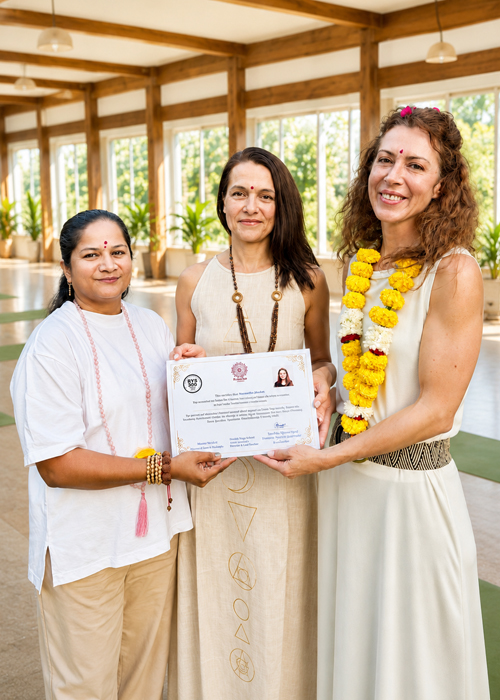
What If You Forget Your Sequence?
You probably will at some point.
Almost every new teacher experiences the moment when the next posture disappears from their mind.
Don’t panic.
Take a breath.
Pause.
Return to something familiar.
You can use a simple transition, allow students to rest or calmly move into the next part of the practice.
Your students don’t know what was written in your notebook.
They only know what happens in the room.
You don’t have to announce:
“I forgot what comes next.”
Simply breathe and continue.
With experience, this becomes much easier.
Teach Within Your Scope
This is one of the most important responsibilities after completing a 200-hour yoga teacher training.
Know what you are trained to teach.
Don’t diagnose medical conditions.
Don’t make claims beyond your knowledge.
Don’t assume that every pain is something you can “fix” with an asana.
And don’t be afraid to refer someone to an appropriately qualified professional when a question goes beyond your scope.
Being a good teacher does not mean having an answer for everything.
Sometimes the most responsible answer is:
“This is outside my area of expertise.”
That is professionalism.
Keep Learning From Every Class
After teaching, take five minutes to reflect.
Ask yourself:
What worked?
What didn’t?
Where did students look confused?
Did I speak too much?
Was the pace appropriate?
Did I give enough options?
Did the sequence match the students?
What would I change next time?
This simple habit can accelerate your development.
Your first class becomes information for your second.
Your second becomes information for your third.
Over time, you begin building your own teaching intelligence.
Your First Students Don’t Need a Perfect Teacher
They need a teacher who is:
prepared
present
honest
observant
respectful
willing to learn
You don’t need to pretend to be an experienced teacher on your first day.
Your students can feel the difference between confidence and performance.
Real confidence comes from preparation and practice.
Not from pretending you have no weaknesses.
What 200 Hours Give You at This Point
This is where everything you studied begins to connect.
Your anatomy knowledge helps you understand movement.
Your sequencing knowledge helps you structure the class.
Your pranayama training helps you integrate breath appropriately.
Your meditation practice can help you remain present.
Your philosophy gives the practice context.
Your teaching methodology gives you tools for communication.
And your practical teaching sessions have already given you a place to make mistakes.
Now you begin putting those pieces together independently.
Your First Class Is Not Your Final Teacher
Remember this.
Your first class does not define your ability as a teacher.
You will change.
Your voice will change.
Your sequencing will change.
Your understanding of students will change.
Your philosophy will deepen.
Your teaching will become more natural.
The teacher you are on your first day will not be the teacher you become after hundreds of classes.
And that is exactly how it should be.
You are not expected to begin as an experienced teacher.
You are expected to begin as a committed student who is willing to keep learning.
The Journey Continues After Arambol
Your time at The Lotus Sutra in Arambol, Goa may give you the foundation.
Your teachers can guide you.
Your classmates can challenge you.
Your training can prepare you.
But eventually, you step outside the training environment.
You stand in front of your own students.
And that is where your next chapter begins.
You take a breath.
You look around the room.
And you remember what your 200 hours were really teaching you:
Not how to perform yoga perfectly.
How to guide another person through a meaningful practice with awareness, responsibility and care.
That is the beginning of becoming a yoga teacher.
Part 19 — Building Your Own Voice as a Yoga Teacher
After completing a 200-hour yoga teacher training in Goa, many new teachers face an unexpected question:
“What kind of yoga teacher am I going to become?”
During training, you learn from experienced teachers.
You observe their language.
You watch how they demonstrate.
You notice how they structure a class.
You learn different approaches to asana, pranayama, meditation and philosophy.
Naturally, some of their teaching style stays with you.
But eventually, you need to discover something that cannot be handed to you in a manual:
your own teaching voice.
You Don’t Need to Copy Your Teacher
When you are new, imitation is normal.
You may use phrases your teacher uses.
You may structure classes in a similar way.
You may demonstrate postures exactly as you were taught.
That is part of learning.
But with experience, you should begin to understand why your teacher taught something in that particular way.
Once you understand the principle behind the method, you have more freedom to communicate it authentically.
The goal is not to become a second version of your teacher.
The goal is to become a teacher who has absorbed the teaching deeply enough to express it responsibly in your own way.
Your Teaching Voice Is Not Just Your Speaking Voice
When we talk about finding your teaching voice, we are not talking only about how you sound.
Your teaching voice includes:
- how you explain
- how you sequence
- how you observe
- how you respond to questions
- how you create atmosphere
- how you use silence
- how you offer modifications
- how you relate to beginners
- how you integrate philosophy
- how you encourage students
- and how you respond when something doesn’t go according to plan
In other words:
Your teaching voice is the way your understanding of yoga becomes visible through your teaching.
Maybe You Are a Quiet Teacher
Not every good teacher needs to be energetic.
Some teachers naturally create a calm environment.
They speak slowly.
They give students space.
They use fewer words.
They allow silence to become part of the practice.
If that is naturally who you are, don’t feel pressured to become loud simply because you think a yoga teacher should have a particular personality.
Quiet confidence can be powerful.
Maybe You Are a More Energetic Teacher
Another teacher may naturally bring enthusiasm into the room.
They may enjoy dynamic Vinyasa.
They may use more expressive language.
They may create an uplifting atmosphere.
That can work beautifully too.
The important thing is that your energy serves the students.
It should not become a performance.
Authenticity does not mean doing whatever feels good to you.
It means expressing yourself while remaining attentive to what your students need.
Your Strengths May Not Be What You Expected
During a 200-hour yoga teacher training, you may discover abilities you did not know you had.
Perhaps you are naturally good at explaining complicated ideas simply.
Perhaps you notice small alignment details.
Perhaps you create beautiful sequences.
Perhaps you are good at making nervous beginners feel comfortable.
Perhaps you have a strong connection with philosophy.
Perhaps your greatest strength is simply that you listen carefully.
Don’t assume that being a good teacher means being good at everything.
Know your strengths.
Then keep developing your weaknesses.
The Best Teachers Continue to Evolve
Your first teaching style will probably not be your final teaching style.
And that is a good thing.
As you teach more, you will discover:
What works.
What doesn’t.
What students respond to.
What needs simplifying.
What you want to study more deeply.
Your teaching may become more concise.
Your sequencing may become more intelligent.
Your voice may become calmer.
Your understanding of beginners may become deeper.
You may eventually incorporate more meditation or philosophy.
Or you may become particularly interested in anatomy and alignment.
Your teaching can evolve as you do.
Don’t Teach to Impress
This is one of the lessons I would emphasize strongly to a new teacher.
You don’t need to prove how much you learned during your 200-hour yoga teacher training in Goa.
You don’t need to demonstrate the most advanced posture.
You don’t need to use Sanskrit terminology in every sentence.
You don’t need to make your classes unnecessarily complicated.
Ask a simpler question:
“Did my students understand and benefit from the practice?”
If the answer is yes, you have achieved something much more important than impressing them.
Teaching Beginners Can Reveal the Quality of Your Understanding
There is a useful test for any teacher:
Can you explain something simple?
If you understand an idea deeply, you should eventually be able to communicate it without making it unnecessarily complicated.
Beginners are particularly valuable teachers in this regard.
They don’t have your vocabulary.
They don’t know the sequence.
They may not understand the traditional terminology.
They force you to communicate clearly.
And when you learn how to teach beginners well, your own understanding often becomes stronger.
Let Students Experience Their Own Practice
A teacher should guide.
But a teacher should not control every second of a student’s experience.
There are moments when you need to speak.
There are moments when you need to demonstrate.
And there are moments when you need to become quiet.
Give students opportunities to notice:
their breath
their sensations
their balance
their effort
their reactions
This is particularly important if you want your teaching to reflect the deeper dimensions of yoga.
Your role is not to become the center of every student’s experience.
Your role is to help them become more aware of themselves.
Your Philosophy Will Influence Your Teaching
You may not realize it at first, but your understanding of yoga philosophy will gradually appear in the way you teach.
If you believe yoga is primarily physical performance, your classes may reflect that.
If you understand yoga as a broader practice of awareness, your teaching may naturally create more space for breath, attention and reflection.
This is why philosophy matters.
It doesn’t need to dominate every class.
But your understanding of why yoga is practiced will influence how you teach it.
Your Personal Practice Is Your Foundation
If you want your teaching to remain authentic, continue practicing yourself.
Not only when you need something to demonstrate.
Not only when you have a class to teach.
Practice when nobody is watching.
Practice when you don’t feel particularly advanced.
Practice when the body feels different.
Practice when you need quiet.
Your students don’t need you to be perfect.
But they benefit from learning from someone who genuinely continues to practice.
You cannot teach from experience you are no longer willing to explore yourself.
What 16+ Years of Teaching Have Taught Me
By Yogini Manisha, Founder & Lead Teacher
After more than 16 years of teaching, I have become less interested in creating teachers who look impressive and more interested in helping students become teachers who are aware and trustworthy.
I have seen students with very different personalities become good teachers.
Some are naturally expressive.
Some are quiet.
Some are highly technical.
Some connect strongly through philosophy.
Some have a wonderful ability to make beginners feel at ease.
There is no single personality that makes a yoga teacher.
What matters is whether the teacher is genuinely present with the student.
I also believe that a teacher should not lose their own identity while respecting the tradition.
Learn the tradition carefully.
Understand what you have been taught.
Practice it.
Then allow your own experience to deepen your expression of it.
That is how an authentic teaching voice develops.
Your Teaching Voice Takes Time
You may finish your 200-hour course without having everything figured out.
That’s okay.
You don’t need to.
Your voice will develop through:
your first class
then your tenth,
then your fiftieth,
then your hundredth.
Each student will teach you something.
Each class will reveal something.
Each mistake will refine something.
Over time, the teacher you are trying to become will gradually become the teacher you naturally are.
Don’t Search for a Teaching Personality. Search for Authenticity.
You don’t need to decide:
“I am going to be a spiritual teacher.”
or:
“I am going to be a very technical teacher.”
or:
“I am going to teach only powerful Vinyasa.”
Give yourself time.
Learn broadly.
Practice deeply.
Observe yourself.
Listen to your students.
Continue studying.
Your direction will become clearer.
And when it does, your teaching will feel less like something you are performing and more like something you genuinely understand.
From Student to Teacher—Without Stopping Being a Student
Perhaps the most beautiful part of becoming a yoga teacher is realizing that the two identities do not have to be separate.
You can be a teacher and remain a student.
You can guide others while continuing to learn.
You can share knowledge while remaining curious.
You can have experience while acknowledging what you don’t know.
That balance keeps teaching alive.
And it is one of the foundations we want students to carry forward from their 200-hour yoga teacher training in Goa.
Because ultimately, your goal is not to become a teacher who has finished learning.
It is to become a teacher who never loses the willingness to learn.