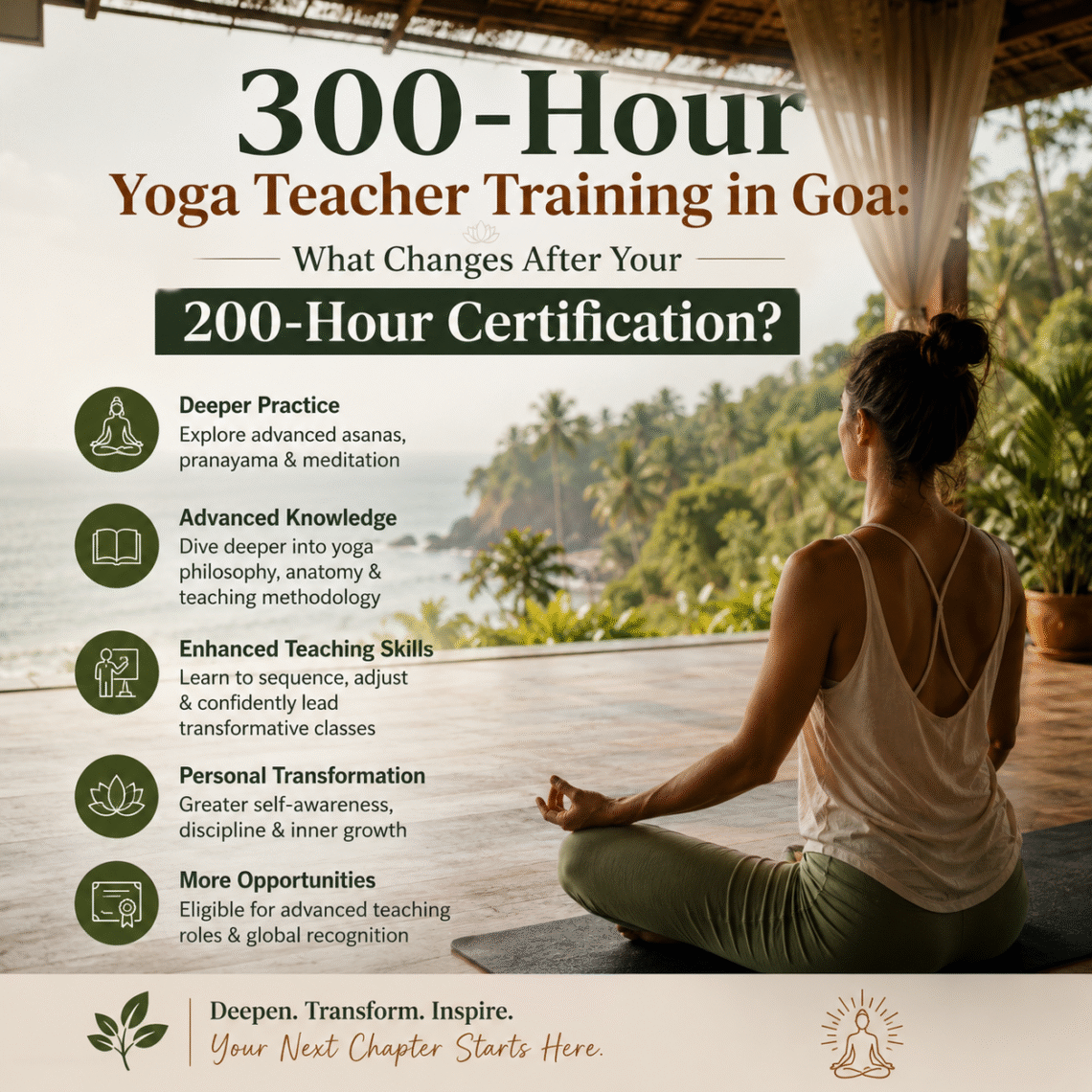
What Changes After Your 200-Hour, If your 200-hour yoga teacher training gave you the foundation, a 300-hour training asks you to go deeper.
Completing a 200-hour yoga teacher training can feel like a major achievement.
You have learned how to structure a class, studied asana, Pranayama, meditation, anatomy and yoga philosophy, and probably taught your first classes.
Table of Contents
You have also discovered something important:
Becoming a yoga teacher is very different from simply practicing yoga.
Then another question often appears:
“What do I actually gain from another 300 hours?”
Is it simply a longer version of a 200-hour course?
Will you just learn more advanced postures?
Do you really need another certification?
And perhaps the most important question:
What changes in you as a teacher after completing advanced yoga teacher training?
At Diksha Yoga School in Goa, we believe the answer is not simply more information.
The deeper purpose of advanced training is to develop greater understanding, stronger observation, more mature teaching skills and a deeper relationship with the practice.
If you already hold a 200-hour certification and are considering a 300-hour Yoga Teacher Training in Goa, this guide will help you understand what actually changes—and what you should look for before choosing an advanced program.
A 300-Hour Training Is Not Simply “200 Hours Plus 100”
One of the easiest mistakes to make is thinking that a 300-hour course is simply a longer 200-hour training.
It isn’t.
Your first teacher training is often about building foundations.
You learn:
- How to practice safely
- How to understand basic alignment
- How to sequence a class
- How to teach fundamental asanas
- How to use your voice
- How to introduce Pranayama and meditation
- Basic anatomy
- Yoga philosophy
- The responsibilities of a teacher
A 300-hour program starts from a different place.
You already have a foundation.
Now the questions become more sophisticated.
Why am I sequencing this way?
What does this student actually need?
How can I adapt a practice without losing its purpose?
How do I teach different levels in the same room?
How do I make my teaching more intelligent rather than simply more complicated?
This is where advanced training becomes valuable.
You are no longer learning only what to teach.
You are learning to understand why you teach it, how you teach it and when to adapt it.
The shift from student to teacher becomes more obvious
During a first teacher training, many students are focused on remembering the sequence.
By the time they enter advanced study, the challenge becomes observation.
You start noticing the student’s breath.
Their posture.
Their energy.
Their hesitation.
Their compensation patterns.
Their level of concentration.
You begin to understand that two people can be performing the same asana while needing completely different guidance.
That is a major step in becoming a mature yoga teacher.
What Changes After Your 200-Hour Certification?
The difference is not necessarily that you suddenly become a completely different teacher.
The change is usually more gradual.
You become more aware.
More observant.
More intentional.
More comfortable adapting.
And ideally, less interested in proving how much you know.
A beginner teacher may think:
“How many poses can I teach?”
An experienced teacher starts asking:
“What does this student actually need today?”
That change in perspective is one of the most important outcomes of advanced yoga education.
200-Hour vs 300-Hour: What Are You Actually Learning?
If you are comparing programs, don’t look only at the number of hours.
Look at the depth and purpose of the training.
| What changes | 200-Hour Training | 300-Hour Advanced Training |
| Main purpose | Build a strong foundation for teaching yoga | Deepen existing knowledge and mature as a teacher |
| Asana | Foundational and intermediate practices | More advanced exploration, refinement and intelligent adaptation |
| Sequencing | Learn how to create safe, logical classes | Develop more sophisticated, purposeful and adaptable sequences |
| Alignment | Understand key principles and common corrections | Develop deeper observation and individualized approaches |
| Anatomy | Build foundational understanding | Apply anatomy more deeply to teaching and adaptation |
| Pranayama | Learn foundational techniques and principles | Explore practices with greater understanding, awareness and context |
| Meditation | Establish fundamental practices | Deepen understanding and personal application |
| Yoga philosophy | Build an introduction to major concepts and traditions | Explore teachings with greater depth and connect them to teaching and daily life |
| Teaching methodology | Learn the foundations of teaching | Refine communication, observation, sequencing and teaching presence |
| Student observation | Begin learning how to observe students | Develop more nuanced observation and individualized guidance |
| Teaching confidence | Build initial confidence | Develop greater maturity, adaptability and presence |
| Personal practice | Establish a consistent foundation | Deepen and refine an established practice |
| Teacher identity | Begin discovering your teaching style | Develop a clearer and more authentic teaching voice |
The important point
A 300-hour training should not simply give you more poses to teach.
It should help you become a more thoughtful teacher.
If a course promises “advanced yoga” but spends most of its time teaching increasingly difficult postures without developing observation, teaching methodology, philosophy, anatomy and self-awareness, ask yourself whether it is really providing the depth you are looking for.
What Should You Already Understand Before Joining a 300-Hour Training?
A 300-hour program is generally intended for students who already have substantial yoga training and experience.
Before booking, ask the school about its prerequisites.
You should be comfortable with regular yoga practice and have a foundation in areas such as:
- Asana practice
- Basic alignment
- Pranayama
- Meditation
- Yoga philosophy
- Teaching methodology
- Class sequencing
- Basic anatomy
Most importantly, you should be ready to question what you already know.
Advanced study is not about arriving with all the answers.
It is about becoming curious again.

What You’ll Study at Diksha Yoga School’s 300-Hour Training
A 300-hour program should not feel like simply adding another 100 hours to your previous teacher training.
At Diksha Yoga School in Goa, the advanced training is designed to build on the foundation you already developed through your earlier yoga education and help you explore the practice with greater depth, awareness and teaching maturity.
The focus is not simply on learning more techniques.
It is on understanding what you already know more deeply—and learning how to apply that understanding more effectively as a teacher.
You continue developing your Hatha Yoga practice with greater attention to alignment, awareness, breath, stability and refinement.
The intention is not simply to make the postures more difficult.
It is to understand the practice more deeply and learn how to approach asana with greater intelligence and awareness.
You explore how movement, breath and sequencing work together to create purposeful practices.
Rather than simply memorizing combinations of postures, the focus moves toward understanding why a sequence is structured in a particular way and how it can be adapted for different students.
Ashtanga provides another framework for exploring discipline, breath, concentration and progression.
Through continued practice, you can develop a greater understanding of structured sequencing and learn how to approach the practice with awareness rather than simply focusing on physical achievement.
At an advanced level, Pranayama becomes more than a breathing exercise added to a yoga class.
You deepen your understanding of breath awareness and Pranayama practices while exploring their relationship with concentration, steadiness and the quality of practice.
Advanced study gives you an opportunity to deepen your own relationship with meditation.
Rather than treating meditation as simply another technique on the timetable, the practice becomes an opportunity to develop greater awareness, concentration and consistency.
This deeper personal experience can also influence the way you introduce meditation to your own students.
As your teaching develops, yoga philosophy can begin to feel less like something you studied for an examination and more like something that informs the way you practice and teach.
The training allows you to explore yogic teachings at a deeper level and consider how they relate to everyday life, personal practice and the responsibilities of a yoga teacher.
The more you teach, the more you realize that there is no single way every body should look in a posture.
A deeper understanding of anatomy and alignment can help you observe movement more carefully, understand individual differences and make more thoughtful teaching choices.
The goal is not to make every student look the same.
It is to develop greater awareness of the body and teach with appropriate care and understanding.
Sequencing
At the foundation level, you learn how to build a safe and logical yoga class.
With more experience, sequencing becomes more intentional.
You begin asking:
Why this posture?
Why now?
What preparation does the student need?
Where is the practice going?
What is the purpose of this sequence?
These questions help move your teaching beyond simply arranging postures into a class.
Teaching Methodology
Knowing yoga and teaching yoga are two different skills.
Advanced teacher training gives you an opportunity to refine how you communicate what you know.
This includes areas such as:
- Clear verbal instruction
- Sequencing
- Observation
- Demonstration
- Teaching presence
- Adaptation
- Giving appropriate feedback
- Developing confidence in front of a class
The aim is not simply to speak more.
It is to communicate more clearly and intentionally.
Student Observation
One of the biggest developments in an experienced teacher is learning to see the student rather than simply see the posture.
You begin noticing breath, movement patterns, concentration, effort and individual differences.
That observation can change the way you teach.
Instead of expecting every student to fit your sequence, you become more capable of responding to the people actually in front of you.
Practical Teaching
Advanced training should not remain entirely theoretical.
Students need opportunities to teach, receive feedback, reflect on their experience and refine their approach.
The objective is not to become a perfect teacher before graduation.
It is to become more aware of what you are doing as a teacher and more confident in continuing to improve.

Refining Your Own Teaching Style
Perhaps the most personal part of advanced training is discovering what kind of teacher you want to become.
Your first teacher training introduces you to methods.
Your teaching experience shows you what works.
Advanced study gives you an opportunity to bring those experiences together and develop a teaching voice that feels authentic to you.
The Goal Is Depth, Not Simply Difficulty
This is an important distinction when comparing 300-hour yoga teacher training programs.
Advanced does not have to mean “more difficult.”
A stronger teacher is not necessarily the person who can demonstrate the most advanced asana.
It may be the teacher who can:
- Observe more carefully
- Explain more clearly
- Adapt more intelligently
- Listen more attentively
- Sequence with greater purpose
- Understand the student in front of them
- Teach without needing to prove how much they know
That is the kind of development advanced yoga education should encourage.
The Teacher Matters Even More at the Advanced Level
At 200 hours, you need a teacher who can help you build strong foundations.
At 300 hours, you need something more.
You need someone who can challenge your thinking.
Someone who can see where your teaching has become habitual.
Someone who can help you refine your sequencing.
Someone who can ask why you are giving a particular instruction.
Someone who can help you move beyond simply copying the way another teacher teaches.
This is one reason the teacher’s experience should be one of the first things you investigate when choosing a 300-hour yoga teacher training in Goa.
A Note From Yogini Manisha
“Advanced yoga education is not about collecting more techniques. It is about developing a deeper understanding of what you are already practicing and learning how to share it with greater awareness.
After many years of teaching, I have found that the strongest teachers are not necessarily the ones who demonstrate the most difficult postures. They are the ones who can observe a student, listen carefully and know when to guide, when to modify and when to simply allow the student to experience the practice.
For me, advanced teacher training is an opportunity to refine that awareness. It is a time to question our habits as teachers, deepen our personal practice and develop a more authentic way of communicating yoga.
The goal is not to become a teacher who knows everything. The goal is to become a teacher who continues to observe, learn and grow.”
— Yogini Manisha
Founder & Lead Yoga Teacher, Diksha Yoga School
This is the difference between collecting another certificate and continuing your education as a yoga teacher.
What Advanced Training Can Change in Your Teaching
You become better at reading the room
Instead of teaching exactly the same class every time, you begin to notice the students in front of you.
Are they tired?
Are they distracted?
Are they experienced?
Is the room ready for a stronger practice?
Would a slower practice be more appropriate?
These observations influence how an experienced teacher teaches.
You become more comfortable adapting
A good sequence is not a rigid list of postures.
It is a framework.
Students have different bodies, experiences, energy levels and needs.
Advanced study can help you become more comfortable modifying practices while preserving the intention behind them.
Your cues become simpler
This is an interesting part of becoming a more experienced teacher.
Beginners sometimes try to say everything.
Experienced teachers learn that more words do not necessarily mean better teaching.
You begin to understand which instruction matters.
You learn when to speak.
When to demonstrate.
When to allow silence.
And when the student’s own experience should take over.
You develop your own teaching voice
Your first teacher training may introduce you to different teaching styles.
With experience, you begin asking:
“What kind of teacher do I actually want to become?”
Your voice develops through practice.
Through mistakes.
Through feedback.
Through teaching different students.
And through continuing to study.
A 300-hour training can become an important part of that process.
Why Choose Goa for Advanced Yoga Teacher Training?
Goa offers something valuable for students who are ready to step away from their normal routine and dedicate time to deeper study.
The environment can provide space.
The practice provides discipline.
The teacher provides guidance.
And the residential experience allows you to live alongside other practitioners who are also committed to learning.

At Diksha Yoga School, advanced students train in Arambol, North Goa, where the coastal environment creates a peaceful setting for intensive study.
But our advice remains the same as it is for any teacher training:
Do not choose a school simply because the location is beautiful.
Choose the teacher.
Choose the curriculum.
Choose the teaching approach.
Choose the environment in which you can genuinely learn.
Goa should support your practice—not distract from it.
How to Choose a 300-Hour Yoga Teacher Training in Goa
Before booking, ask these questions:
| What to check | Why it matters |
| Teacher experience | Advanced students need teachers who can mentor, challenge and give meaningful feedback. |
| Entry requirements | A serious advanced program should explain who the training is designed for. |
| Curriculum depth | Look beyond advanced asana and check philosophy, anatomy, Pranayama, meditation and methodology. |
| Teaching practice | You should have opportunities to refine your teaching rather than only attend lectures. |
| Individual feedback | Advanced development requires personal observation and constructive feedback. |
| Group size | Smaller groups can make meaningful teacher-student interaction easier. |
| Certification | Understand exactly what certification is offered and what it represents. |
| Accommodation | Know what is included and whether the environment supports focused residential study. |
| Meals | Check whether meals are included and what type of food is provided. |
| Daily schedule | Advanced training should provide enough time for practice, study, reflection and rest. |
| Student reviews | Look for genuine experiences from previous students. |
| Total investment | Compare the complete package rather than looking only at the advertised course fee. |
A useful question to ask the school
Before paying your deposit, ask:
“What will I be able to teach, understand or observe more effectively after this 300-hour training than I can today?”
The answer should tell you a lot about the school’s philosophy.
Why Continue Your Yoga Education With Diksha Yoga School?
At Diksha Yoga School, we see advanced teacher training as a continuation of education—not simply another certificate.
The school was founded by Yogini Manisha, whose teaching and mentoring experience spans more than 16 years.
Her approach brings together traditional yoga with practical teaching skills and a strong emphasis on awareness, observation and individual development.

Advanced students can explore areas including:
- Hatha Yoga
- Vinyasa Flow
- Ashtanga foundations and advanced exploration
- Pranayama
- Meditation
- Yoga Philosophy
- Anatomy
- Alignment
- Sequencing
- Teaching Methodology
- Practical teaching
- Student observation
- Refinement of teaching skills
The intention is not to make you perform more difficult postures simply for the sake of difficulty.
It is to help you become a more knowledgeable, observant and confident teacher.
Is a 300-Hour Yoga Teacher Training Worth It?
This depends on where you are in your journey.
If you have just completed your first teacher training and have barely begun teaching, you may benefit more from spending time practicing, teaching and gaining experience.
But if you have already developed a foundation and feel ready to deepen your understanding, a 300-hour program can be a meaningful next step.
Ask yourself:
Do I want to deepen my personal practice?
Do I want to become a more confident teacher?
Do I want to understand anatomy and alignment more deeply?
Do I want to improve my sequencing?
Do I want to develop a more authentic teaching voice?
Do I want to study traditional yoga beyond the introductory level?
If your answer is yes, advanced training may be the right next step.
What Changes After 300 Hours?
Perhaps the biggest change isn’t what you can demonstrate.
It is how you see.
You begin to see the student rather than simply the posture.
You begin to see the purpose behind the sequence.
You begin to understand that alignment isn’t about making every body look the same.
You begin to recognize that teaching isn’t about showing how much you know.
And you begin to understand that yoga education doesn’t really end when you receive a certificate.
It continues every time you practice.
Every time you teach.
Every time a student asks a question you have never considered.
Every time you realize you need to learn something new.
That is what advanced yoga education can give you.
Not simply 300 more hours.
But a deeper relationship with the knowledge you already have.
Ready to Take the Next Step?
If you have completed your 200-hour certification and are searching for a 300-hour yoga teacher training in Goa, take time to compare programs carefully.
Look beyond the photographs.
Ask about the teacher.
Read the curriculum.
Understand the prerequisites.
Ask how much practical teaching you will do.
Find out what is included.
And most importantly, ask whether the program will challenge you to become a better teacher—not simply give you another certificate.

At Diksha Yoga School in Goa, we welcome experienced yoga practitioners and teachers who are ready to continue learning, questioning and refining their practice.
Your 200-hour certification gave you a foundation.
Your next step is deciding how deeply you want to build on it.
Explore the 300-Hour Yoga Teacher Training in Goa
Check upcoming dates, curriculum, accommodation and course inclusions, or contact Diksha Yoga School to discuss whether the advanced program is right for your experience and goals.
Frequently Asked Questions About 300-Hour Yoga Teacher Training in Goa
What is a 300-hour yoga teacher training in Goa?
A 300-hour program is an advanced level of yoga teacher education designed for practitioners who already have substantial foundational training. It focuses on deepening knowledge, refining teaching skills and developing greater understanding and observation.
Can I join a 300-hour yoga teacher training after completing a 200-hour course?
Many advanced programs are designed for students who have already completed foundational teacher training. However, entry requirements vary by school, so check the specific prerequisites before booking.
What is the difference between 200-hour and 300-hour yoga teacher training?
A 200-hour program generally establishes foundational knowledge and teaching skills. A 300-hour program builds on that foundation with greater depth, refinement, observation, advanced methodology and personal development.
Is a 300-hour yoga teacher training only about advanced yoga poses?
No. A strong advanced program should go beyond difficult asanas. Teaching methodology, anatomy, Pranayama, meditation, philosophy, sequencing and student observation can all be important parts of advanced education.
Do I need to be an experienced yoga teacher?
You should check the specific school’s requirements. A 300-hour program is generally intended for practitioners with previous teacher-training experience and a foundation in yoga practice and teaching.
Is a 300-hour yoga teacher training worth it?
It can be valuable if you are ready to deepen your knowledge and refine your teaching. If you have little teaching experience after your 200-hour course, gaining practical teaching experience first may be more beneficial.
Why choose Goa for a 300-hour yoga teacher training?
Goa offers a peaceful environment, an established international yoga community and the opportunity to step away from everyday routines while focusing on study and practice.
What should I look for when choosing a 300-hour yoga teacher training in Goa?
Compare the teacher’s experience, curriculum, prerequisites, teaching practice, group size, individual feedback, certification, accommodation, meals, schedule, student reviews and total course investment.
Final Thought From the Yoga Shala
Your 200-hour certification may have taught you how to teach yoga.
A deeper journey asks you to discover how you want to teach it.
The difference is subtle—but important.
You stop chasing the perfect posture.
You start observing the person in front of you.
You stop trying to say everything.
You start learning what actually needs to be said.
You stop measuring your growth by how much you can demonstrate.
You start measuring it by how deeply you understand.
That is where advanced yoga education begins.
And perhaps the most important thing you can take into your next 300 hours is the willingness to keep learning.