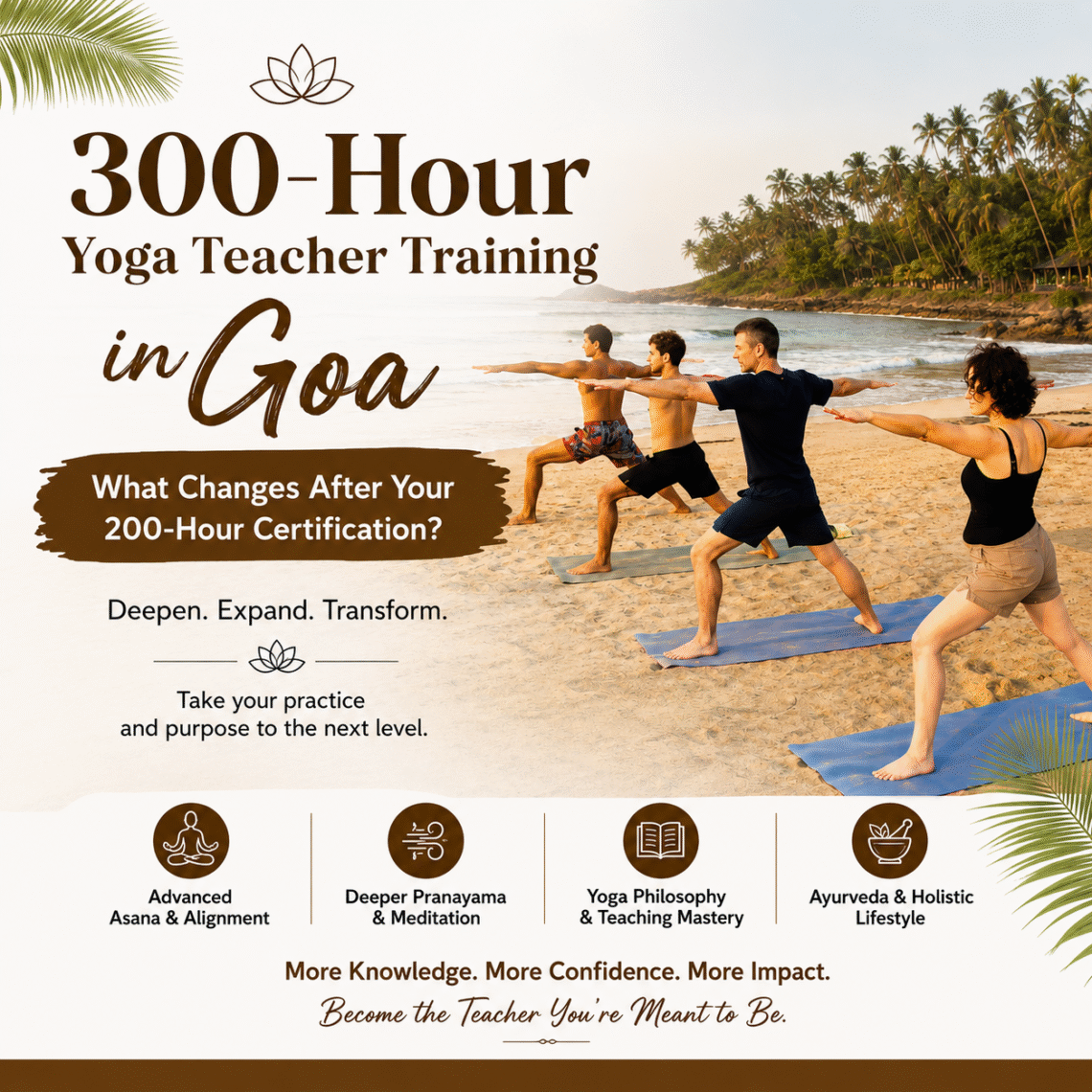
Best 300-Hour Yoga TTC in Goa, Completing a 200-hour yoga teacher training is an important milestone
For many students, it is the first time yoga becomes more than a personal practice. You begin to understand how to structure a class, guide breath and movement, communicate with students, and connect asana with anatomy, philosophy and awareness.
Table of Contents
Start Your Yoga Journey With Us
Book your Yoga Teacher Training 2 months in advance and get up to €100 OFF with our Early Bird Offer! Secure your preferred course dates, reserve your seat in advance, and take the first step toward deepening your yoga practice and becoming a confident yoga teacher.
Early Bird Benefit: Save up to €100
Book 2 Months in Advance
Limited Seats Available
Don’t wait until the last moment — plan your transformation today!
WhatsApp Us Now to Check Availability & Reserve Your Seat
But after teaching for a while, something often changes.
You start asking different questions.
Not just:
“How do I teach this posture?”
but:
“Why am I teaching it?”
Not just:
“Is this the correct alignment?”
but:
“Is this appropriate for the person in front of me?”
And not just:
“How can I make my class more advanced?”
but:
“How can I become a more thoughtful and responsible teacher?”
This is where a 300 Hour Yoga Teacher Training in Goa can become a natural next step.
At Diksha Yoga School, our advanced teacher-training approach at The Lotus Sutra, Arambol, Goa, India is designed to build on the foundation of 200-hour education and take students deeper into practice, teaching, anatomy, sequencing, philosophy and self-awareness.
A 300-hour training should not simply give you another certificate.
It should change the way you understand and teach yoga.
300 Hour Yoga Teacher Training in Goa — At a Glance
| School | Diksha Yoga School |
| Location | The Lotus Sutra, Arambol, Goa, India |
| Training Level | Advanced |
| Recommended For | Yoga teachers and practitioners with foundational 200-hour training |
| Main Focus | Advanced Asana, Anatomy, Sequencing, Pranayama, Meditation, Philosophy & Teaching Methodology |
| Format | Immersive residential training |
| Teaching Development | Advanced teaching practice, observation, sequencing and feedback |
| Certification Pathway | 300-hour advanced training / potential RYT 500 pathway, subject to applicable requirements |
| Next Step | Check current dates, fees and availability |
Quick Answer: What Is a 300-Hour Yoga Teacher Training?
A 300 Hour Yoga Teacher Training is advanced yoga teacher education designed for students who have already completed foundational teacher training.
Rather than starting again with the basics, the focus moves toward deeper understanding and more refined teaching skills.
A comprehensive advanced program can include:
- Advanced asana
- Advanced sequencing
- Anatomy and physiology
- Alignment
- Pranayama
- Meditation
- Yoga philosophy
- Teaching methodology
- Student observation
- Modifications and adaptations
- Teaching practicum
- Professional development
The simplest way to understand the progression is:
200 hours → build the foundation
300 hours → deepen and refine the foundation
The goal is not simply to make your practice more physically difficult.
The goal is to make your understanding deeper and your teaching more intelligent.
What Actually Changes After 200 Hours?
Your first 200-hour training usually gives you the foundations you need to begin teaching.
You learn how to:
- structure a class
- demonstrate asanas
- give basic verbal cues
- introduce pranayama
- guide meditation
- understand foundational anatomy
- study yoga philosophy
- begin teaching other people
But once you start teaching, real questions appear.
A student cannot comfortably do the posture you planned.
Someone has a very different range of motion from the rest of the class.
Your beautifully planned sequence does not work as expected.
A beginner and an experienced practitioner arrive in the same class.
Someone asks you a philosophical question you have never considered deeply.
These experiences change the way you learn.
A 300-hour program gives you an opportunity to return to those questions with more knowledge and experience.
200 Hours vs 300 Hours: What Is the Difference?
| 200-Hour Yoga Teacher Training | 300-Hour Advanced Yoga Teacher Training |
| Establishes foundational knowledge | Deepens existing knowledge |
| Introduces anatomy | Explores anatomy in greater depth and application |
| Introduces sequencing | Develops more intelligent and adaptable sequencing |
| Foundational asana | More advanced and refined asana work |
| Introduction to adjustments | More detailed observation and adjustment skills |
| Foundational pranayama | Deeper exploration of breath practices |
| Introduction to philosophy | Deeper study and application of philosophy |
| Beginning teaching practice | More advanced teaching practicum |
| Builds initial confidence | Refines teaching presence and decision-making |
| Learn how to structure a class | Learn how to adapt a class to real students |
A 300-hour course should not simply be 200 hours again with harder postures.
It should help you become a more capable teacher.
From Knowing the Pose to Understanding the Student
One of the biggest changes after your first teacher training is the way you look at your students.
During a foundational course, you may focus on learning the posture itself.
With more experience, you begin noticing the person practicing it.
Two students may be doing the same asana, but their bodies may look completely different.
Their proportions may differ.
Their mobility may differ.
Their previous injuries or movement history may differ.
Their confidence may differ.
Their understanding of the instruction may differ.
An advanced teacher learns that there is not always one visual shape that every student needs to achieve.
The question becomes:
How can I help this particular student practice appropriately?
That is a much deeper teaching skill.
Advanced Anatomy: From Memorising to Applying
Anatomy is often introduced during a 200-hour teacher training.
You may learn about:
- bones
- joints
- muscles
- movement
- basic biomechanics
- range of motion
After you begin teaching, you discover that knowing anatomical terminology is only the beginning.
The more useful question becomes:
How does anatomy change the way I teach?
A student’s body may not look like the photograph in your training manual.
That does not automatically mean the student is doing something incorrectly.
An advanced teacher needs to observe what is happening, understand the movement and communicate an appropriate option.
This is where anatomy becomes practical rather than simply theoretical.
Advanced Sequencing: From Formula to Intelligence
At 200 hours, you may learn a basic structure for creating a yoga class.
With advanced study, sequencing becomes much more nuanced.
You begin asking:
- What is the intention of this class?
- Who is the class designed for?
- What is the peak posture?
- What preparation does the body need?
- What should come before it?
- What should come afterward?
- What modifications might be necessary?
- What happens if half the class cannot perform the planned posture?
- How can the sequence remain coherent for different levels?
A good sequence is not simply a list of beautiful postures.
Every element should have a reason for being there.
That is one of the skills a serious 300 Hour Yoga Teacher Training in Goa should help you develop.
Teaching Mixed-Level Classes
Once you begin teaching outside a teacher-training environment, you quickly discover that students rarely arrive at exactly the same level.
One person may be completely new to yoga.
Another may have practiced for ten years.
Someone may be naturally flexible.
Someone else may have considerable strength but limited mobility.
Another student may simply feel nervous.
They can all be standing on the same mat.
An advanced teacher learns how to teach the room without losing the individual.
That may mean offering:
a foundational option
a variation
a more challenging option
without making one student feel that their version is inferior.
This is not about making every class complicated.
It is about learning to adapt.
What Will You Study During a 300-Hour Yoga Teacher Training in Goa?
A strong advanced program should deepen the subjects you encountered during your first teacher training rather than simply repeating them.
Depending on the curriculum, advanced study can include:
Advanced Asana
Explore more challenging posture families, transitions, variations and preparation.
Advanced Alignment
Move beyond memorising alignment rules and learn to observe how alignment relates to the individual student.
Anatomy & Physiology
Develop a deeper understanding of movement and how anatomical knowledge can inform teaching decisions.
Advanced Sequencing
Learn to create classes around themes, peak postures, anatomical principles, levels and student needs.
Explore traditional breathing practices with greater attention to technique, awareness and appropriate application.
Develop a deeper understanding of meditation rather than treating it simply as a short closing exercise.
Yoga Philosophy
Move beyond memorising philosophical terminology and begin considering how yogic principles relate to practice, teaching and daily life.
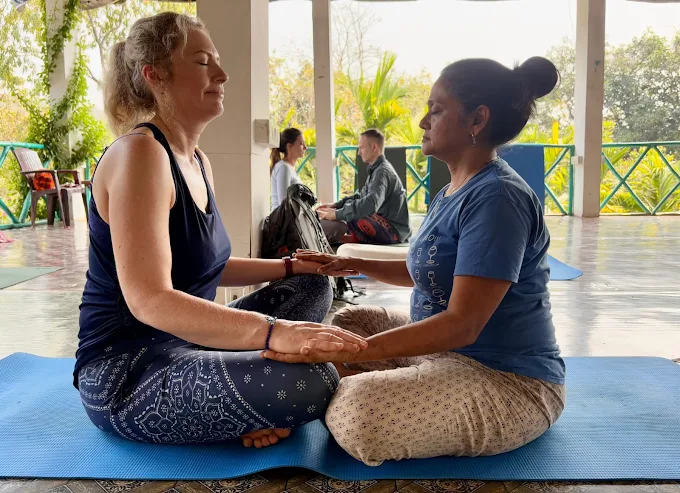
Teaching Methodology
Refine:
- cueing
- demonstration
- observation
- sequencing
- communication
- class management
- modifications
- student support
Teaching Practicum
Teach.
Receive feedback.
Reflect.
Adjust.
Teach again.
That cycle is one of the most valuable parts of advanced teacher development.
Is a 300-Hour Training Just About Advanced Yoga Poses?
No.
This is one of the biggest misconceptions about advanced yoga teacher training.
Advanced does not simply mean:
more difficult asanas.
A teacher can perform extremely advanced postures and still struggle to teach a beginner.
Likewise, an excellent teacher does not need to demonstrate every advanced posture.
Advanced education should deepen:
knowledge
observation
communication
adaptability
teaching judgment
self-awareness
and responsibility.
The physical practice can become more challenging, but that should not be the only measure of progress.
A Personal Perspective From Yogini Manisha
After more than 16 years of teaching and mentoring yoga students, I have seen how the questions students ask change as they gain experience.
At the beginning, students often want to know:
“Am I doing the posture correctly?”
Later, they may ask:
“Why does this posture feel different in my body?”
And once they begin teaching:
“How can I help another person experience this safely?”
That shift is important.
For me, advanced yoga education is not about creating teachers who know the most Sanskrit names or can demonstrate the most difficult postures.
It is about developing teachers who can observe, listen and respond.
A student may need a different instruction.
A sequence may need to change.
A posture may need to be modified.
Sometimes the best teaching decision is not to push further.
The more experience we gain, the more carefully we should teach.
— Yogini Manisha, Founder & Lead Teacher, Diksha Yoga School
Meet Yogini Manisha, Founder of Diksha Yoga School
Yogini Manisha is the founder and lead teacher of Diksha Yoga School, with more than 16 years of experience in yoga teaching, training and mentorship.
Before establishing Diksha Yoga School, she spent many years working in yoga education and leadership, including her experience with Oceanic Yoga.
Diksha Yoga School has reported training more than 23,000 students worldwide.
Her teaching combines traditional yogic knowledge with practical approaches to:
- Hatha Yoga
- Vinyasa Flow
- Pranayama
- Meditation
- Yoga Philosophy
- Anatomy
- Alignment
- Teaching Methodology
Her approach is particularly focused on helping students develop awareness rather than simply collecting techniques.
Internal link: Link the name Yogini Manisha to your full founder/author page.
Who Should Join a 300-Hour Yoga Teacher Training in Goa?
A Is This 300 Hour Yoga Teacher Training in Goa Right for You?
This training may be a good fit if you have already completed your foundational yoga teacher training and now feel that you want to go deeper.
You may be ready for advanced training if:
✓ You have completed a 200-hour yoga teacher training
✓ You have started teaching and want more confidence
✓ You want to understand anatomy beyond the basics
✓ You want to improve your sequencing
✓ You want to become better at adapting classes for different students
✓ You want deeper study of yoga philosophy, pranayama and meditation
✓ You want more supervised teaching practice
✓ You are considering the next stage of your Yoga Alliance teacher-training journey
It may not be the right time if:
- You have not yet completed foundational teacher training
- You are looking only for an advanced-asana retreat
- You want a short holiday rather than an intensive study program
- You are not ready for the commitment of residential training
Choosing the right level is just as important as choosing the right school.
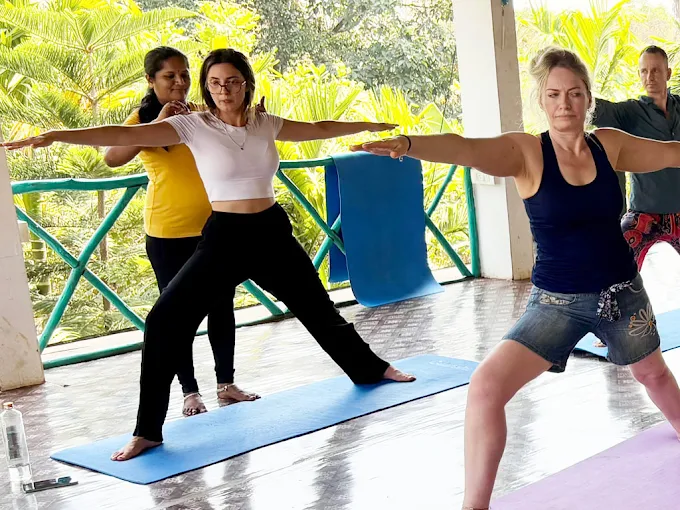
Do You Need Teaching Experience Before Joining?
Not necessarily.
Some students continue directly from their 200-hour training.
Others spend months or years teaching before beginning advanced study.
Both approaches can be valuable.
However, teaching experience can give you real questions to bring into the classroom.
Once you teach real students, you begin to discover things that cannot always be understood from a textbook.
You learn that:
- not every student responds to the same cue
- not every sequence works for every group
- not every body moves in the same way
- not every class follows your original plan
Those experiences can make advanced education much more meaningful.
Why Choose Goa for a 300-Hour Yoga Teacher Training?
Goa offers something different from studying advanced yoga through occasional weekend workshops.
You have the opportunity to spend several weeks immersed in:
practice
study
teaching
reflection
and community.
Goa also provides a unique combination of India’s cultural environment, an established international yoga community and a coastal setting.
For an advanced student, that change of environment can create space to step away from everyday distractions and focus more deeply on learning.
But the same principle applies here as with any yoga destination:
Choose the education first. Let the location enrich the experience.
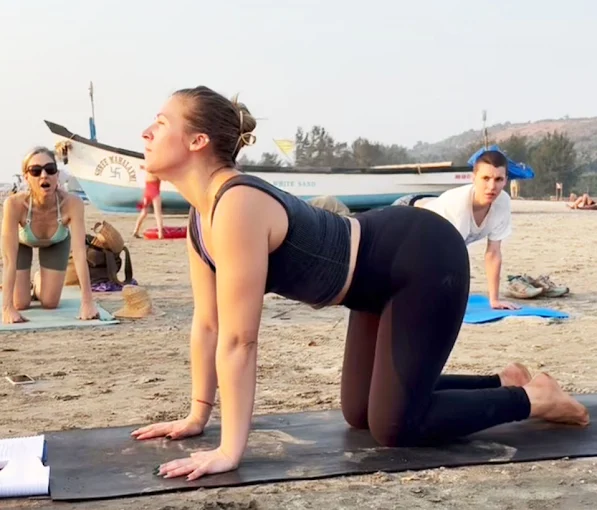
300-Hour Yoga Teacher Training at The Lotus Sutra, Arambol, Goa
Our advanced training is based at The Lotus Sutra in Arambol, Goa, India.
The location is part of the residential experience.
During an intensive teacher training, it can be helpful to have your practice, studies, accommodation and community close to one another.
Your days can develop around a simple rhythm:
Morning practice
↓
Theory and study
↓
Teaching and practical work
↓
Feedback
↓
Personal practice and reflection
↓
Rest
This kind of immersive environment gives you time to process what you are learning rather than immediately returning to the demands of everyday life.
Arambol also has a long-established international visitor and wellness atmosphere, giving students the opportunity to experience Goa outside the classroom while remaining focused on their training.
The location is part of the journey.
The education remains the reason for being there.
What Is Included in the 300 Hour Yoga Teacher Training?
Before booking any advanced teacher training, look carefully at what the advertised price includes.
At Diksha Yoga School, the residential program can be presented clearly around the elements included in the current package.
Depending on the specific intake, these may include:
- Complete 300-hour teacher-training curriculum
- Experienced yoga teachers
- Daily yoga practice
- Advanced teaching methodology
- Anatomy and physiology
- Yoga philosophy
- Pranayama and meditation
- Teaching practicum
- Training materials/manual
- Residential accommodation
- Meals, where included in the selected package
- Course completion certificate
- Welcome and closing experiences, where included
- Student support throughout the training
What Is Different About Advanced Study in Arambol?
There is a difference between visiting Goa for a holiday and living there during a teacher training.
When you are studying for several weeks, the rhythm of the place becomes part of your daily experience.
You practice with the same community.
You learn alongside people from different countries.
You hear different perspectives.
You teach your peers.
You receive feedback.
You have conversations after class.
And gradually, concepts that seemed separate during your 200-hour training begin connecting.
That is one of the most valuable aspects of residential advanced training.
You are not simply attending another yoga course.
You are creating a temporary environment in which yoga becomes a central part of everyday life.
Why Choose Diksha Yoga School for Your 300 Hours?
Choosing an advanced teacher training is different from choosing your first yoga course.
At this stage, you are not simply looking for more information.
You are looking for mentorship, refinement and depth.
At Diksha Yoga School, the focus is on helping students develop:
Experienced teaching
Learn from teachers with substantial experience in yoga teaching and teacher education.
Deeper personal practice
Continue developing your own practice alongside your teaching skills.
Practical teaching
Don’t only study how to teach. Actually teach, receive feedback and refine your approach.
Individual development
Every student arrives with a different background. Advanced training should help you identify your own strengths and areas for development.
Traditional foundation
Explore yoga beyond physical postures through pranayama, meditation and philosophy.
Residential learning
Study, practice and live within the same learning environment at The Lotus Sutra, Arambol, Goa.
How Does Your Teaching Change After 300 Hours?
A good advanced program should help you become more capable of:
Observing students
You begin noticing details rather than simply watching whether someone reaches the expected shape.
Giving clearer cues
You learn to say what is necessary without overwhelming students with instructions.
Creating intelligent sequences
Your classes become more purposeful.
Offering adaptations
You become more comfortable teaching different bodies and levels.
Managing unexpected situations
You learn to adjust your plan when the class requires something different.
Teaching with greater confidence
Not because you know everything, but because you have developed better tools for responding.
Developing your own teaching voice
You begin moving away from simply copying the teacher who trained you.
That last step can be particularly important.
Developing Your Own Teaching Voice
Your first teacher training often gives you a structure.
That structure is useful.
But eventually, every teacher has to ask:
What kind of teacher do I want to be?
You may discover that you love teaching beginners.
You may prefer slower Hatha practices.
You may connect strongly with Vinyasa.
You may become interested in pranayama or meditation.
You may enjoy teaching private clients.
You may discover an interest in anatomy.
Advanced education gives you space to explore those interests while strengthening the foundations underneath them.
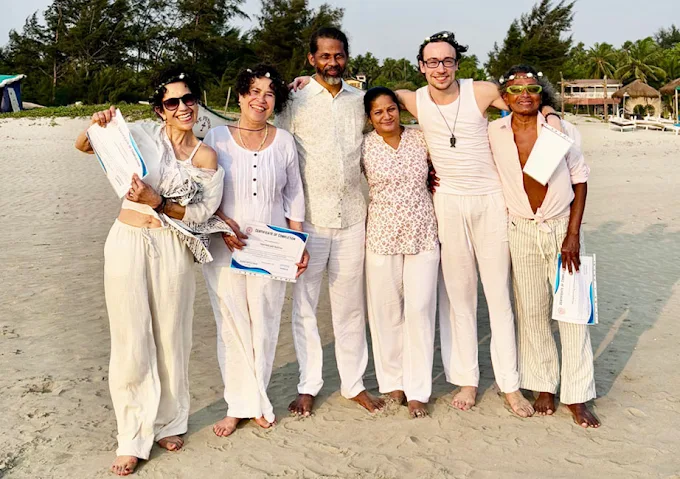
The goal is not for every teacher to sound the same.
It is to help you become a teacher who understands why you teach the way you do.
300-Hour Yoga Teacher Training and the RYT 500 Pathway
Students often ask whether completing a 300-hour course automatically makes them an RYT 500.
The answer is no.
A 300-hour advanced program can form part of the educational pathway toward the RYT 500 credential, subject to the applicable Yoga Alliance requirements and the student’s qualifying training history.
Yoga Alliance’s RYS 300 framework is specifically designed as advanced training that builds upon the foundation developed at the 200-hour level.
So the progression can be understood as:
200-Hour Yoga Teacher Training
↓
Foundational teacher education
↓
Teaching + continued practice
↓
300-Hour Advanced Yoga Teacher Training
↓
Deeper knowledge and teaching development
↓
Potential RYT 500 registration pathway
The training is one part of the journey.
Your continued practice and teaching experience matter too.
How to Choose a 300-Hour Yoga Teacher Training in Goa
There are many programs that use the words “300 Hour Yoga Teacher Training.”
Before choosing one, look beyond the title.
| What to Compare | Why It Matters | Question to Ask |
| RYS 300 status | Helps verify the school’s registration framework | Is this exact program RYS 300? |
| Prerequisites | Advanced study should build on foundations | Is previous 200-hour training required? |
| Curriculum | Determines the depth of education | What advanced subjects are included? |
| Teaching practicum | Develops real teaching ability | How much supervised teaching is included? |
| Advanced anatomy | Helps teachers understand individual bodies | Is anatomy connected to teaching? |
| Sequencing | Important for experienced teachers | Will I create and teach complete sequences? |
| Faculty | Mentorship becomes more important at this level | Who teaches the specialist subjects? |
| Class size | Affects individual feedback | How much personal attention is available? |
| Assessment | Shows whether learning is evaluated | How is practical teaching assessed? |
| Accommodation | Important for residential programs | What exactly is included? |
| Meals | Matters during intensive training | Are meals included? |
| Location | Shapes the learning experience | Where exactly is the training held? |
The best course is not necessarily the one with the most advanced-looking curriculum.
It is the one where the teachers, curriculum, teaching philosophy and learning environment match what you need at this stage of your journey.
Goa vs Koh Samui vs Galle for Advanced Yoga Training
Students considering advanced training may compare several destinations.
| Goa, India | Koh Samui, Thailand | Galle, Sri Lanka |
| Indian cultural and yoga environment | Thai island environment | Southern Sri Lankan coastal environment |
| Established international yoga community | International wellness community | International wellness environment |
| Arambol’s coastal yoga atmosphere | Tropical residential setting | Coastal residential setting |
| Strong connection with India’s yoga traditions | Thai cultural experience | Sri Lankan cultural experience |
| Suitable for students wanting deeper immersion in India | Suitable for yoga + island life | Suitable for yoga + Sri Lankan culture |
There is no universally best destination.
The better question is:
Which environment supports the teacher I want to become?
For students seeking advanced yoga education while experiencing India’s cultural and yoga environment, Goa can offer a particularly meaningful setting.
What Happens After 300 Hours?
Advanced teacher training is not the end of learning.
After completing the program, you may continue through:
- teaching experience
- mentorship
- workshops
- specialist training
- anatomy education
- pranayama
- meditation
- yoga philosophy
- Ayurveda
- yoga therapy studies
- retreats
- personal practice
Some teachers develop a speciality.
Others continue teaching multi-style classes.
Some move into retreats or private teaching.
Others simply use the deeper understanding in their own practice.
There is no single correct path.
Why Choose Diksha Yoga School?
At Diksha Yoga School, we believe advanced training should create depth, not complexity for its own sake.
The aim is not to make students perform more difficult postures simply to demonstrate that they are advanced.
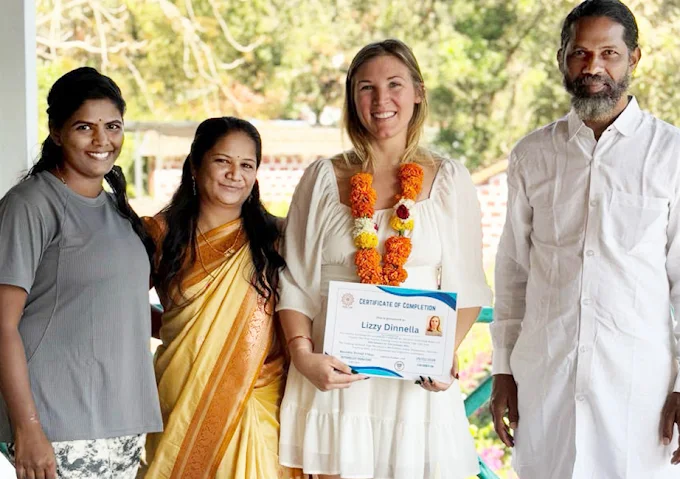
Instead, we want to help teachers develop:
deeper knowledge
better observation
clearer communication
more intelligent sequencing
greater adaptability
stronger teaching presence
and continued self-awareness.
Our approach combines traditional yoga education with practical teacher development.
The goal is not to create teachers who all teach exactly the same way.
It is to help students develop their own authentic teaching voice while respecting the foundations and traditions of yoga.
What Makes a Good Advanced Yoga Teacher?
It is not flexibility.
It is not the ability to perform a handstand.
It is not how many advanced postures you can demonstrate.
And it is not how impressive your social media photographs are.
An advanced teacher learns to:
Observe.
Listen.
Question.
Adapt.
Communicate.
Teach responsibly.
Continue learning.
Respect the individual student.
The more you know, the more carefully you should teach.
10 Questions to Ask Before Booking a 300-Hour Yoga Teacher Training
1. Is the program currently registered as RYS 300?
Verify the exact program rather than relying only on a logo.
2. What are the entry requirements?
Ask whether a previous 200-hour certification is required.
3. What makes the program genuinely advanced?
Look at the curriculum rather than the title.
4. How much teaching practice is included?
You should have opportunities to teach and receive feedback.
5. How detailed is the anatomy?
Ask whether it is connected to practical teaching.
6. Will I learn advanced sequencing?
Find out whether you will create and teach complete classes.
7. Who are the lead teachers?
Research their experience and teaching backgrounds.
8. How large is the group?
Ask how much individual feedback is available.
9. What is included in the residential package?
Clarify accommodation, meals, training materials and other inclusions.
10. What happens after graduation?
Ask how the training fits into your longer-term teaching journey.
Frequently Asked Questions
What is a 300 Hour Yoga Teacher Training in Goa?
A 300-hour yoga teacher training is an advanced program designed to deepen the knowledge and teaching skills developed during foundational 200-hour education.
Can I join a 300-hour yoga teacher training after completing 200 hours?
Yes. Advanced programs are generally intended for students who already have foundational yoga teacher training, although specific admission requirements vary.
What is the difference between 200 and 300 hours?
A 200-hour program establishes foundational knowledge. A 300-hour program builds on that foundation through deeper study, more refined teaching methodology, advanced anatomy, sequencing and practicum.
Is a 300-hour course only about advanced asanas?
No. Advanced training should include much more than physically difficult postures. It can involve anatomy, philosophy, teaching methodology, sequencing, pranayama, meditation, observation and practical teaching.
Do I need teaching experience before joining?
Not necessarily. However, teaching experience can help you bring real questions and classroom situations into your advanced training.
Does completing 300 hours automatically make me RYT 500?
No. A 300-hour training can form part of the educational pathway toward RYT 500, but individual registration depends on the applicable Yoga Alliance requirements and your qualifying training history.
Where is the 300-hour training located?
The program is based at The Lotus Sutra in Arambol, Goa, India.
Why choose Arambol for advanced yoga teacher training?
Arambol offers a coastal environment and an established international yoga and wellness community, while providing students with the opportunity to experience India’s cultural environment during residential study.
What subjects are included in advanced yoga teacher training?
Depending on the program, subjects can include advanced asana, anatomy, sequencing, alignment, pranayama, meditation, yoga philosophy, teaching methodology and teaching practicum.
What can I do after completing 300 hours?
You can continue developing through teaching, mentorship, specialist training, workshops, retreats, personal practice and further yoga education.
About the Author
Founder & Lead Teacher, Diksha Yoga School
Yogini Manisha is the founder and lead teacher of Diksha Yoga School, with more than 16 years of experience in yoga teaching, training and mentorship.
Her teaching combines traditional yogic knowledge with practical approaches to:
- Hatha Yoga
- Vinyasa Flow
- Pranayama
- Meditation
- Yoga Philosophy
- Anatomy
- Alignment
- Teaching Methodology
Through Diksha Yoga School, she has guided a large international community of yoga practitioners and teachers, with the school reporting more than 23,000 students trained worldwide.
Her teaching philosophy is rooted in a simple belief:
The more you learn, the more carefully you should teach.
Advanced yoga is not about showing students how much you know.
It is about understanding what they need.
Ready Ready to Take the Next Step Beyond 200 Hours?
Your 200-hour certification gave you the foundation.
Now you may be ready for a deeper level of study.
At Diksha Yoga School, our 300 Hour Yoga Teacher Training in Goa at The Lotus Sutra, Arambol is designed for students who want to deepen their practice, refine their teaching and continue developing their understanding of yoga.
Before you book, we encourage you to ask questions and make sure the program is right for you.
Explore the Program
→ View 300 Hour Yoga Teacher Training Dates & Fees
→ See the Full Curriculum
→ Check Accommodation & Inclusions
→ Ask About Eligibility
Not ready to book yet? That’s completely fine.
Save this page and come back when you’re ready.
The right teacher training is not a decision to rush.
Choose the teachers.
Choose the curriculum.
Choose the environment.
Then choose the journey.
Your 200 hours gave you the foundation.
Now discover how deeply you can take it.