Choosing between a 100-Hrs vs 200-Hrs Yoga TTC in Sri Lanka is an important decision.
Both programs can deepen your personal practice, introduce you to traditional yogic knowledge, and give you a completely different understanding of yoga. However, they are designed for different levels of commitment and different goals. If you are wondering whether a 100-hour Yoga Teacher Training in Sri Lanka is enough for your journey or whether you should choose a 200-hour Yoga Teacher Training in Sri Lanka, this guide will help you understand the difference clearly.
At Diksha Yoga School, we meet students from many different backgrounds and levels of experience. Some come to Sri Lanka because they want to reconnect with their personal practice. Others are looking for a meaningful experience away from their everyday routine. And many arrive already knowing that they want to become professional yoga teachers.
Table of Contents
After years of teaching students from different countries and backgrounds, one thing has become clear:
There is no single yoga teacher training that is right for everyone.
The better question is:
Which training is right for your goals, experience, available time, and future plans?
A 100-hour program can be an excellent introduction to deeper yoga study and residential immersion. A 200-hour program gives you considerably more time to develop your practice, study yoga in greater depth, and build the foundations needed for teaching.
So before choosing based only on the number of hours or the price, it is worth understanding what you will actually learn, how much teaching practice you receive, and what each program can realistically prepare you for.
Why the Choice Between 100 and 200 Hours Matters
Yoga teacher training is not simply about learning more yoga poses.
A meaningful training can involve:
- Asana practice and alignment
- Traditional Hatha Yoga
- Vinyasa Flow
- Pranayama
- Meditation
- Yoga philosophy
- Anatomy
- Teaching methodology
- Sequencing
- Verbal cueing
- Adjustments and modifications
- Practical teaching
- Personal development
The difference between 100 and 200 hours is therefore not simply “100 hours versus 200 hours.”
It is about how much time you have to learn, practice, observe, teach, receive feedback, and develop confidence.
For someone primarily interested in personal growth, a 100-hour immersion may be exactly what they need.
For someone who already knows they want to teach yoga, a comprehensive 200-hour program may provide the stronger foundation.
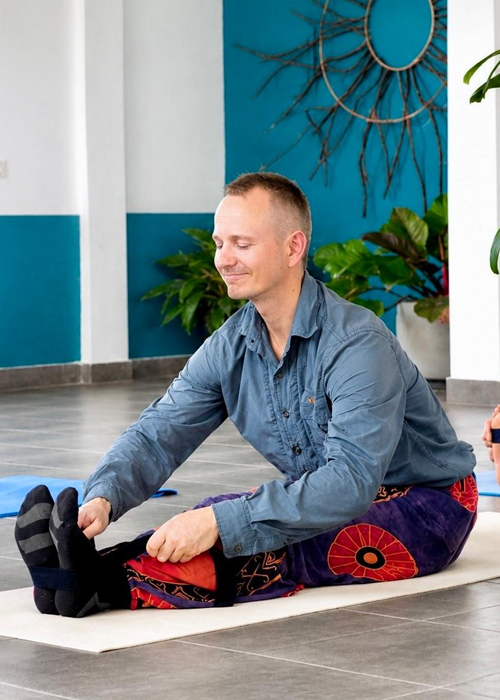
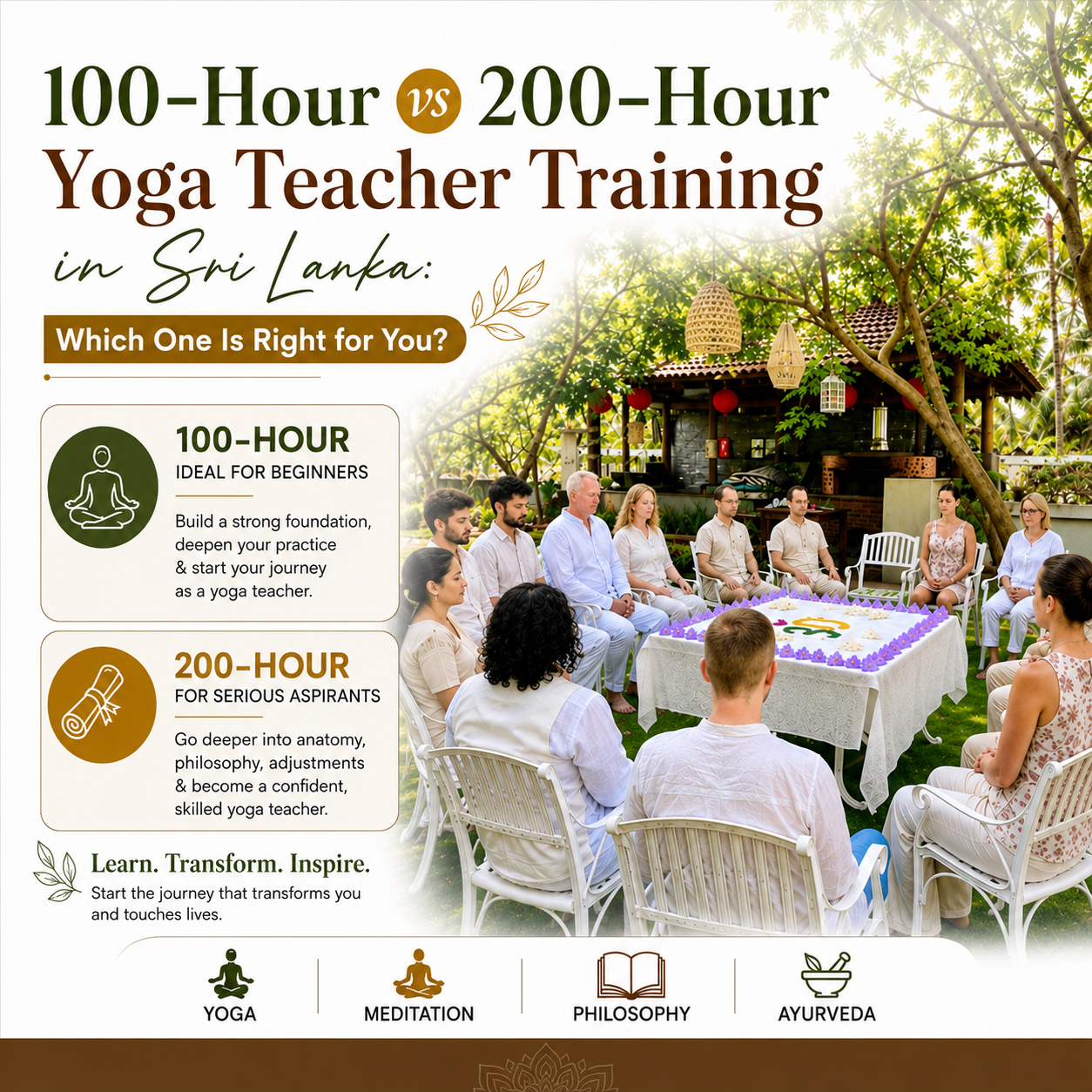
100-Hour vs 200-Hour Yoga Teacher Training in Sri Lanka: Quick Comparison
| Feature | 100-Hour Training | 200-Hour Training |
| Duration | 11 days | 23 days |
| Main purpose | Personal practice, exploration & foundation | Comprehensive teacher training |
| Experience level | Beginner-friendly | Beginner to intermediate |
| Asana study | Foundation & technique | Deeper practice, alignment & teaching |
| Pranayama | Foundational practices | More systematic study & application |
| Meditation | Introduction & regular practice | Deeper study & integration |
| Yoga philosophy | Introduction | More comprehensive study |
| Anatomy | Foundation | More detailed teaching application |
| Teaching methodology | Introduction | Comprehensive |
| Teaching practice | Foundation | Structured practical teaching |
| Residential | Yes | Yes |
| Best suited for | Exploration & personal growth | Students intending to teach |
The important point is that neither program is automatically “better.” The right choice depends on what you want to achieve through your training.
What You Will Learn in the Rest of This Guide
We will compare the two programs in detail, including:
- What a 100-hour training is actually designed for
- What makes a 200-hour training different
- Whether beginners can join a 200-hour course
- How teaching practice differs
- The role of anatomy, philosophy and pranayama
- How much time you really need
- The difference between personal practice and teacher preparation
- Why studying at Serene Garden Villa, Galle, Sri Lanka creates a residential learning experience
- Which course makes sense if you want to teach professionally
- What to consider before investing in a yoga teacher training
- Frequently asked questions about 100-hour and 200-hour training in Sri Lanka
The goal is not to convince you to choose the longer course. The goal is to help you choose the course that genuinely fits your yoga journey.
What Is a 100-Hour Yoga Teacher Training in Sri Lanka?
A 100-hour Yoga Teacher Training in Sri Lanka can be an excellent starting point if you want to go deeper into yoga without immediately committing to a longer 200-hour program.
At Diksha Yoga School, the 100-hour training is designed to introduce students to the wider dimensions of yoga—not only asana practice, but also Hatha Yoga, Vinyasa Flow, pranayama, meditation, yoga philosophy, anatomy, alignment, and teaching methodology. The program is suitable for beginners and students who want to deepen their existing practice.
The purpose of a 100-hour program is not simply to complete a shorter version of a 200-hour course.
It can be a valuable opportunity to experience the discipline of residential yoga education, understand the foundations of traditional yoga, and discover whether you want to continue toward professional teaching.
A 100-hour training may be right for you if:
- You are new to yoga or have a developing practice.
- You want to deepen your personal practice.
- You have limited time for residential training.
- You want to explore yoga philosophy and meditation more deeply.
- You are interested in becoming a yoga teacher but are not completely sure yet.
- You want an immersive yoga experience in Sri Lanka.
- You want to build a foundation before continuing to a longer teacher-training program.
What Do You Actually Study During 100 Hours?
A strong 100-hour program should not be reduced to learning a list of yoga poses.
The training should help you understand the relationship between body, breath, mind, awareness, and yogic philosophy.
At Diksha Yoga School, the curriculum includes areas such as:
Asana Practice
Students explore the foundations of Hatha Yoga, Ashtanga Yoga and Vinyasa Flow, with attention to alignment, safe practice, modifications, sequencing, and developing confidence in practice and teaching.
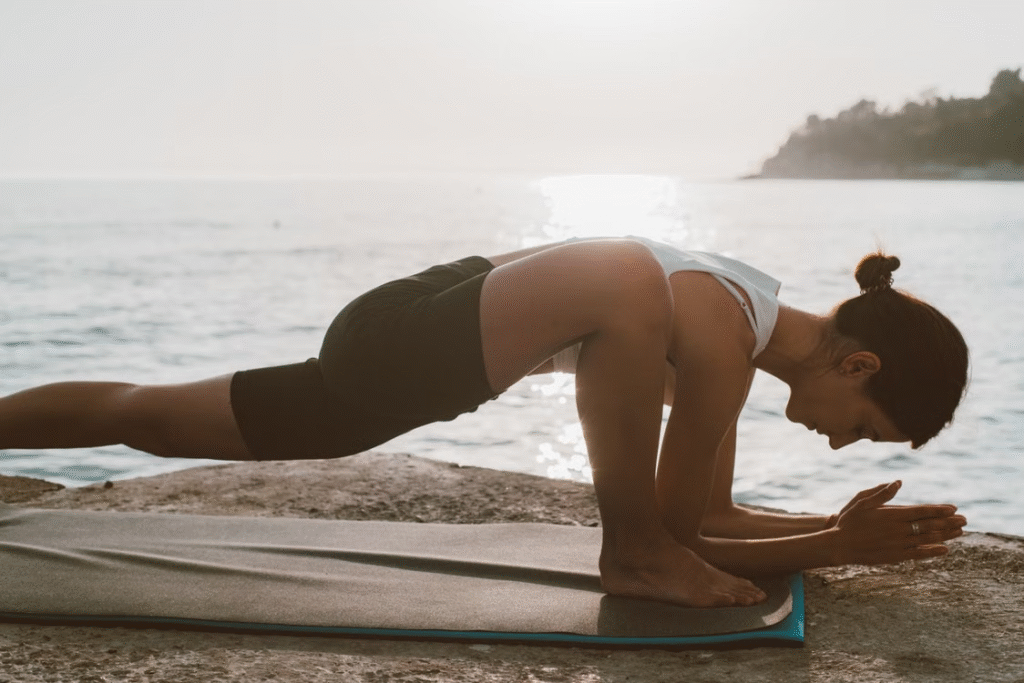
The emphasis is not simply:
“Can you perform the pose?”
It is also:
“Do you understand the pose well enough to explain it, adapt it, and practice it safely?”
Pranayama
Students are introduced to yogic breathing practices and learn how breath can become an important part of a complete yoga practice.
Rather than treating pranayama as something separate from asana, the training helps students understand how breath, concentration, movement, and awareness work together.
Meditation
Meditation provides another dimension to the training.
Regular practice gives students the opportunity to experience stillness, concentration, observation, and self-awareness rather than simply learning about meditation theoretically.
Yoga is much more than physical postures.
The 100-hour curriculum introduces students to important areas of yogic philosophy, including Patanjali’s Yoga Sutras, the Eight Limbs of Yoga, yogic lifestyle, chakras, koshas, mudras and bandhas, depending on the course curriculum.
This helps students begin understanding the question:
What does it actually mean to live yoga, rather than simply practice yoga?
What We Have Learned From Teaching 100-Hour Students
One of the most valuable parts of a shorter training is often not what students expect.
Many people arrive thinking they need to become stronger or more flexible.
But during the training, they often discover that their biggest development comes from awareness and understanding.
A student may initially focus on whether their posture looks “correct.” With guidance, they begin to notice their breathing, alignment, concentration, and the reasons behind the practice.
They begin asking better questions.
Instead of:
“How do I get deeper into this pose?”
the question becomes:
“What is this posture teaching me?”
That shift is important.
It is one of the reasons a 100-hour residential immersion can be valuable even for students who are not yet certain that they want to become yoga teachers.
Can a 100-Hour Course Prepare You for 200 Hours?
Yes. In fact, this can be one of the most useful reasons to choose a 100-hour program.
Diksha Yoga School describes its 100-hour training as a foundation that can help students prepare for further 200-hour teacher training.
It allows you to experience:
Residential training → Daily practice → Philosophy → Pranayama → Meditation → Teaching foundations
before deciding whether you want to continue into a more comprehensive teacher-training pathway.
However, if you already know that your goal is to become a professional yoga teacher, you may prefer to begin directly with the 200-hour Yoga Teacher Training rather than taking a shorter course first.
What a 100-Hour Course Does—and Does Not—Mean
This distinction is important when comparing yoga schools.
A 100-hour certificate should not automatically be assumed to be equivalent to a comprehensive 200-hour teacher-training qualification.
Different schools structure their programs differently, so prospective students should always check:
- What subjects are included?
- How much practical teaching is provided?
- What certification is awarded?
- Is accommodation included?
- What is the actual duration?
- Can the training form part of a longer pathway?
- What does the school’s Yoga Alliance registration actually cover?
This is especially important because current Sri Lanka listings include different 100-hour formats, durations, inclusions, and certification structures.
The number “100” alone does not tell you the quality of the education.
The curriculum, teachers, practical experience, student support, and learning environment matter just as much.
Why Choose a Residential 100-Hour Training?
A residential course creates a different learning environment from attending one yoga class each week.
At Serene Garden Villa, Galle, Sri Lanka, students can step away from their normal routines and dedicate their time to practice, study, reflection, and community.
Instead of:
Yoga class → go home → return to normal life
the experience becomes:
Wake up → Practice → Study → Eat → Reflect → Learn → Rest
That immersion can help students establish a consistent rhythm and experience yoga as a way of life rather than simply another activity.
The 100-hour experience is therefore about more than the certificate.
It is about giving yourself enough space to slow down and ask:
What do I actually want from yoga?
And sometimes that question is the beginning of a much deeper journey.
What Is a 200-Hour Yoga Teacher Training in Sri Lanka?
If you already know that you want to become a yoga teacher, the 200-hour Yoga Teacher Training in Sri Lanka is the more comprehensive path.
A 200-hour program gives you substantially more time to move beyond learning yoga for yourself and begin understanding how to guide another person through a safe, meaningful, and well-structured yoga class.
At Diksha Yoga School, the 200-hour residential program in Galle is a 23-day, multi-style training covering Hatha, Ashtanga, Vinyasa Flow, pranayama, meditation, yoga philosophy, anatomy, alignment, sequencing, and teaching methodology.
The goal is not simply to give you more poses to practice.
It is to help you develop the knowledge and confidence to practice, understand, communicate, and teach yoga.
Who Is the 200-Hour Training Designed For?
A 200-hour program can be suitable for both beginners and experienced practitioners.
You do not need to arrive already knowing how to teach.
You also do not need:
- Advanced flexibility
- Handstand experience
- Years of yoga practice
- An advanced asana practice
- Previous teaching experience
What matters more is your willingness to learn consistently and participate fully in the training.
The 200-hour program may be the better choice if:
- You already know you want to teach yoga.
- You want comprehensive teacher preparation.
- You want deeper study of yoga philosophy.
- You want more anatomy and alignment education.
- You want structured teaching practice.
- You want to learn how to create and teach complete classes.
- You want a stronger foundation for a professional yoga-teaching journey.
- You can commit to a longer residential immersion.
What Makes 200 Hours Different From 100 Hours?
The biggest difference is depth.
With 100 hours, you are introduced to many important aspects of yoga.
With 200 hours, you have considerably more time to revisit those subjects, ask questions, practice them, and begin applying them as a teacher.
Think about the progression:
Learn → Practice → Observe → Teach → Receive Feedback → Improve
This cycle is extremely important.
You might understand how to perform Trikonasana after one class.
But teaching Trikonasana requires you to understand much more:
- How to explain the posture
- How to demonstrate it
- What alignment principles matter
- What common mistakes to observe
- How to modify it
- How to use appropriate verbal cues
- How to adapt it to different students
- Where it belongs in a sequence
That is the difference between practicing yoga and learning to teach yoga.
What You Study During a 200-Hour Yoga Teacher Training
A strong 200-hour program should give you a balanced education rather than focusing only on physical practice.
At Diksha Yoga School, the curriculum covers several interconnected areas.
1. Asana Practice
Students study the foundations of:
- Traditional Hatha Yoga
- Ashtanga Yoga
- Vinyasa Flow
- Alignment
- Modifications
- Sequencing
- Teaching techniques
The emphasis is on developing both your personal practice and your ability to guide others.
2. Pranayama
You explore traditional breathing practices and begin understanding how breath influences concentration, awareness, and the overall yoga practice.
Depending on the curriculum, practices can include techniques such as:
- Nadi Shodhana
- Kapalabhati
- Bhastrika
- Ujjayi
- Sheetali
- Sheetkari
You also begin understanding the relationship between pranayama and other yogic practices rather than treating breathing exercises as an isolated subject.
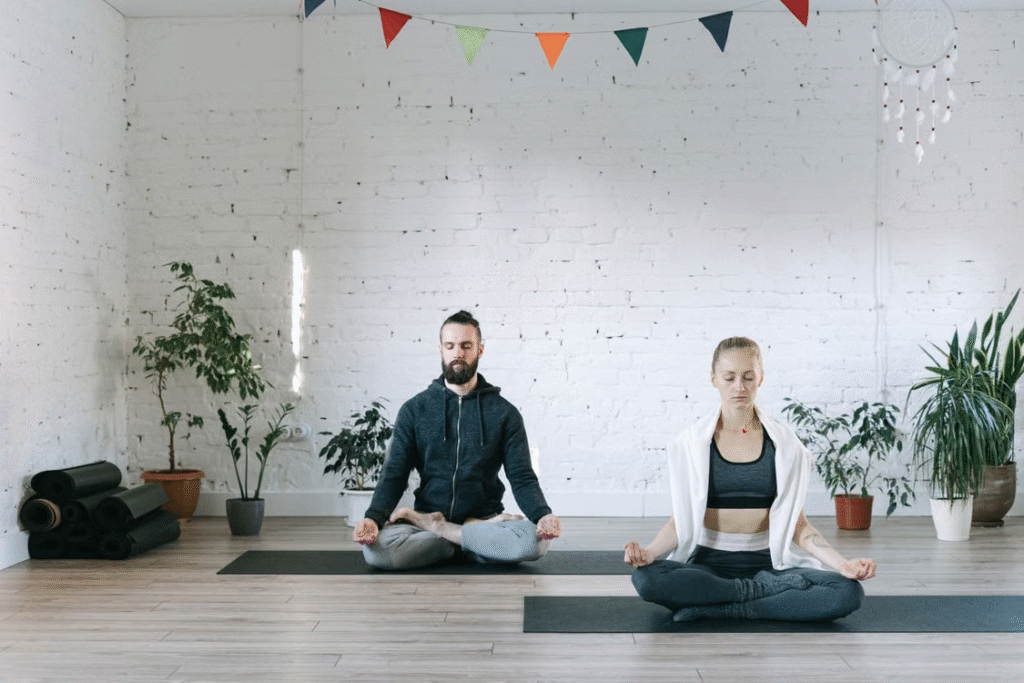
3. Meditation
Meditation becomes part of the daily rhythm rather than simply another topic in a textbook.
Students develop experience with concentration, awareness, observation, and stillness.
This is particularly important for future teachers.
You cannot effectively guide students through practices you have never taken the time to experience yourself.
4. Yoga Philosophy
The 200-hour curriculum goes beyond the physical dimension of yoga.
Students explore areas including:
- Patanjali’s Yoga Sutras
- The Eight Limbs of Yoga
- Yamas and Niyamas
- Bhagavad Gita
- Chakras
- Koshas
- Mudras
- Bandhas
- Yogic lifestyle
The purpose is not simply to memorize philosophical terminology.
It is to begin understanding how yogic philosophy can influence the way you practice, live, and teach.
Anatomy and Alignment: Learning to See the Student
One of the most important transitions during teacher training happens when students stop looking only at their own bodies.
You begin learning how to observe someone else.
A future teacher needs to understand questions such as:
Why is this student struggling with the posture?
Should I offer a modification?
Is this movement appropriate for this student today?
What cue will actually help them understand the movement?
Should I ask them to go deeper—or should I ask them to stop?
This is why anatomy and alignment are not simply academic subjects.
They influence your real teaching decisions.
Current 200-hour programs in Sri Lanka commonly emphasize anatomy, biomechanics, alignment, sequencing, observation, and practical teaching as core components of teacher preparation.
Teaching Methodology: Where the Teacher Training Really Begins
You can be an excellent yoga practitioner and still feel completely unprepared to teach your first class.
Teaching is a different skill.
During teacher training, you begin learning how to:
Sequence a Class
Create a logical progression from preparation and warm-up through the main practice and toward relaxation.
Give Clear Verbal Cues
Use language that students can understand without becoming overwhelmed by too many instructions.
Demonstrate
Know when a demonstration is helpful and when students need to experience the movement themselves.
Modify
Adapt postures for different levels, abilities, and needs.
Use Your Voice
Learn how tone, volume, pace, pauses, and presence influence the atmosphere of a class.
Observe
Look beyond whether a student “looks right” and develop the ability to notice what is actually happening.
Teach With Confidence
Eventually, you have to stand in front of people and teach.
That experience cannot be replaced by reading about teaching.
The Practice–Teach–Feedback Cycle
One of the most valuable parts of a comprehensive teacher training is the opportunity to practice teaching while you are still learning.
At Diksha Yoga School, we encourage students to think of teaching development as a continuous process:
Practice
Understand the technique yourself.
↓
Observe
Watch how another teacher approaches it.
↓
Teach
Try communicating it to other students.
↓
Receive Feedback
Understand what worked and what could be improved.
↓
Adjust
Change your cueing, sequencing, timing, or approach.
↓
Teach Again
Apply what you have learned.
This is how confidence gradually develops.
The goal is not to leave the course knowing a memorized script.
The goal is to become comfortable enough to think, observe, adapt, and teach.
What We Have Learned From Training Future Teachers
After years of teaching students from different countries and backgrounds, one lesson becomes very clear:
The strongest yoga teachers are not necessarily the students who can perform the most advanced poses.
Some of the most promising teachers begin with very ordinary physical practices.
What makes them stand out is their ability to:
- Listen
- Observe
- Ask questions
- Accept feedback
- Communicate clearly
- Remain patient
- Adapt to different students
- Continue learning
A beautiful personal practice is valuable.
But teaching requires something more.
It requires the ability to see another person.
That is one of the most important changes students begin experiencing during a 200-hour teacher training.
Is a 200-Hour Yoga Teacher Training Suitable for Beginners?
Yes.
This is one of the biggest misconceptions about yoga teacher training.
You do not have to become “advanced” before you begin.
In fact, a good teacher-training environment should help you understand that there is no final stage where you suddenly become perfect at yoga.
You will continue learning.
You will continue adapting.
You will continue discovering new things about your own practice.
At Diksha Yoga School, the 200-hour program is open to students from beginner to intermediate levels.
So if you are thinking:
“I am not flexible enough to become a yoga teacher.”
Remember:
Flexibility is a physical quality. Teaching is a skill.
They are not the same thing
Why the 23-Day Residential Experience Matters
The additional time in a 200-hour program is not simply more classroom hours.
It gives you more time to live the practice.
At Serene Garden Villa, Galle, Sri Lanka, students can remain within a residential learning environment throughout their training.
Your days are built around a consistent rhythm:
Morning practice → Study → Practice → Teaching → Reflection → Rest
That repetition matters.
You begin to understand yoga not as something you attend for 90 minutes and then leave behind, but as something that gradually becomes part of your daily routine.
200-Hour Training: A Deeper Commitment, But Also a Deeper Experience
A 23-day residential program requires more time and commitment than an 11-day course.
But that additional commitment can provide something that is difficult to achieve in a shorter immersion:
time to change.
Time to become more comfortable with your body.
Time to understand your breath.
Time to study philosophy.
Time to ask difficult questions.
Time to practice teaching.
Time to make mistakes.
Time to receive feedback.
Time to try again.
And time to discover what kind of yoga teacher you want to become.
100 Hours or 200 Hours?
At this point, the difference can be summarized simply:
100 hours:
Explore yoga more deeply and build a strong foundation.
200 hours:
Immerse yourself more completely and develop the foundations for teaching.
Neither choice is wrong.
But if you already know that teaching yoga is your goal, the 200-hour route generally gives you the more complete starting point.
And if you are still exploring, the 100-hour training can give you the space to discover whether you want to continue.
100-Hour vs 200-Hour Yoga Teacher Training in Sri Lanka: Curriculum & Teaching Practice Comparison
The biggest difference between a 100-hour and 200-hour yoga teacher training is not simply the number of hours.
It is how much time you have to understand each subject, practice it repeatedly, and begin applying it as a future teacher.
A shorter program can introduce you to many important areas of yoga. A 200-hour program gives you more space to revisit those areas, ask questions, receive feedback, and develop greater confidence.
Here is a practical comparison.
100-Hour vs 200-Hour Yoga Teacher Training: Curriculum Comparison
| Area of Training | 100-Hour Yoga Teacher Training | 200-Hour Yoga Teacher Training |
| Duration | 11 days | 23 days |
| Asana | Foundation, technique & regular practice | Deeper practice, alignment, sequencing & teaching application |
| Hatha Yoga | Introduction and foundational practice | More extensive study and application |
| Vinyasa Flow | Introduction to flow and transitions | Deeper sequencing and teaching practice |
| Pranayama | Foundational breathing practices | Broader practice and deeper application |
| Meditation | Introduction and regular practice | More time for practice and integration |
| Yoga Philosophy | Introduction to key yogic concepts | More comprehensive philosophical study |
| Anatomy | Foundational understanding | More detailed understanding for teaching |
| Alignment | Basic principles | More detailed observation and application |
| Sequencing | Introduction | Structured class sequencing |
| Teaching Methodology | Introduction | Comprehensive teacher preparation |
| Practical Teaching | Foundation | More structured teaching opportunities |
| Feedback | Limited by shorter duration | More opportunity for practice and feedback |
| Best suited for | Exploration, personal growth & foundation | Students preparing for a teaching pathway |
The table gives you the overview.
But the real difference becomes clearer when you look at what each subject means in practice.
Asana: From Practicing Yourself to Teaching Others
In a 100-hour training, you have the opportunity to develop your understanding of foundational asanas and explore how alignment, breath, awareness, and movement work together.
The 200-hour program allows considerably more time to take that knowledge further.
You begin moving from:
“How do I perform this posture?”
to:
“How do I teach this posture to another person?”
That requires a different level of understanding.
For example, when studying Trikonasana, a future teacher needs to think about more than simply reproducing the shape.
You may need to consider:
- How should the posture be introduced?
- What should the student’s feet do?
- How should the spine be positioned?
- What should the student do if they cannot reach the floor?
- Which verbal cues are most useful?
- What common mistakes should you watch for?
- When should the posture be modified?
- How does it fit into the sequence?
This is where additional training time becomes valuable.
Pranayama: Understanding the Breath
Pranayama is an important part of both programs.
Students can be introduced to traditional practices such as:
- Nadi Shodhana
- Kapalabhati
- Bhastrika
- Ujjayi
- Sheetali
- Sheetkari
The difference is the amount of time available to practice, understand, and integrate these techniques.
In a 100-hour immersion, you may establish a strong foundation.
In a 200-hour training, you have more opportunity to develop a regular practice and understand how pranayama fits within a complete yoga session.
For a future teacher, this matters because teaching pranayama requires more than knowing the name of a technique.
You need to understand how to explain it clearly, how to structure the practice, and how to guide students through it responsibly.
Meditation: Experience Before Teaching
Meditation is another area where immersion makes a difference.
A student can read about meditation in a book.
But reading about meditation is not the same as practicing it every day.
Residential training creates a rhythm in which meditation becomes part of your daily experience.
You begin to notice:
- How concentration changes
- How distractions arise
- How the breath influences attention
- How stillness feels
- How your own mind responds to regular practice
For someone who eventually wants to guide meditation, this personal experience is particularly valuable.
Yoga Philosophy: Understanding the Tradition
Yoga teacher training should not be reduced to physical exercise.
Traditional yoga includes a much wider body of knowledge.
Students can explore subjects such as:
- Patanjali’s Yoga Sutras
- The Eight Limbs of Yoga
- Yamas and Niyamas
- Bhagavad Gita
- Yogic lifestyle
- Meditation
- Chakras
- Koshas
- Mudras
- Bandhas
The 100-hour course introduces students to important philosophical foundations.
The 200-hour course provides more time to explore these ideas and consider how they relate to everyday practice and teaching.
This is particularly important if you want to become a teacher who can explain why yoga is practiced—not simply demonstrate how to perform an asana.
Anatomy: From Information to Application
Anatomy is another area where the longer training can make a meaningful difference.
You do not need to become an anatomy expert or medical professional to teach yoga.
But you should develop enough understanding to make thoughtful teaching decisions.
A future teacher should gradually become comfortable asking:
What movement is happening here?
What might be limiting this student?
Should I offer a modification?
Is this cue helping or confusing?
Does this student need to go deeper—or should they stop?
The 200-hour program gives students more time to connect anatomical concepts with actual movement and teaching.
That connection between theory and observation is one of the most important parts of teacher preparation.
Teaching Methodology: The Real Transition to Becoming a Teacher
This is perhaps the most important difference between the two programs.
You can know hundreds of yoga poses and still not know how to teach a yoga class.
Teaching requires you to combine knowledge with communication.
A teacher needs to learn how to:
Sequence
Create a logical progression rather than simply putting poses together.
Cue
Give instructions that are clear, concise, and understandable.
Demonstrate
Know when to demonstrate a posture and when students should learn through verbal guidance.
Modify
Offer appropriate variations for students with different levels and needs.
Observe
Pay attention to what students are actually doing.
Manage Time
Understand how to create a complete class within a specific time frame.
Use Your Voice
Develop appropriate volume, pace, tone, pauses, and presence.
Hold Space
Create an environment in which students feel supported and able to learn.
These are teaching skills, not simply yoga skills.
Practical Teaching: Why More Time Matters
This is where the 200-hour program has a particularly important advantage for students who want to teach.
Knowing the theory is one thing.
Standing in front of a group is another.
The first time a student teaches, they may discover that:
- They speak too quickly.
- They forget part of their sequence.
- Their instructions are too complicated.
- They demonstrate too much.
- They do not notice what students are doing.
- They run out of time.
- They become nervous.
None of this means they are failing.
It means they are learning to teach.
The important part is having enough time to practice, receive feedback, make adjustments, and try again.
That is why a comprehensive 200-hour training can provide a stronger foundation for someone who wants to teach professionally.
The Learning Cycle
At Diksha Yoga School, we believe teacher development is not simply:
Learn → Memorize → Certificate
A more meaningful process is:
Learn
Understand the technique, philosophy, anatomy, and methodology.
↓
Practice
Experience it in your own body and mind.
↓
Observe
Watch experienced teachers and fellow students.
↓
Teach
Begin communicating what you have learned.
↓
Receive Feedback
Understand what worked and what needs improvement.
↓
Adapt
Change your cueing, sequencing, timing, or approach.
↓
Teach Again
Apply what you have learned with greater awareness.
This process is difficult to compress into a very short training.
It is one of the strongest reasons students who already know they want to teach may benefit from the additional time of a 200-hour program.
Which Course Gives You More Teaching Confidence?
If your main goal is personal growth, teaching confidence may not be your primary concern.
In that case, a 100-hour program can provide a meaningful and focused immersion.
But if you are thinking:
“I want to stand in front of a class and teach confidently.”
then teaching methodology and practical experience become much more important.
The 200-hour pathway gives you more time to develop those skills.
You do not leave the course as a “perfect teacher.”
You leave with something more realistic and valuable:
a foundation from which you can continue developing as a teacher.
What We Have Observed in Our Students
One of the most valuable lessons from teaching students over the years is that confidence rarely appears all at once.
A student may arrive quietly and hesitate to speak during the first few days.
Later, they may volunteer to demonstrate.
Then they may teach a short sequence.
Then they teach a complete section of a class.
Eventually, they begin trusting their own voice.
That progression is one of the most rewarding parts of teacher training.
It is also why we believe students should have opportunities to practice rather than simply listen to lectures.
A teacher is developed through experience—not only information.
Which Course Gives You Deeper Learning?
The answer depends on what you mean by “deeper.”
A 100-hour training can be deeply meaningful for personal practice.
You can develop a stronger relationship with your body, breath, meditation, and yogic philosophy.
A 200-hour training is designed to provide greater breadth and depth for teacher preparation.
You have more time to connect:
Practice + Philosophy + Anatomy + Teaching + Experience
So the question is not:
“Is 200 hours better than 100 hours?”
The better question is:
“Do I need a personal yoga immersion, or am I preparing to become a yoga teacher?”
That answer will usually make your decision much easier.
Which Yoga Teacher Training in Sri Lanka Is Right for You?
After comparing the curriculum, teaching methodology, and learning experience, the decision becomes much simpler:
Do you want to explore yoga more deeply, or are you preparing to teach it?
Both paths are valuable. The right choice depends on your intention, available time, previous experience, and what you want to do after the training.
Choose the 100-Hour Yoga Teacher Training If…
You Want to Deepen Your Personal Practice
If your primary goal is to understand your own practice more deeply, a 100-hour training can provide a meaningful immersion.
You have time to explore:
- Asana
- Hatha Yoga
- Vinyasa Flow
- Pranayama
- Meditation
- Yoga philosophy
- Alignment
- Foundational anatomy
You can step away from your normal routine and dedicate several days entirely to yoga.
For many students, that alone can be transformative.
You Are Curious About Becoming a Teacher
You may love yoga but still be asking yourself:
“Do I really want to teach?”
If you are not certain, a 100-hour program can give you an opportunity to experience teacher training before making a longer commitment.
You can discover whether you enjoy:
- Studying yoga philosophy
- Practicing every day
- Learning anatomy
- Discussing teaching techniques
- Observing other students
- Standing in front of a group
- Sharing what you have learned
Sometimes you only discover whether teaching is right for you after experiencing the learning environment yourself.
You Have Limited Time
Time is one of the most practical differences.
100 Hours → 11 Days
200 Hours → 23 Days
If your work, family, or other responsibilities make a 23-day residential commitment difficult, an 11-day immersion may be a more realistic option.
A shorter course that you can fully commit to is better than choosing a longer course that creates unnecessary pressure.
You Want a First Immersion in Sri Lanka
A 100-hour residential training can also work well if you want to combine your yoga education with the experience of travelling to southern Sri Lanka.
At Serene Garden Villa in Galle, you can step away from everyday distractions and create a dedicated period for practice, study, rest, and reflection.
The experience becomes more than attending a class.
You are temporarily creating a different daily rhythm around yoga.
Choose the 200-Hour Yoga Teacher Training If…
You Already Know You Want to Teach Yoga
This is the clearest reason to choose 200 hours.
If you are already thinking about teaching at:
- Yoga studios
- Retreat centres
- Wellness resorts
- Private sessions
- Community classes
- Your own yoga business
then a comprehensive 200-hour foundation is generally the more appropriate starting point.
You need time to develop more than your personal practice.
You need to learn how to teach other people.
You Want Comprehensive Teacher Preparation
A 200-hour program allows more time for the subjects that future teachers need to integrate:
Asana + Anatomy + Philosophy + Pranayama + Meditation + Teaching Methodology
You are not studying these subjects as completely separate topics.
You begin seeing how they connect.
For example:
Your anatomy knowledge influences your alignment cues.
Your personal asana practice influences your demonstrations.
Your philosophy studies influence how you approach teaching.
Your meditation practice influences your presence in the classroom.
That integration is an important part of becoming a well-rounded teacher.
You Want More Practical Teaching Experience
This is one of the biggest reasons to choose 200 hours.
You may know the theory.
But eventually, you need to stand in front of students.
You need to speak.
You need to demonstrate.
You need to observe.
You need to make decisions.
And sometimes, you need to change your entire plan because the class in front of you needs something different.
That confidence develops through practice and feedback.
A longer residential program gives you more room for this development.
You Want Deeper Study
If you are the kind of student who keeps asking:
“Why?”
then the 200-hour program may suit you better.
Why does this posture work this way?
Why do we use this breathing technique?
Why is this sequence structured in this order?
Why might one student need a modification while another does not?
How does traditional yoga philosophy connect with modern teaching?
These questions require time.
A comprehensive training gives you more opportunity to explore them.
What If You Are a Complete Beginner?
You can still choose the 200-hour Yoga Teacher Training in Sri Lanka.
Being a beginner does not automatically mean that you should choose 100 hours.
The more important question is:
What is your intention?
If you are a beginner and say:
“I want to explore yoga and see where it takes me.”
A 100-hour course may be an excellent beginning.
But if you say:
“I am new to yoga, but I already know that I want to become a yoga teacher.”
Then beginning directly with a comprehensive 200-hour program may make more sense.
You do not need to become advanced before beginning your teacher-training journey.
The training is where you learn.
What If You Are Already an Experienced Yoga Practitioner?
If you have practiced yoga for several years, that does not automatically mean you should skip directly to an advanced course.
Your previous experience is valuable, but teaching requires a different set of skills.
Ask yourself:
- Have I studied anatomy?
- Can I sequence a complete class?
- Can I give clear verbal instructions?
- Can I adapt a posture for different students?
- Have I practiced teaching?
- Do I understand yoga philosophy beyond general concepts?
- Can I confidently guide pranayama and meditation?
If the answer to several of these is no, a comprehensive 200-hour teacher training can still provide an important foundation.
What About Certification?
Certification is another important consideration.
A common mistake is to compare yoga teacher trainings only by the number of hours and price.
Before booking, look carefully at:
- The school’s registration status
- What certification you receive
- What the certificate represents
- Curriculum requirements
- Teaching practice
- Teacher qualifications
- Whether accommodation is included
- Whether the course is residential
For students specifically seeking the Yoga Alliance pathway, it is important to verify the current registration status and applicable Yoga Alliance requirements directly with the school and Yoga Alliance.
The certificate should never be the only reason you choose a school.
The education behind the certificate matters.
100 Hours vs 200 Hours: Your Decision in One Table
| If Your Main Goal Is… | Better Fit |
| Deepening your personal practice | 100 Hours |
| Experiencing residential yoga training | 100 Hours |
| Exploring whether teaching is right for you | 100 Hours |
| You have limited time | 100 Hours |
| Building a comprehensive teaching foundation | 200 Hours |
| Learning teaching methodology in greater depth | 200 Hours |
| Developing structured teaching practice | 200 Hours |
| Studying anatomy more deeply | 200 Hours |
| Building confidence teaching classes | 200 Hours |
| Beginning a professional teaching journey | 200 Hours |
A Simple Five-Question Test
If you are still undecided, answer these five questions honestly.
1. Do I want to teach yoga professionally?
Yes → 200 hours
Not sure → 100 hours may be a useful starting point
2. How much time can I commit?
Around 11 days → 100 hours
Around 23 days → 200 hours
3. Do I want deeper anatomy and teaching methodology?
Yes → 200 hours
4. Am I primarily looking for personal transformation?
Yes → 100 hours can be an excellent choice
5. Do I want structured teaching practice?
Yes → 200 hours
The Most Important Question: What Do You Want to Become?
Instead of asking:
“Which course is more impressive?”
ask:
“Who do I want to become after this training?”
If you want to return home with a deeper personal practice and a broader understanding of yoga, the 100-hour training may be exactly what you need.
If you want to develop yourself toward becoming a yoga teacher, the 200-hour training gives you substantially more time to build that foundation.
Neither path is less meaningful.
They simply serve different purposes.
Our Honest Recommendation
At Diksha Yoga School, we do not believe every student should automatically choose the longest course.
If you are genuinely exploring yoga, have limited time, or are uncertain about teaching, 100 hours can be a very valuable experience.
But if you already know:
“I want to become a yoga teacher.”
then we would generally recommend giving yourself the additional time and depth of the 200-hour Yoga Teacher Training.
The goal is not to leave the training knowing everything.
No teacher knows everything.
The goal is to leave with a strong enough foundation to continue learning, continue practicing, and begin teaching responsibly and confidently.
Why Choose Serene Garden Villa, Galle, Sri Lanka?
Choosing a yoga teacher training is not only about the curriculum.
For a residential program, where you study, how you spend your days, and the environment around you can have a meaningful influence on your experience.
Diksha Yoga School’s Sri Lanka training takes place at Serene Garden Villa in Galle, Sri Lanka, where students can step away from their normal routines and dedicate their time to yoga practice, study, reflection, and community.
For students searching specifically for yoga teacher training in Galle, the experience combines structured yoga education with residential living in southern Sri Lanka.
Why Galle Is a Meaningful Setting for Yoga Teacher Training
Galle offers something that is difficult to recreate in a normal city-based training environment.
The southern Sri Lankan setting provides an opportunity to slow down and create distance from everyday responsibilities.
Instead of rushing between work, home, appointments, and a yoga class, students can create a much simpler rhythm:
Wake up → Practice → Study → Eat → Reflect → Rest
That simplicity can become an important part of the learning experience.
Yoga teacher training is intensive. You are learning with your body, your mind, and your attention every day.
Having a dedicated residential environment allows you to remain connected to that process.
Your Residential Experience at Serene Garden Villa
At Serene Garden Villa, the training environment becomes part of the experience.
Students stay in the same residential setting where they can focus on their training rather than spending time commuting between accommodation and classes.
This creates more opportunities to:
- Prepare for the next practice
- Review what you learned during class
- Speak with teachers and fellow students
- Rest between sessions
- Reflect on your experience
- Build connections with other students
For many people travelling internationally for yoga teacher training, this sense of immersion is one of the most valuable parts of the journey.
You are not simply attending a course in Sri Lanka.
You are living within the training experience.
What Does a Typical Training Day Feel Like?
A residential yoga teacher training day can be very different from a normal holiday.
Your schedule has a clear purpose.
Morning
Pranayama • Meditation • Asana Practice
You begin the day by bringing awareness to the breath, body, and mind.
Late Morning
Philosophy • Anatomy • Teaching Methodology
The physical practice is complemented by theoretical and educational study.
Afternoon
Asana • Alignment • Sequencing • Teaching Practice
This is where students begin connecting knowledge with practical application.
Evening
Meditation • Reflection • Community
The day gradually becomes quieter, giving students time to absorb what they have learned.
The exact schedule can vary depending on the training program and teaching requirements.
The important part is the rhythm.
You practice. You study. You reflect. You repeat.
Why Residential Learning Can Be More Immersive
Imagine studying yoga for several hours and then immediately returning to your normal environment.
Emails.
Work.
Traffic.
Social commitments.
Household responsibilities.
It can be difficult to maintain the same level of concentration.
Residential training creates a different experience.
Your surroundings continuously remind you why you are there.
You wake up knowing that yoga is the focus of your day.
You meet other students who have travelled for the same purpose.
You have opportunities to discuss what you are learning outside the classroom.
And gradually, the training becomes part of your daily rhythm.
The Community Is Part of the Experience
One of the unexpected benefits of residential yoga teacher training is the community.
Students often arrive from different countries, cultures, professions, and backgrounds.
They may have very little in common outside yoga.
But once the training begins, they share:
- Morning practices
- Classes
- Meals
- Philosophy discussions
- Teaching practice
- Challenges
- Breakthroughs
- Quiet moments
- Laughter
A group can become a small community surprisingly quickly.
For many students, the friendships they develop during teacher training become one of the memories they take home with them.
Food and Daily Nourishment
Food is another important part of an intensive yoga training.
When you are practicing several hours each day and studying continuously, your body needs regular nourishment.
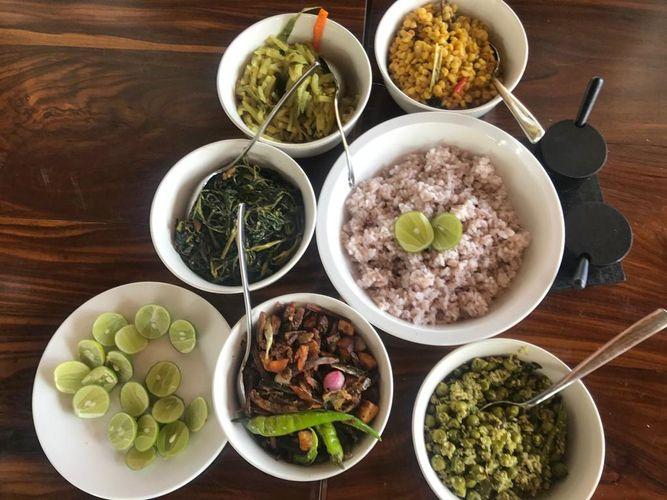
Residential programs at Diksha Yoga School include vegetarian meals designed to support the training environment.

The intention is simple:
Eat → Nourish → Practice → Learn
Food is not treated as something separate from the training.
It supports the energy required for your daily practice and study.
Students with specific dietary requirements should communicate those needs with the school before booking so that the available options can be confirmed in advance.
A Different Kind of Travel Experience
Travelling to Sri Lanka for yoga teacher training can offer a different experience from travelling purely for tourism.
Instead of moving from one attraction to another, your trip has a central purpose.
You are learning something.
You are practicing something.
You are meeting people.
You are developing a discipline.
And you are giving yourself time away from your usual environment.
Of course, there can still be opportunities to experience the culture and surroundings of Galle during appropriate free time.
But the central focus remains:
Yoga.
Why Location Matters When Choosing a Yoga TTC
When comparing yoga teacher training programs, students often focus on:
Price → Duration → Certificate
Those things matter.
But residential students should also consider:
Where will I actually spend 11 or 23 days?
Ask yourself:
- Is the environment peaceful enough for study?
- Is accommodation available on-site?
- Can I rest properly between sessions?
- Is the training environment supportive?
- Will I have opportunities to connect with other students?
- Does the location complement the kind of experience I want?
A beautiful location alone does not make a good yoga school.
Likewise, a strong curriculum is harder to fully appreciate if the residential environment creates unnecessary distractions.
The best experience brings the two together:
Good teaching + supportive environment.
Serene Garden Villa and the Learning Journey
The purpose of choosing Serene Garden Villa in Galle is not simply to give students somewhere to sleep.
The residential setting supports the larger learning journey.
During a 100-hour program, it gives students the opportunity to immerse themselves in a shorter, focused experience.
During a 200-hour program, the same residential rhythm becomes even more important because students remain immersed for approximately three weeks.
Over time, the daily routine starts to feel natural.
You wake up.
You practice.
You learn.
You eat.
You teach.
You reflect.
You rest.
And then you begin again.
That repetition is where much of the transformation happens.
Learning Yoga Away From Your Normal Routine
There is something powerful about temporarily stepping away from familiar surroundings.
When you are at home, your identity can be connected to your normal responsibilities:
Your job. Your schedule. Your responsibilities. Your usual habits.
When you travel for yoga teacher training, you create a temporary space where you can ask different questions:
What do I actually want?
Why am I practicing yoga?
What kind of teacher do I want to become?
What habits do I want to take home with me?
These questions are not necessarily answered in one class.
Sometimes they emerge naturally over several weeks of practice and reflection.
That is one reason residential yoga teacher training can become such a meaningful personal experience.
Galle Yoga Teacher Training: More Than a Course
For students searching for yoga teacher training in Galle, the appeal is not only the destination.
It is the combination of:
Structured education
Residential immersion
Daily practice
Experienced guidance
International student community
Time for reflection
At Diksha Yoga School, the intention is to bring these elements together so students can focus on their learning while experiencing the unique atmosphere of southern Sri Lanka.
A Note for International Students
If you are travelling to Sri Lanka from another country, planning ahead is important.
Before booking, confirm:
- Your training dates
- Arrival and departure arrangements
- Accommodation details
- What meals are included
- Airport transfer arrangements, if applicable
- Visa requirements
- Travel insurance
- What is included in your course package
- Any dietary or accommodation requirements
A well-planned journey allows you to arrive with fewer practical concerns and focus more fully on the training.
The Setting Is Part of the Story—But the Teaching Comes First
We believe it is important to say this clearly:
A beautiful location cannot replace good yoga education.
Serene Garden Villa provides the residential setting.
But the heart of the experience remains the teachers, curriculum, practical training, personal attention, and willingness of the student to learn.
That is why, when comparing yoga teacher training programs in Sri Lanka, we recommend looking at the complete picture.
Don’t choose only because the photographs are beautiful.
Don’t choose only because the price is low.
And don’t choose only because the location sounds attractive.
Look at:
Who teaches you.
What they teach.
How they teach.
How much practical experience you receive.
What support is available.
And what you are actually taking home with you.
Your Time at Serene Garden Villa
Whether you choose the 100-hour or 200-hour Yoga Teacher Training in Sri Lanka, your time at Serene Garden Villa is intended to give you something that everyday life often makes difficult:
Space.
Space to practice.
Space to study.
Space to ask questions.
Space to make mistakes.
Space to learn.
Space to become quieter.
And, ultimately, space to discover what yoga means to you.
What Makes Diksha Yoga School Different?
Choosing a yoga teacher training is a significant investment of your time, money, energy, and trust.
There are many yoga schools in Sri Lanka, so the question should not simply be:
“Which course is cheapest?”
A better question is:
“Who will teach me, how will they teach me, and what kind of teacher will I become through this experience?”
At Diksha Yoga School, our approach is based on combining traditional yogic knowledge with practical teaching skills and personal guidance.
The aim is not simply to help students complete their required hours.
It is to help them develop a deeper understanding of yoga and learn how to share that understanding responsibly with others.
Learning From Yogini Manisha
At the heart of Diksha Yoga School is Yogini Manisha, founder and lead teacher.
Her teaching approach has developed through many years of working with yoga students and teachers from different backgrounds.
Rather than treating yoga as only a physical discipline, her approach brings together:
- Traditional Hatha Yoga
- Vinyasa Flow
- Pranayama
- Meditation
- Yoga philosophy
- Anatomy
- Alignment
- Teaching methodology
- Personal awareness
- Practical teaching
This combination is important because future teachers need more than physical knowledge.
They need to understand how yoga is practiced, why it is practiced, and how to communicate it to another person.
Experience Matters—But How That Experience Is Used Matters More
When comparing yoga teacher training schools, it is easy to see statements such as:
“Experienced teachers.”
But experience should mean more than simply a number of years.
Ask:
- Has the teacher worked with beginners?
- Have they taught international students?
- Do they understand different learning styles?
- Can they explain difficult concepts simply?
- Do they provide individual feedback?
- Do students actually get opportunities to teach?
- Does the teacher continue learning themselves?
These questions tell you much more about the quality of a training than a marketing phrase alone.
Yogini Manisha’s approach is centered on observation, awareness, personal guidance, and practical application, helping students gradually move from being yoga practitioners toward becoming confident teachers.
Traditional Yoga With a Practical Teaching Approach
One of the distinguishing elements of Diksha Yoga School is the attempt to bring two things together:
Traditional Yogic Knowledge
Students explore classical areas such as:
- Hatha Yoga
- Pranayama
- Meditation
- Yoga philosophy
- Patanjali’s Yoga Sutras
- Yamas and Niyamas
- Bandhas
- Mudras
- Yogic lifestyle
Modern Teaching Skills
At the same time, students learn practical skills such as:
- Sequencing
- Verbal cueing
- Alignment
- Modifications
- Class planning
- Demonstration
- Observation
- Teaching practice
- Student communication
The intention is not to choose between tradition and modern teaching.
It is to understand how they can work together.
Yoga Is More Than How a Pose Looks
A common misconception about becoming a yoga teacher is that the best practitioner automatically becomes the best teacher.
That is not necessarily true.
A student can perform an advanced asana beautifully and still struggle to explain a simple posture to someone else.
Teaching requires another level of awareness.
You need to notice:
What is the student experiencing?
What are they misunderstanding?
What instruction would help them?
Should they go deeper—or should they modify the posture?
This is why Diksha Yoga School places importance on observation and teaching methodology, rather than focusing only on physical performance.
Personal Attention During Teacher Training
A yoga teacher training should not feel like sitting anonymously in a large classroom.
Students need opportunities to ask questions, receive feedback, and discuss what they are learning.
Personal attention becomes particularly important during:
- Alignment practice
- Teaching practice
- Sequencing
- Anatomy
- Pranayama
- Meditation
- Philosophy discussions
Students learn differently.
Some understand a concept immediately.
Others need to experience it physically.
Some learn through discussion.
Others learn through observation and repetition.
A good teacher needs to recognize those differences.
What We Have Learned From Teaching Students
After working with students from different countries and levels of experience, we have noticed that the students who develop most strongly as teachers are not necessarily those who arrive with the most advanced physical practice.
They are often the students who are willing to:
Listen.
Ask questions.
Accept feedback.
Practice again.
Stay curious.
This is why we encourage students not to compare their bodies with one another during training.
Everyone arrives with a different history.
One person may have excellent flexibility.
Another may have strong discipline.
Someone else may have years of meditation experience.
Another may have a natural ability to communicate.
Teacher training is about developing the whole person—not winning a competition in flexibility.
From Student to Teacher
The transition from practitioner to teacher does not happen in one day.
It develops gradually.
At first, you may simply learn to perform and understand the practice.
Then you begin observing your teachers.
Then you practice explaining a posture.
Then you teach a short sequence.
Then you receive feedback.
Then you teach again.
Eventually, you begin finding your own voice.
This is why we see teacher training as a process of development, rather than simply a certificate at the end.
What Should You Look For When Comparing Yoga Schools?
Before booking any Yoga Teacher Training in Sri Lanka, we recommend asking these questions:
1. Who are the teachers?
Look beyond the school’s logo and marketing.
Learn about the actual people who will teach you.
2. How much experience do they have?
Look for genuine teaching experience rather than vague claims.
3. What is included in the curriculum?
A comprehensive training should go beyond asana.
4. How much practical teaching do students receive?
Reading about teaching is not the same as teaching.
5. How much personal feedback will you receive?
This can make a major difference during an intensive course.
6. What certification will you receive?
Understand exactly what the certificate represents.
7. Where will you stay?
For residential training, accommodation and environment matter.
8. What do previous students say?
Look for genuine reviews discussing teachers, curriculum, support, and overall experience.
Why Student Reviews Matter
No school should expect you to believe every claim simply because it appears on its own website.
Previous students provide another perspective.
When researching a Yoga TTC in Sri Lanka, look for reviews that mention specific experiences:
- Teaching quality
- Teacher support
- Curriculum
- Personal attention
- Practical teaching
- Accommodation
- Food
- Student community
- Personal growth
Detailed reviews are much more useful than simply seeing a collection of five-star ratings.
They help you understand what the experience actually feels like.
A Message From Yogini Manisha
“Yoga teaching is not about being the most flexible person in the room. It is about learning to observe, listen, understand, and guide with awareness.”
For me, teacher training is not simply about giving students information.
It is about helping them experience yoga deeply enough that the knowledge becomes their own.
A future teacher needs to develop a strong personal practice, but they also need humility.
You will make mistakes.
You will sometimes forget your sequence.
You may not know the answer to every question.
And that is okay.
A good teacher remains a student.
The journey does not end when you receive your certificate.
It continues every time you practice, teach, observe, and learn something new.
— Yogini Manisha
Founder & Lead Teacher, Diksha Yoga School
Why Our Approach Goes Beyond the Certificate
A certificate can show that you completed a course.
It cannot, by itself, show how deeply you understood the practice.
That is why we encourage students to focus on what happens during the training, not only what happens on the final day.
Ask yourself:
Did I understand more than when I arrived?
Did I become more aware of my own practice?
Can I explain what I have learned?
Can I observe another student’s practice?
Can I teach with greater clarity?
Do I feel motivated to continue learning?
Those are the outcomes that matter.
The Diksha Yoga School Learning Philosophy
Our approach can be summarized simply:
Learn Traditionally
Understand the foundations and philosophy of yoga.
Practice Personally
Experience the teachings through your own body, breath, and mind.
Understand Deeply
Connect asana, pranayama, meditation, philosophy, and anatomy.
Teach Practically
Apply what you learn through sequencing, cueing, observation, and teaching practice.
Continue Learning
Understand that completing a teacher training is the beginning of your teaching journey—not the end.
A Teacher Is Always a Student
Perhaps the most important lesson we want students to take home is this:
You do not need to know everything to begin teaching.
But you should remain willing to learn.
The strongest teachers continue practicing.
They continue studying.
They continue asking questions.
They continue listening to their students.
And they continue refining their understanding of yoga.
That is the spirit we want students to carry with them after completing their training at Serene Garden Villa, Galle, Sri Lanka.
Cost, Value & What to Look For When Booking Yoga Teacher Training in Sri Lanka
Cost is naturally one of the biggest considerations when choosing between a 100-hour and 200-hour Yoga Teacher Training in Sri Lanka.
But comparing programs only by their headline price can be misleading.
A lower-priced course may include fewer services, fewer training hours, different accommodation, fewer meals, or less practical teaching. A higher-priced course is not automatically better either.
The better question is:
What am I actually receiving for my investment?
100-Hour vs 200-Hour Yoga Teacher Training: Understanding the Investment
The two programs represent different levels of commitment.
A 100-hour training at Diksha Yoga School is structured as an 11-day residential experience, while the 200-hour program is structured as a 23-day residential training.
That additional time affects more than the number of classroom hours.
It also means more time for:
- Daily yoga practice
- Philosophy
- Pranayama
- Meditation
- Anatomy
- Alignment
- Teaching methodology
- Sequencing
- Practical teaching
- Feedback
- Personal reflection
So when comparing prices, don’t simply calculate:
Course fee ÷ number of days
Look at the complete experience.
What Should Be Included in a Yoga Teacher Training Package?
Before booking any Yoga TTC in Sri Lanka, ask the school to clearly explain what is included.
Depending on the specific program and package, important factors may include:
Training
- Full scheduled training hours
- Asana classes
- Pranayama
- Meditation
- Philosophy
- Anatomy
- Teaching methodology
- Practical teaching
For a residential program, understand:
- Number of nights
- Room type
- Private or shared accommodation
- Facilities available
- Check-in and check-out arrangements
Meals
Check:
- Number of meals per day
- Vegetarian options
- Vegan options
- Dietary requirements
- Whether meals are included throughout the training

Training Materials
Ask whether your package includes:
- Course manual
- Printed materials
- Digital resources
- Other study materials
Certification
Understand:
- What certificate you receive
- Which organization or school issues it
- What the certification represents
- Whether the course forms part of a particular Yoga Alliance pathway
Additional Services
Depending on the program, you may also want to compare:
- Airport transfers
- Welcome ceremony
- Closing ceremony
- Excursions
- Student support
- Additional workshops
Don’t Compare Only the Course Fee
Imagine you find two 200-hour programs.
School A
Lower course price, but:
- Accommodation costs extra
- Meals cost extra
- Training materials cost extra
- Airport transfer is not included
School B
Higher initial price, but includes:
- Residential accommodation
- Daily meals
- Training materials
- Complete scheduled training
- Practical teaching
- Student support
The second program may actually provide better overall value.
This is why we recommend comparing the complete package, not simply the advertised starting price.
What Does “Value” Really Mean?
Value is not simply about getting the most things for the lowest price.
For a yoga teacher training, value can come from:
Quality of Teaching
Who is actually teaching you?
Depth of Curriculum
Are you studying yoga beyond physical postures?
Practical Experience
Do you actually get opportunities to teach?
Personal Attention
Can you ask questions and receive meaningful feedback?
Residential Environment
Is the environment supportive of learning and rest?
Student Community
Will you be surrounded by people who are also committed to the practice?
Long-Term Benefit
Will the knowledge and skills you gain continue to help you after you leave Sri Lanka?
These factors can be more important than saving a small amount on the initial course fee.
What About the Price Difference Between 100 and 200 Hours?
It is natural for students to think:
“If 100 hours costs less, why shouldn’t I simply choose that?”
The answer depends on your goal.
If you primarily want:
Personal growth + yoga immersion + exploration
then 100 hours may offer excellent value.
But if you want:
Comprehensive teacher preparation + deeper study + practical teaching
then the additional investment in a 200-hour program may be worthwhile.
The question is not whether the 200-hour course costs more.
It does.
The question is whether the additional education and time are valuable for your particular goal.
A Practical Way to Compare Yoga Teacher Training Prices
Before making your decision, create a simple checklist.
| What to Compare | 100-Hour | 200-Hour |
| Training days | 11 | 23 |
| Total training hours | 100 | 200 |
| Accommodation | Check package | Check package |
| Meals | Check package | Check package |
| Training manual | Check package | Check package |
| Practical teaching | Compare curriculum | Compare curriculum |
| Anatomy | Foundation | More comprehensive |
| Philosophy | Foundation | Deeper study |
| Teaching methodology | Introduction | Comprehensive |
| Certification | Verify details | Verify details |
| Airport transfer | Verify package | Verify package |
| Additional activities | Verify package | Verify package |
Always confirm current inclusions directly with the school before booking, as packages, dates, accommodation options, and prices can change.


Why the Cheapest Yoga Teacher Training Is Not Always the Best Choice
Choosing a yoga teacher training is an investment in your education.
If your goal is to become a teacher, consider the cost of leaving the course without enough practical experience.
You may save money initially but later realize you need:
- Additional workshops
- More teaching practice
- More anatomy education
- More sequencing practice
- Additional mentorship
A comprehensive training with strong practical foundations can sometimes provide better long-term value.
That doesn’t mean you need to choose the most expensive school.
It means you should choose the school whose education matches your goals.
What Should You Ask Before Paying a Deposit?
Before booking your place, we recommend asking the school:
About the Course
- What exactly is included in the curriculum?
- How many hours are practical?
- How many hours are theory?
- How much teaching practice will I receive?
About the Teachers
- Who will teach the course?
- What is their teaching experience?
- Will the lead teacher be present throughout the program?
About Accommodation
- What type of room will I receive?
- Is it private or shared?
- How many nights are included?
About Food
- How many meals are provided?
- Can dietary requirements be accommodated?
About Certification
- What certificate will I receive?
- What does it qualify me for?
- What Yoga Alliance registration or pathway applies to this specific course?
About Payment
- What deposit is required?
- What is the cancellation policy?
- When is the remaining balance due?
Clear answers to these questions can prevent misunderstandings later.
The Investment Is Also About Your Time
There is another cost that students sometimes overlook:
Your time.
Taking 11 or 23 days away from your normal life is a significant commitment.
You may need to arrange:
- Time off work
- Flights
- Travel insurance
- Visa arrangements
- Personal responsibilities
- Family arrangements
This is why choosing the right course the first time matters.
If you know you want to teach, committing to a comprehensive 200-hour program may make more sense than taking a shorter course and later realizing you need additional training.
If you are still exploring, an 11-day 100-hour immersion may be a more comfortable first step.
What We Recommend When Comparing Schools
Don’t make your decision based on one factor.
Instead, score each school across:
Teachers
Curriculum
Practical teaching
Accommodation
Food
Student reviews
Certification
Location
Personal attention
Total cost



Then ask yourself:
Which school offers the learning experience I actually want?
That question is more useful than:
“Which school is cheapest?”
A Transparent Approach to Course Investment
We believe students should know what they are paying for before they make a booking decision.
That means clearly understanding:
- Course duration
- Training content
- Accommodation
- Meals
- Certification
- Materials
- Additional inclusions
- Payment terms
- Cancellation conditions
If you are considering a 100-hour or 200-hour Yoga Teacher Training in Galle, Sri Lanka, ask for the current course details before making your final decision.
Prices and package inclusions can change between training dates, so always confirm the latest information with Diksha Yoga School.
The Bottom Line
The cheapest yoga teacher training is not necessarily the best value.
And the most expensive one is not automatically the best.
The right investment is the one that gives you the education, practical experience, support, and environment you need for your personal goal.
Choose 100 hours when:
You want a shorter immersive experience, personal growth, foundational knowledge, or an opportunity to explore teaching.
Choose 200 hours when:
You want deeper study, structured teaching practice, and a stronger foundation for becoming a yoga teacher.
Ultimately, you are not simply paying for hours.
You are investing in what you will know, how you will practice, and what you will eventually be able to share with others.
Frequently Asked Questions About 100-Hour vs 200-Hour Yoga Teacher Training in Sri Lanka
Is 100-Hour Yoga Teacher Training in Sri Lanka Suitable for Beginners?
Yes. A 100-hour program can be a good option for beginners who want to build a foundation, deepen their personal practice, and experience residential yoga training without immediately committing to a longer program.
You do not need to be highly flexible or advanced in yoga to begin.
What matters more is your willingness to practice consistently, learn, and remain open to new perspectives.
Can Beginners Join a 200-Hour Yoga Teacher Training in Sri Lanka?
Yes.
A beginner does not need to master advanced asanas before joining a 200-hour program.
If your goal is to become a yoga teacher, you can begin your journey at the beginner level and develop your knowledge throughout the training.
The important qualities are:
- Commitment
- Curiosity
- Discipline
- Openness to feedback
- Willingness to practice
You are joining teacher training to learn, not because you already know everything.
Is 100 Hours Enough to Become a Yoga Teacher?
A 100-hour course can provide valuable foundational knowledge, but it should not automatically be considered equivalent to a comprehensive 200-hour teacher-training qualification.
Certification structures differ between schools.
If your main goal is to become a professionally trained yoga teacher, carefully check what the 100-hour course qualifies you to do and whether it forms part of a recognized pathway toward further training.
For students who already know they want to teach, a comprehensive 200-hour Yoga Teacher Training in Sri Lanka is generally the more appropriate foundation.
How Long Is a 100-Hour Yoga Teacher Training in Sri Lanka?
At Diksha Yoga School, the 100-hour residential training is structured as an 11-day program.
The shorter format makes it suitable for students who want an immersive experience but have limited time available.
How Long Is a 200-Hour Yoga Teacher Training in Sri Lanka?
Diksha Yoga School’s 200-hour residential training is structured as a 23-day program.
The additional time allows students to spend more time studying and practicing:
- Asana
- Pranayama
- Meditation
- Yoga philosophy
- Anatomy
- Alignment
- Teaching methodology
- Sequencing
- Practical teaching
Where Is the Yoga Teacher Training Held in Sri Lanka?
The training takes place at Serene Garden Villa in Galle, Sri Lanka.
The residential environment allows students to stay close to their training and create a daily rhythm centered around yoga practice, study, reflection, and community.
Why Choose Yoga Teacher Training in Galle?
Galle provides a peaceful setting for students looking for an immersive yoga experience in southern Sri Lanka.
But the location is only one part of the decision.
When choosing a Yoga Teacher Training in Galle, you should also consider:
- Teacher experience
- Curriculum
- Practical teaching
- Personal attention
- Accommodation
- Meals
- Certification
- Student reviews
- Total course cost
A beautiful destination is valuable, but good teaching should remain the priority.
Is Yoga Teacher Training in Sri Lanka Worth It?
It can be, particularly if you are looking for more than a conventional yoga retreat.
A residential teacher training gives you an opportunity to dedicate a significant period of time to:
Practice + Study + Reflection + Community
For someone who wants to become a teacher, it can also provide structured education and practical teaching experience.
The value ultimately depends on the quality of the school, teachers, curriculum, practical experience, and the goals you bring to the training.
What Styles of Yoga Are Taught at Diksha Yoga School?
The programs follow a multi-style approach that includes areas such as:
- Traditional Hatha Yoga
- Ashtanga Yoga
- Vinyasa Flow
- Pranayama
- Meditation
- Yoga Philosophy
The exact curriculum can vary according to the specific training program.
Do I Need to Be Flexible to Join Yoga Teacher Training?
No.
Flexibility is not a requirement for becoming a good yoga teacher.
In fact, teacher training should help you understand that every student’s body is different.
A teacher needs to develop:
Awareness → Observation → Communication → Adaptability
rather than simply demonstrating advanced physical postures.
Does the Training Include Accommodation?
The Sri Lanka programs are residential, with accommodation provided according to the applicable course package.
Before booking, confirm the current room type, number of nights, and inclusions for your selected training date.
Are Meals Included?
Residential packages include meals according to the specific course package.
Students with dietary requirements should communicate their needs before booking so the available options can be confirmed.
Is the Training Yoga Alliance Registered?
Diksha Yoga School offers Yoga Alliance-related teacher-training pathways, but students should verify the current registration status, specific designation, and applicable Yoga Alliance requirements for the particular course before booking.
This distinction matters because not every yoga course or certificate has the same registration status.
When certification is important to you, always verify exactly what the school and course provide.
Can I Continue My Yoga Education After 200 Hours?
Yes.
A 200-hour foundation can be followed by further study, depending on your goals and the school’s available pathways.
Possible next steps may include:
- 300-hour advanced teacher training
- 500-hour training pathway
- Specialized workshops
- Anatomy study
- Meditation training
- Advanced pranayama
- Continued teaching mentorship
Completing 200 hours should be viewed as a foundation—not the end of your education.
100-Hour vs 200-Hour Yoga Teacher Training in Sri Lanka: Final Verdict
After looking at the curriculum, teaching practice, duration, residential experience, and future goals, the choice can be summarized quite simply.
Choose 100 Hours If You Want:
A shorter immersion
You have approximately 11 days available and want an intensive but more compact experience.
Personal growth
Your primary objective is to deepen your own yoga practice and understanding.
Exploration
You are curious about teacher training but are not yet certain that teaching is your future path.
Foundational knowledge
You want to explore asana, pranayama, meditation, philosophy, and other areas of yoga.
Choose 200 Hours If You Want:
A comprehensive foundation
You want to study yoga in greater depth rather than simply experience an introduction.
Professional teacher preparation
You already know that teaching yoga is something you want to pursue.
More practical experience
You want structured opportunities to teach, receive feedback, and develop confidence.
Deeper study
You want more time for anatomy, philosophy, alignment, sequencing, pranayama, meditation, and teaching methodology.
A longer immersion
You can commit approximately 23 days to residential yoga training.
Still Unsure Which One to Choose?
Ask yourself one final question:
What do I want to be able to do when I return home?
If your answer is:
“I want to understand my own practice more deeply.”
Consider 100 hours.
If your answer is:
“I want to start developing myself as a yoga teacher.”
Consider 200 hours.
And if your answer is:
“I’m not sure yet.”
That’s okay too.
You don’t need to force yourself into a decision simply because one course is longer.
Choose the training that matches your present intention.
Your Yoga Journey Does Not Need to Begin With Perfection
You do not need to be flexible enough.
You do not need to know every Sanskrit term.
You do not need to perform advanced postures.
You do not need to know exactly what your future looks like.
You simply need the willingness to learn.
A yoga teacher training can give you the structure, guidance, practice, and community to take the next step.
At Diksha Yoga School, our intention is to create an environment where students can learn yoga not only through information, but through daily practice and experience.
Begin Your Yoga Teacher Training in Sri Lanka
Whether you choose 100 hours or 200 hours, your journey begins with the same decision:
to give yourself time to learn.
At Serene Garden Villa, Galle, Sri Lanka, you can step away from your usual routine and dedicate your days to yoga practice, study, reflection, and connection.
Interested in 100 Hours?
Explore our 100-Hour Yoga Teacher Training in Sri Lanka for a focused residential immersion designed to deepen your practice and introduce you to the broader dimensions of yoga.
Ready for 200 Hours?
Explore our 200-Hour Yoga Teacher Training in Sri Lanka for a comprehensive residential program designed for students who want deeper study and a stronger foundation for teaching.
Still Have Questions?
Contact Diksha Yoga School and tell us:
- Your previous yoga experience
- Your main goal
- How many days you can commit
- Whether you want to teach professionally
We can then help you determine which program is most appropriate for your journey.
Final Thought From Yogini Manisha
“Yoga is not about becoming perfect. It is about becoming more aware.”
Your teacher-training journey does not begin when you can perform every posture.
It begins when you become willing to learn.
Whether that first step is 100 hours or 200 hours, choose it with intention.
Practice with sincerity.
Learn with curiosity.
Teach with awareness.
And remember that becoming a yoga teacher is not about reaching the end of the journey.
It is about continuing to walk the path.