How Much Does 300 Hour Yoga TTC Cost, If you have already completed a 200-hour yoga teacher training and feel ready to go deeper, a 300-hour yoga teacher training in Sri Lanka can be the next stage of your education.
But before booking, there is one practical question most students want answered:
How much does a 300-hour yoga teacher training in Sri Lanka actually cost in 2026?
The answer depends on accommodation, course inclusions, teacher experience, curriculum, meals and the overall residential experience.
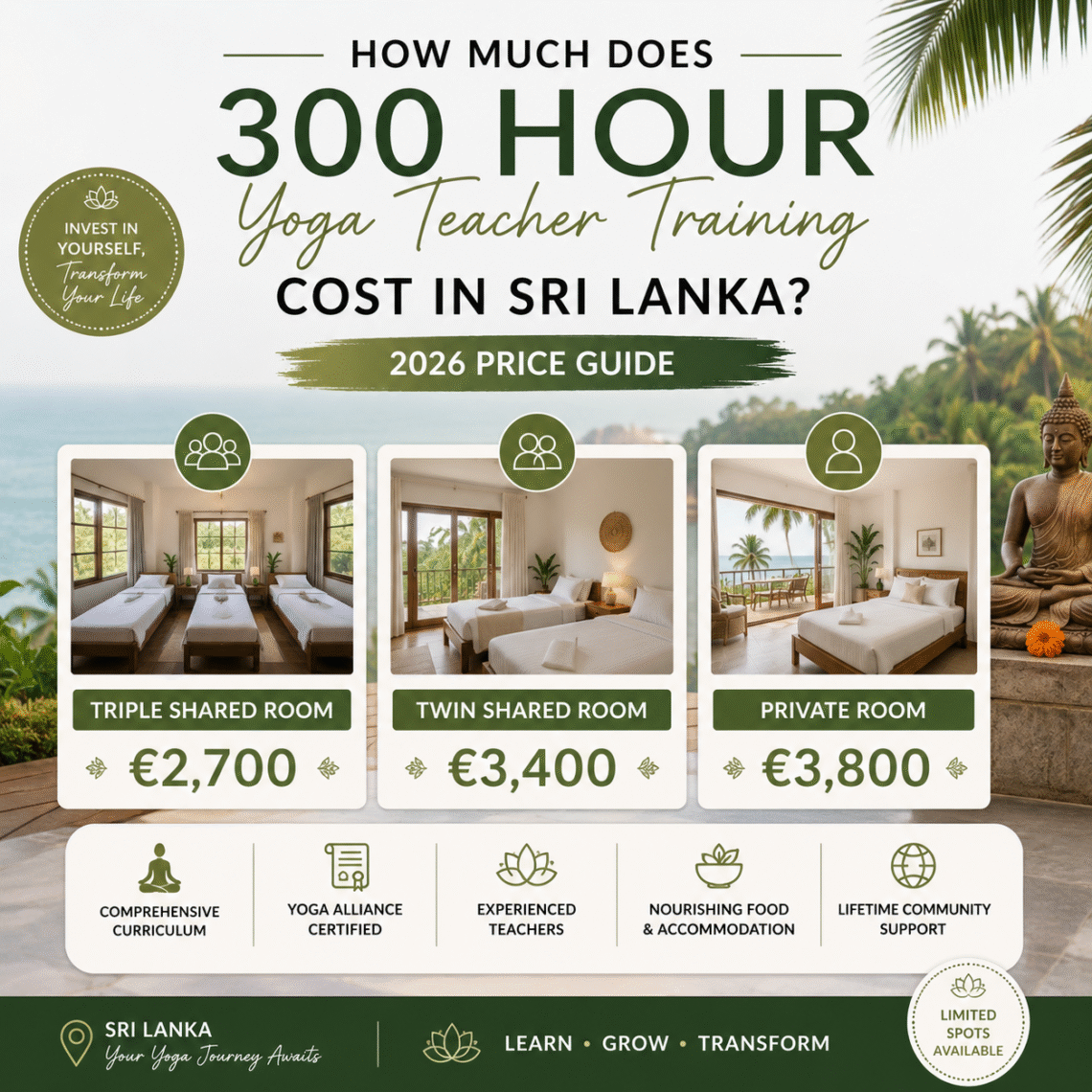
At Diksha Yoga School, the current published 2026 prices for the 300-hour residential program are €2,700 for triple sharing, €3,400 for twin sharing and €3,800 for a private room. The program is currently listed as a 28-day residential training in Galle, Sri Lanka.
But price alone doesn’t tell you whether a 300-hour training is good value.
A more useful question is:
What am I actually receiving for the investment, and will this training help me become a more knowledgeable, confident and capable yoga teacher?
This guide looks at the 300-hour yoga teacher training cost in Sri Lanka in 2026, what the price includes, how to compare programs, what you can expect to study, and whether a 300-hour training is the right next step for you.
Upcoming 300 Hour Yoga Teacher Training Dats-28 Days
| Month | Course | Duration | Upcoming Dates |
|---|---|---|---|
| October 2026 | 300 Hour Yoga Teacher Training | 28 Days | 5 Oct – 1 Nov 2026 |
| November 2026 | 300 Hour Yoga Teacher Training | 28 Days | 5 Nov – 2 Dec 2026 |
| December 2026 | 300 Hour Yoga Teacher Training | 28 Days | 5 Dec 2026 – 1 Jan 2027 |
EARLY BIRD OFFER — SAVE €100! 🎉
Book your 300-Hour Yoga Teacher Training Course at least 2 months in advance and get an exclusive €100 OFF your course fee.
✨ Early Bird Discount: €100 OFF
📅 Book 2 Months Early
🧘 Limited Seats Available
🌿 Transform Your Practice • Deepen Your Knowledge • Become a Confident Yoga Teacher
Reserve your seat early and save €100!
📲 Book Now & Secure Your Early Bird Offer
Table of Contents
Quick Answer: How Much Does 300 Hour Yoga Teacher Training Cost in Sri Lanka?
For a residential 300-hour program, accommodation is one of the main factors that changes the total price.
Diksha Yoga School’s current published 2026 fees are:
| Accommodation | 2026 Published Price |
| Triple shared room | €2,700 |
| Twin shared room | €3,400 |
| Private room | €3,800 |
The current course page lists multiple 2026 start dates from July through December and describes the program as a 28-day residential advanced training in Galle.
At a glance
Lowest published option: €2,700
Twin-sharing option: €3,400
Private-room option: €3,800
Course duration: 28 days
Location: Galle, Sri Lanka
Level: Advanced / continuing education after foundational training
Always confirm the current price and inclusions for your chosen date before paying a deposit.
What Does a 300 Hour Yoga Teacher Training Actually Cost?
The course fee is only one part of the total investment.
For a residential 300-hour training, think about your budget in three categories.
1. Course and residential costs
- 300-hour training
- Accommodation
- Meals
- Course materials
- Teaching practice
- Assessment
- Course certificate
2. Travel costs
- International flight
- Visa or travel authorization
- Travel insurance
- Airport transportation if not included
3. Personal expenses
- Extra nights
- Personal shopping
- Additional excursions
- Cafés and snacks
- Local transportation outside the program
- Personal activities
This is why two students can attend the same 300-hour training and still have different total trip costs.
Your room choice, flights, travel dates and personal spending habits all affect the final amount.
What Determines the Cost of a 300 Hour Yoga TTC in Sri Lanka?
1. Accommodation
Accommodation can make a significant difference to the price.
At Diksha Yoga School, the current 2026 published options are:
Triple sharing — €2,700
Twin sharing — €3,400
Private room — €3,800
If your priority is keeping your overall investment lower, shared accommodation may be the practical choice.
If you value privacy and personal space after an intensive day of study, a private room may be worth the additional cost.
Neither is automatically better.
It depends on how you want to experience your training.
2. Meals and Daily Living
A 28-day residential training means food and daily living expenses can become a significant part of your overall travel budget.
Before booking, ask:
- How many meals are included?
- Are meals vegetarian?
- Are vegan options available?
- Is drinking water included?
- Are meals provided throughout the training?
- Are special dietary requirements accommodated?
- Are meals included on arrival and departure days?
The current Diksha course page lists breakfast and lunch under course information and also describes daily vegetarian meals among the course inclusions. Because package details can change, confirm the exact meal arrangement for your chosen 2026 dates before booking.
3. Teacher Experience
A 300-hour course is an advanced investment.
At this stage, the teacher’s experience matters enormously.
You are not simply learning how to perform more difficult asanas.
You are refining how you:
- Observe students
- Give instructions
- Build sequences
- Make adjustments
- Communicate
- Understand anatomy
- Teach different levels
- Develop your professional presence
Diksha Yoga School is led by Yogini Manisha, who has more than 16 years of teaching experience and has guided thousands of students through yoga education and teacher training.
This kind of experience is particularly valuable at the advanced level because students often need individual feedback rather than simply more information.
4. Curriculum Depth
A 300-hour program should go beyond repeating the material you already studied in your 200-hour training.
You should look for depth and refinement.
The current Diksha 300-hour curriculum includes:
- Advanced Hatha Yoga
- Ashtanga Yoga
- Vinyasa Flow
- Advanced asana
- Alignment and modifications
- Advanced pranayama
- Bandhas
- Meditation
- Yoga philosophy
- Patanjali Yoga Sutras
- Chakras and Koshas
- Anatomy and biomechanics
- Adjustments
- Advanced sequencing
- Teaching methodology
- Professional ethics
- Practice teaching
- Ayurveda and yogic lifestyle
That’s the type of curriculum that makes a 300-hour course meaningfully different from simply taking another 200-hour-style training.
What Will You Learn in a 300 Hour Yoga Teacher Training?
A good 300-hour training should help you refine what you already know and develop areas that were only introduced during your foundational training.
Advanced Asana Practice
You explore more challenging postures, variations, alignment principles, modifications and intelligent sequencing.
The objective isn’t simply to perform advanced poses.
It is to understand how and why to teach them appropriately.
You move beyond basic breathing techniques and explore more refined pranayama practices, bandhas and the relationship between breath, concentration and energy.
Advanced Yoga Philosophy
A 300-hour training gives you more time to explore subjects such as:
- Patanjali’s Yoga Sutras
- Eight Limbs of Yoga
- Chakras
- Koshas
- Pranas
- Mudras
- Karma
- Dharma
- Yamas and Niyamas
- Yogic lifestyle
The current Diksha syllabus specifically includes these areas.
Anatomy, Alignment and Adjustments
This is one of the areas where advanced teacher training can become particularly valuable.
You can explore:
- Functional anatomy
- Biomechanics
- Alignment
- Modifications
- Injury prevention
- Hands-on adjustments
- Observation skills
The goal is to make your teaching more informed and responsive.
Advanced Sequencing
You learn how to build classes with greater intention.
This can include:
- Peak-pose sequencing
- Progressive sequencing
- Theme-based classes
- Level-based modifications
- Transitions
- Class planning
- Intelligent use of props
- Appropriate pacing
Teaching Practice and Feedback
One of the most important parts of advanced teacher training is actually teaching.
You should have opportunities to:
Teach → Receive feedback → Reflect → Improve → Teach again
The current Diksha program includes peer teaching, feedback sessions and teaching assessments.
Is a 300 Hour Yoga Teacher Training Worth the Cost?
For the right student, it can be.
But I wouldn’t recommend a 300-hour course simply because it sounds more advanced.
Ask yourself:
Have I already completed a 200-hour training?
Do I genuinely want to continue developing as a teacher?
Do I want deeper knowledge of anatomy, philosophy and teaching methodology?
Am I looking for more confidence in teaching?
Do I want to refine my sequencing and observation skills?
Am I ready to invest another month in intensive study?
If the answer is yes, a 300-hour program can be a meaningful next step.
Do You Need 200 Hours Before a 300 Hour Yoga Teacher Training?
This is an important distinction.
A 300-hour advanced program is generally designed as continuing education for teachers who already have a foundational 200-hour qualification.
Diksha Yoga School describes its 300-hour program specifically for graduates of a 200-hour yoga teacher training.
So if you haven’t completed foundational teacher training yet, a 200-hour program is generally the more appropriate place to begin.
200 Hour vs 300 Hour Yoga Teacher Training
If you’re deciding between the two, here’s the simplest comparison:
| 200 Hour | 300 Hour | |
| Purpose | Foundational teacher training | Advanced continuing education |
| Previous training | Not normally required | Usually requires 200-hour foundation |
| Asana | Foundation | Advanced refinement |
| Anatomy | Foundation | Deeper / applied |
| Philosophy | Foundation | More extensive |
| Sequencing | Foundational | Advanced |
| Teaching practice | Yes | More advanced |
| Adjustments | Introduction | Deeper application |
| Professional development | Foundation | Advanced |
| Best for | New teachers | Existing yoga teachers |
Choose 200 hours if:
You are building your first comprehensive teacher-training foundation.
Choose 300 hours if:
You already have a strong foundation and want to develop your teaching further.
What Does a 300 Hour Yoga Teacher Training Cost Per Training Hour?
A simple cost-per-hour calculation can help you understand the size of the investment.
Using the current published Diksha 2026 prices:
Triple sharing
€2,700 ÷ 300 = €9 per training hour
Twin sharing
€3,400 ÷ 300 = approximately €11.33 per training hour
Private room
€3,800 ÷ 300 = approximately €12.67 per training hour
| Accommodation | Course Fee | Approx. Cost Per Training Hour |
| Triple shared | €2,700 | €9.00 |
| Twin shared | €3,400 | €11.33 |
| Private | €3,800 | €12.67 |
These calculations are based on the current published course fees and the 300 training hours.
But don’t mistake price per hour for quality.
A lower cost per hour doesn’t automatically mean a better course.
You also need to consider:
- Teacher experience
- Curriculum depth
- Accommodation
- Meals
- Class size
- Teaching practice
- Feedback
- Course materials
- Certification
- Location
- Overall learning environment
Cost per hour is useful for understanding your investment, but it is not a measure of teaching quality.
What Is Included in a 300 Hour Yoga Teacher Training?
Before booking, find out exactly what your course fee covers.
The current Diksha course page lists:
- 28 days residential training
- Accommodation
- Vegetarian meals
- Comprehensive course manual
- Teaching practicum
- Assessment and certification
- Wi-Fi
- Supportive learning environment
- Local excursions and experiences
The exact inclusions should always be confirmed for your selected date and accommodation package.
What Is Usually NOT Included?
Depending on the school, you may need to budget separately for:
- International flights
- Visa or travel authorization
- Travel insurance
- Extra nights
- Personal transportation
- Personal shopping
- Additional excursions
- Spa treatments
- Personal activities
- Meals outside the included package
So don’t calculate your Sri Lanka budget using the course fee alone.
What Does a 300 Hour Yoga Teacher Training in Sri Lanka Really Cost?
Here’s a realistic way to plan your overall budget:
| Expense | What to Budget |
| 300-hour residential TTC | €2,700–€3,800 at current Diksha prices |
| International flight | Depends on departure country |
| Visa | Depends on nationality |
| Travel insurance | Depends on provider |
| Personal spending | Depends on lifestyle |
| Extra accommodation | If arriving early or staying longer |
| Airport transfer | Check package |
| Additional excursions | Check package |
The course price is not always the same as your total trip cost.
A lower tuition price can become more expensive overall if accommodation, meals, transportation and other essentials are charged separately.
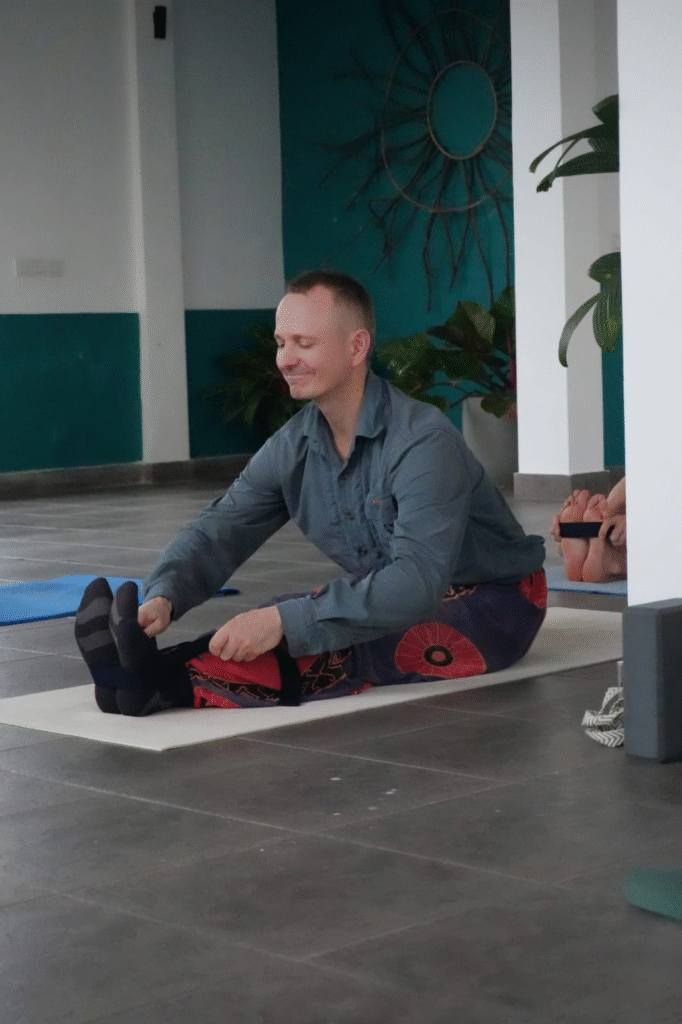
Compare the complete package rather than the headline tuition fee.
Is Sri Lanka a Good Place for Advanced Yoga Teacher Training?
There is a practical reason many students choose a residential training abroad.
You step away from your normal environment.
For 28 days, your attention can be centred around:
Practice. Study. Teaching. Reflection. Community.
Sri Lanka adds another dimension through its tropical environment, beaches, culture and slower rhythm of life.
Diksha Yoga School’s current 300-hour program is based in Galle, giving students a residential environment in southern Sri Lanka while they undertake their advanced training.
For an advanced program, that uninterrupted period can be particularly valuable.
Why Choose Diksha Yoga School for 300 Hours?
Choosing an advanced yoga teacher training is different from choosing a yoga holiday.
You are investing in your professional development.
At Diksha Yoga School, the 300-hour program combines traditional yogic teachings with modern teaching methodology and focuses on helping existing teachers deepen both their practice and their ability to teach.
Learn with Yogini Manisha
Yogini Manisha is the Founder and Lead Teacher of Diksha Yoga School.
With more than 16 years of teaching experience and experience guiding 23,000+ students worldwide, her approach combines traditional Hatha Yoga, Vinyasa Flow, pranayama, meditation and philosophy with practical teaching methodology.
At the advanced level, the emphasis is not simply on learning more poses.
It is on developing better observation, clearer communication, intelligent sequencing and greater awareness of the student in front of you.
A 300-Hour Course Should Challenge Your Teaching, Not Just Your Body
One of the easiest mistakes in advanced yoga training is assuming that “advanced” means more difficult postures.
It doesn’t have to.
A more advanced teacher should ideally become better at:
- Seeing what a student needs
- Offering appropriate modifications
- Creating intelligent sequences
- Explaining complex concepts simply
- Understanding movement and anatomy
- Teaching different levels
- Giving useful feedback
- Managing a class
- Maintaining professional boundaries
- Integrating yoga philosophy into teaching
That is the kind of development a good 300-hour program should encourage.
Who Should Choose a 300 Hour Yoga Teacher Training?
A 300-hour program may be right for you if you:
- Have already completed a 200-hour yoga teacher training
- Currently teach yoga
- Want to deepen your personal practice
- Want more advanced teaching skills
- Want to improve sequencing
- Want deeper anatomy and alignment knowledge
- Want to study yoga philosophy more deeply
- Want more teaching confidence
- Want to develop professionally as a yoga teacher
Who Should NOT Choose a 300 Hour Course Yet?
A 300-hour course may not be the right starting point if:
- You have never completed foundational teacher training
- You are completely new to structured yoga education
- You are looking for a short yoga retreat
- You only want to improve flexibility
- You don’t currently have the time for a 28-day intensive
- You aren’t ready for advanced study
If you are at the beginning of your teacher-training journey, explore a 200-hour yoga teacher training in Sri Lanka first.
How to Choose the Right 300 Hour Yoga TTC
Before booking, ask yourself:
1. Who teaches the course?
Look beyond the school’s marketing. Learn about the actual lead teachers.
2. What is the curriculum?
Does it genuinely go deeper than your 200-hour training?
3. How much teaching practice is included?
Advanced knowledge is much more useful when you can apply it.
4. How much personal feedback will I receive?
This can be more valuable than simply adding more lectures.
5. What is included in the price?
Accommodation, food, materials, transfers and excursions can change the real cost.
6. What is the class size?
Smaller groups can provide more opportunities for individual guidance.
7. What certification will I receive?
Make sure you understand exactly what the school issues after successful completion and how it relates to your existing 200-hour qualification.
Is a More Expensive 300 Hour Yoga TTC Better?
Not necessarily.
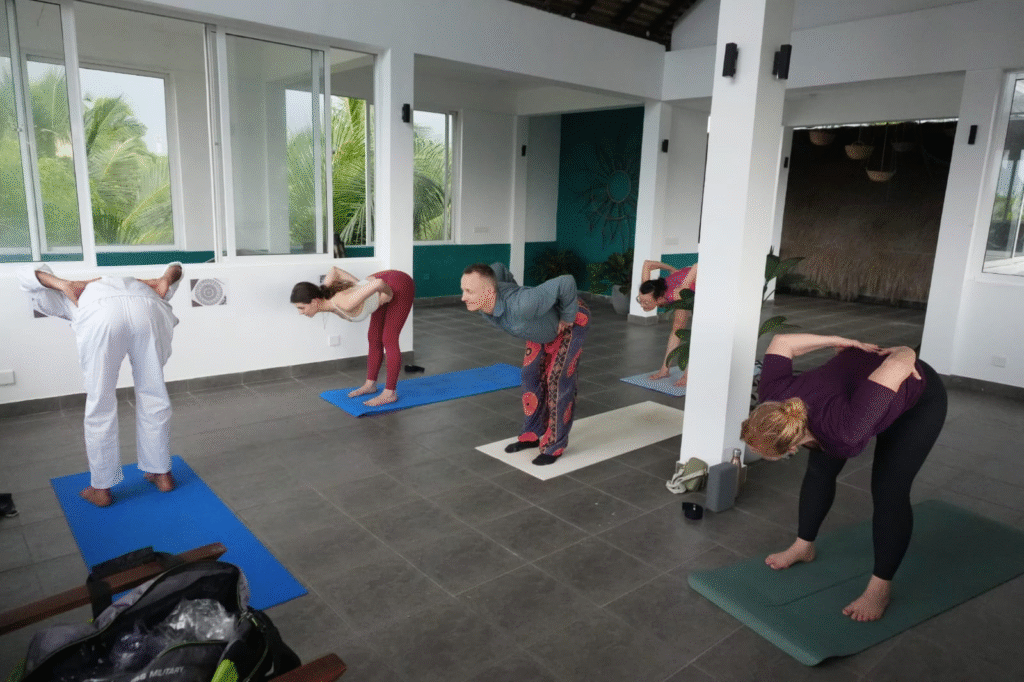
A higher price may reflect:
- Private accommodation
- Premium location
- Smaller groups
- More included services
- Teacher experience
- Additional activities
But price alone doesn’t determine educational quality.
A better question is:
Will this program make me a better-informed and more capable yoga teacher?
That’s the investment that matters.
How to Save Money on a 300 Hour Yoga Teacher Training
Choose Shared Accommodation
At Diksha Yoga School, the current published 2026 triple-sharing option is €2,700 compared with €3,800 for a private room.
If privacy isn’t your priority, shared accommodation can substantially reduce the course investment.
Compare Complete Packages
Don’t compare tuition alone.
Compare:
Training + accommodation + meals + materials + practicum + certification + transfers.
Book Early
If an early-bird offer is available for your chosen date, booking ahead can reduce the overall course price.
The current Diksha page advertises an early-bird saving of up to €100.
Questions to Ask Before Booking a 300 Hour Yoga Teacher Training
Before paying your deposit, ask:
- Do I need a 200-hour certification first?
- What is the complete course price?
- What room options are available?
- How many meals are included?
- Who teaches the course?
- How many students will be in the group?
- What advanced subjects are covered?
- How much teaching practice is included?
- How much individual feedback will I receive?
- Is anatomy included?
- Are adjustments included?
- Is advanced sequencing included?
- What certification will I receive?
- What is included in the package?
- What expenses are not included?
- Are airport transfers included?
- What are the cancellation terms?
- What 2026 dates are available?
A good school should be able to answer these questions clearly before you make a financial commitment.
Frequently Asked Questions
How much does a 300-hour yoga teacher training cost in Sri Lanka in 2026?
At Diksha Yoga School, the current published 2026 fees are €2,700 for triple sharing, €3,400 for twin sharing and €3,800 for a private room.
How long is a 300-hour yoga teacher training in Sri Lanka?
The current Diksha program is structured as a 28-day residential training.
Do I need a 200-hour yoga teacher training before doing 300 hours?
A 300-hour program is generally designed as advanced continuing education after foundational teacher training. Diksha’s current program specifically describes itself as being for graduates of a 200-hour training.
What do you learn in a 300-hour yoga teacher training?
The current Diksha curriculum includes advanced asana, pranayama, yoga philosophy, anatomy, alignment, adjustments, sequencing, meditation, Ayurveda, professional teaching methodology and teaching practice.
Is a 300-hour yoga teacher training worth it?
It can be a valuable investment if you have already completed foundational training and want to deepen your teaching skills, philosophy, anatomy, sequencing and personal practice.
Can I do a 300-hour yoga teacher training if I don’t teach yet?
It depends on the school. A 300-hour course is generally intended for people who already have foundational teacher training. If you have completed 200 hours but haven’t started teaching professionally, you may still benefit from advanced study, but check the individual school’s prerequisites.
What is the difference between 200 and 300 hours?
A 200-hour course generally establishes foundational knowledge and teaching skills. A 300-hour course is advanced continuing education that builds on that foundation through deeper study, refinement and professional development.
Does the course include accommodation?
The current Diksha 300-hour program is residential and lists comfortable accommodation among its inclusions. The exact room category depends on the package selected.
Are meals included?
The current course information lists daily vegetarian meals, while the course-information section specifies breakfast and lunch. Confirm the exact meal package for your selected date before booking.
300 Hour Yoga Teacher Training Prices at Diksha Yoga School
The current published 2026 prices are:
| Room Type | 2026 Published Price |
| Triple Shared | €2,700 |
| Twin Shared | €3,400 |
| Private Room | €3,800 |
The current page lists these prices across its 2026 course dates from July through December. Prices and availability can change, so confirm the exact fee before making a booking.
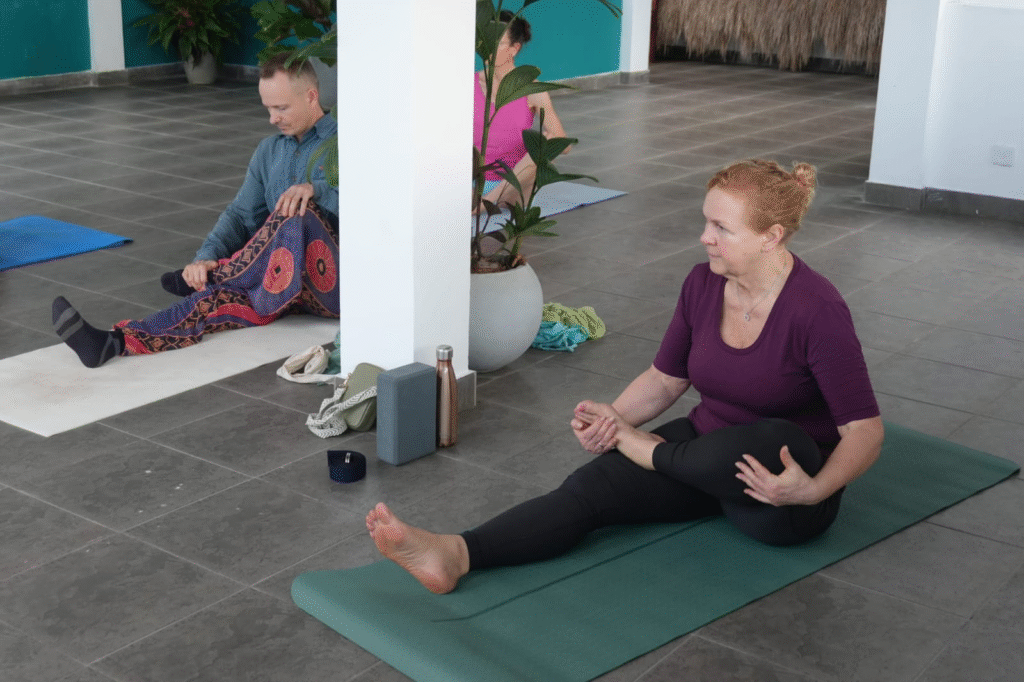
Ready to Take Your Yoga Teaching to the Next Level?
A 300-hour yoga teacher training is not simply another month of yoga classes.
It is an opportunity to revisit what you already know, question what you think you know, and develop greater depth as both a practitioner and teacher.
If you have completed your foundational training and feel ready to explore advanced asana, pranayama, anatomy, philosophy, sequencing, adjustments and teaching methodology, a 300-hour residential program can be a meaningful next step.
At Diksha Yoga School, the training combines traditional yoga education with practical teaching development in a residential environment in Galle, Sri Lanka.
Explore the 300 Hour Yoga Teacher Training
Check current 2026 dates, accommodation options and availability.
[View 300 Hour Course & Fees →]
[Ask About Availability →]
About the Author
Founder & Lead Teacher, Diksha Yoga School
Yogini Manisha is the founder and lead teacher of Diksha Yoga School. With more than 16 years of teaching experience and experience guiding 23,000+ students worldwide, she focuses on sharing traditional yoga while making the learning process practical and accessible for modern practitioners.
Her teaching integrates Hatha Yoga, Vinyasa Flow, pranayama, meditation, yoga philosophy, anatomy, alignment and teaching methodology.
At Diksha Yoga School, the aim is not simply to help students perform yoga postures. It is to help teachers develop greater awareness, confidence, observation skills and a deeper understanding of the tradition they are sharing.
Reviewed for course information: Diksha Yoga School course team
Last updated: August 2026
Student Says — 300-Hour Training
“After completing my 200-hour training, I knew I wanted to continue learning, but I wanted something deeper than simply adding another certificate. The 300-hour training in Sri Lanka gave me the space to really develop as a teacher. The advanced sequencing, anatomy, adjustments and teaching practice were especially valuable. I received honest feedback throughout the course, which helped me become much more confident and aware when teaching. The whole experience in Sri Lanka was both challenging and deeply rewarding.”
— Nick, Australia | 300-Hour Yoga Teacher Training, 2026
Saudi Arabia — 300-Hour Training
“I came to Sri Lanka looking for a deeper understanding of yoga and left with a completely different perspective on my teaching. I loved that the training went beyond advanced asanas and included philosophy, pranayama, meditation, anatomy and teaching methodology. The personal guidance from Yogini Manisha made a big difference because I could ask questions and receive feedback on my teaching. Living and studying in the same environment for 28 days also gave me the time and space to truly immerse myself in the practice.”
— Hanade, Saudi Arabia | 300-Hour Yoga Teacher Training, 2026