Updated: August 2026
Written by: Yogini Manisha, Founder & Lead Teacher at Diksha Yoga School
How Much Does Yoga TTC Cost in Sri Lanka, If you are searching for yoga teacher training in Sri Lanka, one of the first questions you will probably ask is simple: how much does it actually cost?
The answer depends on the number of training hours, accommodation, room type, meals, teaching experience, certification, and what is included in the package.
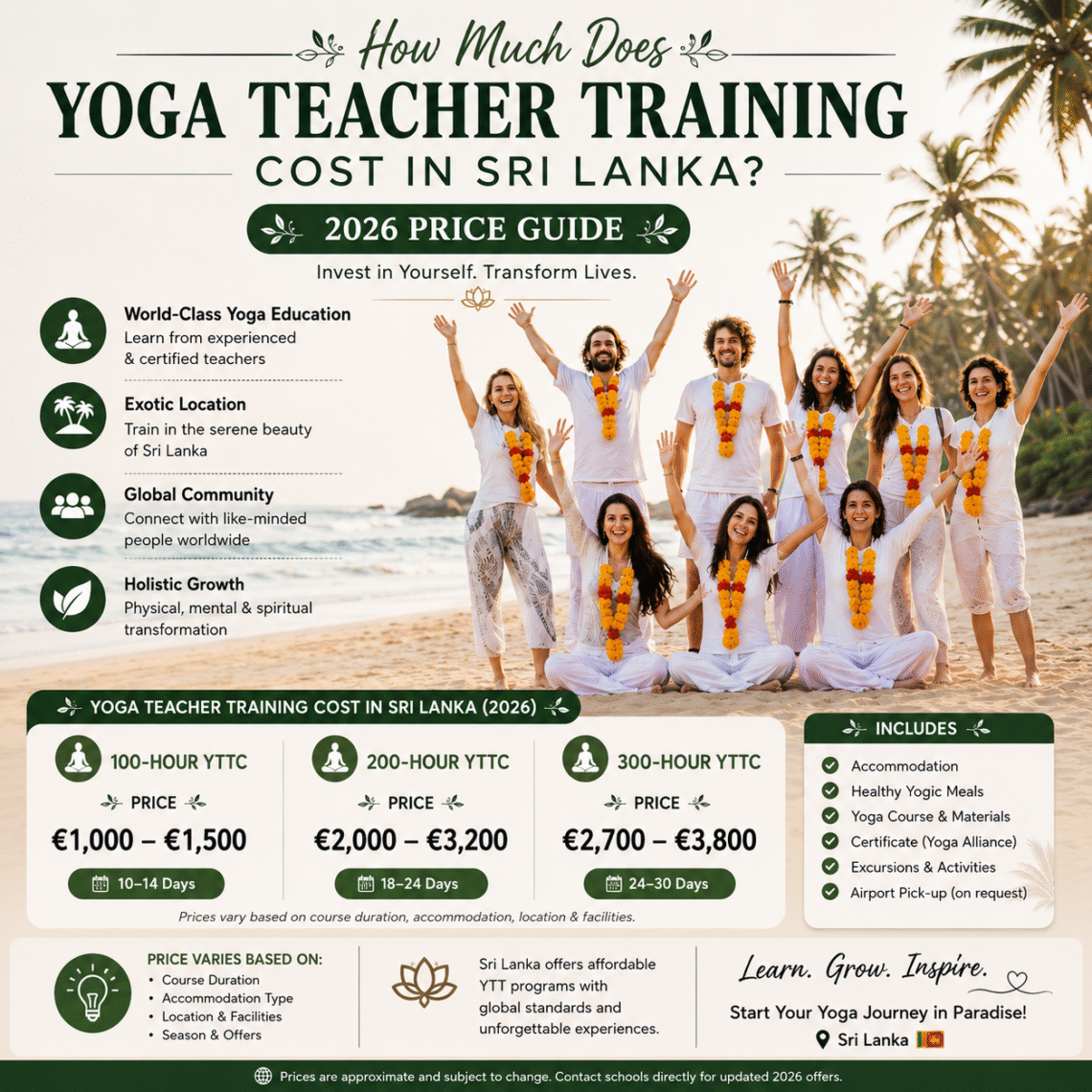
In 2026, residential yoga teacher training programs in Sri Lanka can range from more affordable foundational courses to premium immersive programs. At Diksha Yoga School, for example, current published 2026 fees range from €1,000 for a triple-shared 100-hour program to €3,800 for a private-room 300-hour program. Our 200-hour training currently ranges from €2,000 to €3,200, depending on accommodation.
But price alone does not tell you whether a yoga teacher training is good value.
A €1,500 course can be more expensive in the long run than a €2,500 course if accommodation, meals, teaching practice, course materials, or meaningful teacher guidance are not included.
This guide explains what you can realistically expect to pay for yoga teacher training in Sri Lanka in 2026, what your money should include, how much different training levels cost, and how to choose a program without simply choosing the cheapest option.
Upcoming 200-Hour Yoga Teacher Training Dates in Sri Lanka – 2026
| Month | Course | Location | Duration | Upcoming Dates |
|---|---|---|---|---|
| October 2026 | 200-Hour Yoga TTC | Galle, Sri Lanka | 23 Days | 05 Oct – 27 Oct 2026 |
| November 2026 | 200-Hour Yoga TTC | Galle, Sri Lanka | 23 Days | 05 Nov – 27 Nov 2026 |
| December 2026 | 200-Hour Yoga TTC | Galle, Sri Lanka | 23 Days | 05 Dec – 27 Dec 2026 |
Early Bird Offer
Save €100 — Book 2 Months Early!
Reserve your seat at least 2 months before the course start date and get an exclusive €100 Early Bird Discount.
Limited seats available — book early to secure your place.
WhatsApp Booking Button:💬 Book Now on WhatsApp
Table of Contents
Quick Answer: How Much Does Yoga Teacher Training Cost in Sri Lanka in 2026?
As a practical 2026 guide, residential yoga teacher training prices in Sri Lanka vary according to the course level and accommodation.
| Yoga Teacher Training | Typical Course Level | Example 2026 Fee Range at Diksha Yoga School |
| 50 Hour Yoga Training | Short immersion / foundation | From €700 |
| 100 Hour Yoga Teacher Training | Foundation / deeper immersion | €1,000–€1,500 |
| 200 Hour Yoga Teacher Training | Professional foundational teacher training | €2,000–€3,200 |
| 300 Hour Yoga Teacher Training | Advanced teacher training | €2,700–€3,800 |
Fees vary according to room category and course dates. Always check the current course page before booking.
At Diksha Yoga School, the current published 2026 prices show three accommodation levels for the residential programs. The 100-hour program is listed at €1,500 private, €1,300 twin shared, and €1,000 triple shared. The 200-hour program is listed at €3,200 private, €2,500 twin shared, and €2,000 triple shared. The 300-hour program is listed at €3,800 private, €3,400 twin shared, and €2,700 triple shared.
This gives you a much clearer picture than simply searching for “cheap yoga teacher training Sri Lanka.”
What Determines the Cost of Yoga Teacher Training in Sri Lanka?
Two yoga schools can offer the same number of training hours and have very different prices.
That is normal.
The real cost is influenced by several factors.
1. Number of Training Hours
A 50-hour immersion naturally costs less than a 200-hour professional training, while a 300-hour advanced program requires considerably more time and teaching depth.
Generally:
50 hours → introductory or continuing education
100 hours → foundational immersion
200 hours → comprehensive foundational teacher training
300 hours → advanced teacher training
If your goal is to become a yoga teacher, don’t automatically choose a shorter course simply because it is cheaper.
The right question is:
What level of training do I actually need for my goal?
2. Accommodation
Accommodation can make a significant difference to the final yoga TTC price.
Residential programs commonly offer:
- Private rooms
- Twin-sharing rooms
- Triple-sharing rooms
At Diksha Yoga School, the 2026 published fees demonstrate how room selection changes the total investment. For the 200-hour program, for example, the published price is €3,200 for a private room, €2,500 for twin sharing, and €2,000 for triple sharing.
If your main priority is learning and keeping your budget manageable, shared accommodation can be a sensible option.
If privacy and personal space matter more, a private room may be worth the additional cost.
3. Meals and Residential Support
Another important question is:
Does the course price include food?
A residential yoga teacher training is much easier when you don’t have to leave the training environment every day to find meals.
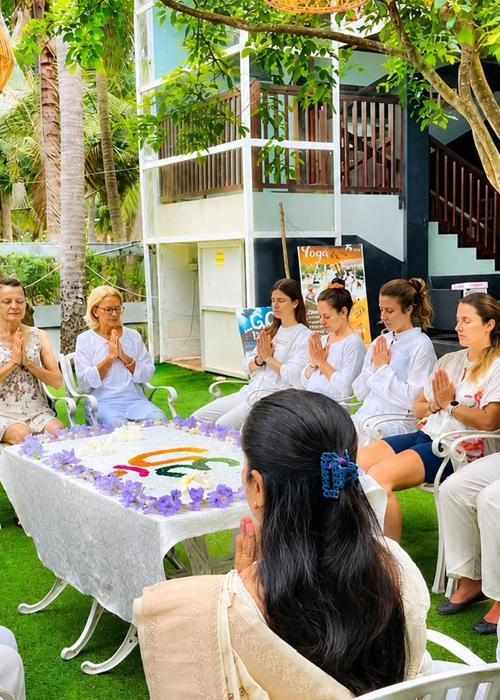
At Diksha Yoga School’s Sri Lanka programs, accommodation and meals are included as part of the residential experience, with the school describing vegetarian and vegan yogic meals as part of the training environment.
Before booking any school, ask exactly:
- How many meals are included?
- Are vegetarian meals provided?
- Are vegan options available?
- Is drinking water included?
- Are meals provided every day?
- Are meals included on arrival and departure days?
These details can make a surprisingly large difference to your actual travel budget.
4. Teacher Experience
Yoga teacher training is not simply about the room, food, or location.
You are paying for access to teachers who have spent years studying, practising and teaching yoga.
This is one of the reasons we believe it is important to know who is actually teaching your course.
At Diksha Yoga School, the training is led by Yogini Manisha, who founded the school after more than 16 years of teaching and training experience. The school currently states that she has guided more than 23,000 students from around the world.
For us, teacher training is not about memorising a list of yoga poses.
It is about learning how to understand the practice, work with different students, communicate clearly, observe alignment, teach safely and develop your own relationship with yoga.
That human connection is difficult to measure on a price comparison table.
5. Curriculum and Teaching Practice
A low-priced course can look attractive until you discover that much of the actual teaching content is missing.
Before booking, look for a curriculum that covers areas such as:
- Hatha Yoga
- Vinyasa Flow
- Ashtanga foundations
- Asana alignment
- Pranayama
- Meditation
- Yoga philosophy
- Anatomy and physiology
- Teaching methodology
- Sequencing
- Verbal cueing
- Adjustments
- Teaching practice
- Student observation
- Yogic lifestyle
For a serious 200-hour teacher training, curriculum depth matters particularly because the purpose is not simply to practise yoga but to develop the knowledge and skills required to teach.
Yoga Alliance’s RYS 200 framework, for example, includes techniques, training and practice, anatomy and physiology, yoga humanities, and professional essentials.
6. Certification and School Credentials
This is an area where students should be especially careful.
The phrase “Yoga Alliance certified” is used widely online, but it is important to understand exactly what a school means by it.
Yoga Alliance distinguishes between Registered Yoga School designations such as:
- RYS 200
- RYS 300
- RYS 500
An RYS 200 program is the foundational 200-hour teacher training credential, while RYS 300 represents advanced training built on that foundation.
Before paying a deposit, check:
- The school’s Yoga Alliance listing.
- The exact course designation.
- What certificate you receive after graduation.
- Whether the course is residential or online.
- Whether teaching practice is included.
- Whether assessments are part of the program.
Do not choose a course purely because the words “Yoga Alliance” appear on its website.
How Much Does a 100 Hour Yoga Teacher Training Cost in Sri Lanka?
A 100-hour yoga teacher training in Sri Lanka is often chosen by students who want a deeper immersion without committing immediately to a full 200-hour program.
It can also be useful for practitioners who want to strengthen their personal practice before progressing into more advanced teacher training.
At Diksha Yoga School, the current 2026 published fee is:
| Accommodation | 2026 Published Fee |
| Private room | €1,500 |
| Twin shared | €1,300 |
| Triple shared | €1,000 |
The current course page describes the program as covering Hatha, Ashtanga, Vinyasa Flow, pranayama, meditation, philosophy, anatomy, alignment and teaching methodology. (Diksha Yoga)
Who is the 100-hour course suitable for?
It can be a good fit if you:
- Are relatively new to structured yoga study
- Want to deepen your personal practice
- Want an introduction to teaching methodology
- Are considering a future 200-hour training
- Want a shorter residential yoga immersion
- Prefer to begin gradually rather than committing to a month-long program
One important clarification: 100 hours is not the same professional credential as a 200-hour foundational teacher training.
If your goal is to pursue the standard 200-hour teacher-training pathway, compare the 100-hour course with the full 200-hour option before booking.
How Much Does a 200 Hour Yoga Teacher Training Cost in Sri Lanka?
For many students, this is the most important price point.
A 200-hour yoga teacher training in Sri Lanka is generally the level people investigate when they want comprehensive foundational teacher training and intend to develop the skills to teach yoga.
At Diksha Yoga School, the current 2026 published prices are:
| Room Type | 200-Hour Course Fee |
| Private room | €3,200 |
| Twin shared room | €2,500 |
| Triple shared room | €2,000 |
The current program includes a broad curriculum covering asana practice, pranayama, meditation, yoga philosophy, anatomy, alignment and teaching-related study, alongside the residential experience.
Is €2,000–€3,200 expensive for 200-hour yoga teacher training?
Not necessarily.
The better way to evaluate the price is to ask what is included.
For example, a €2,000 residential course that includes accommodation, meals, teaching practice, course materials and assessment can represent better overall value than a lower tuition fee that requires you to pay separately for accommodation, food and other essentials.
This is why it is important to compare the complete package, rather than looking only at the advertised tuition fee.
The headline course price is only one part of your total investment.
What Does a 200-Hour Yoga Teacher Training Cost Per Training Hour?
Looking only at the total course price can sometimes make it difficult to compare different accommodation options. One simple way to understand the investment is to calculate the approximate cost per training hour.
Based on Diksha Yoga School’s published 2026 prices for the 200-hour residential program:
| Accommodation | Course Fee | Approx. Cost Per Training Hour |
| Triple shared | €2,000 | €10 per hour |
| Twin shared | €2,500 | €12.50 per hour |
| Private room | €3,200 | €16 per hour |
The calculation is simple:
€2,000 ÷ 200 hours = €10 per training hour
€2,500 ÷ 200 hours = €12.50 per training hour
€3,200 ÷ 200 hours = €16 per training hour
This gives you another useful way to understand the difference between the accommodation options. However, a lower cost per training hour does not automatically mean better value.
Your overall investment also reflects factors such as the experience of the teachers, accommodation, meals, curriculum depth, teaching practice, class size, course materials and the level of personal guidance you receive.
For example, choosing a shared room may reduce the cost per training hour, while choosing a private room gives you more personal space. The better option depends on your budget and what you want from your yoga teacher training experience.
What Does “Cost Per Hour” Really Tell You?
The calculation should be used as a budgeting tool, not as a measure of teaching quality.
Two yoga teacher training programs could both offer 200 hours but provide very different experiences. One might include accommodation, meals, teaching practice and course materials, while another might charge separately for several of these.
That is why it is important to compare the total package, not simply the price per hour.
When comparing yoga teacher training in Sri Lanka, look at:
- Total training hours
- Teacher experience
- Curriculum and subjects covered
- Teaching practice and feedback
- Accommodation
- Meals
- Course materials
- Certification
- Class size
- Personal support
The cheapest price per hour is not necessarily the best value. The goal is to find the training that gives you the right combination of education, practical experience, support and overall cost.
€1,500 tuition + €700 accommodation + €400 food + additional local costs.
The headline course fee is only one part of your total investment.
How Much Does a 300 Hour Yoga Teacher Training Cost in Sri Lanka?
A 300-hour course is generally intended for students who already have a solid foundation and want to deepen their teaching knowledge and personal practice.
At Diksha Yoga School, the current 2026 published fees are:
| Accommodation | 300-Hour Course Fee |
| Private room | €3,800 |
| Twin shared | €3,400 |
| Triple shared | €2,700 |
The program includes advanced study in yoga practice, philosophy, meditation, pranayama, anatomy and teaching skills, together with residential accommodation and a structured learning environment.
A 300-hour program should not be viewed simply as a “longer 200-hour course.”
You should expect more depth, more refinement and greater emphasis on teaching development.
What Is Usually Included in a Yoga Teacher Training Package?
When comparing schools, make a list of what is actually included.
A residential program may include:
Your room for the duration of the training.
Yoga Classes
Daily guided practices and theoretical sessions.
Course Materials
Training manuals or other study resources.
Depending on the school, one, two or three meals per day.
Teaching Practice
Opportunities to practise teaching under guidance.
Assessment
Evaluation before completion.
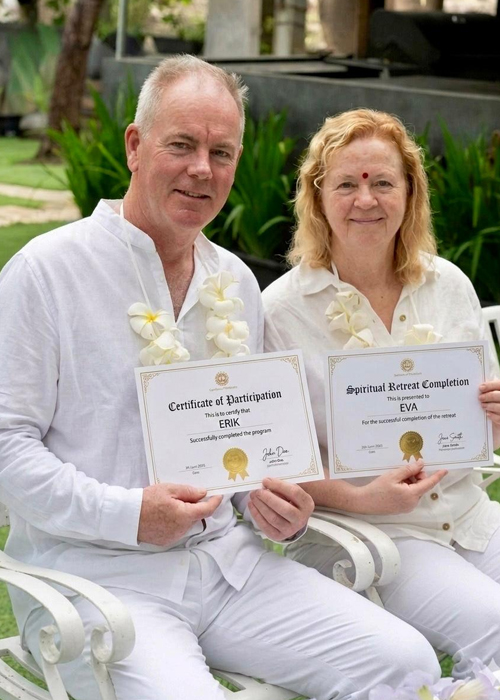
Certificate
A certificate issued after successful completion.
Airport Assistance
Some residential schools provide airport pickup or arrival support.
Cultural or Wellness Activities
Some programs include activities such as nature walks, meditation sessions, chanting or cultural experiences.
Diksha Yoga School’s Sri Lanka programs highlight accommodation, meals, course materials, teaching practice, assessment and certification among the residential training experience.
Always confirm the current inclusions before booking because packages and schedules can change.
What Is NOT Usually Included in the Yoga TTC Price?
This is where students sometimes underestimate their total budget.
Your course fee may not include:
- International flights
- Visa costs
- Travel insurance
- Personal shopping
- Additional excursions
- Spa treatments
- Personal transportation outside included transfers
- Extra nights before or after the course
- Personal expenses
- Some airport or departure costs
So if your yoga teacher training costs €2,500, don’t assume your entire Sri Lanka trip will cost €2,500.
Create a separate travel budget.
How Much Extra Money Should You Budget for Sri Lanka?
A simple way to plan is to divide your budget into four categories.
| Expense | Plan Separately? |
| Yoga teacher training | Yes |
| International flights | Yes |
| Visa / travel documents | Yes |
| Travel insurance | Yes |
| Personal spending | Yes |
| Extra accommodation | If needed |
| Airport transfer | Check whether included |
| Excursions | Check package |
The advantage of choosing a residential yoga teacher training is that a large portion of your daily living costs can already be organised into one package.
That makes budgeting easier.
What Does a Yoga Teacher Training in Sri Lanka Really Cost in 2026?
| Expense | Budget to Plan |
| 200-hour residential TTC | €2,000–€3,200 |
| International flight | Depends on departure country |
| Visa | Depends on nationality |
| Travel insurance | Depends on provider |
| Personal spending | Depends on lifestyle |
| Extra nights | Only if arriving early/leaving late |
The course price is not always the same as the total trip cost. A lower tuition fee can sometimes become more expensive overall once accommodation, meals, transportation and other daily expenses are added.
For this reason, when comparing yoga teacher training in Sri Lanka, look at the total cost of the experience, not just the advertised course fee.
Is Sri Lanka a Cheap Place for Yoga Teacher Training?
Sri Lanka can offer good value for an immersive residential yoga experience, but “cheap” should not be the main goal.
A teacher training is an educational investment.
You are spending weeks learning something that you may use for years.
A better question is:
What am I receiving for the price I am paying?
Look at:
- Teacher experience
- Curriculum depth
- Student-to-teacher ratio
- Accommodation quality
- Food
- Teaching practice
- Certification
- Class size
- Personal guidance
- School reputation
- Student feedback
- Location
- Support before arrival
This gives you a much more realistic picture of value.
Affordable vs Cheap: There Is a Difference
There is nothing wrong with wanting an affordable yoga teacher training.
In fact, affordability is one of the reasons students choose Sri Lanka.
But affordable does not have to mean cutting corners.
A good-value program should give you a balance of:
Education + experienced teachers + practical training + accommodation + food + support + certification.
If one course is dramatically cheaper than the others, investigate why.
Ask:
Is accommodation included?
Are meals included?
How many students are in the group?
How much teaching practice will I receive?
Who teaches the course?
What happens if I struggle with a particular subject?
These questions often tell you more than the price itself.
What Should You Look for in a 200 Hour Yoga Teacher Training?
If becoming a yoga teacher is your main goal, I recommend paying particular attention to the following.
1. A Clearly Structured Curriculum
You should know what you will study before you pay your deposit.
2. Experienced Teachers
Look for teachers with a real teaching history rather than simply impressive marketing language.
3. Teaching Practice
You should have opportunities to teach, receive feedback and improve.
Understanding how the body moves is important for teaching responsibly.
5. Philosophy
Yoga teacher training should go beyond physical postures.
6. Small or Manageable Groups
A smaller group can allow more personal feedback and interaction.
7. Transparent Pricing
The school should clearly explain what your course fee includes.
8. Real Student Experiences
Look for genuine testimonials and identifiable student feedback rather than anonymous marketing statements.
Why Choose Sri Lanka for Yoga Teacher Training?
There is something particularly special about studying yoga away from your normal routine.
Sri Lanka offers tropical landscapes, beaches, greenery, a rich cultural environment and a slower rhythm of life.
For many students, the attraction is not simply learning yoga in another country.
It is having enough space to step away from work, screens, responsibilities and everyday distractions.
That creates an opportunity to practise yoga as a lifestyle rather than simply attending another class.
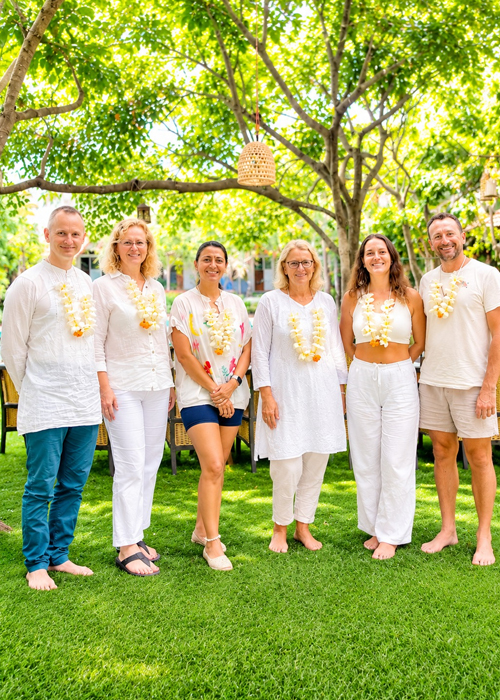
At Diksha Yoga School, our Sri Lankan training is based in Galle in southern Sri Lanka, where students can combine structured study with a peaceful natural environment.
Why Train with Diksha Yoga School?
Choosing a yoga school is personal.
We don’t believe every student needs the same teacher, location or teaching style.
At Diksha Yoga School, our approach is centred around authentic yoga education while keeping the learning practical and accessible for modern students.
Learn with Yogini Manisha
Yogini Manisha founded Diksha Yoga School after more than 16 years of teaching experience and has guided more than 23,000 students worldwide.
Her teaching combines traditional Hatha Yoga, Vinyasa Flow, pranayama, meditation and yogic philosophy with attention to alignment, awareness and teaching methodology.
Learn Beyond the Asana
A teacher training should not be just a month of doing difficult postures.
You learn how to understand the principles behind the practice.
That means studying:
- Breath
- Mind
- Meditation
- Philosophy
- Anatomy
- Alignment
- Teaching
- Observation
- Communication
- Self-awareness
Personal Attention
We believe students learn differently.
Some need more help with alignment.
Others need support with teaching confidence.
Some students arrive with years of practice but little teaching experience.
Others arrive as complete beginners.
A good teacher sees those differences.
Which Yoga Teacher Training Should You Choose?
Here is a simple way to decide.
| Your Goal | Course to Consider |
| Explore yoga more deeply | 50 Hour |
| Build a stronger foundation | 100 Hour |
| Become a professionally trained yoga teacher | 200 Hour |
| Deepen an existing teaching foundation | 300 Hour |
| Build a comprehensive long-term training pathway | 200 + 300 Hour |
If you are completely new to yoga, you do not necessarily need to start with the most advanced course.
If you already teach yoga and want advanced study, a 300-hour program may make more sense.
And if your goal is specifically to establish yourself as a yoga teacher, the 200-hour pathway is usually the most important one to investigate.
How to Save Money on Yoga Teacher Training in Sri Lanka
You don’t necessarily need to choose the cheapest school to reduce your budget.
Instead, consider these practical options.
Choose Shared Accommodation
The difference between private and shared rooms can be substantial.
At Diksha Yoga School, choosing triple sharing instead of a private room currently reduces the published 200-hour fee from €3,200 to €2,000.
Book Early
Some schools offer early-booking discounts or limited promotional rates.
Compare the Complete Package
Don’t compare tuition fees alone.
Compare:
Course + accommodation + meals + materials + transfers + certification + teaching practice.
Travel During Your Training
If you already plan to visit Sri Lanka, combining your travel with your teacher training can make the overall trip more efficient.
Is a More Expensive Yoga Teacher Training Better?
No.
Price is not a reliable measurement of quality.
A more expensive course might have:
- Better accommodation
- Smaller groups
- More experienced teachers
- More included services
But that doesn’t automatically make it better for you.
Similarly, a lower-cost program may offer excellent education.
The important thing is value for your particular goal.
Ask yourself:
“If I spend these three or four weeks here, will I leave with knowledge, confidence and practical teaching skills that justify the investment?”
That is the question we would encourage every student to ask.
Questions to Ask Before Booking a Yoga Teacher Training in Sri Lanka
Before paying your deposit, send the school these questions:
- What is the complete course fee?
- What room options are available?
- How many meals are included each day?
- Is accommodation included?
- Who are the lead teachers?
- How many students are expected in the group?
- How much teaching practice is included?
- What subjects are covered?
- What certification will I receive?
- Is the school currently registered with Yoga Alliance?
- Are airport transfers included?
- Are course materials included?
- What expenses are not included?
- What are the cancellation and refund terms?
- What dates are available in 2026?
A professional school should be comfortable answering these questions clearly.
Frequently Asked Questions
How much does yoga teacher training cost in Sri Lanka in 2026?
The price depends on the course level, accommodation and inclusions. At Diksha Yoga School, current published 2026 prices range from €700 for selected 50-hour options, €1,000–€1,500 for 100 hours, €2,000–€3,200 for 200 hours and €2,700–€3,800 for 300 hours.
How much does a 200-hour yoga teacher training cost in Sri Lanka?
At Diksha Yoga School, the current published 2026 200-hour fees are €2,000 for triple sharing, €2,500 for twin sharing and €3,200 for private accommodation.
Is accommodation included in yoga teacher training in Sri Lanka?
Many residential programs include accommodation, but you should always confirm the package. Diksha Yoga School’s Sri Lanka programs are residential and include accommodation options as part of the training package.
Are meals included?
Meal arrangements vary between schools. Diksha Yoga School’s Sri Lanka programs include meals as part of the residential experience; check the individual course page for the current meal schedule and inclusions.
Is Sri Lanka good for yoga teacher training?
Sri Lanka can be an excellent destination for students who want an immersive yoga experience combined with nature, tropical surroundings and a peaceful environment. The best choice, however, depends on the school’s teachers, curriculum, certification, accommodation and teaching approach.
Can beginners join yoga teacher training in Sri Lanka?
Yes. Some programs are specifically designed for beginners. Diksha Yoga School’s 100-hour Sri Lanka program welcomes beginners and intermediate practitioners.
Is a 100-hour yoga teacher training enough to become a yoga teacher?
A 100-hour course can provide valuable foundational education, but it should not automatically be treated as equivalent to a 200-hour foundational teacher-training credential. If your goal is to pursue a professional teaching pathway, carefully compare the 200-hour requirements and certification.
Is a 200-hour yoga teacher training worth the cost?
For students who genuinely want to develop as yoga teachers, a well-structured 200-hour program can be a worthwhile investment. Look beyond the price and evaluate the curriculum, teachers, teaching practice, accommodation, certification and student support.
What is the cheapest way to do yoga teacher training in Sri Lanka?
Choosing shared accommodation is one of the simplest ways to reduce the total course cost. You can also compare residential packages carefully and look for early-booking offers.
2026 Yoga Teacher Training Prices at Diksha Yoga School
For students who are ready to compare the options, here is the current published overview:
| Program | Private | Twin Shared | Triple Shared |
| 100 Hour | €1,500 | €1,300 | €1,000 |
| 200 Hour | €3,200 | €2,500 | €2,000 |
| 300 Hour | €3,800 | €3,400 | €2,700 |
These are published 2026 prices and can change according to dates, availability or promotional offers. Please confirm the current fee before making a booking.
Ready to Find the Right Yoga Teacher Training in Sri Lanka?
Choosing a yoga teacher training is a personal decision.
You may be looking for a career change.
You may want to deepen a practice you have loved for years.
Or perhaps you simply feel that it is time to step away from your usual routine and give yourself several weeks to study, practise and reconnect.
Whatever brings you here, don’t choose a course only because it has the lowest price.
Choose the school where the teachers, curriculum, environment, accommodation and teaching philosophy feel right for you.
At Diksha Yoga School, we welcome students from different backgrounds and levels of experience and create an environment where yoga can be studied both as a practice and as a way of living.
Interested in joining our next yoga teacher training in Galle, Sri Lanka?
Explore our current course dates, accommodation options and availability, then contact our team to discuss which program is right for you.
Explore Yoga Teacher Training in Sri Lanka
100 Hour Yoga Teacher Training in Sri Lanka
For students looking for a foundational immersion.
200 Hour Yoga Teacher Training in Sri Lanka
For students looking for comprehensive foundational teacher training.
300 Hour Yoga Teacher Training in Sri Lanka
For experienced practitioners and teachers ready for advanced study.
[Check Current Dates & Fees →]
About the Author
Founder & Lead Teacher, Diksha Yoga School
Yogini Manisha is the founder and lead teacher of Diksha Yoga School. With more than 16 years of teaching experience and experience guiding 23,000+ students worldwide, she has dedicated her teaching to sharing traditional yoga while making the learning process practical and accessible for modern practitioners.
Her teaching integrates traditional Hatha Yoga, Vinyasa Flow, pranayama, meditation, yoga philosophy, anatomy, alignment and teaching methodology.
At Diksha Yoga School, her focus is not simply on helping students perform yoga postures. The aim is to help students understand the practice, develop awareness and confidence, and eventually share yoga responsibly with others.