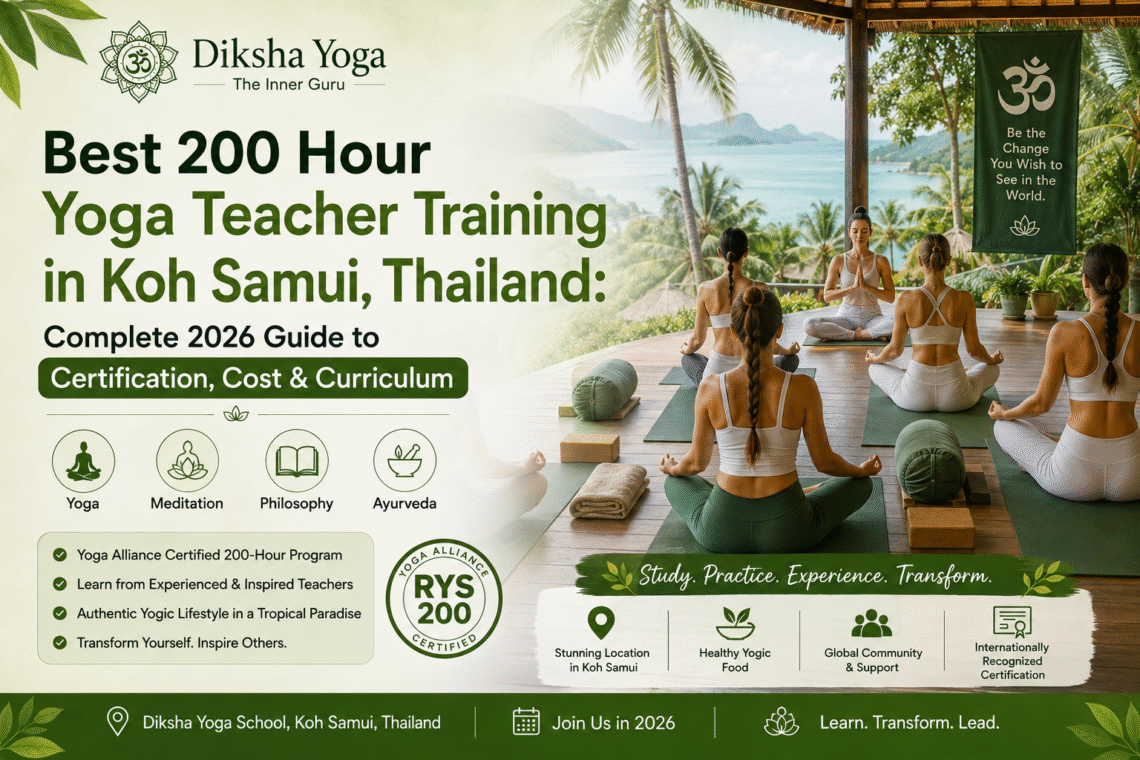
Choosing a Best 200 Hour Yoga TTC in Thailand is a bigger decision than choosing a holiday. You are not simply booking a few days of yoga classes.
You are committing several weeks to learning how yoga works, practicing it every day, studying its philosophy, understanding the body, developing teaching skills and discovering how the practice can become part of your life.
And when that journey takes place on an island like Koh Samui, Thailand, the experience can become even more immersive.
Table of Contents
But beautiful beaches alone do not make a good yoga teacher training.
The real questions are:
Who will teach you?
What will you actually learn?
How much practical teaching will you receive?
Is the training suitable for your experience level?
What does the course fee include?
What certification will you receive?
Will you receive personal guidance?
This complete guide explores those questions and everything else you should know before choosing a 200 Hour Yoga Teacher Training in Koh Samui.
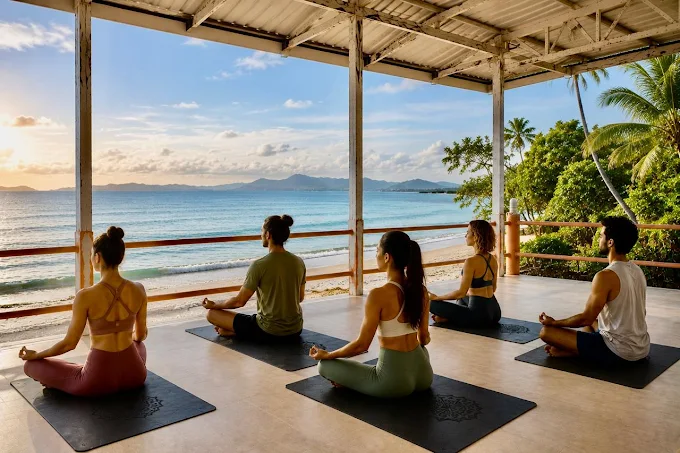
What Is a 200 Hour Yoga Teacher Training?
A 200-hour yoga teacher training is generally considered a foundational professional yoga education.
But the word “200” can sometimes make the course sound like a simple calculation.
It isn’t.
The 200 hours represent a period of intensive study and practice in which students explore yoga from several different perspectives.
You don’t simply spend 200 hours doing asanas.
A comprehensive program can include:
- Hatha Yoga
- Vinyasa Flow
- Ashtanga foundations
- Pranayama
- Meditation
- Yoga philosophy
- Anatomy
- Alignment
- Teaching methodology
- Sequencing
- Practical teaching
- Yogic lifestyle
- Relaxation techniques
The objective is to develop a foundation that allows you to continue growing as both a practitioner and, if you choose, a yoga teacher.
Is a 200 Hour Yoga Teacher Training Only for Future Teachers?
No.
Although many students join because they want to teach professionally, that isn’t the only reason to undertake a 200-hour course.
Some students come because they want to understand their personal practice more deeply.
Others want to take a meaningful break from their normal routine.
Some have practiced yoga for years but have never studied the philosophy, anatomy or teaching principles behind what they do.
And some simply feel that yoga has become important enough in their lives that they want to understand it at a much deeper level.
A residential teacher training can serve all of these purposes.
The important thing is to know why you are joining.
Why Choose Koh Samui for a 200 Hour Yoga Teacher Training?
Koh Samui offers something that is difficult to reproduce in a conventional classroom environment.
It creates distance from your normal routine.
You wake up somewhere different.
Your daily schedule becomes simpler.
You have access to nature.
You practice alongside people from different countries.
And for several weeks, yoga becomes one of the central parts of your day.
Koh Samui is already an established wellness and travel destination, and Diksha Yoga School’s existing programs position the island as a setting for immersive yoga education.
But the real advantage is not simply the tropical scenery.
It is the possibility of creating space to learn.
Yoga Teacher Training in Thailand: More Than a Change of Location
Travelling to another country for yoga teacher training changes the experience.
At home, your normal responsibilities continue to compete for your attention.
Work.
Family.
Emails.
Appointments.
Traffic.
Social commitments.
During a residential training, much of that noise temporarily becomes quieter.
Your attention can move toward:
Practice.
Study.
Breath.
Meditation.
Reflection.
Teaching.
This is one reason residential yoga teacher training can be so powerful.
You aren’t simply attending a class.
You are temporarily living inside the learning environment.
Why Koh Samui Can Be a Good Environment for Learning Yoga
There is something naturally conducive to mindfulness about island life.
The pace can be slower.
Nature is always nearby.
There is more opportunity to spend time outdoors.
And the separation from your normal environment can encourage you to become more present.
During a 200 Hour Yoga TTC in Koh Samui, these surroundings can complement the discipline of the training.
You may spend the morning studying breath and movement and later have time to walk, reflect or simply sit quietly.
That contrast matters.
Intensive study needs moments of recovery.
But the Destination Is Only One Part of the Experience
A beautiful location can make a photograph look impressive.
It cannot teach you yoga.
That is why choosing the school matters more than choosing the island.
Before booking, look carefully at:
The teachers
Who are they?
How long have they been teaching?
What is their approach?
The curriculum
Does it go beyond physical postures?
Practical teaching
Will you actually teach during the course?
Personal attention
Can you ask questions and receive individual feedback?
Where will you live during the training?
Food
Are meals included?
Certification
What exactly will you receive after completion?
Student support
Who will help you if you have difficulties?
These questions tell you much more about a school than a beautiful photograph of a beach.
Who Is a 200 Hour Yoga Teacher Training in Koh Samui For?
A well-structured foundational program can welcome people from different backgrounds.
Beginners
You don’t need to arrive as an advanced yogi.
You don’t need to perform complicated inversions.
And you don’t need years of teaching experience.
What you need is the willingness to learn.
A beginner may initially find the amount of information overwhelming.
That is normal.
Teacher training is supposed to introduce you to subjects you haven’t studied before.
Experienced Yoga Practitioners
Perhaps you’ve practiced yoga for several years.
You know the postures.
You attend classes regularly.
But you’ve never really studied:
Why does this posture work?
What happens anatomically?
How does breath change the practice?
Where did these teachings come from?
How should a class actually be sequenced?
A 200-hour training can bring those separate pieces together.
Aspiring Yoga Teachers
If your goal is to teach yoga, the training gives you a structured foundation.
You’ll begin learning not only how to practice but how to communicate.
That distinction is important.
Being able to perform a posture doesn’t automatically mean you can teach it.
Teaching requires observation, communication, adaptation and responsibility.
Wellness and Fitness Professionals
People already working in wellness, fitness or related areas may also use a yoga teacher training to broaden their knowledge.
The combination of movement, breath, meditation, anatomy and philosophy can provide a wider perspective on wellbeing.
Do You Need to Be Flexible?
No.
This is one of the biggest misconceptions about yoga teacher training.
You don’t need to be able to touch your toes.
You don’t need to do the splits.
You don’t need to perform a handstand.
And you certainly don’t need to look like an Instagram yoga model.
Yoga is not a flexibility competition.
In fact, being able to experience your own limitations can help you become more empathetic toward future students.
A teacher needs to understand that every body is different.
What You Actually Need to Bring
The most important thing you bring to a teacher training isn’t flexibility.
It’s curiosity.
You need to be willing to:
- Practice consistently
- Listen carefully
- Ask questions
- Receive corrections
- Study
- Try again
- Accept that you won’t understand everything immediately
You may also need patience.
There will probably be moments when something that seemed simple suddenly becomes complicated.
That’s part of learning.
What Makes a Good 200-Hour Program?
A strong program should not feel like 200 disconnected hours.
The subjects should connect.
For example:
You learn anatomy.
Then you see anatomy during asana practice.
You study pranayama.
Then you experience its effect during meditation.
You learn sequencing.
Then you build a class.
You study philosophy.
Then you discuss how those ideas relate to teaching and daily life.
That connection is what transforms a syllabus into an education.
The Diksha Yoga School Approach
Diksha Yoga School’s existing Koh Samui program materials describe an approach combining traditional yoga teachings with modern teaching methods, including Hatha Yoga, Vinyasa Flow, pranayama, meditation, philosophy, anatomy, alignment and teaching methodology.
The school also highlights small and personalized batches, practical guidance and alignment-focused practice.
For the 200-hour program, that philosophy should remain central:
Traditional knowledge.
Practical understanding.
Personal guidance.
Teaching confidence.
Rather than simply memorizing a list of postures, students should learn to understand what they are doing and why.
Learning From Yogini Manisha
Teacher training is deeply influenced by the person standing in front of the classroom.
Diksha Yoga School identifies Yogini Manisha as its lead trainer and describes her teaching approach as combining traditional yogic wisdom with supportive mentorship and modern learning methods.
Her role is important because a teacher training should involve more than delivering information.
Students need guidance.
They need corrections.
They need encouragement.
And sometimes they need someone to help them see a problem from a completely different perspective.
That relationship between teacher and student is one of the most important parts of a residential training.
Traditional Yoga in a Modern World
Yoga has ancient roots.
But today’s yoga teacher may teach students from dozens of different cultures.
Students may have different bodies.
Different abilities.
Different beliefs.
Different reasons for practicing.
A modern teacher therefore needs to understand tradition while also knowing how to communicate clearly and responsibly.
That is why subjects such as anatomy, alignment, teaching methodology and practical sequencing belong alongside philosophy, meditation and traditional practices.
The goal is not to replace traditional yoga.
It is to understand it well enough to communicate it appropriately in today’s world.
What You Will Begin to Discover
A 200-hour training often starts with a simple question:
“How do I do this posture?”
But over time, the questions become deeper.
“Why do we practice it?”
“What is happening in the body?”
“How should I modify it?”
“How would I explain it to a beginner?”
“What happens when the student’s body is different from mine?”
“How does breath influence the experience?”
That change in questioning is one of the signs that you are beginning to think like a teacher.
The First Step Toward Becoming a Yoga Teacher
You don’t become a good teacher on the day you receive a certificate.
The certificate marks the completion of a training period.
Teaching is a continuing process.
You learn from every class.
Every student.
Every mistake.
Every question.
Every difficult moment.
A good 200-hour program should therefore give you something more valuable than a certificate:
a foundation for lifelong learning.
Why a Residential Training Can Change the Experience
Imagine spending several weeks with the same group of students.
You practice together.
You study together.
You eat together.
You make mistakes together.
You encourage one another.
The community becomes part of the education.
For many students, these relationships become one of the most memorable parts of teacher training.
You arrive as individuals.
You gradually become a group.
And by the end, you may leave with friendships that extend far beyond Koh Samui.
What This Guide Will Cover
Choosing a 200 Hour Yoga Teacher Training in Koh Samui, Thailand involves much more than deciding on a destination.
In the rest of this guide, we’ll explore:
Part 2
The complete 200-hour curriculum — what you actually study and how the subjects connect.
Part 3
Daily residential life in Koh Samui — practice, study, meals, accommodation, community and the real training experience.
Part 4
Cost and fees — what a 200-hour Thailand YTT can include and how to compare the true value of different programs.
Part 5
Why Diksha Yoga School — teaching philosophy, Yogini Manisha, personal attention, experience and what differentiates the school.
Part 6
FAQs and booking guide — beginners, certification, cost, accommodation, meals, airport pickup, 2026 dates and everything you should know before making a decision.
Your Yoga Journey Can Start Here
You don’t need to know exactly where your yoga journey will take you.
Perhaps you want to become a teacher.
Perhaps you want to deepen your personal practice.
Perhaps you simply feel that it is time to step away from your normal routine and learn something meaningful.
Whatever brought you here, a 200-hour training is an opportunity to slow down, study deeply and experience yoga beyond the surface.
And doing that in Koh Samui, Thailand gives you a setting where learning, nature and community can come together.
The island is the setting.
The teachers provide the guidance.
The curriculum provides the structure.
But your willingness to learn is what makes the journey yours.
This is not simply 200 hours of yoga.
It is the beginning of understanding what yoga can become in your life.
What Do You Study During a 200 Hour Yoga Teacher Training?
Although the exact curriculum varies between schools, a comprehensive foundational program should cover several core areas.
At Diksha Yoga School, the educational approach combines traditional practices with practical teacher-development skills.
The main areas include:
- Hatha Yoga
- Vinyasa Flow
- Ashtanga foundations
- Pranayama
- Meditation
- Yoga philosophy
- Anatomy
- Alignment
- Teaching methodology
- Sequencing
- Practical teaching
- Yogic lifestyle
The objective is to develop both personal practice and teaching ability.
Hatha Yoga forms an important foundation for understanding the relationship between body, breath and awareness.
Students explore yoga postures with attention to:
- Alignment
- Stability
- Breath
- Awareness
- Strength
- Flexibility
- Concentration
Rather than rushing through postures, students learn to observe what is happening inside the body.
This creates an important foundation for future teaching.
A teacher needs to understand not only what a posture looks like but also how it feels and what its purpose may be.
2. Vinyasa Flow
Vinyasa introduces another dimension of practice.
Instead of treating postures as isolated shapes, students learn how movement can be connected through breath.
You begin exploring:
Movement → Breath → Transition → Awareness
Students learn how to create logical sequences and how one posture can prepare the body for another.
This eventually becomes an important part of teaching methodology.
A beautiful sequence isn’t necessarily a good sequence.
A good sequence has purpose.
It considers preparation, progression, peak poses and recovery.
3. Ashtanga Foundations
Ashtanga-based practices can introduce students to discipline, breath awareness and structured sequencing.
The emphasis is not simply on completing a demanding sequence.
Students begin understanding:
- Breath-led movement
- Consistency
- Drishti
- Bandha awareness
- Strength
- Stability
- Transitions
These principles can also influence how students approach other forms of yoga.
4. Pranayama — Understanding the Breath
Yoga teacher training becomes much deeper when students begin studying the breath.
Pranayama is not simply “breathing exercises.”
It is a traditional yogic discipline involving conscious regulation and awareness of breath.
Students may explore practices such as:
- Nadi Shodhana
- Kapalabhati
- Bhastrika
- Ujjayi
- Sheetali
- Sheetkari
The purpose is to develop understanding and awareness rather than simply performing techniques mechanically.
Students also begin considering when particular practices may or may not be appropriate.
That awareness becomes important when teaching others.
5. Bandhas
Bandhas introduce students to another layer of traditional yoga practice.
The foundational practices may include:
Mula Bandha
Associated with awareness and engagement around the pelvic floor.
Uddiyana Bandha
Explored in relation to the abdominal region and traditional yogic techniques.
Jalandhara Bandha
Explored through the relationship of the throat, breath and energetic practices.
Bandha practices require careful instruction.
They should not be treated as something to force.
The objective is understanding, awareness and appropriate practice.
6. Meditation
A yoga teacher training should not become entirely focused on physical movement.
Meditation helps students explore attention itself.
Students can be introduced to practices involving:
- Dharana
- Dhyana
- Mantra meditation
- Japa
- Awareness practices
- Yoga Nidra
These practices encourage students to experience yoga beyond physical flexibility.
For future teachers, personal experience with meditation can also help them guide students more authentically.
7. Yoga Philosophy
Philosophy gives context to the physical practice.
Students can explore important traditional sources and concepts, including:
Patanjali’s Yoga Sutras
Students begin exploring the classical framework of yoga and concepts such as the eight limbs.
Bhagavad Gita
The text provides an opportunity to explore themes including duty, action, discipline and the relationship between action and inner awareness.
Hatha Yoga Pradipika
Students explore an important traditional text connected with Hatha Yoga practices.
The purpose isn’t simply to memorize Sanskrit terminology.
It is to understand the ideas and consider how they relate to practice and life.
8. Yoga Anatomy
Anatomy is one of the subjects that transforms the way students see physical practice.
Instead of simply thinking:
“My knee needs to go here.”
you begin asking:
What is happening at the joint?
Which muscles are involved?
What range of movement is available?
Why might two students experience the same posture differently?
This knowledge helps teachers communicate more responsibly.
Students can explore areas such as:
- Skeletal structure
- Muscles
- Joints
- Movement
- Range of motion
- Major muscle groups
- Alignment principles
- Common movement considerations
9. Alignment
Alignment is not about making every student’s body look identical.
Good alignment education teaches students to understand the relationship between movement, structure, stability and individual anatomy.
A teacher may need to offer different options for different students.
For example, two people performing the same posture may require different modifications because their bodies are different.
This is why alignment should be taught as a principle rather than a rigid visual formula.
10. Teaching Methodology
This is where the student begins transitioning toward becoming a teacher.
Knowing yoga and teaching yoga are different abilities.
Teaching methodology can include:
- How to structure a class
- How to introduce a posture
- How to give clear instructions
- How to use demonstrations
- How to sequence safely
- How to modify postures
- How to observe students
- How to manage time
- How to use your voice
- How to create a supportive classroom
These skills require practice.
You cannot learn them simply by reading about them.
11. Sequencing
Sequencing is one of the creative parts of becoming a yoga teacher.
Students learn to think about the journey of a class.
For example:
Arrival → Breath → Warm-up → Preparation → Standing work → Peak sequence → Cooling → Relaxation
The exact structure can change depending on the purpose of the class.
A beginner class should not be sequenced in the same way as an advanced practice.
A morning energizing class may have a different intention from an evening restorative session.
Good sequencing therefore requires both knowledge and judgment.
12. Verbal Cueing
A teacher may understand exactly what they want a student to do.
The challenge is explaining it clearly.
Instead of giving complicated instructions, teachers learn to communicate using simple, purposeful language.
For example, instead of giving five instructions simultaneously, you learn to prioritize the most important action first.
Students gradually develop the ability to:
- Give concise cues
- Use appropriate terminology
- Speak with confidence
- Avoid unnecessary information
- Coordinate speech with movement
- Adapt instructions when students need help
Clear communication is one of the most valuable teaching skills you can develop.
13. Practical Teaching
Eventually, you have to stand at the front of the room.
This is where theory becomes real.
You may begin by teaching a single posture.
Then a short sequence.
Then a section of a class.
Eventually, you work toward teaching a complete session.
At first, you may feel nervous.
You may forget a transition.
You may speak too quickly.
You may give too many instructions.
That’s normal.
The purpose of practical teaching is to give you a safe environment in which to make mistakes and improve.
Learning Through Feedback
Feedback is one of the most valuable parts of teacher training.
After teaching, you can discover:
What worked?
What was unclear?
Did the sequence make sense?
Was the pace appropriate?
Did you observe your students?
Were your instructions easy to understand?
Could you have offered a modification?
This process gradually develops teaching confidence.
The goal isn’t to become perfect.
The goal is to become more aware.
14. Adjustments and Modifications
Every student is different.
Some students may be very flexible.
Others may have limited mobility.
Some may be strong.
Others may need more support.
A responsible yoga teacher needs to understand that one instruction cannot always work for everyone.
Teacher training therefore introduces the importance of:
- Verbal modifications
- Props where appropriate
- Different variations
- Alignment awareness
- Observing individual students
- Respecting personal boundaries
The teacher’s role is not to force a student into a shape.
It is to help the student practice appropriately.
15. The Role of the Teacher
As training progresses, students begin to understand that being a yoga teacher involves responsibility.
You are not simply demonstrating poses.
You are creating an environment in which another person trusts you with their practice.
That requires:
Awareness.
Humility.
Observation.
Communication.
Patience.
Professionalism.
And continued learning.
16. Yogic Lifestyle
A residential training also gives students an opportunity to explore yoga beyond the classroom.
This can include awareness of:
- Daily routine
- Food
- Sleep
- Meditation
- Self-discipline
- Mindful communication
- Personal practice
- Reflection
The purpose isn’t to create a temporary version of yourself for the duration of the course.
It is to explore which practices genuinely support your life.
17. Ayurveda Foundations
Yoga and Ayurveda have historically developed alongside one another within Indian traditions.
An introductory study may include concepts such as:
- The doshas
- Daily routine
- Seasonal routine
- Lifestyle awareness
- Food and wellbeing
This provides students with another perspective on the relationship between lifestyle and wellbeing.
It should be approached as an educational foundation rather than as a substitute for qualified medical or clinical care.
Bringing the Curriculum Together
The most valuable part of a 200-hour course is not necessarily any individual subject.
It is how the subjects begin connecting.
Imagine this:
You learn a standing posture.
Then anatomy helps you understand the movement.
Alignment helps you teach it safely.
Pranayama teaches you how to connect breath with practice.
Sequencing helps you place it within a class.
Teaching methodology helps you explain it.
Philosophy reminds you that yoga is more than the physical shape.
Suddenly, one posture has become an entire learning experience.
That is what a comprehensive teacher training should achieve.
From Practitioner to Teacher
At the beginning of the course, you may primarily think:
“How do I practice this?”
As the weeks progress, the question changes:
“How can I help another person experience this appropriately?”
That shift is fundamental.
You begin looking at yoga from the student’s perspective.
You become more aware of different bodies.
You learn to listen.
You learn to observe.
You learn that teaching is not about showing what you can do.
It is about helping someone else learn.
Why the 200 Hours Matter
Two hundred hours is a substantial commitment.
You will not master every aspect of yoga within those hours.
No one does.
Instead, you build a foundation.
You learn the language.
You develop your personal practice.
You study the traditional teachings.
You understand basic anatomy.
You practice teaching.
And you leave with a clearer idea of where your own yoga education should go next.
That is why a 200-hour course should be viewed as a beginning, not an ending.
Your Foundation for Teaching Starts Here
A strong 200 Hour Yoga Teacher Training in Koh Samui, Thailand should leave you with more than a collection of techniques.
It should leave you with questions.
Curiosity.
Discipline.
Greater body awareness.
A deeper relationship with your breath.
An understanding of yoga’s philosophical roots.
And the confidence to continue learning.
Because becoming a yoga teacher is not about reaching a point where you know everything.
It is about developing enough understanding to begin sharing what you know responsibly—and enough humility to remain a student.
What Is a Typical Day Like?
Every training day can have its own rhythm, depending on the school’s schedule and the subjects being covered.
A typical day may include a combination of:
Morning yoga practice
Pranayama
Meditation
Breakfast
Theory classes
Anatomy and philosophy
Teaching methodology
Practical teaching
Lunch
Afternoon study
Personal practice
Evening relaxation or meditation
The schedule is intensive, but it is designed around learning.
You are not expected to spend every waking minute doing physical yoga.
A teacher training requires your body, mind and attention.
The Morning Begins With Practice
For many students, the morning practice becomes one of the most meaningful parts of the training.
Before the distractions of the day begin, you have time to come to your mat.
The focus may vary depending on the day’s program.
One morning may emphasize traditional Hatha Yoga.
Another may involve Vinyasa Flow.
Another may focus more heavily on pranayama and meditation.
The objective is not simply to become physically stronger.
Morning practice gives you an opportunity to observe yourself.
How do you feel today?
Is your body tired?
Is your mind distracted?
Is your breath steady?
Can you remain present?
These observations become part of your education.
Pranayama and Meditation
The physical practice is only one part of yoga.
Breathwork and meditation help create another layer of awareness.
Students may explore traditional pranayama practices and different approaches to meditation throughout the program.
Over time, you may begin to notice something interesting.
The same posture can feel completely different depending on your breath and mental state.
That experience is difficult to learn from a textbook.
You need to practice it.
Breakfast and Time to Recover
After morning practice, students have time to eat and recover.
A residential program makes regular meals particularly important because the days can be physically and mentally demanding.
Diksha Yoga School’s Koh Samui program materials describe three vegetarian meals per day as part of the residential experience.
Having meals arranged as part of the training means students can spend less time worrying about where to eat and more time focusing on their education.
Learning Doesn’t Stop When You Leave the Yoga Mat
One of the biggest misconceptions about yoga teacher training is that most of the day is spent practicing asanas.
It isn’t.
A serious 200-hour program also requires study.
You may spend part of the day exploring:
- Anatomy
- Yoga philosophy
- Teaching methodology
- Alignment
- Sequencing
- Pranayama theory
- Meditation
- Traditional yoga texts
Some classes are practical.
Others require concentration and note-taking.
You may find yourself sitting with a notebook one moment and standing on a yoga mat the next.
That combination is what makes teacher training so comprehensive.
Anatomy: Understanding the Human Body
Anatomy classes can change how you experience yoga.
Instead of looking at a posture simply as a shape, you begin to understand movement.
You start noticing:
Where is the movement coming from?
Which joints are involved?
What range of motion is available?
Why does one student experience a posture differently from another?
This knowledge becomes especially important when you begin teaching.
A yoga teacher works with real people—not identical bodies.
Yoga Philosophy: Looking Beyond the Physical Practice
Another part of the day may take you away from physical practice entirely.
You may sit together and discuss the philosophical foundations of yoga.
Questions become deeper:
What is yoga?
What does awareness mean?
What is discipline?
How should we approach practice?
What does non-attachment mean in everyday life?
These discussions can challenge your assumptions.
And that is a good thing.
Yoga philosophy should not simply be something you memorize for an examination.
It should give you something to contemplate.
Practical Teaching: When You Step Forward
Eventually, the classroom becomes your teaching space.
You stand in front of your fellow students.
Suddenly, knowing a posture is no longer enough.
You need to explain it.
You need to demonstrate.
You need to observe.
You need to decide what instruction comes next.
You need to manage your voice and timing.
And you need to stay present even when you feel nervous.
This is where many students experience a major shift.
They stop thinking only as practitioners.
They begin thinking as teachers.
You Don’t Need to Be a Perfect Teacher on Day One
You will make mistakes.
You may forget a Sanskrit name.
You may lose your sequence.
You may speak too quickly.
You may give an instruction that doesn’t make sense.
You may suddenly realize that everyone is looking at you and you have forgotten what comes next.
That’s okay.
Teacher training is precisely where you are supposed to learn.
The important thing is what happens afterward.
You receive feedback.
You try again.
You become more aware.
You improve.
Learning From Other Students
One of the unique parts of international residential yoga training is the student community.
You may find yourself practicing alongside people from different countries, cultures and professional backgrounds.
One student may have practiced yoga for ten years.
Another may be relatively new.
Someone may be interested in teaching professionally.
Another may simply want personal transformation.
Everyone arrives with a different story.
That diversity can become part of your education.
You learn not only from your teachers but also from the people practicing beside you.
Life Outside the Classroom
Intensive training doesn’t mean you have to spend every moment studying.
You also need time to breathe.
Koh Samui provides a natural setting for stepping away from the classroom when the schedule allows.
You may have time to:
- Walk
- Rest
- Read
- Reflect
- Spend time in nature
- Explore the local area
- Connect with fellow students
- Practice independently
Those quieter moments are valuable.
Sometimes an idea from the morning’s philosophy class makes more sense when you are sitting quietly later in the day.
Why Nature Matters During an Intensive Training
A teacher training can be mentally demanding.
You are absorbing new information almost every day.
You are practicing physically.
You are learning to teach.
You are meeting new people.
And you are adjusting to a new environment.
Having access to nature can provide a useful contrast.
The tropical environment of Koh Samui offers opportunities to step away from screens and normal routines and reconnect with a slower rhythm.
The goal isn’t to turn the training into a holiday.
It is to create balance between discipline and recovery.
Accommodation During the Training
Where you live matters when you are studying for several weeks.
You don’t want accommodation to become another daily logistical problem.
A residential yoga teacher training allows students to stay within the training environment and build their routine around the course.
Diksha Yoga School’s Thailand program information describes residential accommodation as part of its course packages.
Depending on the selected package, students can choose the accommodation option appropriate to their needs.
Before booking, it is always important to confirm the current room category, availability and exact inclusions for your chosen dates.
Three Meals a Day
Food becomes especially important during an intensive training.
You are practicing.
You are studying.
You are moving.
You need regular nourishment.
The residential package includes three vegetarian meals each day, according to the school’s published Thailand program information.
The intention is to support a simple routine where students don’t have to spend part of every day arranging their own meals.
For many students, eating together also becomes part of the community experience.
Airport Pickup and Arrival
Arriving in another country can feel overwhelming, particularly if this is your first visit to Thailand.
Having airport pickup arranged can make the beginning of the experience much easier.
Diksha Yoga School’s Thailand program information lists airport pickup among the included course features.
Students should provide their flight details according to the school’s booking instructions so the arrival arrangements can be coordinated.
Exploring Koh Samui During Your Training
Koh Samui isn’t just a training location.
It is an island with beaches, temples, local communities, markets and natural surroundings.
Depending on the course schedule, students may have opportunities to experience some of the island.
Diksha Yoga School also includes excursions as part of its Thailand training packages.
The purpose isn’t to turn teacher training into sightseeing.
Rather, these experiences can give students an opportunity to step outside the classroom and experience the culture and environment around them.
Finding Balance Between Study and Exploration
One mistake students sometimes make is trying to do everything.
They want to attend every class.
Explore every beach.
See every attraction.
Take hundreds of photographs.
Stay socially active.
And still get enough sleep.
A 200-hour training is already intensive.
You don’t need to see all of Koh Samui during those few weeks.
Sometimes the best decision is to rest.
Your body needs recovery.
Your mind needs quiet.
And your learning needs time to settle.
The Community Becomes Part of the Journey
As the days pass, something changes.
The people who were strangers on the first day become familiar.
You begin recognizing each other’s strengths.
You help each other remember sequences.
You practice teaching together.
You laugh about mistakes.
You encourage one another when the schedule becomes demanding.
And eventually, the group becomes part of the experience.
For many graduates, these relationships remain one of the strongest memories of teacher training.
The Emotional Side of a 200-Hour Training
Not every day will feel inspiring.
There may be mornings when you are tired.
There may be days when the information feels overwhelming.
You may question whether you are good enough.
You may struggle with a particular posture.
You may feel nervous before teaching.
This is normal.
Growth rarely happens when everything feels easy.
A good residential environment gives you the opportunity to work through those moments with teachers and fellow students around you.
What You May Notice by the End
The physical changes may be noticeable.
Perhaps your practice becomes stronger.
Perhaps your balance improves.
Perhaps your breathing becomes more controlled.
But the more important changes may be less visible.
You may become:
More observant.
More patient.
More confident.
More comfortable speaking in front of others.
More aware of your own body.
More curious about yoga philosophy.
More compassionate toward different bodies and abilities.
These are the qualities that can continue developing long after you leave Koh Samui.
A Day in the Life Is More Than a Schedule
A timetable can tell you when class begins.
It cannot tell you what you will discover.
One student may arrive hoping to become a teacher and discover a deeper personal practice.
Another may arrive for personal growth and discover a passion for teaching.
Someone may come looking for a break from everyday life and leave with a completely different perspective.
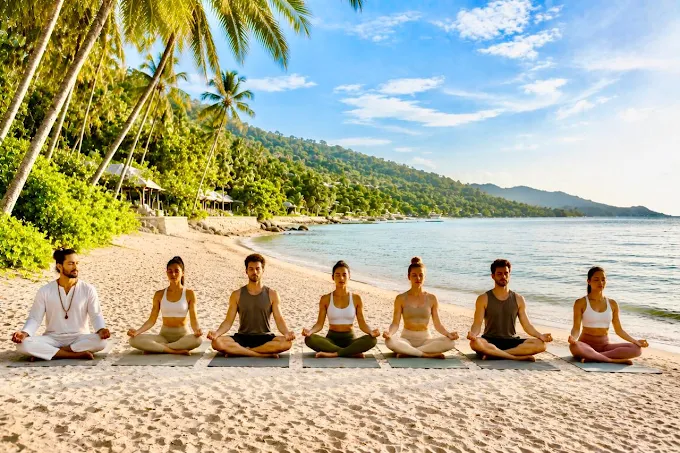
There is no single outcome.
That is what makes a residential yoga teacher training personal.
Koh Samui Becomes Part of the Memory
Years later, you may not remember every anatomy lecture.
You may not remember every sequence.
You may even forget some of the Sanskrit terminology.
But you may remember:
The first morning you practiced together.
The nervousness before your first teaching session.
The conversations after class.
The meals shared with your group.
The feeling of stepping outside after a long day.
The quiet moments when something suddenly made sense.
That is the difference between simply taking a course and living the learning experience.
Preparing for the Residential Experience
Before arriving, prepare yourself for a few weeks of commitment.
Bring comfortable practice clothing.
Bring a notebook.
Bring an open mind.
And most importantly, don’t arrive expecting to already know everything.
You are coming to learn.
You may be challenged.
You may be corrected.
You may discover that some of your assumptions about yoga were incomplete.
That’s exactly what education is supposed to do.
The Koh Samui Experience in One Sentence
A residential 200 Hour Yoga Teacher Training in Koh Samui, Thailand combines structured yoga education with the opportunity to temporarily step away from ordinary life and immerse yourself in practice, study, community and personal reflection.
The island provides the environment.
The curriculum provides the structure.
The teachers provide guidance.
And you provide the commitment.
How Much Does 200 Hour Yoga Teacher Training in Thailand Cost?
The cost of a 200-hour program in Thailand varies considerably.
The final price can depend on:
- Location
- Course duration
- Accommodation
- Private or shared room
- Food
- Teacher experience
- Group size
- Certification
- Course inclusions
- Excursions
- Training facilities
- Time of year
For a residential 200 Hour Yoga TTC in Koh Samui, accommodation and daily living arrangements can make a substantial difference to the overall cost.
This is why students should compare complete packages rather than looking only at tuition.
What Should Be Included in a Residential 200-Hour Program?
Before booking, look carefully at the list of inclusions.
A comprehensive residential package may include:
Accommodation
Your room for the duration of the training.
Three Daily Meals
Regular vegetarian meals during the course.
Airport Pickup
Transfer from Samui Airport to the training location.
Yoga Training
The complete 200-hour curriculum and teaching sessions.
Training Materials
A course manual or other educational materials.
Certification
A certificate after successful completion of the training requirements.
Excursions
Selected cultural or local experiences during the program.
Welcome & Closing Ceremonies
An opportunity to begin and complete the training as a community.
Diksha Yoga School’s published Thailand program information includes accommodation, three meals per day, airport pickup, training materials, certification and excursions among the course features.
Always confirm the current inclusions for your specific dates before making a payment.
Private vs Shared Accommodation
One of the biggest factors affecting the overall cost is your accommodation choice.
Shared Accommodation
Shared accommodation can be a good option for students who want to keep the total cost lower and enjoy a more social residential experience.
You may also find that sharing a room makes it easier to connect with another student during the first few days.
For many students, the friendships formed during shared accommodation become part of the teacher-training experience.
Private Accommodation
Private accommodation offers more personal space.
This can be particularly valuable after an intensive day of practice and study.
Having somewhere quiet to return to can give you time to:
- Rest
- Read
- Study
- Journal
- Meditate
- Prepare for the next day
If privacy is important to you, the additional cost may be worthwhile.
Don’t Compare Only the Course Fee
Imagine two programs.
School A
Course fee: lower
But you need to pay separately for:
- Accommodation
- Meals
- Airport transfer
- Training materials
- Local transport
School B
Course fee: higher
But the package includes:
- Accommodation
- Three meals daily
- Airport pickup
- Training manual
- Certification
- Excursions
At first glance, School A appears cheaper.
But after adding all the additional expenses, the difference may be much smaller—or may disappear completely.
This is why total trip cost is more useful than the advertised tuition price.
What Does a 200 Hour Yoga Teacher Training Actually Give You?
The most important part of the investment isn’t the room or the meals.
It’s the education.
During the program, you’re investing in:
Time with experienced teachers
Daily guided practice
Anatomy education
Yoga philosophy
Pranayama
Meditation
Teaching methodology
Sequencing
Practical teaching
Feedback
Personal development
A good program should help you develop skills that remain valuable after you leave Thailand.
Certification: What Are You Paying For?
Certification is an important part of comparing yoga teacher training programs.
Before booking, ask exactly:
- What certificate do I receive?
- What school issues the certificate?
- Is the school Yoga Alliance registered?
- What are the completion requirements?
- Do I need to attend all classes?
- Is there a practical teaching assessment?
- Are there any additional certification fees?
Diksha Yoga School’s Thailand program materials identify the school as Yoga Alliance registered and include certification within the program offering.
Students should always verify the current registration and certification details applicable to their particular course before enrolling.
Is a Yoga Alliance Registered Course Important?
For many aspiring teachers, Yoga Alliance registration is an important consideration when choosing a foundational teacher-training program.
However, students should understand what the registration actually means.
A registered school and an individual’s later professional registration are not necessarily the same thing.
If your long-term goal is to register individually with Yoga Alliance or pursue a particular professional pathway, check the current requirements directly before booking.
The important point is to understand what your course provides rather than assuming that every “200-hour certificate” has identical recognition.
The Value of a Residential Program
There is another part of the cost that is easy to overlook:
immersion.
You aren’t only paying for classroom hours.
You are temporarily changing your environment.
You don’t need to commute to class every day.
You don’t need to arrange meals between sessions.
You don’t need to return home after class and immediately switch back into your normal routine.
Instead, yoga becomes part of your daily rhythm.
That immersion can make it easier to maintain consistency and concentrate on learning.
What About Food?
Food is a practical consideration during an intensive training.
If meals aren’t included, you need to budget for them separately.
You also need to spend time finding restaurants or arranging food between classes.
A residential package with meals simplifies this.
Diksha Yoga School’s Thailand program information states that three vegetarian meals per day are included.
For students following a vegetarian or sattvic-oriented routine during training, having meals arranged can make the experience considerably easier.
Airport Transfer: A Small Detail That Matters
Samui Airport is the main arrival point for international students travelling to Koh Samui.
After a long international flight, navigating an unfamiliar destination with luggage can be stressful.
Airport pickup removes one of those arrival-day decisions.
Diksha Yoga School lists airport pickup among the inclusions of its Thailand training package.
Students should send their flight information according to the school’s instructions before arrival.
What Other Expenses Should You Budget For?
Even when a residential package is comprehensive, you should plan for expenses outside the course.
These can include:
- International flights
- Visa or entry-related costs, where applicable
- Travel insurance
- Personal shopping
- Additional drinks or snacks
- Laundry
- Personal transport
- Optional activities
- Personal excursions
- Airport expenses outside the arranged transfer
- Any additional nights before or after the program
Planning these expenses in advance helps avoid surprises.
Should You Choose the Cheapest 200-Hour Course?
Not necessarily.
Price matters.
But value matters more.
A very low price isn’t automatically a bargain if:
- The group is extremely large
- Teaching support is limited
- Accommodation is poor
- Meals aren’t included
- Practical teaching is minimal
- The curriculum is unclear
- Certification information is vague
Likewise, an expensive program isn’t automatically better.
The goal is to find the strongest combination of:
Education + teachers + practical experience + accommodation + support + transparency.
How to Compare Two Yoga Teacher Training Schools
Before booking, create a simple comparison.
| What to compare | School A | School B |
| 200-hour curriculum | ✓ | ✓ |
| Experienced teachers | ✓ | ✓ |
| Practical teaching | ? | ✓ |
| Accommodation | ✓ | ✓ |
| Three meals | ? | ✓ |
| Airport pickup | ? | ✓ |
| Training materials | ✓ | ✓ |
| Certification | ? | ✓ |
| Excursions | ? | ✓ |
| Group size | ? | ? |
| Personal attention | ? | ? |
| Additional charges | ? | ? |
The question marks are important.
Ask before paying.
What Makes Diksha Yoga School’s Package Different?
Diksha Yoga School’s Thailand program materials present the training as a residential experience rather than simply classroom tuition.
The package information includes:
- Accommodation
- Three vegetarian meals daily
- Airport pickup
- Training materials
- Yoga Alliance certification
- Excursions
- Welcome and closing experiences
This approach allows students to think about the complete training experience rather than arranging every element independently.
The Real Cost of a 200-Hour Training Is More Than Money
There is another investment that isn’t shown on a price list.
Time.
A residential 200-hour training requires you to step away from your normal life.
You may need to take time away from:
- Work
- Family
- Business
- Social commitments
- Everyday responsibilities
That can be challenging.
But it can also be exactly what makes the experience valuable.
For several weeks, you have permission to focus on something deeply meaningful to you.
Is a 200 Hour Yoga Teacher Training in Koh Samui Worth the Investment?
For the right student, it can be.
If your goal is simply to collect a certificate as quickly and cheaply as possible, there are many ways to approach yoga education.
But if you want:
- Immersive learning
- Daily practice
- Personal guidance
- Practical teaching
- Traditional yoga education
- Anatomy and alignment
- A supportive community
- Time away from your usual routine
then a residential 200 Hour Yoga Teacher Training in Koh Samui can offer much more than a qualification.
It can become a foundation for your next stage of life.
Questions to Ask Before You Pay a Deposit
Before making your booking, ask the school:
Course
What exactly does the 200-hour curriculum include?
Teachers
Who will teach the course and what is their experience?
What room options are available?
Food
Are three meals included every day?
Transfer
Is airport pickup included?
Certification
What certificate will I receive?
Additional costs
Are there compulsory charges beyond the advertised price?
Schedule
What are the arrival and departure dates?
Group
How many students will be attending?
Cancellation
What happens if I need to change my plans?
A professional school should be willing to answer these questions clearly.
Your Investment Should Continue After Graduation
The best outcome of a 200-hour course isn’t simply receiving a certificate on the final day.
It is leaving with something you can continue developing.
Your personal practice.
Your teaching voice.
Your understanding of anatomy.
Your relationship with meditation.
Your knowledge of philosophy.
Your confidence.
Your curiosity.
The certificate marks a milestone.
Your education continues.
Choosing Value Over Price
When comparing 200 Hour Yoga Teacher Training Thailand fees, don’t ask only:
“Which one costs less?”
Ask:
“Which program gives me the education and experience I actually want?”
Look at the complete package.
Look at the teachers.
Look at the curriculum.
Look at the practical teaching.
Look at the accommodation.
Look at the student experience.
Then make your decision.
Because the cheapest training isn’t necessarily the best value.
And the most expensive training isn’t automatically the best either.
The right training is the one that gives you a strong education, appropriate support and an experience you can genuinely build upon.
Your 200-Hour Investment Can Become a New Beginning
When you arrive in Koh Samui, you are investing in more than several weeks away from home.
You’re investing in your knowledge.
Your practice.
Your confidence.
Your ability to teach.
And potentially, a new direction in your life.
The financial part of the decision matters.
But the long-term value of the education matters even more.
Choose carefully.
Ask questions.
Understand what is included.
And choose a program because it feels right for your goals—not simply because it has the lowest number on the price list.
More Than a Yoga Holiday
There is an important difference between joining a yoga retreat and joining a yoga teacher training.
A retreat may give you time to relax, practice and recharge.
A teacher training asks more from you.
You study.
You practice.
You observe.
You teach.
You receive corrections.
You study anatomy.
You explore philosophy.
You learn how to communicate.
And you gradually develop the confidence to guide another person.
Diksha Yoga School approaches teacher training as an educational journey, rather than simply a holiday with yoga classes.
The Teaching Philosophy Behind Diksha Yoga School
At the heart of the school’s approach is the belief that yoga is more than physical movement.
Asana is important.
But it is only one part of the wider practice.
A deeper understanding can include:
Breath
Awareness
Meditation
Philosophy
Energy
Alignment
Self-observation
Discipline
Teaching
This creates a more complete learning experience.
Students aren’t encouraged simply to collect postures.
They are encouraged to understand what they are practicing and why.
Learning Traditional Yoga in a Modern Environment
Yoga has a long and complex history.
At the same time, today’s yoga teacher works with modern students.
That creates an important responsibility.
Teachers need to respect the traditional roots of yoga while communicating those teachings clearly to contemporary practitioners.
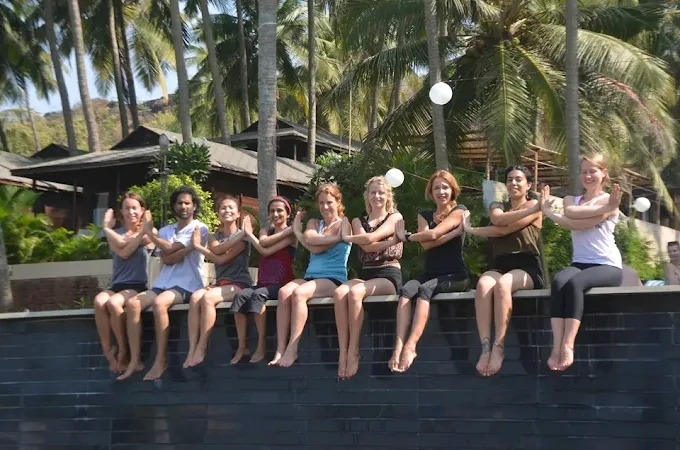
Diksha Yoga School’s published Thailand program materials describe a combination of traditional Hatha Yoga, Vinyasa Flow, pranayama, meditation, philosophy, anatomy, alignment and teaching methodology.
This combination helps students develop both:
Traditional understanding
and
Practical teaching skills
The goal isn’t to choose one over the other.
It is to understand how they can work together.
Yogini Manisha — The Person Behind the Teaching
A teacher training is shaped by its teachers.
Diksha Yoga School identifies Yogini Manisha as its founder and lead teacher, with more than 16 years of teaching and mentoring experience.
Her approach emphasizes traditional yogic knowledge together with practical teaching, personal guidance and awareness of the deeper dimensions of yoga.
This experience matters because teacher training isn’t only about delivering information.
An experienced teacher can help students understand:
What matters most.
What needs more practice.
Where students are struggling.
How to communicate difficult concepts.
How to approach different bodies and abilities.
And sometimes, simply how to keep going when the training becomes challenging.
Why Experience Matters in Teacher Training
Imagine learning how to teach yoga from someone who has only recently started teaching.
Compare that with learning from someone who has spent many years observing students, teaching different levels, adapting classes and refining their own methodology.
Experience doesn’t mean a teacher knows everything.
It means they have encountered many different situations.
A teacher with extensive experience can often help students avoid common mistakes and understand the difference between performing yoga and teaching yoga.
Personal Attention Matters
Teacher training is personal.
Two students can hear the same explanation and understand it completely differently.
One student may need help with alignment.
Another may struggle with sequencing.
Another may be nervous about teaching.
Someone else may have questions about philosophy.
This is why personal interaction matters.
Diksha Yoga School emphasizes small groups and personal attention in its Thailand program materials.
A smaller learning environment can make it easier to ask questions, receive feedback and develop a relationship with your teachers.
You Are Not Just a Number in the Room
A large class can make it difficult for a teacher to notice every student’s development.
During teacher training, individual feedback can be particularly valuable.
Your teacher may notice:
- The way you demonstrate
- How you give instructions
- Your voice
- Your timing
- Your alignment
- Your confidence
- Your sequencing
- Your interaction with students
These small observations can create significant improvements.
From Knowing Yoga to Teaching Yoga
This is one of the most important transitions during a 200-hour course.
You may already know how to practice a posture.
But teaching requires another level of awareness.
You have to ask:
Can my student understand my instruction?
Am I giving too much information?
Am I observing what is actually happening?
Can I offer an appropriate modification?
Is the sequence logical?
Is my voice clear?
Am I creating a safe and supportive environment?
These are teaching questions.
And they require practical experience.
Practical Teaching Is Essential
A teacher-training certificate should not be the first time you ever stand in front of a group and attempt to teach.
Practical teaching should be part of the learning process.
You practice.
You make mistakes.
Your teachers provide feedback.
You practice again.
This process gradually develops confidence.
Diksha Yoga School’s Thailand program information includes teaching methodology, sequencing, alignment and practical elements as part of its yoga education approach.
Learning to Teach Different Bodies
One of the most important lessons a yoga teacher can learn is:
Every student is different.
A posture that feels comfortable for one person may feel completely different for another.
Height differs.
Proportions differ.
Mobility differs.
Strength differs.
Experience differs.
Confidence differs.
Therefore, teaching cannot be based on making everyone look identical.
A good teacher learns to observe and adapt.
Alignment Without Obsession
Alignment is valuable.
But alignment should not become a rigid rule that ignores individual anatomy.
Teacher training should help students understand principles rather than simply memorize shapes.
Instead of:
“Every student’s knee must be exactly here.”
the more useful question can be:
“What is appropriate for this student’s body and the intention of the posture?”
That change in perspective can make a significant difference in teaching quality.
Developing Your Own Teaching Voice
At the beginning, many new teachers sound like the teachers they learned from.
That’s normal.
You borrow phrases.
You copy sequencing patterns.
You try to remember exactly how your teacher explained something.
But gradually, you develop your own voice.
You learn:
- How you naturally communicate
- What kind of classes you enjoy teaching
- How you want students to feel
- What teaching style suits you
- Where your strengths are
- Where you still need to grow
A good teacher training gives you a foundation.
It shouldn’t force you to become a copy of someone else.
Small Groups Create Community
A residential program can become surprisingly personal.
You spend a lot of time with your fellow students.
You practice together.
Study together.
Eat together.
Teach each other.
Give and receive feedback.
And gradually, the group becomes a support system.
This can be particularly meaningful for students travelling internationally for the first time.
You may arrive in Koh Samui knowing nobody.
You can leave with an international network of fellow yoga practitioners and teachers.
International Learning Environment
Yoga has become a global practice.
Students joining a training in Thailand may come from different countries and cultural backgrounds.
That diversity can improve your teaching.
Why?
Because you learn that communication isn’t always universal.
A phrase that makes perfect sense to one person may confuse another.
A cultural reference may not translate.
Different students may approach spirituality differently.
Learning alongside an international group helps you become more aware of these differences.
That awareness can become an important part of teaching internationally.
A Place to Study, Not Just Visit
Koh Samui is famous for its beaches and tropical surroundings.
But when you come for a 200-hour teacher training, the island becomes more than a holiday destination.
For several weeks, it becomes your learning environment.
Your daily rhythm can revolve around:
Practice
Study
Meals
Teaching
Reflection
Community
That immersion is one of the strongest reasons students choose residential teacher training.
The Importance of the Learning Environment
Your surroundings influence your experience.
A stressful environment can make intensive learning harder.
A supportive environment can make it easier to concentrate.
This is why accommodation, food, schedule, community and teacher support all matter.
Diksha Yoga School’s Thailand residential package includes accommodation, three vegetarian meals per day, airport pickup, training materials, certification and excursions according to its published program information.
The intention is to create an environment where students can focus on the training rather than constantly managing logistics.
What Makes Diksha Different?
There are many yoga schools in Thailand.
So the question isn’t:
“Is Diksha the only yoga school in Thailand?”
It isn’t.
The better question is:
“What kind of learning experience does Diksha offer?”
The school’s approach brings together:
Traditional Yoga
Respect for classical yogic practices and philosophy.
Modern Teaching Skills
An emphasis on anatomy, alignment, sequencing and communication.
Personal Attention
A learning environment designed to provide interaction and feedback.
Practical Experience
Students don’t only listen—they practice teaching.
Residential Immersion
Accommodation and daily meals allow students to live within the training experience.
International Community
Students learn alongside practitioners from different backgrounds.
Together, these elements create a more complete teacher-training experience.
A Certificate Is Only the Beginning
It is easy to become focused on the final certificate.
But imagine finishing your course with a certificate and still being afraid to teach.
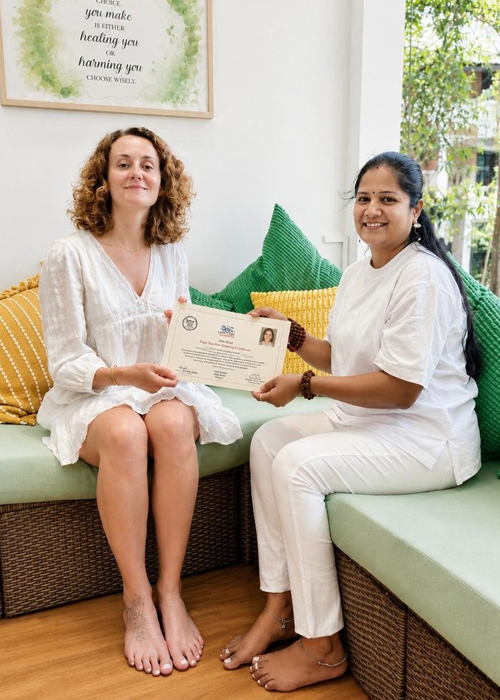
The more valuable outcome is leaving with:
Understanding
Practice
Teaching experience
Confidence
Self-awareness
A desire to continue learning
The certificate records your completion.
Your actual education is what you carry forward.
What You Can Take Home From the Training
After several weeks of intensive study, students can leave with a stronger foundation in:
- Hatha Yoga
- Vinyasa Flow
- Pranayama
- Meditation
- Yoga philosophy
- Anatomy
- Alignment
- Sequencing
- Teaching methodology
- Practical teaching
But there is another layer.
You may also leave with a better understanding of yourself.
Your habits.
Your reactions.
Your strengths.
Your limitations.
Your relationship with discipline.
Your relationship with stillness.
That personal dimension is one reason yoga teacher training can become much more than professional education.
Who Might Benefit Most From Diksha’s Approach?
This type of training may be particularly suitable for someone who wants:
A traditional foundation with modern teaching skills
Personal guidance rather than only large-group instruction
A residential learning environment
Practical teaching experience
An international student community
A deeper understanding of yoga beyond asana
A structured path toward becoming a confident teacher
If your only priority is finding the cheapest 200-hour course, there may be other options.
But if you are looking for an immersive education where the learning experience matters, those factors deserve serious consideration.
Your Relationship With Yoga Can Change
You may arrive in Koh Samui thinking that yoga is primarily about movement.
After several weeks of study, you may begin seeing it differently.
The breath becomes part of movement.
Meditation becomes part of practice.
Philosophy becomes relevant to daily decisions.
Anatomy changes how you understand postures.
Teaching changes how you observe.
And personal practice becomes something deeper than simply completing a sequence.
That is the kind of transformation a meaningful teacher training can create.
Choosing a Teacher Is Choosing a Foundation
The school you choose will influence the way you understand yoga.
Your teachers will influence the language you use.
The corrections you receive will influence your practice.
The philosophy you study will influence the way you think.
And the teaching practice you experience will influence the teacher you eventually become.
That’s why the decision deserves time.
Don’t choose only because the photographs are beautiful.
Don’t choose only because the price is low.
And don’t choose only because the destination is attractive.
Choose because the teachers, curriculum, philosophy and learning environment make sense for you.
Why Koh Samui + Diksha Yoga School?
For students looking for a 200 Hour Yoga Teacher Training in Koh Samui, Thailand, the combination can be compelling:
Koh Samui provides the tropical residential environment.
Diksha Yoga School provides the structured yoga education.
Experienced teachers provide guidance.
Practical teaching develops confidence.
The student community provides support.
And the residential format gives you the opportunity to step away from everyday distractions and immerse yourself in learning.
The destination may be what first attracts you.
But the education is what should ultimately matter.
Your Journey From Student to Teacher
Nobody becomes a finished yoga teacher in 200 hours.
You become a student with a stronger foundation.
From there, your journey continues.
You teach your first class.
You discover what you don’t know.
You study more.
You practice more.
You learn from your students.
You develop your own voice.
You continue exploring.
And slowly, you become the teacher you once hoped to become.
That is why the final day of teacher training should not feel like an ending.
It should feel like an opening.
Begin Your 200-Hour Journey in Koh Samui
If you are searching for a 200 Hour Yoga Teacher Training in Koh Samui, Thailand, look beyond the certificate and the photographs.
Look at the people.
Look at the curriculum.
Look at the teaching philosophy.
Look at the practical experience.
Look at what is actually included.
And most importantly, ask yourself:
“Is this the environment in which I want to learn yoga?”
If the answer is yes, your next step is to explore the available training dates, accommodation options and current fees.
Your journey doesn’t begin when you feel completely ready.
It begins when you decide to start.
Frequently Asked Questions About 200 Hour Yoga Teacher Training in Koh Samui
Can beginners join a 200-hour yoga teacher training?
Yes.
You do not need to be an advanced yoga practitioner to begin a foundational teacher-training program.
You don’t need to perform advanced inversions, be extremely flexible or have years of teaching experience.
What matters most is your willingness to practice, study, listen and learn.
A 200-hour program is designed to build a foundation.
You are not expected to arrive already knowing everything.
Do I need previous yoga experience?
Previous experience can be helpful, but the appropriate requirement depends on the school and course.
If you already practice yoga regularly, you may recognize some of the postures and terminology.
If you are newer to yoga, you may need more time to become familiar with the practices.
Either way, the training involves learning.
The most important preparation is an open mind and realistic expectations about the intensity of a residential course.
Do I need to be flexible to become a yoga teacher?
No.
Flexibility is not a requirement for becoming a good yoga teacher.
In fact, understanding your own physical limitations can help you appreciate how different your future students may be.
A good teacher learns to work with different bodies rather than expecting everyone to look the same.
Is a 200-hour course physically difficult?
It can be demanding.
You may practice yoga regularly while also attending theory classes, studying anatomy and philosophy, and participating in teaching practice.
Some days may feel physically challenging.
Other days may be more mentally demanding.
This is why rest, hydration, nutrition and listening to your body are important during the training.
You should always communicate with your teachers about individual physical limitations or concerns.
How long does a 200-hour yoga teacher training take?
A residential 200-hour training is commonly completed over several weeks, although the exact duration varies by school and program structure.
Diksha Yoga School’s residential programs are designed as immersive training experiences rather than isolated weekend classes.
Always check the specific start date, end date and accommodation nights for the course you are considering.
What Is Included in the Diksha Yoga School Thailand Program?
The school’s published Thailand program information describes a residential package that includes several key components.
These include:
- Yoga teacher training
- Accommodation
- Three vegetarian meals per day
- Airport pickup
- Training materials
- Certification
- Excursions
- Welcome and closing experiences
Exact inclusions can vary by course and booking arrangement, so students should confirm the current package for their chosen dates before paying.
Is Accommodation Included?
Yes, residential accommodation is part of the published Thailand program package.
The exact room type and availability depend on the selected accommodation option.
Students should confirm whether they are choosing private or shared accommodation and verify the number of included nights before booking.
Are Meals Included?
Yes.
The published Thailand program information states that three vegetarian meals per day are included.
Having meals included can make residential training easier because students don’t need to arrange food between intensive training sessions.
Is Airport Pickup Included?
Yes.
Airport pickup is listed among the included features of the Thailand residential program.
Students should provide their arrival information according to the school’s booking instructions so the transfer can be arranged
Which Airport Should I Fly To?
For Koh Samui, the principal arrival airport is Samui International Airport (USM).
When booking flights, check your arrival time carefully against the school’s course arrival instructions.
If you are travelling internationally, allow enough time for connections and unexpected delays.
Do I Receive a Yoga Teacher Training Certificate?
Yes, certification is included in the published Thailand program information.
Students should complete the required training and attendance requirements to receive their certificate.
Before booking, it is sensible to confirm the exact certificate title and current registration details applicable to your chosen program.
Is Diksha Yoga School Yoga Alliance Registered?
Diksha Yoga School’s published Thailand materials identify the school as Yoga Alliance registered.
For students who intend to pursue a professional yoga-teaching pathway, it is important to understand the distinction between completing a registered school’s training and any separate requirements for an individual’s professional registration.
Always check the current Yoga Alliance requirements directly if professional registration is part of your long-term plan.
Can I Teach Yoga After Completing 200 Hours?
A 200-hour foundational teacher training is designed to prepare students to begin teaching yoga.
However, completing a course does not mean that you have mastered teaching.
Your development continues through:
- Practice
- Observation
- Teaching
- Feedback
- Further education
- Personal experience
Your first class after graduation may feel very different from your first practice during teacher training.
That is normal.
Confidence grows through experience.
Is 200 Hours Enough to Become a Good Yoga Teacher?
It is enough to build a foundation.
It is not enough to know everything about yoga.
Think of 200 hours as the beginning of your professional education.
You learn the foundations of:
Asana
Pranayama
Meditation
Anatomy
Philosophy
Sequencing
Teaching methodology
Then you continue developing.
Many teachers eventually explore advanced training, specialized areas, anatomy, meditation, therapeutics or other branches of yoga education.
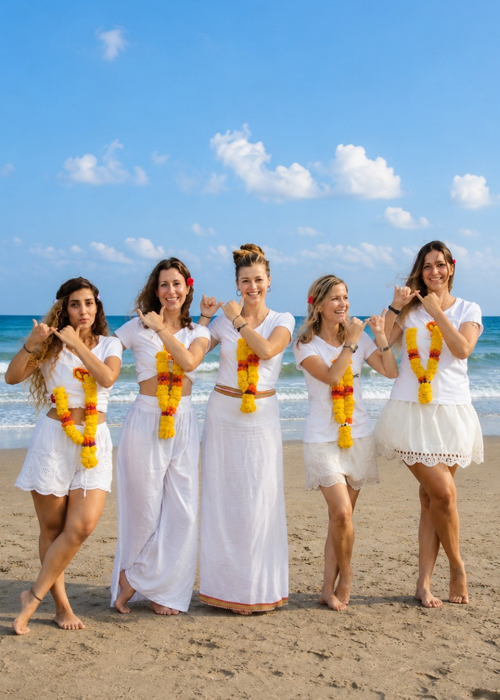
What Should I Bring to a Yoga Teacher Training in Thailand?
Your exact packing list depends on the school’s current requirements, but useful items can include:
- Comfortable yoga clothes
- Light clothing for tropical weather
- Notebook and pens
- Personal toiletries
- Reusable water bottle
- Comfortable walking shoes
- Any personal medications or essential items
- Travel documents
- Appropriate sun protection
You may also want a small journal.
Teacher training can give you a lot to think about, and writing down your observations can help you remember the journey.
Should I Bring My Own Yoga Mat?
Check with the school before travelling.
If mats and other basic equipment are provided, you may not need to carry your own.
If you have a personal mat that you strongly prefer, bringing it can make your practice feel more familiar.
What Is the Best Time to Do Yoga Teacher Training in Koh Samui?
Koh Samui has a tropical climate, and conditions vary throughout the year.
Your decision should consider:
- Course dates
- Weather
- Travel availability
- Flight prices
- Personal schedule
- Accommodation availability
The most important thing is to select dates that allow you to commit fully to the entire program.
Can I Explore Koh Samui During the Training?
Yes, when the course schedule allows.
However, remember that a 200-hour training is an intensive educational program.
You may have limited free time.
Rather than trying to see everything, use your free periods thoughtfully.
Rest is just as important as sightseeing.
Selected excursions may also be included as part of the residential program.
Can I Join Alone?
Absolutely.
Many people travel alone for yoga teacher training.
You may initially feel nervous about arriving in another country without knowing anyone.
But residential programs naturally create opportunities to meet people because students practice, study and eat together.
You may arrive alone and quickly become part of a group.
What If I Am Nervous About Teaching?
Almost everyone who has never taught before can feel nervous.
Standing in front of a group is very different from practicing alone.
That’s why practical teaching should happen gradually.
You begin with small steps.
You receive feedback.
You learn what works.
Then you try again.
You don’t need to be a confident teacher on your first teaching day.
You need to be willing to practice becoming one.
What If I Make Mistakes During Teaching Practice?
Make them.
That’s what training is for.
You may forget an instruction.
You may lose your sequence.
You may speak too quickly.
You may accidentally give too much information.
You may realize afterward that you missed something.
Every mistake can become useful feedback.
The goal is not to leave training believing you will never make mistakes.
The goal is to leave knowing how to learn from them.
Is Koh Samui Better Than India for Yoga Teacher Training?
There is no universal answer.
India offers an extraordinarily deep connection to yoga’s cultural and historical roots.
Thailand offers a different residential environment, with an international wellness culture and the tropical setting of Koh Samui.
The better destination depends on what you want from the experience.
If your priority is a traditional immersion in India, you may prefer India.
If you want a combination of yoga education, international community and island-based residential living, Koh Samui may be an attractive choice.
The quality of the school and teachers should remain more important than the country name.
Why Choose Koh Samui for Your 200-Hour Training?
For many students, the attraction is the combination of:
Yoga education
Tropical surroundings
Residential immersion
International community
Time away from normal routines
Personal reflection
But remember:
The beach cannot teach you how to teach yoga.
The destination creates the environment.
The school creates the educational experience.
How Should I Choose a 200-Hour Yoga School?
Before booking, ask yourself these questions:
1. Who are the teachers?
Look for real teaching experience and a clear teaching philosophy.
2. What exactly is taught?
Read the curriculum rather than relying only on the words “200 hours.”
3. Is there practical teaching?
You should have opportunities to practice teaching.
4. How much personal attention will I receive?
Group size matters.
5. What is included?
Check accommodation, meals, transfers, materials and certification.
6. Are there hidden costs?
Ask before paying.
7. Does the teaching style suit me?
A school can be excellent and still not be the right fit for every student.
A Simple Booking Checklist
Before confirming your place, make sure you know:
☑ Course start date
☑ Course completion date
☑ Arrival and departure arrangements
☑ Accommodation type
☑ Number of accommodation nights
☑ Meals included
☑ Airport transfer arrangements
☑ Course curriculum
☑ Certification requirements
☑ Total course fee
☑ Deposit amount
☑ Payment method
☑ Cancellation policy
☑ What you need to bring
When these details are clear, booking becomes much easier.
Don’t Choose a School Only Because It Ranks on Google
This may sound surprising, especially when you’re searching for the best 200 Hour Yoga Teacher Training in Koh Samui.
But search rankings should help you discover schools—not make the decision for you.
Look beyond the first page.
Read the curriculum.
Look at the teachers.
Read student experiences.
Check the course structure.
Ask questions.
Then decide.
SEO can help you find a school.
Trust should help you choose one.
What Should You Expect From the Final Day?
The final day can be emotional.
You have spent weeks with the same group.
You’ve practiced together.
Studied together.
Struggled together.
Laughed together.
And gradually developed confidence.
The closing ceremony marks the completion of the training.
But it is also the beginning of your next chapter.
You may leave with a certificate.
But more importantly, you leave with a new responsibility:
to continue learning.
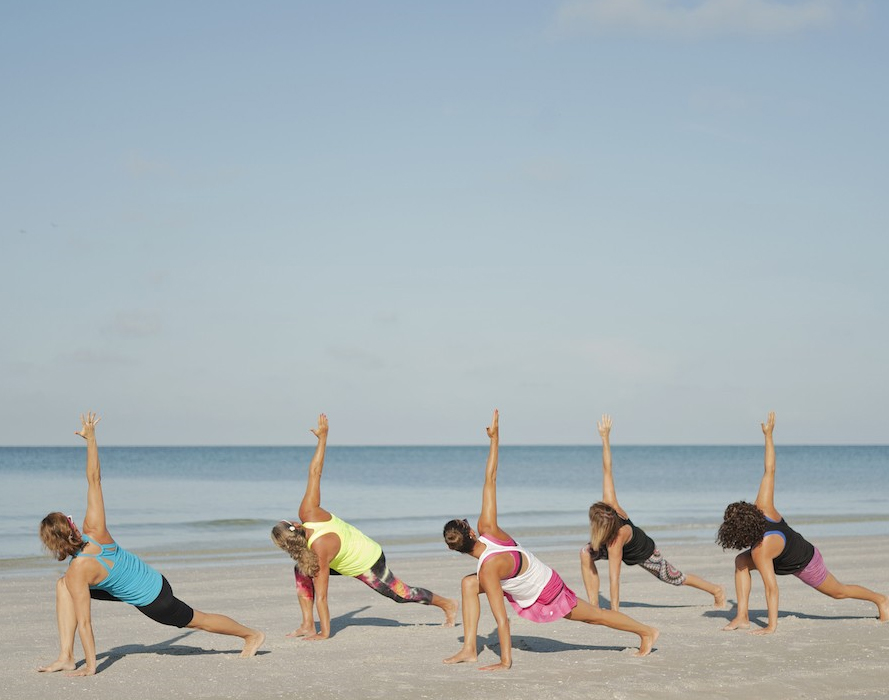
Your First Class After Graduation
Eventually, you’ll stand at the front of a room again.
But this time, the students won’t be your classmates.
They will be people who have come to you to learn.
You may feel nervous.
That’s okay.
Remember the first time you taught during training.
Remember your teachers’ feedback.
Remember that you don’t have to know everything.
Your responsibility is to teach what you understand, continue studying and remain aware of your students.
That mindset can carry you much further than confidence alone.
What Makes a 200-Hour Training Truly Valuable?
The value isn’t measured only by the number of hours.
It comes from the quality of those hours.
One hundred hours of memorization is different from one hundred hours of meaningful practice and feedback.
A strong teacher-training experience should encourage you to:
Understand rather than memorize.
Observe rather than judge.
Practice rather than simply watch.
Teach rather than only demonstrate.
Question rather than blindly accept.
Continue learning rather than believe you have finished.
That is the foundation of responsible yoga education.
Your Journey Doesn’t End at 200 Hours
There will always be another book to read.
Another technique to explore.
Another student to learn from.
Another aspect of anatomy to understand.
Another meditation practice to experience.
Another question to investigate.
That is one of the beautiful things about yoga.
There is always more.
Your 200-hour training gives you a map.
Your own practice determines where you go next.
Why Students Choose an Immersive Experience
People travel across countries and continents to undertake yoga teacher training because they are looking for more than a certificate.
They want a change of environment.
A deeper practice.
New friendships.
A challenge.
A period of reflection.
A new professional direction.
Or simply the opportunity to spend several weeks doing something meaningful.
Koh Samui provides the setting.
A residential training provides the structure.
And the student brings the intention.
Your 200 Hour Yoga Teacher Training in Koh Samui Starts With One Decision
You don’t have to know exactly who you will become after the training.
You don’t need to know where you will teach.
You don’t need to know whether teaching will become your full-time career.
You simply need to know that you want to learn.
Because a yoga teacher is never really finished learning.
The 200-hour journey gives you the opportunity to build a foundation—with practice, study, guidance and community around you.
Ready to Begin?
If you have been searching for:
200 Hour Yoga Teacher Training Thailand
Yoga Teacher Training in Koh Samui
200 Hour Yoga Certification Thailand
Yoga Teacher Training Koh Samui
Best 200 Hour Yoga Teacher Training in Thailand
then the next step should not simply be to compare prices.
Compare the complete experience.
Look at the curriculum.
Meet the teachers.
Understand what is included.
Ask your questions.
Choose the accommodation that suits you.
And make sure the dates work for your life.
Start Your Yoga Teacher Journey in Koh Samui
There is a moment when researching needs to become deciding.
You have read about the curriculum.
You understand what residential training involves.
You know what to look for in a school.
You understand the importance of teachers, practical experience and personal attention.
Now comes the most personal question:
Are you ready to begin?
A 200-hour yoga teacher training isn’t simply 200 hours added to your calendar.
It can become a period of learning, discipline, self-discovery and connection.
You may arrive as someone who simply loves yoga.
You may leave with the foundation to share it with others.
And somewhere between those two points, you may discover that the journey was never only about becoming a yoga teacher.
It was about becoming a more conscious student of yoga.
Begin Your Journey With Diksha Yoga School
Diksha Yoga School welcomes students who want to explore yoga through traditional Hatha Yoga, Vinyasa Flow, pranayama, meditation, philosophy, anatomy, alignment and teaching methodology, within a residential learning environment.
If Koh Samui feels like the right environment for your next chapter, explore the current 200-hour course dates, accommodation options and fees, and speak with the school before making your booking.
Your journey doesn’t begin when you feel ready.
It begins when you decide to start.
Join a 200 Hour Yoga Teacher Training in Koh Samui, Thailand—and give yourself the time, space and guidance to discover what yoga can become in your life.