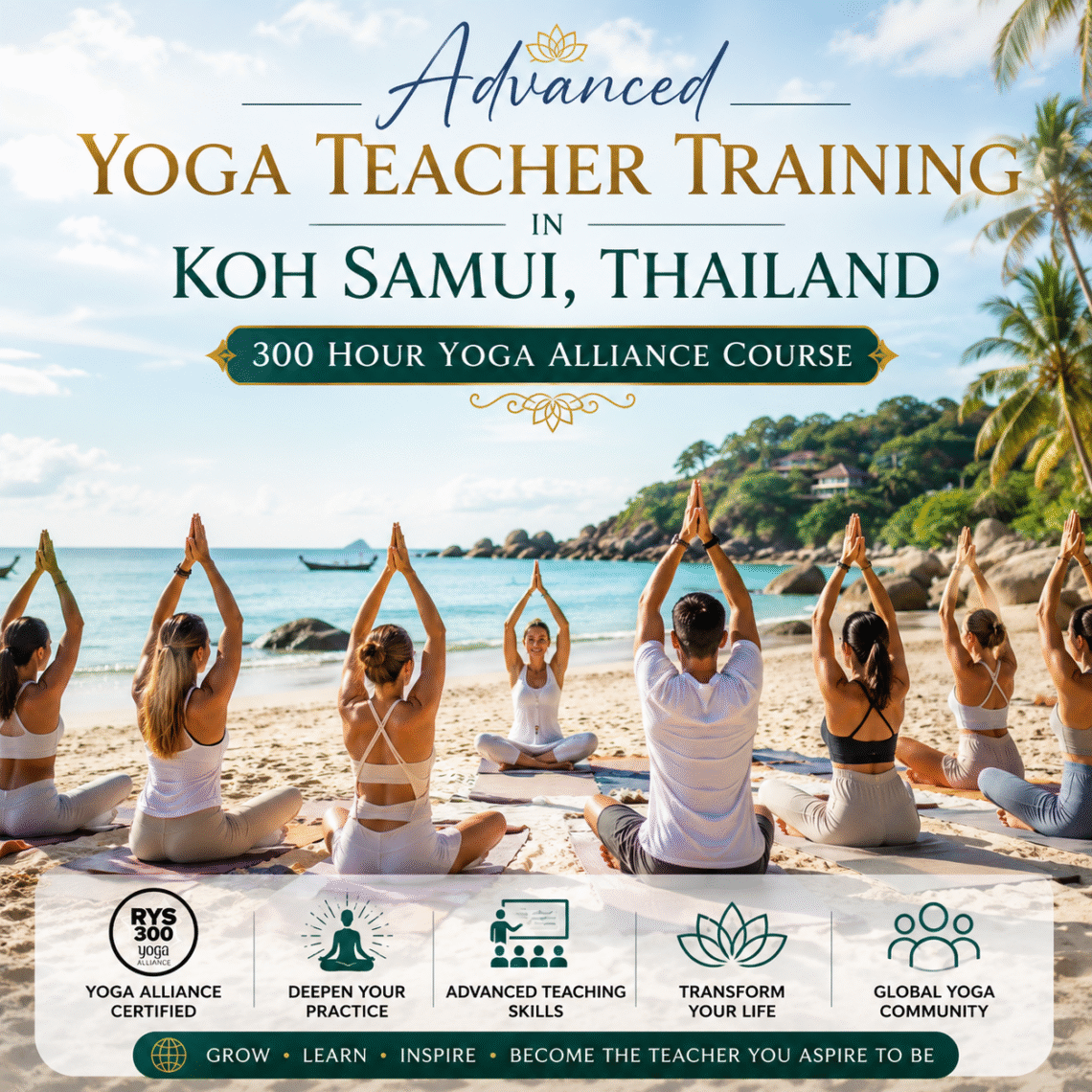
300 Hour Yoga Alliance Course in Koh Samui, Thailand, There comes a point in every yoga teacher’s journey when the foundation no longer feels like enough.
You may have completed your 200-hour certification, started teaching classes, and gained valuable experience. Yet, after guiding students for some time, you begin to realize that yoga is far deeper than learning postures or remembering sequences. Questions naturally arise: How can I support students with different bodies? Why do some students struggle with the same pose while others move effortlessly? How can I create classes that inspire confidence, healing, and transformation?
These questions are not signs that you are lacking—they are signs that you are evolving as a teacher.
An Advanced Yoga Teacher Training in Koh Samui, Thailand is designed for this stage of the journey. It is an opportunity to move beyond the fundamentals and explore yoga with greater depth, clarity, and confidence. Rather than simply adding more poses to your repertoire, a 300 Hour Yoga Alliance Course encourages you to refine your teaching skills, strengthen your understanding of anatomy and philosophy, deepen your personal practice, and discover your authentic voice as a teacher.
At Diksha Yoga School, we believe that great yoga teachers are not created overnight. They are shaped through consistent practice, thoughtful self-inquiry, experienced mentorship, and a willingness to keep learning. Our 300 Hour Yoga Alliance Course is built for teachers who are committed to that lifelong path.
Set on the peaceful island of Koh Samui, our training combines traditional yogic teachings with modern education in anatomy, biomechanics, intelligent sequencing, meditation, pranayama, and teaching methodology. The tropical surroundings provide a calm and supportive environment where students can fully immerse themselves in both study and self-discovery.
Whether your goal is to become a more confident teacher, specialise in advanced instruction, or simply reconnect with your own practice, this course offers the knowledge, guidance, and experience to help you take the next step.
Table of Contents
Why Advance Your Yoga Journey?
Many teachers believe that completing a 200-hour training marks the end of their education. In reality, it is only the beginning.
The first certification provides a strong foundation, introducing you to yoga philosophy, basic anatomy, teaching methodology, and the essential principles of Hatha and Vinyasa Yoga. However, once you begin teaching real students, you quickly discover that every class presents new challenges and opportunities to grow.
Perhaps you’ve wondered how to modify a posture for someone recovering from an injury, how to sequence a class that feels balanced and purposeful, or how to support students with different levels of flexibility and strength. These are the moments that inspire many teachers to pursue a 300 Hour Yoga Alliance Course
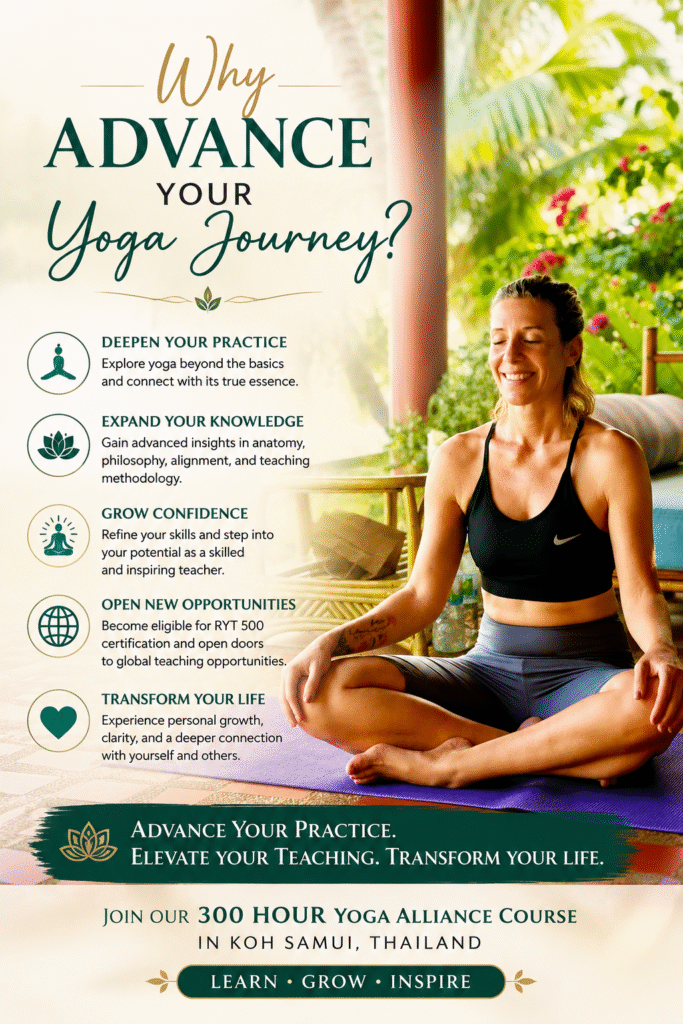
An advanced training is about developing the ability to think critically, teach safely, and respond to the unique needs of every student who steps onto the mat.
At Diksha Yoga School we encourage teachers to move beyond memorised routines and cultivate a deeper understanding of movement, breath, and awareness. Our goal is not to create teachers who simply lead classes, but educators who can inspire confidence, build meaningful connections with students, and continue learning throughout their lives.
The transformation that takes place during an advanced training is often just as personal as it is professional. Many graduates describe feeling more grounded, more present, and more connected to the true purpose of yoga—not only as a practice, but as a way of living.
Why Koh Samui Is Better Than Bali or Goa
This is a high-value opportunity.
Create a comparison table:
| Koh Samui | Bali | Goa |
| Smaller crowds | Busier tourism | Seasonal |
| Peaceful beaches | Heavy traffic in some areas | Busy during peak season |
| Tropical climate | Humid | Monsoon season |
| Easier focus | More distractions | Seasonal tourism |
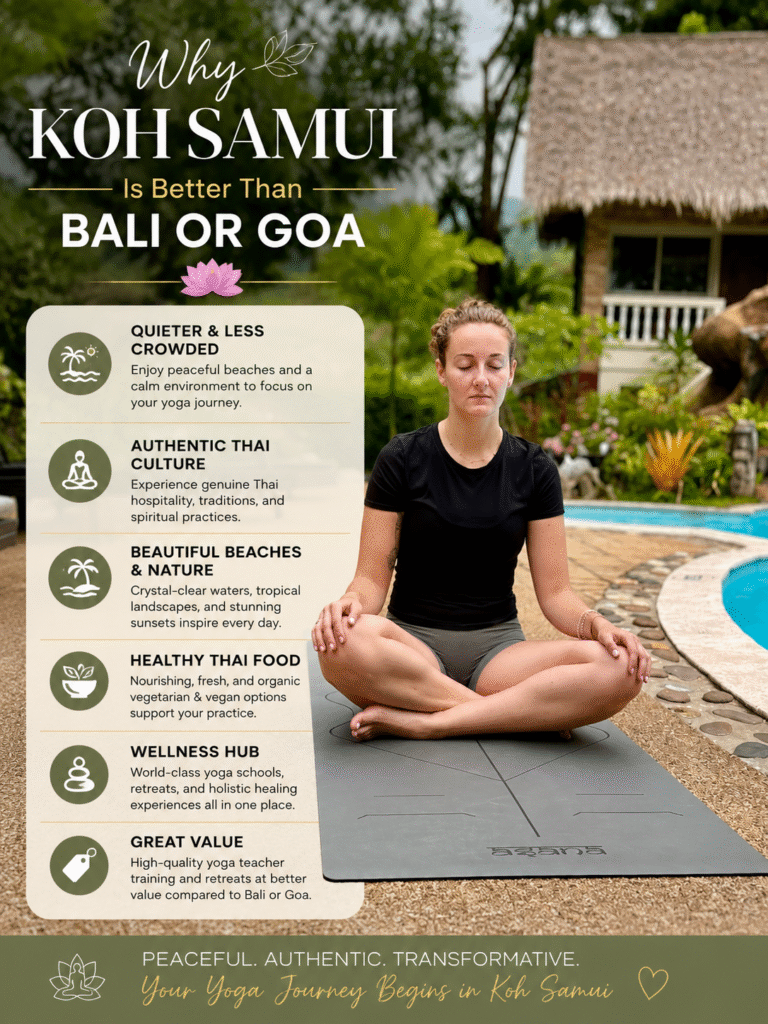
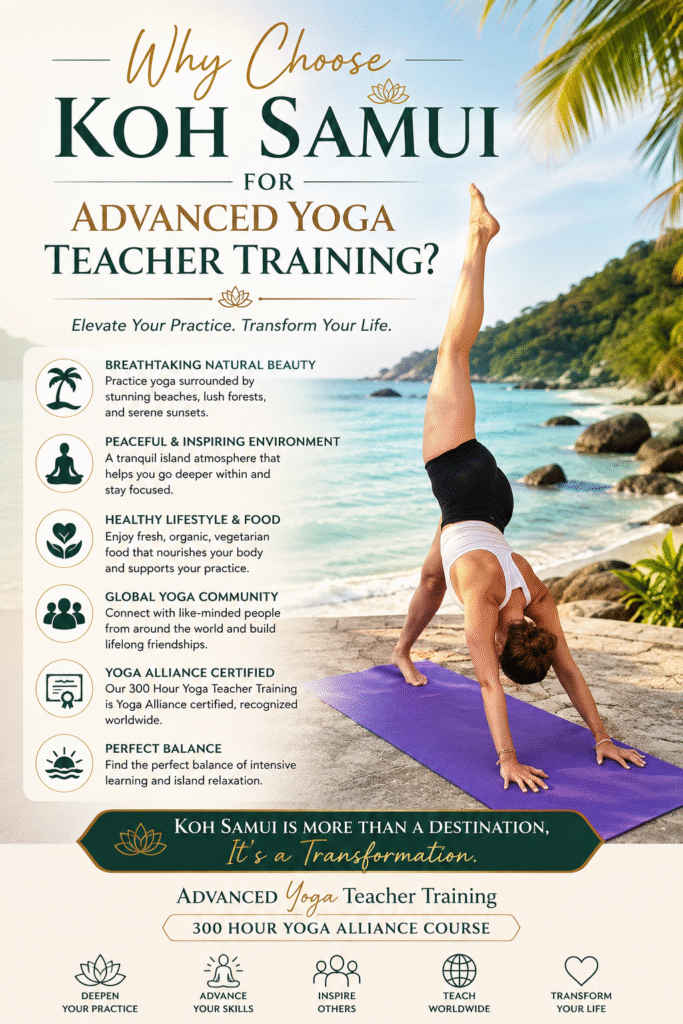
Why Choose Koh Samui for Advanced Yoga Teacher Training?
A Tropical Island That Supports Deep Learning
Choosing the right destination for your advanced yoga training is just as important as choosing the right school.
Koh Samui is one of Thailand’s most beautiful islands, known for its white sandy beaches, swaying coconut palms, lush tropical landscapes, and peaceful atmosphere. Unlike busy cities filled with constant distractions, the island naturally encourages a slower pace of life. This allows students to fully immerse themselves in their studies while also enjoying moments of rest and reflection.
Every day begins with the sound of the ocean, fresh tropical air, and the quiet energy of the island. Morning meditation feels more profound as the sun rises over the sea, while evening walks along the beach provide space to reflect on everything learned during the day.
Training in Koh Samui is about more than attending classes. It is about experiencing a lifestyle that supports balance, mindfulness, and personal growth.
The island’s warm climate allows for year-round outdoor practice, while its abundance of fresh fruits, nourishing vegetarian cuisine, and natural beauty complements the yogic lifestyle. Between intensive training sessions, students often spend time relaxing on the beach, visiting temples, exploring local markets, or simply enjoying moments of silence in nature.
Many graduates tell us that Koh Samui became an important teacher in its own right. The calm surroundings encouraged them to slow down, become more present, and reconnect with themselves away from the demands of everyday life.
For teachers seeking not only professional development but also genuine personal transformation, Koh Samui offers an environment that is both inspiring and deeply restorative.
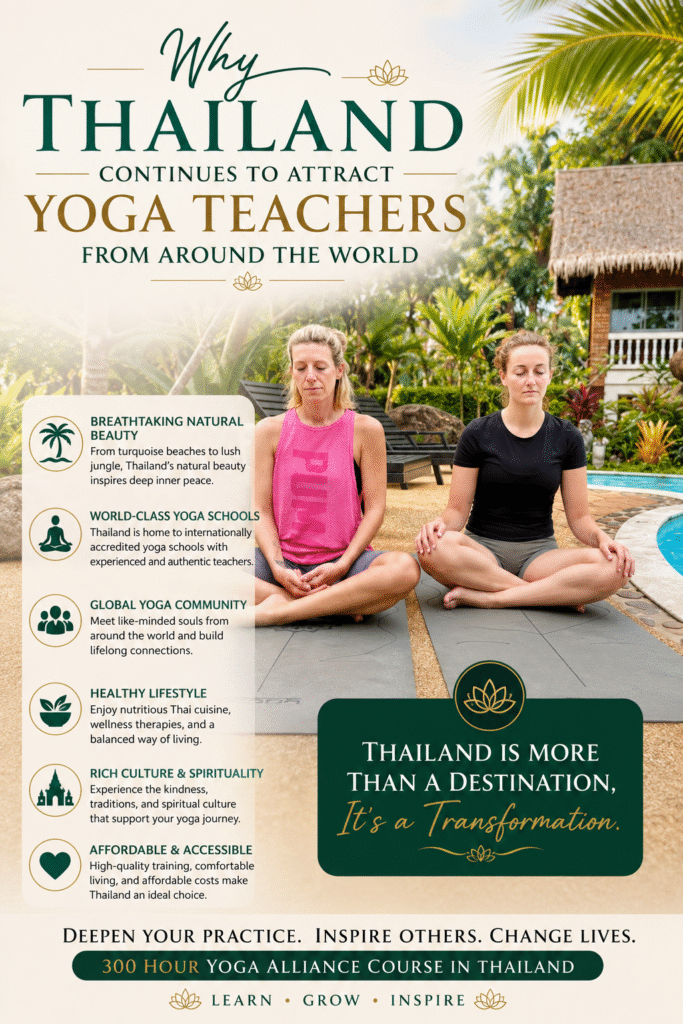
Why Thailand Continues to Attract Yoga Teachers from Around the World
Thailand has become one of the world’s most popular destinations for yoga teacher training, and for good reason.
Students from Europe, North America, Australia, Asia, and beyond choose Thailand because it offers a unique combination of affordability, natural beauty, cultural richness, and internationally recognised yoga education.
For advanced practitioners, the country provides an ideal setting to step away from routine, reduce distractions, and dedicate several weeks entirely to practice and study.
At Diksha Yoga School, we have welcomed students from many different countries, each bringing their own experiences, perspectives, and intentions. Learning alongside an international community creates meaningful discussions, lasting friendships, and a deeper appreciation for yoga as a universal practice that connects people across cultures.
Your time in Koh Samui becomes much more than a certification—it becomes a shared journey of learning, growth, and transformation.
Koh Samui vs Bali vs Goa: Which Destination Is Best for Your 300 Hour Yoga Alliance Course?
Before choosing a yoga school, many students first compare destinations. Bali, Goa, and Koh Samui are all popular choices for 300 Hour Yoga Alliance Course, but each offers a different experience. The right destination depends on what you hope to gain from your training.
If your goal is to deepen your practice with fewer distractions, a peaceful environment, and a supportive learning atmosphere, Koh Samui offers several unique advantages.
| Feature | Koh Samui, Thailand | Bali, Indonesia | Goa, India |
| Atmosphere | Peaceful island with a relaxed pace | Vibrant and energetic | Lively during the season |
| Crowds | Smaller crowds in many areas | Popular tourist destination | Can be busy in peak months |
| Beaches | Quiet tropical beaches | Beautiful but often busier | Great beaches with seasonal tourism |
| Environment for Study | Calm and focused | More nightlife and activities nearby | Depends on the season and location |
| Climate | Warm tropical weather most of the year | Tropical and humid | Tropical with a pronounced monsoon season |
| Lifestyle | Wellness-focused | Strong digital nomad culture | Mix of yoga, tourism, and local culture |
| Ideal For | Students seeking deep immersion | Students wanting yoga plus travel | Students wanting a traditional India experience |
Every destination has something special to offer. Bali is known for its vibrant wellness community, Goa offers a rich connection to India’s yoga culture, and Koh Samui provides a peaceful island setting that many students find ideal for immersive learning and personal reflection.
At Diksha Yoga School, we chose Koh Samui because it creates an environment where students can step away from everyday distractions, focus on their studies, and enjoy the balance of structured learning and restorative island life.
Part 2: Why Choose Diksha Yoga School for Your 300 Hour Yoga Alliance Course
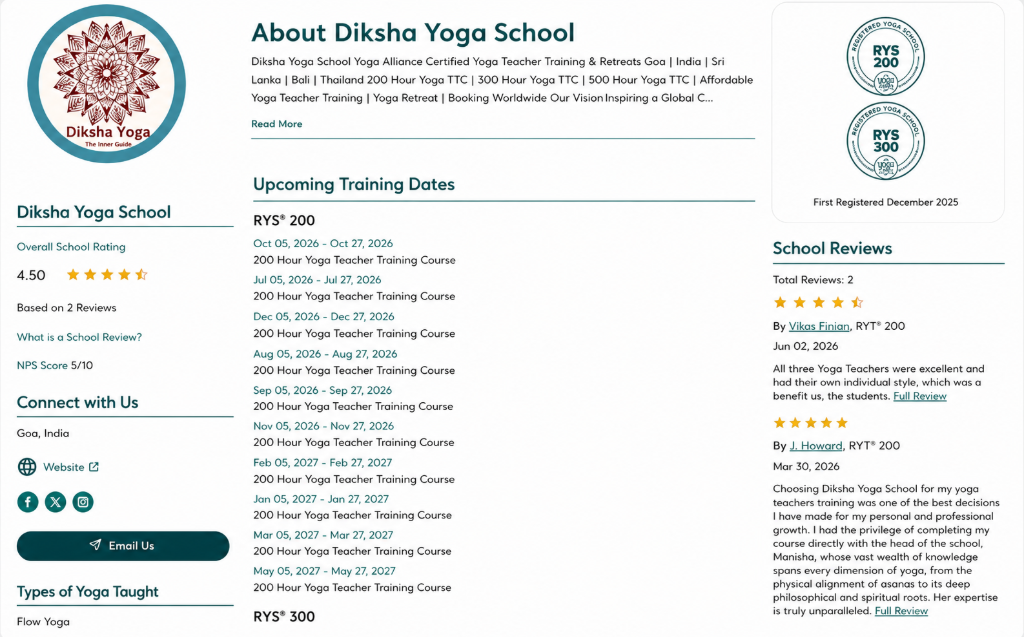
Continue Your Journey with Experienced Mentors
Choosing a 300 Hour Yoga Alliance Course is a significant decision. By this stage, you are no longer searching for your first certification—you are looking for teachers who can challenge your understanding, refine your skills, and support your continued growth.
Many yoga teachers complete their 200-hour training only to discover that every school teaches differently. Some focus heavily on physical practice, while others emphasise philosophy or meditation. The key is finding a program that brings these elements together in a balanced and practical way.
At Diksha Yoga School, our goal is to help you become more than a certified yoga teacher. We aim to help you become a teacher who understands why each practice matters, how to adapt it for different students, and when to apply it with confidence and compassion.
Our advanced training is designed to create knowledgeable, thoughtful, and authentic teachers who can confidently guide students in studios, retreats, private sessions, and wellness centres anywhere in the world.
A School Built on Experience, Not Trends
Today, yoga has become increasingly popular around the world. While this has made yoga more accessible, it has also created an overwhelming number of teacher training courses.
Many programs promise quick certifications or focus primarily on social media-friendly poses. At Diksha Yoga School, we believe yoga deserves a deeper approach.
Our curriculum is rooted in traditional yogic principles while embracing modern knowledge of anatomy, movement science, and effective teaching methods. We encourage our students to ask questions, explore different perspectives, and develop their own authentic teaching voice rather than simply copying a sequence.
Yoga is a lifelong practice of learning, and we strive to create an environment where curiosity and self-discovery are just as important as technical knowledge.
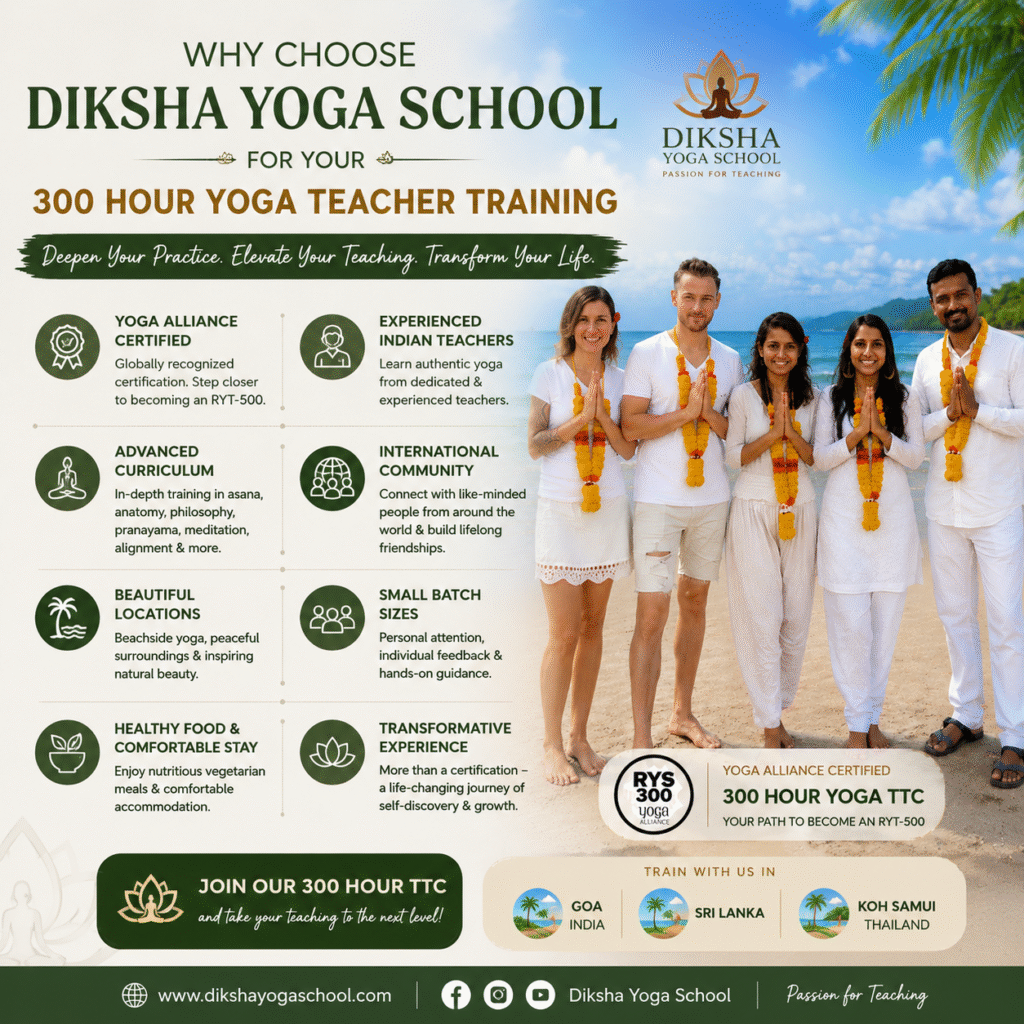
Learn from Teachers Who Continue to Practice Every Day
One of the most valuable aspects of any advanced yoga training is the quality of the teachers guiding you.
Our faculty believes that teaching yoga begins with continuing to be a student.
Rather than teaching from theory alone, our instructors bring years of practical experience in leading teacher trainings, workshops, retreats, and regular yoga classes. Every lesson is supported by real-life teaching experience, allowing students to understand how yogic principles apply in everyday practice.
Throughout the training, our teachers share not only techniques but also the lessons they have learned from years of working with students of different ages, abilities, and backgrounds.
This creates a learning experience that feels personal, practical, and deeply inspiring.
Small Groups Create Better Teachers
One of the reasons students choose Diksha Yoga School is our commitment to maintaining small class sizes.
Many larger teacher training programs welcome dozens of students into a single course. While this allows schools to accommodate more participants, it often limits personal interaction with the teaching team.
We have intentionally chosen a different approach.
Smaller groups allow us to give every student individual attention throughout the training.
This means you receive:
- Personal alignment guidance
- Individual teaching feedback
- One-to-one mentoring throughout the course
- Time to ask questions during class
- Detailed observations during teaching practice
- Support that matches your own pace of learning
Whether you are confident from the beginning or still discovering your teaching style, our mentors are there to guide you every step of the way.
Many of our graduates tell us that this personal support became one of the most valuable parts of their experience.
A Safe and Supportive Learning Environment
Learning becomes easier when students feel comfortable asking questions.
We understand that every participant arrives with different experiences. Some have already been teaching for several years, while others have completed their 200-hour certification only recently.
There is no expectation that everyone begins at the same level.
Instead, we encourage an atmosphere of respect, openness, and collaboration where students learn from both their teachers and one another.
Mistakes are welcomed as opportunities for growth, and constructive feedback is always given with kindness and clarity.
By creating a supportive environment, students gain the confidence to experiment, refine their teaching, and develop their own authentic style.
Our Teaching Philosophy
At Diksha Yoga School, we believe yoga is much more than physical exercise.
A truly effective yoga teacher understands that every student arrives with a unique body, life experience, and intention.
Instead of teaching students to fit into a posture, we teach future teachers how to adapt yoga to suit the individual.
This philosophy influences every aspect of our curriculum.
Throughout the course, you’ll learn to:
- Observe before you instruct.
- Listen before you adjust.
- Teach with awareness rather than assumption.
- Prioritise safety over aesthetics.
- Encourage progress instead of perfection.
- Create inclusive classes that welcome all levels.
These principles help teachers build trust with their students and create classes where everyone feels supported.
Who Is This 300 Hour Yoga Alliance Course For?
Our advanced course welcomes yoga teachers from many different backgrounds.
This training may be the right next step if you:
- Have completed a 200 Hour Yoga Teacher Training.
- Want to deepen your understanding of yoga beyond the basics.
- Feel ready to teach with more confidence.
- Wish to improve your knowledge of anatomy and biomechanics.
- Want to offer safer and more effective adjustments.
- Dream of leading retreats or workshops.
- Plan to teach internationally.
- Hope to specialise in advanced yoga education.
- Want to reconnect with your own personal practice.
Whether you currently teach every day or only occasionally, the course provides practical knowledge that can immediately enhance your teaching.
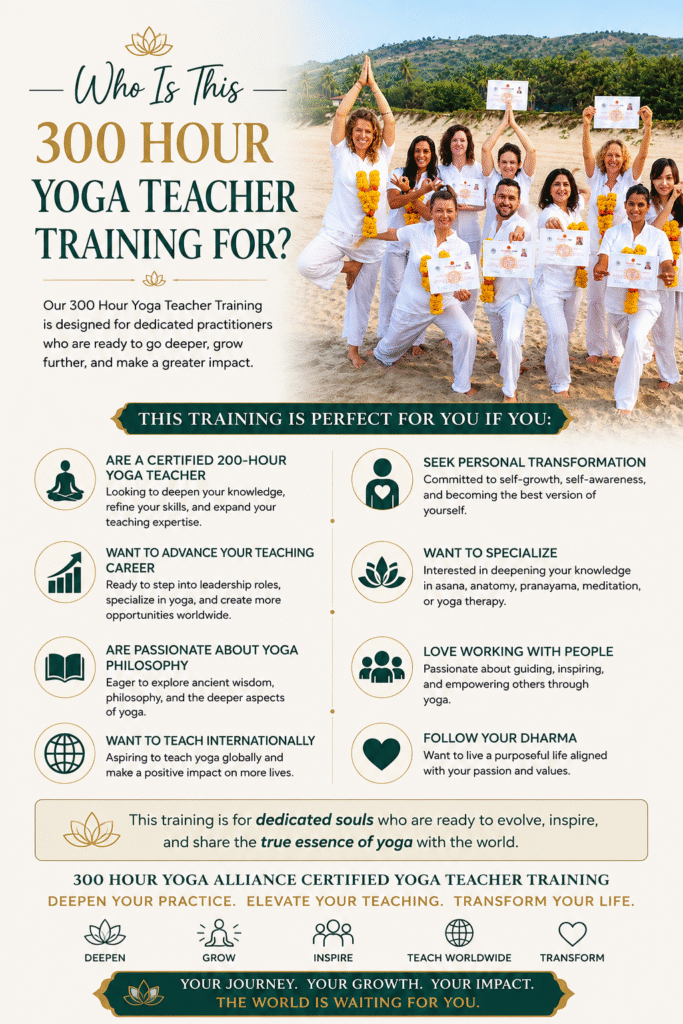
More Than a Certification
Many students arrive believing they are coming to earn another certificate.
They leave with something much more valuable.
Over the weeks of training, you’ll notice subtle but meaningful changes—not only in your teaching but also in the way you observe, communicate, breathe, and move through daily life.
You’ll begin to see yoga less as a series of poses and more as a lifelong practice of awareness.
You’ll become more confident in your decisions as a teacher, more adaptable in your approach, and more comfortable trusting your own intuition.
These qualities cannot be measured by an exam, yet they are often the greatest transformation our graduates experience.
Learn Alongside an International Yoga Community
One of the unique aspects of studying in Thailand is the opportunity to meet students from around the world.
Every training brings together people with different cultures, professions, and life experiences, all connected by a shared passion for yoga.
During the course, you’ll practice together, teach one another, exchange ideas, and build friendships that often continue long after graduation.
Many of our alumni return to visit, attend advanced workshops, or collaborate with fellow graduates in retreats and yoga events across the world.
The connections you build during your training often become just as meaningful as the knowledge you gain.
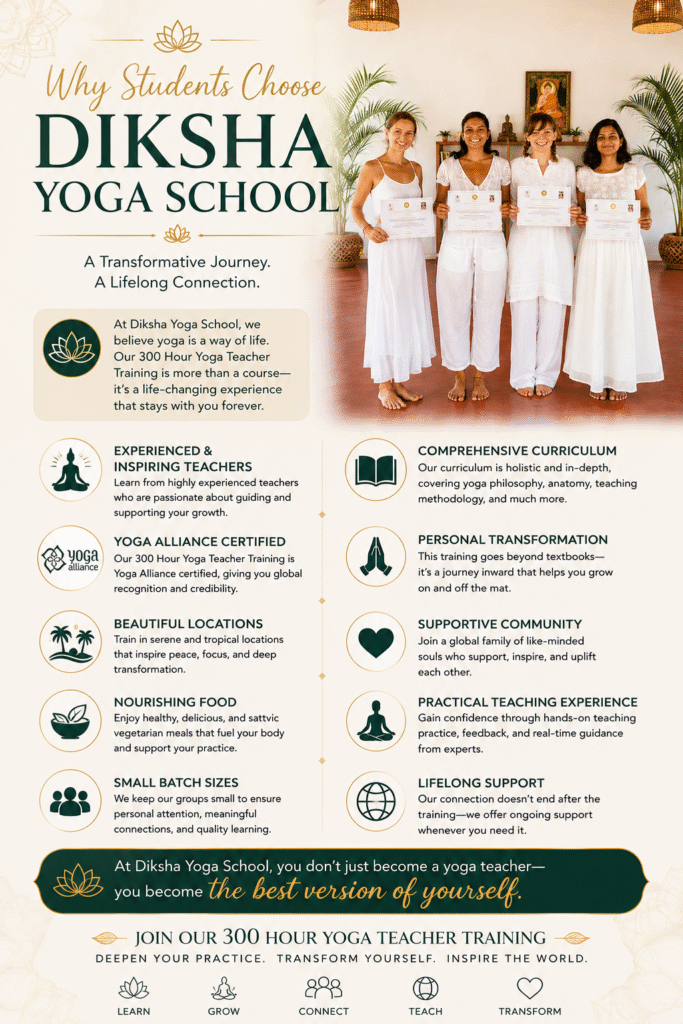
Why Students Choose Diksha Yoga School
Students consistently choose Diksha Yoga School because we offer:
- ✔️ Yoga Alliance Registered 300 Hour Yoga Alliance Course
- ✔️ Small groups with personal attention
- ✔️ Experienced and supportive teachers
- ✔️ Traditional yoga combined with modern anatomy
- ✔️ Daily meditation and pranayama practice
- ✔️ Practical teaching experience and feedback
- ✔️ Comfortable accommodation in Koh Samui
- ✔️ Healthy vegetarian meals
- ✔️ Airport pickup and organised excursions
- ✔️ A welcoming international yoga community
These elements come together to create an immersive learning experience that supports both professional development and personal transformation.
Part 3: Complete 300 Hour Yoga Alliance Course Curriculum
A 300-hour yoga teacher training should do more than introduce advanced postures. It should help you understand how to teach with confidence, adapt to different students, and deepen your own practice. That philosophy shapes every module at Diksha Yoga School.
Our curriculum is carefully designed to balance traditional yogic wisdom with modern teaching methods. Each day builds on the previous one, allowing you to integrate new knowledge through practice, observation, discussion, and teaching experience.
Rather than overwhelming students with information, we focus on helping you understand why each technique matters and how to apply it effectively in real-life classes.
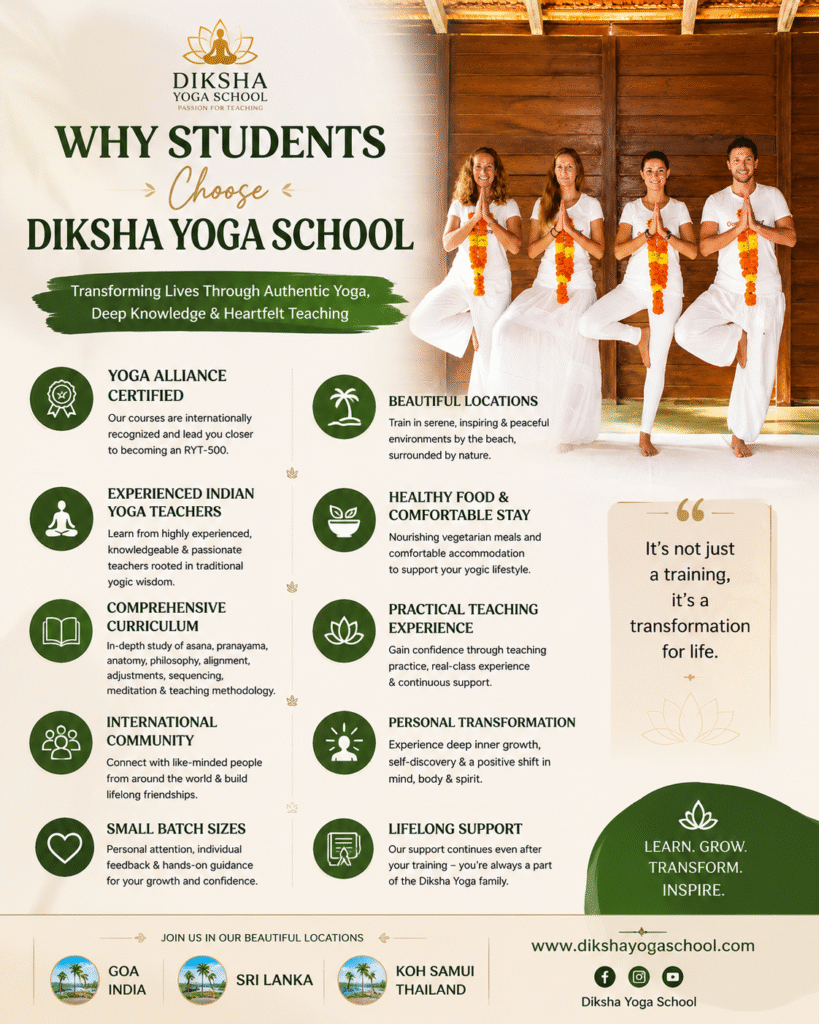
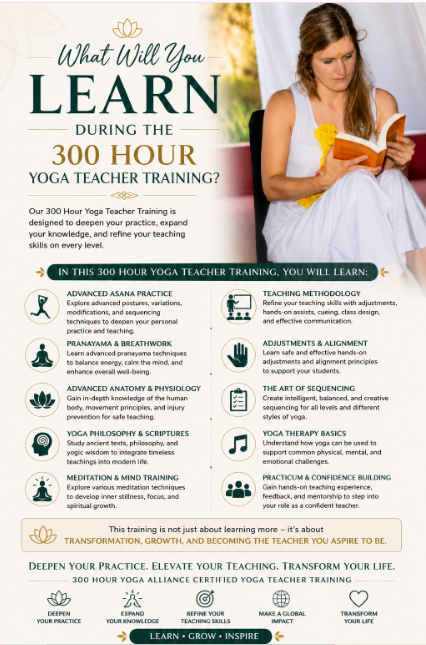
What Will You Learn During the 300 Hour Yoga Alliance Course?
The course follows the educational standards of a Yoga Alliance Registered 300 Hour Yoga Alliance Course while going beyond the minimum requirements to offer a richer and more practical learning experience.
Throughout the training, you will develop advanced skills in:
- Advanced Hatha Yoga
- Advanced Vinyasa Flow
- Functional Anatomy and Biomechanics
- Intelligent Class Sequencing
- Yoga Philosophy
- Meditation
- Pranayama
- Teaching Methodology
- Hands-On Adjustments
- Yoga Nidra
- Ayurveda
- Professional Teaching Practice
Every subject is interconnected, helping you become a well-rounded and confident yoga teacher.
Advanced Hatha Yoga: Mastering Stability, Awareness, and Precision
Hatha Yoga remains the foundation of our advanced teacher training.
While many people associate Hatha Yoga with slower movement, experienced practitioners know that it requires exceptional concentration, alignment, strength, and breath awareness.
In this module, we move beyond simply holding postures. You will explore the subtle actions within each pose and understand how small adjustments can completely transform the experience of an asana.
Topics include:
- Advanced standing postures
- Hip-opening practices
- Deep forward folds
- Twisting postures
- Advanced backbends
- Balance postures
- Preparations for inversions
- Safe transitions between postures
Students also learn how to modify these poses for practitioners with different levels of mobility, flexibility, and strength.
This approach prepares you to teach diverse groups with confidence rather than relying on one fixed sequence.
Advanced Vinyasa Flow: Creating Intelligent and Creative Sequences
A beautiful Vinyasa class is more than flowing from one posture to another.
It has rhythm, purpose, and balance.
During this module, you’ll learn how to design classes that are physically challenging while remaining safe and accessible.
You’ll explore:
- Breath-led movement
- Intelligent transitions
- Peak pose sequencing
- Progressive warm-ups
- Creative transitions
- Balancing strength and flexibility
- Counterposes and recovery
- Building themed classes
As your confidence grows, you’ll begin creating your own sequences and teaching them to fellow trainees under the guidance of experienced instructors.
Through constructive feedback, you’ll refine your cueing, pacing, and class structure.
Understanding the Purpose Behind Every Sequence
One of the most common mistakes new teachers make is selecting postures randomly.
A strong yoga class should feel intentional from beginning to end.
Throughout the training, you’ll discover how to sequence classes that prepare the body gradually, reduce the risk of injury, and create a meaningful experience for students.
You’ll learn how to sequence for:
- Beginners
- Intermediate practitioners
- Advanced practitioners
- Mixed-level classes
- Private sessions
- Workshop-style classes
- Therapeutic yoga
- Dynamic Vinyasa
- Gentle Hatha Yoga
Understanding sequencing allows you to adapt your teaching to different environments and student needs rather than relying on memorised routines.
Asana Lab: Exploring Yoga Beyond the Final Pose
One of the most exciting parts of the course is our dedicated Asana Lab.
This is where curiosity is encouraged.
Instead of rushing through postures, we slow down and examine each movement in detail.
Questions explored during these sessions include:
- Which muscles are working?
- Which joints require protection?
- What common alignment mistakes occur?
- Which verbal cues are most effective?
- When should hands-on adjustments be used?
- How can props improve accessibility?
- What modifications support different body types?
By studying movement from multiple perspectives, you’ll become more confident in both your own practice and your teaching.
Arm Balances: Building Strength Through Technique
Many students believe arm balances depend only on upper-body strength.
In reality, they rely on coordination, stability, breath awareness, and intelligent weight distribution.
During this module, you’ll safely explore arm balances such as:
- Crow Pose (Bakasana)
- Side Crow (Parsva Bakasana)
- Eight-Angle Pose (Astavakrasana)
- Firefly Pose (Tittibhasana)
- Flying Pigeon variations
- Forearm balance preparations
Rather than focusing on achieving the final posture, you’ll learn progressive techniques that make these poses approachable for a wide range of students.
As a teacher, understanding these progressions allows you to guide students safely without creating unnecessary pressure or fear.
Inversions: Confidence Through Safe Progression
Inversions often represent a major milestone in yoga practice.
However, they should never be approached with haste.
During the course, you’ll explore the principles behind inversions, including:
- Shoulder stability
- Core engagement
- Spinal alignment
- Balance awareness
- Entry and exit techniques
- Spotting methods
- Safe teaching progressions
Postures may include:
- Headstand (Sirsasana)
- Forearm Stand (Pincha Mayurasana)
- Handstand preparation (Adho Mukha Vrksasana)
- Shoulder Stand (Sarvangasana)
- Plough Pose (Halasana)
Our teachers emphasise proper preparation, helping you understand when a student is ready to progress and when modifications are more appropriate.
Backbends: Opening with Awareness
Backbends can be energising and transformative when practised correctly.
They also require patience, mobility, and careful preparation.
Throughout this module, you’ll study:
- Shoulder opening techniques
- Thoracic spine mobility
- Hip flexor release
- Safe spinal extension
- Breath awareness during backbends
- Counterposes for recovery
Advanced postures may include:
- Wheel Pose (Urdhva Dhanurasana)
- Camel Pose (Ustrasana)
- King Pigeon preparations
- Forearm Wheel variations
- Drop-back progressions
Students also learn how to recognise limitations, avoid compression, and create intelligent backbend sequences for different levels.
Hip Openers and Mobility Training
Healthy hips contribute to stability, balance, and freedom of movement.
Rather than forcing flexibility, we focus on sustainable mobility and joint awareness.
Topics include:
- External and internal hip rotation
- Hip anatomy
- Active versus passive flexibility
- Safe stretching techniques
- Mobility drills
- Props for support
- Yin-inspired approaches
- Functional movement patterns
These skills help teachers design classes that improve mobility without compromising safety.
Teaching Beyond Physical Practice
As your technical skills develop, you’ll also begin teaching complete classes throughout the training.
These sessions include:
- Lesson planning
- Voice projection
- Demonstration techniques
- Student observation
- Time management
- Giving and receiving feedback
- Building confidence in front of a class
Each teaching session is followed by constructive feedback from senior teachers, helping you recognise your strengths and identify areas for continued growth.
By graduation, you’ll have gained valuable teaching experience that prepares you for professional classes rather than simply theoretical knowledge.
A Curriculum That Supports Lifelong Learning
One of the greatest benefits of an advanced teacher training is learning how to continue growing after graduation.
Instead of memorising information for an exam, you’ll develop the ability to ask better questions, observe more carefully, and approach yoga with curiosity and humility.
This mindset allows your practice and teaching to evolve naturally over time.
At Diksha Yoga School, we believe the most inspiring teachers are those who remain lifelong students.
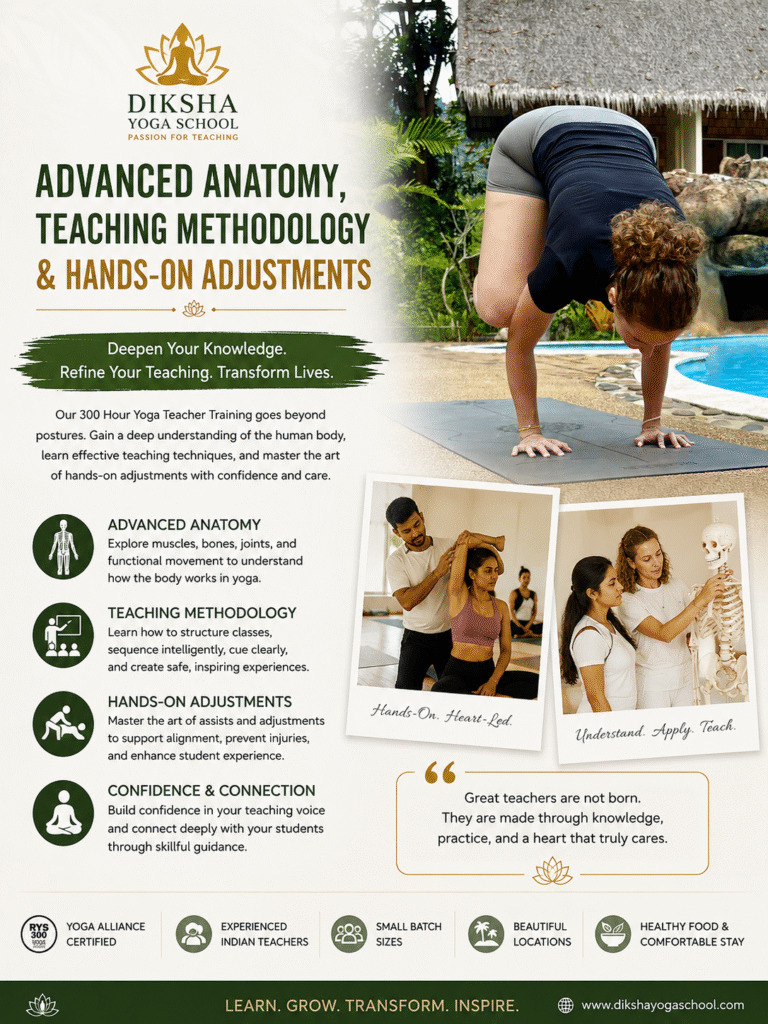
Part 4: Advanced Anatomy, Teaching Methodology & Hands-On Adjustments
One of the biggest differences between a good yoga teacher and an exceptional one is not the number of advanced postures they can perform—it’s their understanding of the human body.
As teachers gain experience, they quickly realise that no two students move in the same way. A cue that works beautifully for one person may not work for another. Some students have naturally mobile joints, while others require more stability. Previous injuries, posture, age, lifestyle, and even stress levels all influence how someone experiences a yoga practice.
This is why anatomy becomes one of the most valuable subjects in a 300 Hour Yoga Alliance Course.
At Diksha Yoga School, anatomy is not taught as a separate academic subject filled with complicated terminology. Instead, it is integrated into your daily practice so that every lesson helps you understand how movement, breath, and alignment work together.
By the end of this module, you’ll not only understand the body better—you’ll teach with greater confidence, precision, and compassion.
Advanced Yoga Anatomy for Yoga Teachers
Understanding anatomy transforms the way you teach.
Instead of simply asking students to copy a posture, you’ll begin to observe how each individual body moves and learn how to adapt your instructions accordingly.
Throughout this module, you’ll study:
- Skeletal anatomy relevant to yoga
- Major muscle groups and their functions
- Joint mobility and stability
- The spine and healthy movement patterns
- Shoulder and hip mechanics
- Knee alignment and protection
- Core stability
- The role of fascia in movement
Rather than memorising every anatomical term, you’ll focus on practical knowledge that directly improves your teaching.
Every concept is connected to real yoga postures, making anatomy easier to understand and apply in your classes.
Functional Biomechanics: Understanding How the Body Moves
Biomechanics helps us understand why the body moves the way it does.
This knowledge allows teachers to recognise inefficient movement patterns and guide students towards healthier alignment.
During this module, you’ll explore:
Movement Rather Than Shapes
Yoga is not about forcing every body into the same shape.
Instead, you’ll learn to observe:
- Joint movement
- Weight distribution
- Balance
- Stability
- Muscle engagement
- Breath coordination
This perspective helps teachers work with the body instead of against it.
Individual Differences Matter
One of the most important lessons in advanced training is understanding that every skeleton is unique.
Some students naturally have:
- Deeper hip sockets
- Greater shoulder mobility
- Limited spinal extension
- Longer limbs
- Different pelvic structures
These natural variations influence how postures look and feel.
Rather than expecting every student to achieve the same aesthetic shape, you’ll learn to teach according to functional movement and individual ability.
This approach creates safer and more inclusive yoga classes.
Injury Prevention: Teaching with Awareness
Many yoga injuries are not caused by difficult postures.
They often result from repeating movements without awareness or progressing too quickly.
As a teacher, your role is not simply to guide movement but to recognise when students need additional support or alternative options.
Topics covered include:
- Recognising common movement compensations
- Understanding overuse injuries
- Safe progression into advanced postures
- Recovery strategies
- Working with beginners
- Supporting older practitioners
- Teaching students returning after injury
You’ll also discuss when it is appropriate to modify a posture and when it is best to encourage rest.
Learning to make these decisions is an essential part of becoming a responsible yoga teacher.
Intelligent Alignment Instead of Perfect Alignment
For many years, yoga was taught using the idea that there is one “correct” way to perform every posture.
Modern understanding tells us otherwise.
Alignment is important—but it should always respect the unique structure of each body.
At Diksha Yoga School, we encourage teachers to focus on:
- Stability before flexibility
- Comfort before appearance
- Breath before depth
- Awareness before achievement
This philosophy helps students develop sustainable practices rather than chasing perfect-looking postures.
Hands-On Adjustments: Teaching with Respect and Consent
Hands-on adjustments can be one of the most supportive tools available to a yoga teacher when offered thoughtfully.
They can help students experience greater stability, awareness, and confidence within a posture.
However, adjustments should never be used to force a body into deeper positions or create discomfort.
Throughout this module, students learn how to approach adjustments with professionalism, sensitivity, and clear communication.
The Importance of Consent
Before making any physical adjustment, permission should always be requested.
Students have different comfort levels, cultural backgrounds, and personal experiences.
Creating a respectful environment means allowing every student to choose whether they would like hands-on assistance.
Consent is not simply a formality—it is an important part of building trust between teacher and student.
Practical Adjustment Skills
You’ll practice:
- Observation before adjustment
- Clear communication
- Safe hand placement
- Direction of support
- When verbal cues are more effective
- Using props instead of physical contact
- Supporting balance safely
- Assisting different body types
Every adjustment is demonstrated, practised, and refined under the guidance of experienced teachers.
Teaching Methodology: Becoming a Confident Teacher
Knowing yoga and teaching yoga are two very different skills.
Many newly certified teachers understand the practice but struggle to communicate clearly once they begin leading classes.
This module focuses on transforming knowledge into confident teaching.
You’ll develop practical skills in:
- Verbal cueing
- Demonstration techniques
- Class pacing
- Voice projection
- Reading the room
- Building student confidence
- Managing mixed-level classes
- Maintaining class energy
By teaching regularly throughout the course, you’ll gradually become more comfortable leading groups with clarity and authenticity.
Learning to Observe Before You Speak
One of the most valuable habits a yoga teacher can develop is observation.
Before offering corrections, experienced teachers first take time to notice:
- How a student enters the posture
- Breathing patterns
- Signs of tension
- Balance and stability
- Facial expressions
- Areas of effort and ease
Observation allows your teaching to become more responsive rather than automatic.
Students feel seen, understood, and supported rather than corrected.
The Art of Effective Cueing
Simple language often creates the most powerful classes.
During your training, you’ll learn how to replace overly complicated instructions with cues that are:
- Clear
- Precise
- Easy to visualise
- Accessible for beginners
- Helpful for experienced practitioners
You’ll also learn when silence can be just as valuable as speaking.
Sometimes giving students space to explore a posture independently creates deeper awareness than constant instruction.
Teaching Different Body Types
Every yoga class includes students with unique bodies, goals, and experiences.
An excellent teacher knows how to adapt rather than expecting students to fit one ideal.
You’ll explore teaching strategies for:
- Beginners
- Older adults
- Flexible students
- Strength-focused practitioners
- Students with limited mobility
- Athletes
- Office workers
- Mixed-level groups
This knowledge allows you to create classes where everyone feels included and capable.
Teaching Practice and Personal Feedback
Throughout the training, teaching is not limited to one final assessment.
Instead, you’ll teach regularly, receive personalised feedback, and continue refining your skills.
Each practice teaching session helps you improve:
- Class planning
- Cueing
- Demonstration
- Presence
- Confidence
- Professionalism
Our teachers provide supportive feedback that encourages growth while helping you develop your own authentic teaching style.
The goal is not to imitate another teacher but to discover your own voice.
Learning That Continues Beyond Graduation
Completing a 300 Hour Yoga Alliance Course is not the end of your education.
If anything, it marks the beginning of a deeper relationship with yoga.
The knowledge you gain in anatomy, biomechanics, teaching methodology, and observation will continue to influence your classes for years to come.
Many graduates tell us that these subjects changed the way they practise yoga just as much as the way they teach it.
When you understand the body more clearly, your teaching becomes safer, more adaptable, and more meaningful.
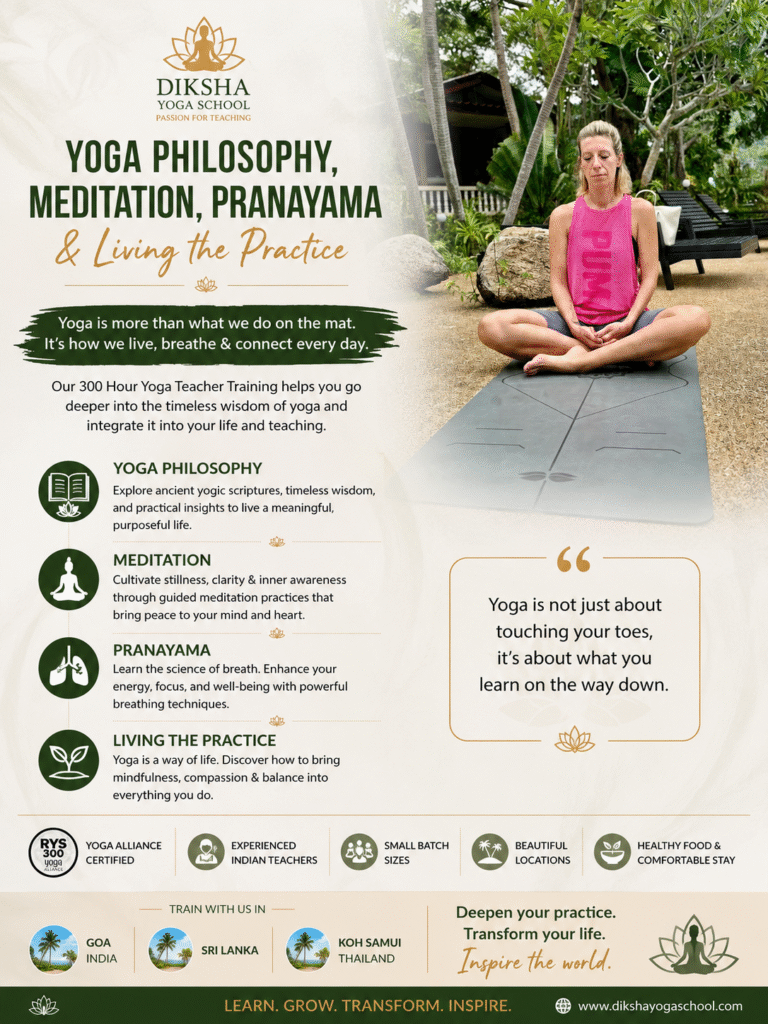
Part 5: Yoga Philosophy, Meditation, Pranayama & Living the Practice
As your yoga journey deepens, you begin to realise something important:
Yoga is not about mastering more postures. It is about understanding yourself more deeply.
Many students join a 300 Hour Yoga Alliance Course expecting to learn advanced arm balances, complex sequencing, or challenging inversions. While these are certainly valuable parts of the curriculum, they are only one aspect of becoming an experienced yoga teacher.
The heart of yoga lies in awareness.
It is found in the way you breathe during moments of stress, the compassion you show your students, the patience you cultivate in your own practice, and the presence you bring to every class.
At Diksha Yoga School, we believe that a truly advanced teacher is someone who embodies yoga—not only on the mat but in everyday life.
For this reason, philosophy, meditation, pranayama, and self-inquiry are woven into every day of the training rather than treated as separate subjects.
Yoga Philosophy: Bringing Ancient Wisdom into Modern Life
Many people imagine yoga philosophy as a collection of ancient texts that are difficult to understand.
In reality, yoga philosophy offers practical guidance for living with greater awareness, balance, and purpose.
Throughout this module, we explore how these teachings remain deeply relevant in today’s fast-paced world.
Instead of simply memorising verses, you’ll reflect on how yogic principles influence your teaching, your relationships, and your daily choices.
These discussions often become some of the most meaningful moments of the training, encouraging students to look inward and connect with their own experiences.
The Yoga Sutras of Patanjali
The Yoga Sutras provide one of the most influential foundations of classical yoga.
Rather than viewing yoga as a physical discipline alone, Patanjali presents yoga as a path toward greater clarity and inner peace.
During the course, you’ll explore key concepts including:
- The meaning of yoga
- The Eight Limbs of Yoga
- Cultivating discipline through practice
- Developing self-awareness
- Managing the fluctuations of the mind
- The importance of consistent practice and non-attachment
Instead of approaching these teachings academically, we’ll discuss how they can support modern yoga teachers in both personal life and professional practice.
The Eight Limbs of Yoga
Many yoga classes focus primarily on Asana, yet it is only one limb of the yogic path.
During your training, you’ll deepen your understanding of all Eight Limbs:
- Yama – Ethical principles for living with integrity.
- Niyama – Personal practices that support inner growth.
- Asana – Creating stability and comfort within the body.
- Pranayama – Expanding awareness through conscious breathing.
- Pratyahara – Turning attention inward.
- Dharana – Developing focused concentration.
- Dhyana – Sustaining meditation with ease.
- Samadhi – Experiencing unity and inner stillness.
Rather than teaching these concepts as theory alone, we encourage students to explore how they naturally unfold through consistent practice.
Exploring the Bhagavad Gita
The Bhagavad Gita is often described as one of the world’s greatest spiritual texts.
Within its teachings, we find guidance on courage, purpose, selfless action, and living with awareness.
During the training, we discuss themes such as:
- Understanding Dharma
- Acting without attachment to outcomes
- Balancing effort and surrender
- Making conscious decisions
- Remaining steady during challenges
These conversations often resonate deeply with yoga teachers, especially those navigating the responsibilities of guiding others while continuing their own personal journey.
Wisdom from the Hatha Yoga Pradipika
The Hatha Yoga Pradipika provides valuable insight into traditional yogic practices.
Students explore subjects including:
- The purpose of Hatha Yoga
- Pranayama practices
- Mudras
- Bandhas
- Cleansing techniques
- Meditation preparation
- Energy cultivation
Understanding these traditional teachings allows modern teachers to appreciate the roots of contemporary yoga practice.
Pranayama: The Bridge Between Body and Mind
Breath is at the centre of every yoga practice.
While many students first encounter pranayama during a 200-hour training, an advanced course provides the opportunity to experience these practices on a much deeper level.
Each day begins with guided pranayama sessions that encourage greater awareness, concentration, and vitality.
Throughout the course, you’ll develop both a personal practice and the confidence to teach breathwork safely.
Practices may include:
- Nadi Shodhana (Alternate Nostril Breathing)
- Ujjayi Pranayama
- Kapalabhati
- Bhastrika
- Sheetali and Sheetkari
- Bhramari (Humming Bee Breath)
You’ll also explore when each technique is appropriate, how to introduce pranayama gradually, and how breath influences the nervous system.
Understanding Bandhas
Bandhas are subtle internal locks that help direct and stabilise energy during practice.
Rather than approaching them as abstract concepts, you’ll experience how they support posture, breath, and movement.
Topics include:
- Mula Bandha
- Uddiyana Bandha
- Jalandhara Bandha
- Coordinating bandhas with pranayama
- Integrating bandhas into asana practice
With regular practice, these techniques create greater stability, efficiency, and awareness.
Meditation: Developing Presence
Meditation is often misunderstood as the practice of emptying the mind.
In reality, meditation teaches us to observe our thoughts without becoming controlled by them.
Throughout the training, students experience a variety of meditation techniques, allowing them to discover practices that feel authentic and sustainable.
Sessions may include:
- Breath awareness meditation
- Mindfulness meditation
- Loving-kindness meditation
- Chakra meditation
- Mantra meditation
- Silent sitting
- Walking meditation
- Guided visualisation
Over time, meditation becomes less about achieving a particular experience and more about cultivating consistent presence.
Yoga Nidra: Deep Rest and Restoration
Modern life often leaves people feeling physically tired yet mentally overstimulated.
Yoga Nidra offers an opportunity to experience profound relaxation while remaining consciously aware.
During this module, you’ll learn:
- The science behind Yoga Nidra
- Structuring a complete practice
- Voice guidance techniques
- Relaxation sequencing
- Teaching Yoga Nidra to different groups
Many graduates incorporate Yoga Nidra into their regular classes because of its ability to reduce stress and improve overall wellbeing.
Ayurveda: Supporting Balance Through Daily Living
Yoga and Ayurveda have supported one another for thousands of years.
While this course is not designed to create Ayurvedic practitioners, it introduces foundational concepts that complement yoga teaching.
You’ll explore:
- The three doshas
- Daily routines (Dinacharya)
- Seasonal living (Ritucharya)
- Yogic nutrition
- Lifestyle practices
- Rest and recovery
- Creating balance through simple daily habits
These principles help teachers support students in developing sustainable wellbeing beyond the yoga mat.
Ethics of Teaching Yoga
Knowledge alone does not make someone a respected teacher.
Integrity, compassion, and professionalism are equally important.
Throughout the course, we discuss ethical responsibilities including:
- Respecting student boundaries
- Professional communication
- Creating inclusive classes
- Teaching with humility
- Continuing education
- Understanding the teacher–student relationship
- Maintaining authenticity
We encourage teachers to recognise that every interaction with a student carries responsibility and trust.
Building a Sustainable Career as a Yoga Teacher
Many graduates hope to teach yoga professionally after completing their training.
However, success in teaching is not measured by social media followers or performing advanced postures.
A sustainable yoga career is built through consistency, knowledge, genuine relationships, and a commitment to serving students.
During this module, you’ll explore practical topics such as:
- Finding your unique teaching style
- Building confidence as a new teacher
- Teaching private sessions
- Leading workshops
- Retreat facilitation
- Creating long-term student relationships
- Continuing your professional development
These discussions prepare graduates not only to teach classes but to build meaningful careers within the yoga community.
Becoming the Teacher You Once Needed
One of the most beautiful transformations that occurs during an advanced teacher training is subtle.
You begin to teach less from memory and more from experience.
Instead of trying to impress your students, you learn to support them.
Instead of focusing on perfect demonstrations, you focus on helping others feel safe, confident, and connected.
This shift changes everything.
It transforms yoga from something you perform into something you live.
And that is the true purpose of an advanced yoga teacher training.
Part 6: Life at Diksha Yoga School, Certification, FAQs & Begin Your Next Chapter
Completing a 300 Hour Yoga Alliance Course in Koh Samui, Thailand is about much more than earning another certificate. It is an opportunity to dedicate time to yourself, deepen your understanding of yoga, and experience a way of living that many students carry with them long after the course has ended.
At Diksha Yoga School, we believe your learning continues beyond the yoga shala. The environment you live in, the food you eat, the people you meet, and the experiences you share all become part of your journey.
For nearly a month, you step away from daily routines and immerse yourself in a supportive community where every day is an opportunity to grow as both a teacher and an individual.
Your Home During the Training
One of the reasons students enjoy training with us is the peaceful environment of our course venue at Health Oasis Resort in Koh Samui.
Surrounded by tropical greenery and only a short distance from the beach, the resort provides a calm atmosphere that supports focused study while allowing time for rest and relaxation.
Students can choose comfortable accommodation designed to make their stay enjoyable throughout the training.
Whether you prefer the privacy of your own room or enjoy sharing the experience with another student, every space is designed to help you feel at home.
Nourishing Your Practice with Healthy Food
Yoga extends far beyond movement.
The food we eat influences our energy, concentration, and overall wellbeing.
Throughout the course, students enjoy freshly prepared vegetarian meals that support an active lifestyle and complement daily yoga practice.
Meals are carefully prepared using fresh ingredients and offer a balanced variety of:
- Seasonal vegetables
- Fresh tropical fruits
- Whole grains
- Plant-based proteins
- Herbal teas
- Healthy snacks
Sharing meals together also becomes an important part of the community experience, creating opportunities to connect with fellow students from around the world.
A Typical Day During the 300 Hour Yoga Alliance Course
Every day is thoughtfully structured to balance physical practice, academic learning, teaching experience, and personal reflection.
While schedules may vary slightly throughout the course, a typical day includes:
Early Morning
Morning Session
- Healthy Breakfast
- Yoga Philosophy
- Functional Anatomy
- Biomechanics
Afternoon
- Nutritious Lunch
- Rest and Self-Study
- Teaching Methodology
- Hands-on Adjustments
Evening
- Advanced Vinyasa Practice
- Teaching Practicum
- Group Discussion
- Meditation or Yoga Nidra
This balanced routine allows students to absorb new knowledge while maintaining their own physical and mental wellbeing.
What’s Included in Your Course
Your 300 Hour Yoga Alliance Course at Diksha Yoga School includes everything you need for a comfortable and immersive learning experience.
Your Course Includes
- ✔️ 300 Hour Yoga Alliance Course Registered Certification
- ✔️ Comfortable Accommodation
- ✔️ Daily Vegetarian Meals
- ✔️ Airport Pickup
- ✔️ Comprehensive Training Manual
- ✔️ Daily Yoga Classes
- ✔️ Anatomy & Philosophy Classes
- ✔️ Meditation & Pranayama Sessions
- ✔️ Teaching Practice
- ✔️ Hands-on Adjustment Training
- ✔️ Welcome Ceremony
- ✔️ Closing Ceremony
- ✔️ Excursions Around Koh Samui
- ✔️ Lifetime Memories and Global Community
Our goal is to allow you to focus entirely on your learning while we take care of the details.
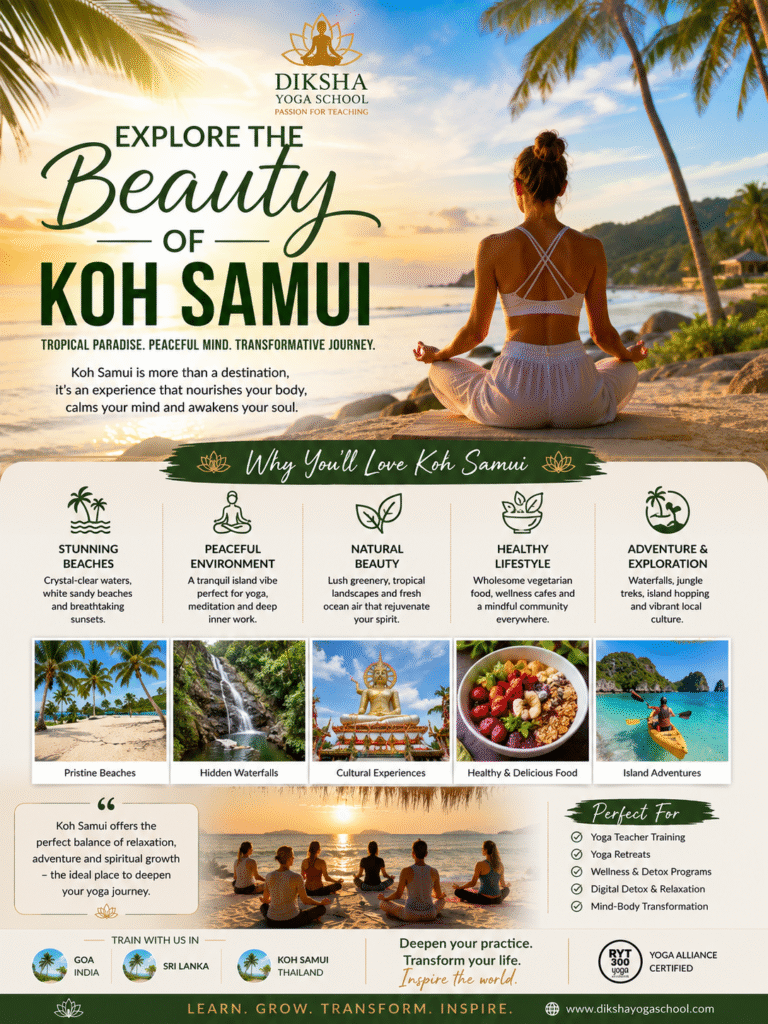
Explore the Beauty of Koh Samui
Learning also happens outside the classroom.
Throughout the training, students have opportunities to experience some of Koh Samui’s beautiful cultural and natural attractions.
Depending on the schedule, excursions may include visits to:
- Big Buddha Temple
- Peaceful beaches
- Local markets
- Scenic viewpoints
- Waterfalls
- Cultural landmarks
These experiences create wonderful moments of relaxation while allowing students to appreciate the unique spirit of the island.
Yoga Alliance Certification
After successfully completing the course, graduates receive a 300 Hour Yoga Alliance Course from Diksha Yoga School
This internationally recognised certification allows eligible graduates to continue their professional yoga teaching journey and, when combined with a qualifying 200-hour certification, work toward the educational requirements for a 500-hour Yoga Alliance pathway.
More importantly, you’ll leave with practical teaching experience, deeper knowledge, and increased confidence to support students safely and effectively.
Why Students Choose Diksha Yoga School
Every yoga school offers a curriculum.
What truly makes the difference is the learning experience.
Students choose Diksha Yoga School because they value:
- Personal attention in small groups
- Experienced and supportive teachers
- Traditional yoga taught with modern understanding
- Practical teaching experience
- A welcoming international community
- Beautiful island surroundings
- Comfortable accommodation
- Healthy vegetarian meals
- Authentic yogic lifestyle
- Lifelong friendships and professional connections
For many graduates, the people they meet become just as meaningful as the knowledge they gain.
Frequently Asked Questions
Do I need a 200 Hour Yoga Teacher Training before joining?
Yes. This advanced course is designed for students who have already completed a recognised 200-hour yoga teacher training.
Is this course suitable if I have only recently completed my 200-hour training?
Absolutely.
Many students continue directly into a 300-hour program to build confidence before beginning their teaching career.
Will I need to perform advanced yoga poses?
No.
Advanced yoga is not about achieving the most difficult posture.
We focus on intelligent progressions, safe teaching methods, and understanding movement rather than forcing flexibility.
Is this course Yoga Alliance certified?
Yes.
Diksha Yoga School is a Yoga Alliance Registered School, and graduates receive a recognised 300-hour certification upon successful completion.
Can international students join?
Yes.
Our students come from Europe, North America, South America, Australia, Asia, and many other parts of the world.
English is the language of instruction.
What should I bring?
Comfortable yoga clothing, a notebook, an open mind, and a willingness to learn.
We’ll provide the course materials needed for your training.
Will I have teaching practice?
Yes.
Teaching practice is one of the most valuable parts of the course.
You’ll receive regular opportunities to teach and personalised feedback from experienced instructors.
Are meals included?
Yes.
Daily vegetarian meals are included and carefully prepared to support your yoga practice and overall wellbeing.
Is airport pickup included?
Yes.
We provide airport pickup to help make your arrival in Koh Samui smooth and stress-free.
Can I teach internationally after completing the course?
Many graduates use their certification to teach in yoga studios, wellness centres, retreats, gyms, and private settings around the world, subject to local regulations and registration requirements.
Begin Your Next Chapter
Every yoga teacher reaches a point where they feel called to go deeper.
Not because they need another certificate, but because they want to understand yoga more completely.
The Advanced Yoga Teacher Training in Koh Samui, Thailand at Diksha Yoga School is designed for teachers who are ready to refine their knowledge, strengthen their confidence, and continue evolving with guidance from experienced mentors.
During your time with us, you’ll deepen your personal practice, improve your teaching skills, explore traditional yogic wisdom, and become part of an international community united by a shared love of yoga.
Whether your dream is to teach around the world, lead retreats, specialise in advanced education, or simply reconnect with the essence of your own practice, this training offers the space, support, and inspiration to help you move forward.
We look forward to welcoming you to Health Oasis Resort in Koh Samui, where your next chapter as a yoga teacher begins.

Continue Exploring Diksha Yoga School
To learn more and plan your journey, explore these helpful pages:
Testimonials Student …………………
⭐⭐⭐⭐⭐ 1. Emily Carter 🇨🇦 Canada
“The Best Decision for My Yoga Journey”
After completing my 200-hour training, I wanted a school that focused on authentic yoga rather than just certification. Diksha Yoga School exceeded every expectation. The anatomy classes, philosophy sessions, teaching methodology, and hands-on adjustments completely transformed my confidence as a teacher.
The peaceful environment, supportive teachers, and international community made every day inspiring. I returned to Canada feeling more knowledgeable, more confident, and truly connected to the essence of yoga.
— Emily Carter, Canada
⭐⭐⭐⭐⭐ 2. Lukas Schneider 🇩🇪 Germany
“More Than Advanced Training—A Complete Transformation”
I joined the 300 Hour Yoga Alliance Course to deepen my understanding of yoga, and I found much more than I expected. Every teacher shared their knowledge with genuine passion and patience. The curriculum was challenging, practical, and deeply rooted in traditional yoga.
The friendships I built with students from around the world made this experience unforgettable. I now teach with greater confidence and a much deeper understanding of yoga.
— Lukas Schneider, Germany
⭐⭐⭐⭐⭐ 3. Sofia Martinez 🇪🇸 Spain
“An Authentic Yoga Experience I’ll Never Forget”
From the very first day, I felt welcomed into a beautiful international yoga family. The balance between asana practice, meditation, pranayama, philosophy, and teaching practice was perfect.
The instructors gave personal guidance throughout the course, helping me refine my alignment and teaching skills. This training helped me grow not only as a yoga teacher but also as a person. I highly recommend Diksha Yoga School to anyone looking for an authentic 300 Hour Yoga Alliance Course.
— Sofia Martinez, Spain