Reviewed by Master Nirakar E-RYT 500 · Updated October 2026
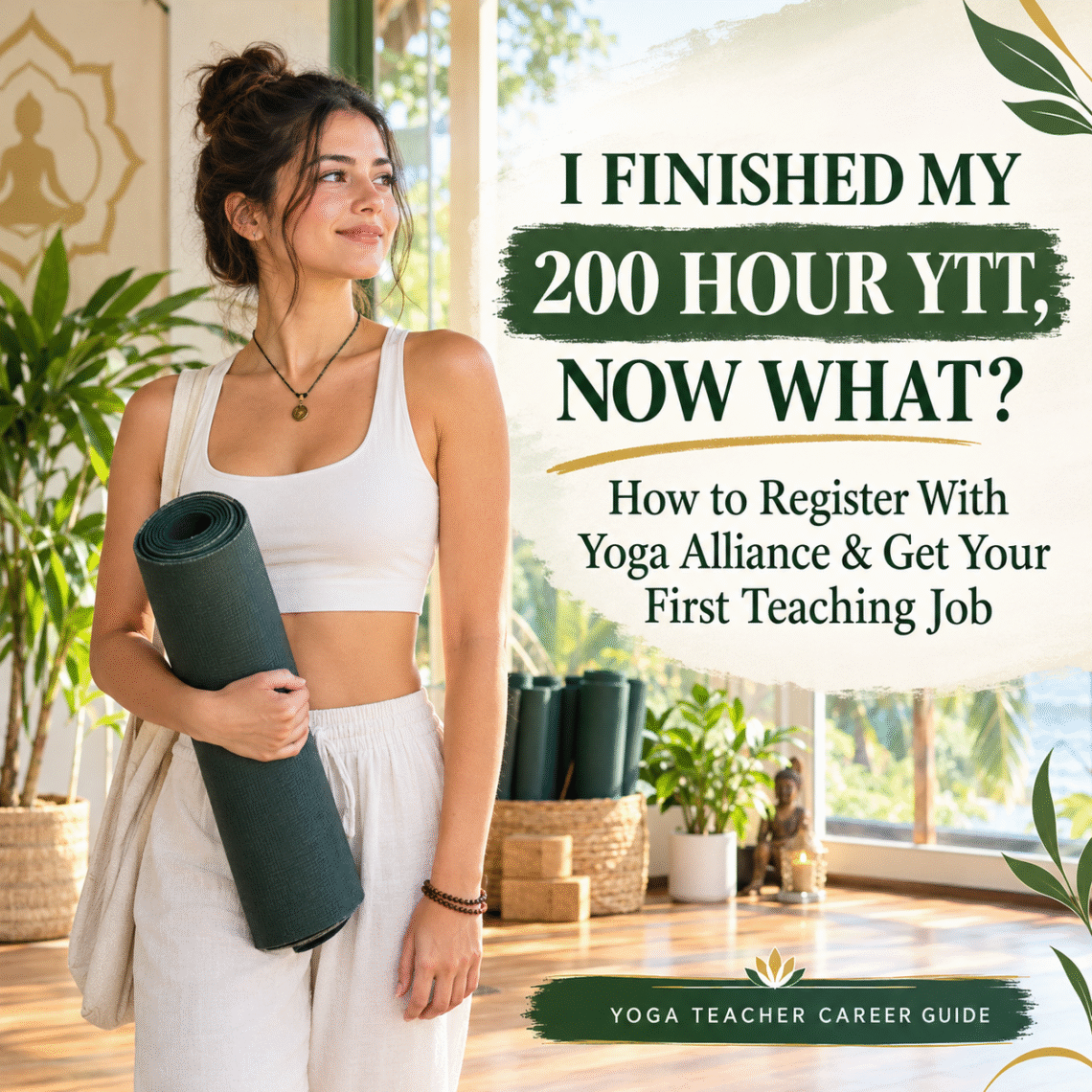
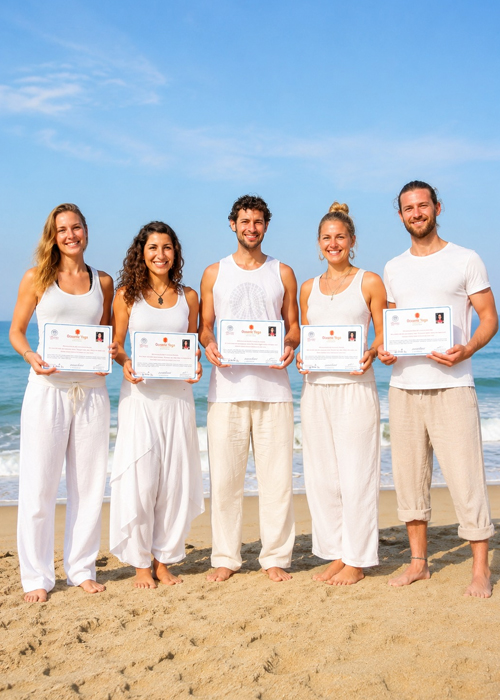
You’ve done it. Weeks of early mornings, anatomy notes, practice teaching and tears in the final closing circle, and now you’re holding your 200 hour yoga teacher training certificate.
Then comes the quiet question almost every graduate asks a few days later: now what?
This guide walks you through the next steps. First, how to register with Yoga Alliance as an RYT 200, what it costs and how to keep your registration active. Then the part nobody really teaches you: how to go from certificate to your first paid class.
It applies whether you trained with Diksha Yoga School in Arambol, Goa, Galle, Sri Lanka or Koh Samui, Thailand, or at any other Yoga Alliance Registered School.
Table of Contents
Your first 30 days after teacher training
| When | What to do |
| Week 1 | Rest. Let the training settle. Keep your personal practice going. |
| Week 1–2 | Register with Yoga Alliance as an RYT 200 (if you choose to) |
| Week 2 | Get yoga teacher liability insurance |
| Week 2–3 | Teach free or donation classes to friends, family or colleagues |
| Week 3–4 | Write your teaching bio and CV, and take good photos |
| Week 4 | Contact studios, gyms and wellness spaces, and offer a demo class |
Do you need to register with Yoga Alliance?
Registration with Yoga Alliance is voluntary. Your certificate comes from your school, and it’s yours whether you register or not. Registration is a separate step, with a separate fee, that you choose to take.
So why do most graduates register?
- Recognition: many studios, gyms and retreats look for “RYT 200” when they hire.
- Insurance: some insurers ask about your training or registration.
- Visibility: you can list yourself in the Yoga Alliance online directory.
- Your path to RYT 500: registering now makes it straightforward to upgrade after a 300 hour training.
One thing to know: “RYT” is a Yoga Alliance trademark. You can only call yourself an RYT 200 once your registration is complete and paid.
How to register with Yoga Alliance: step by step
You can register at any time after graduating. There’s no deadline, so it doesn’t matter if you finished training last week or several years ago.
- Create an account at yogaalliance.org, or use the invitation email your school may have sent you. Use your full name exactly as it appears on your certificate.
- Click “Register Now” under Teacher Registration and choose RYT 200.
- Enter your training details: your school’s name and your training’s start and end dates, exactly as they appear on your certificate.
- Upload your certificate.
- Wait for your school to confirm. Your Registered Yoga School checks your request and confirms you completed the training. If the school doesn’t respond within two weeks, Yoga Alliance’s own team reviews it.
- Pay your fees once you receive the confirmation email.
- Write a short review of your training. Your registration isn’t complete until you do.
- Publish your profile if you want to appear in the Yoga Alliance directory. Profiles aren’t public automatically.
Trained with Diksha in Goa, Sri Lanka or Thailand? The process is the same for every location: select Diksha Yoga School as your Registered Yoga School when you apply. Contact us if you need a copy of your certificate or help with the process.
What it costs
| Fee | Amount |
| One-time application fee | US$50 |
| Annual membership | US$65 per year |
| Total for your first year | US$115 |
The fee is the same wherever you trained, and it’s paid to Yoga Alliance, not to your school.
Common registration mistakes
- Mismatched details. Your name and dates must match your certificate exactly.
- Combining shorter courses. A 50 hour and a 100 hour course can’t be added together to make 200 hours. All 200 hours must come from one training at one Registered Yoga School.
- Training at a non-registered school. Only graduates of a current Registered Yoga School can register. If you’re choosing a school, check it in the Yoga Alliance directory first.
- Forgetting the review. Your registration stays incomplete until you submit it.
How to keep your registration active
Once you’re registered, four things keep your RYT status in good standing:
- Follow Yoga Alliance’s code of conduct and ethical commitment.
- Follow its policy on the use of yoga therapy terms.
- Pay your annual membership fee.
- Complete continuing education every three years.
Continuing education: every three years, Yoga Alliance asks RYTs to log 75 hours: 45 hours of teaching and 30 hours of further yoga training. Some of the training hours must be “contact hours”, meaning live or interactive learning. Once you’re teaching regularly, the teaching hours add up quickly. Workshops, retreats and advanced trainings count towards the training hours. Always check the current requirements in your Yoga Alliance account, as they’re updated from time to time.
Before you teach: get insured
Yoga teacher liability insurance protects you if a student is injured in your class. Many studios, gyms and retreats won’t let you teach without it.
The right policy depends on the country you teach in, so look for a provider that covers yoga teachers in your country and abroad, if you plan to teach at retreats. Check whether it covers online classes, hands-on assists and any props you use.
How to get your first teaching job
Very few new teachers walk straight into a full timetable. Most build up over a few months, a class here and a class there. That’s normal. These are the routes that work best for new teachers.
1. Teach before you’re paid
Offer free or donation classes to friends, family, colleagues or a local community group. You’ll gain confidence, find your teaching voice and build up the hours you’ll need later for RYT 500 and continuing education.
2. Start where you practise
The studio where you’re already a student is your best first door. The owners know you, and you know their style and students. Ask about covering classes for teachers who are away. Cover teaching is how many teachers get their first regular slot.
3. Gyms and fitness centres
Gyms often hire new teachers and usually offer regular weekly slots. The classes tend to be shorter and more fitness-focused, which is great practice for clear, simple cueing.
4. Corporate and workplace yoga
Many companies offer yoga as an employee benefit. If you already work in an office, start with your own workplace. A short lunchtime class is an easy first offer.
5. Retreats, hotels and wellness resorts
In places like Goa, Sri Lanka and Thailand, resorts and retreat centres hire teachers, especially in high season. These roles suit teachers who are flexible about travel, and they’re a wonderful way to gain experience.
6. Private and small-group classes
One-to-one sessions pay well and let you adapt your teaching to one person. Start with people you know, and let happy clients recommend you.
7. Online classes
Online classes let you teach anyone, anywhere. Start small, with a weekly live class for people who already know you, rather than trying to build a big following straight away.
8. Community and specialist classes
Community centres, schools, care homes and charities often look for yoga teachers. Gentle, chair or seniors’ yoga is in demand, and it’s a meaningful way to teach.
Jasmine St. Cliere
⭐⭐⭐⭐⭐
My teacher training with Diksha Yoga was one of the best things in my life. Amazing course, amazing experience in an amazing place. It was such a valuable journey in my life. I went on and I have made a yoga family for life! I left, not wanting to leave, but feeling so amazing in myself and excited to teach and share the new skills I had gained from the course. If you have Yogini Manisha teaching on your course, you are very lucky as she is the best.
Emily, USA
⭐⭐⭐⭐⭐
“My 200 Hour Yoga Teacher Training at Diksha Yoga School was a life-changing experience. The teachers were incredibly supportive, especially Yogini Manisha, who guided us with deep knowledge and compassion. I gained confidence in teaching yoga, improved my personal practice, and built a strong foundation in Anatomy, Philosophy, and Alignment. The peaceful environment and structured learning made this journey truly unforgettable.”
Read More:- Reviews from Our Yoga Teacher Training Students
How to stand out as a new teacher
- Write a short teaching bio: who you are, where you trained, what style you teach and who your classes are for.
- Prepare a one-page yoga CV: your training, your registration, any specialisms and the classes you’ve taught.
- Get good photos of yourself teaching or practising, in natural light.
- Plan a strong demo class. Many studios ask you to audition. Teach a class you know well, keep it simple, and focus on clear cues and a warm welcome rather than advanced postures.
- Find a niche. “Gentle yoga for desk workers” or “yoga for runners” is easier to remember, and easier to hire for, than “all styles for everyone”.
- Keep practising. Your personal practice is where your teaching keeps growing.
When to take your 300 hour training
Many teachers come back for a 300 hour training once they’ve taught for a while. You don’t need to rush. Most get the most out of it after 6–12 months of real teaching, when they know exactly what they want to learn: deeper anatomy, better sequencing, hands-on adjustments, or more philosophy and meditation.
The path to RYT 500:
- Complete your 200 hour training (done!).
- Teach and build experience.
- Complete a 300 hour training at a Registered Yoga School.
- Log 100 teaching hours after your training, then upgrade your registration to RYT 500.
Where Diksha Yoga School trains
Diksha Yoga School runs residential yoga teacher trainings in three beautiful locations:
- Arambol, Goa, India: our main school at The Lotus Sutra, on Arambol Beach in North Goa.
- Galle, Sri Lanka: on Sri Lanka’s south coast.
- Koh Samui, Thailand: an island in the Gulf of Thailand.
Wherever you trained for your 200 hours, with us or with another school, your next step can be the 300 hour training below.
Our 300 hour yoga teacher training in Goa
Our 300 hour training is a 28-day residential course at The Lotus Sutra, a beachfront venue on Arambol Beach in North Goa. It’s built for teachers who already have a 200 hour foundation and want to teach with more depth, skill and confidence.
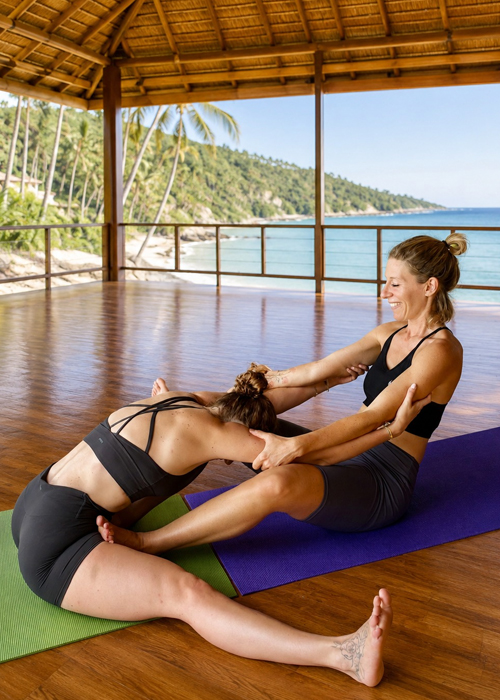
You’ll go deeper into advanced Hatha, Vinyasa Flow and Ashtanga foundations, pranayama and shatkarma, meditation, philosophy, anatomy, alignment and hands-on adjustments. Above all, you’ll teach every day. You’ll plan and lead full classes, build progressive sequences, refine your cueing and receive personal feedback.
Groups are capped at 10 students, so you’re taught as an individual. Your lead teacher is our founder, Yogini Manisha, an E-RYT 500 and Yoga Alliance Continuing Education Provider with more than 16 years of teaching experience.
Diksha Yoga School is a Yoga Alliance Registered Yoga School (RYS 300). That means your 300 hour certificate, together with your 200 hour certificate, counts towards RYT 500 registration.
| Course details | |
| Duration | 28 days / 27 nights |
| Location | The Lotus Sutra, Arambol Beach, North Goa |
| Group size | Maximum 10 students |
| Fees | €2,200 twin shared room, €3,000 private room |
| Included | Accommodation, 3 sattvic vegetarian meals daily, Wi-Fi, course manual, local excursions and airport pickup from Mopa or Dabolim |
| Upcoming batches | 5 Nov – 2 Dec 2026, 5 Dec 2026 – 1 Jan 2027, 5 Jan – 1 Feb 2027 |
You’re welcome to join whether you trained with us in Goa, Sri Lanka or Thailand, or at another school. A completed 200 hour training is recommended. To register as an RYT 500 afterwards, your 200 hour training must also be from a Yoga Alliance Registered School.
👉 See all 300 hour yoga teacher training dates and fees
Frequently asked questions
Do I need to register with Yoga Alliance to teach yoga?
No. Registration is voluntary, and your certificate comes from your school. Many studios and gyms prefer RYT-registered teachers, though, so most graduates register.
How much does it cost to register with Yoga Alliance?
US$115 for the first year: a one-time US$50 application fee plus US$65 annual membership. After that, it’s US$65 a year.
Is there a deadline to register after my yoga teacher training?
No. You can register with Yoga Alliance at any time after completing your training at a Registered Yoga School.
Can I combine shorter yoga courses to register as an RYT 200?
No. All 200 hours must come from a single training at one Registered Yoga School.
How do I keep my Yoga Alliance registration active?
Pay your annual membership fee, follow Yoga Alliance’s code of conduct, and complete continuing education every three years: currently 45 teaching hours and 30 training hours.
How do I become an RYT 500?
Complete a 300 hour training at a Registered Yoga School, then log 100 teaching hours after that training, and upgrade your registration.
How long should I wait before doing a 300 hour training?
There’s no rule, but many teachers benefit most after 6–12 months of teaching, when they know which skills they want to develop.
Can I do my 300 hour training with Diksha if I did my 200 hour elsewhere?
Yes. Our 300 hour course welcomes graduates of any 200 hour training. If you plan to register as an RYT 500, your 200 hour training should be from a Yoga Alliance Registered School.
I trained with Diksha in Sri Lanka or Thailand. How do I register with Yoga Alliance?
The same way as graduates in Goa. Create your Yoga Alliance account, choose RYT 200, select Diksha Yoga School as your Registered Yoga School, and upload your certificate. We’ll confirm your training.
Your teaching journey starts now
Your 200 hour training was never the finish line. It’s the start of a lifelong practice of learning and sharing. Register, get insured, teach your first free class this month, and let the rest grow from there.
When you’re ready to go deeper, we’d love to welcome you back, whether you first trained with us in Goa, Sri Lanka or Thailand, or somewhere else entirely.
👉 Explore our 300 hour yoga teacher training in Goa
Questions about registration or your next step? Contact our team. We’re happy to help, wherever you trained.
You might also like: Best Time for Yoga Teacher Training in Goa, Sri Lanka and Thailand
About the author
Yogini Manisha is the founder and lead teacher of Diksha Yoga School. She is an E-RYT 500 and Yoga Alliance Continuing Education Provider (YACEP) with more than 16 years of teaching experience. She has trained 20000+ teachers in Goa, Sri Lanka and Thailand, and helps every graduate through their Yoga Alliance registration.