Reviewed by Master Nirakar E-RYT 500 · Updated October 2026
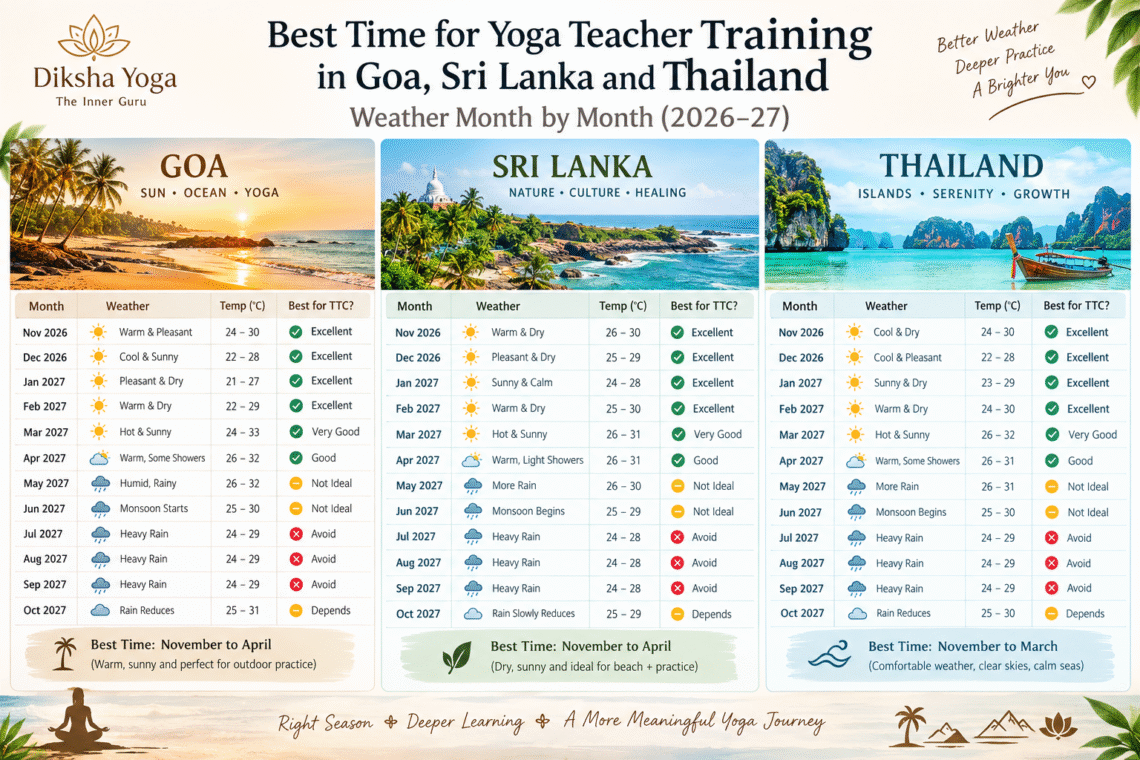
Best Time for Yoga Teacher Training depends on where you go. If you want the driest weather, train in Goa from November to April, in Galle from January to March, or in Koh Samui from February to April. Those are the honest answers, and they are not the same for all three places.
Most yoga schools will tell you their location is “perfect all year”. That is rarely true. Goa, Galle and Koh Samui are all warm every month, but each one gets its rain at a different time of year. Knowing when helps you choose the right place and the right batch.
At Diksha Yoga School we run our 200-hour training in all three places. Every batch runs from the 5th to the 27th of the month, from November 2026 to May 2027. So we have no reason to push you towards one place. Below is the weather for each location, month by month, and which batch we would choose in your position.
All weather figures are long-term monthly averages from Weather2Travel. Any single year can be wetter or drier.
Table of Contents

The best time for yoga teacher training: quick answer
| Location | Driest months | Wettest months | Daytime high | 200-hour fee (from) |
| Arambol, Goa, India | November to April | June to September (we don’t run then) | 32–33°C | €1,800 |
| Galle, Sri Lanka | January to March | October, November and May | 29–31°C | €2,000 |
| Koh Samui, Thailand | February to April | October to December | 29–32°C | €2,800 |
Goa is the clear winner for dry weather from November to April. Galle and Koh Samui both have a wet patch inside our season, so it pays to choose your month carefully there.
Goa (Arambol): dry and sunny from November to April
Goa has the simplest weather of the three. The southwest monsoon brings almost all of the year’s rain between June and September, and after that the sky clears for months. December to February averages about 10 hours of sunshine a day.
Why Arambol, Goa Is a Great Place for Yoga Teacher Training
| Month | Rain (mm) | Rainy days | High / low (°C) | What it feels like |
| October | 126 | 5 | 32 / 24 | Green after the monsoon, a few showers, humid. We don’t run a batch yet |
| November | 32 | 2 | 33 / 22 | Season opens. Dry, sunny, still lush, Arambol is calm |
| December | 14 | 0 | 33 / 21 | Dry and sunny, cooler nights. Busiest month in Goa (Christmas and New Year) |
| January | 0 | 0 | 32 / 20 | The most comfortable month. Coolest mornings for 6:30 AM pranayama |
| February | 0 | 0 | 32 / 21 | Dry, clear, still pleasant at night |
| March | 1 | 0 | 32 / 23 | Warming up, nights get sticky |
| April | 8 | 0 | 33 / 26 | Hot and humid. Practice is planned around the cooler hours |
| May | 96 | 3 | 33 / 27 | Hottest and most humid month, first pre-monsoon storms late in the month |
| June to September | 263–923 a month | 13–25 | 29–30 / 24–25 | Monsoon. We don’t run residential training in these months |
Our honest take: for most people, January and February are the most comfortable months to train in Goa. November is our hidden gem: dry and green, and quieter than December. April and May are fine if you handle heat well, but the afternoons are tiring.
One thing to know about December: Goa is very busy over Christmas and New Year. The 5–27 December batch overlaps with the start of that rush, but Arambol is far quieter than the busy beaches further south, and your days stay at the shala. Book flights early if you plan to stay on for New Year.
👉 See the 200-Hour Yoga Teacher Training in Goa
Galle, Sri Lanka: best from January to March
Galle has no fully dry season. It sits where two monsoons meet, so some rain falls every month. The difference is in how much. January and February get less than a third of October’s rain, with only 5 rainy days each.
| Month | Rain (mm) | Rainy days | High / low (°C) | What it feels like |
| October | 340 | 14 | 29 / 23 | Wettest month of the year. We don’t run a batch |
| November | 296 | 14 | 29 / 22 | Still the rainy season. Showers are often heavy but short, town is quiet |
| December | 181 | 10 | 29 / 22 | Rain easing through the month, more sunny days |
| January | 94 | 5 | 29 / 22 | Driest month. Calm sea, clear mornings |
| February | 101 | 5 | 30 / 22 | Almost as dry as January, and among the sunniest months |
| March | 122 | 7 | 31 / 23 | Sunny and warm, the hottest days arrive |
| April | 234 | 11 | 31 / 24 | Hot and humid, afternoon storms build |
| May | 304 | 12 | 30 / 25 | Southwest monsoon arrives, frequent rain |
| June to September | 173–249 a month | 10–12 | 29 / 24 | Monsoon on the southwest coast. We don’t run batches |
Why Galle, Sri Lanka Is a Great Place for Yoga Teacher Training
Our honest take: if dry weather matters to you, choose the January, February or March batch in Galle. They fill first for that reason. November and May are Galle’s wettest batches. They suit students who care more about a quiet town and fewer crowds than beach days.
The temperature hardly changes in Galle. Highs stay between 29 and 31°C all year, so heat is never the issue here. Rain and humidity are.
👉 See the 200-Hour Yoga Teacher Training in Sri Lanka
Koh Samui, Thailand: best from February to April
Koh Samui runs on a different calendar from the rest of Thailand. Phuket and the Andaman coast get their rain from May to October. Samui, on the Gulf side, gets its heaviest rain from October to December. November is the wettest of any of our batch months across all three locations.
| Month | Rain (mm) | Rainy days | High / low (°C) | What it feels like |
| October | 274 | 20 | 30 / 23 | Rainy season begins, cloudy and windy days |
| November | 462 | 19 | 29 / 23 | Wettest month. Heavy downpours, rough sea, very green |
| December | 188 | 13 | 29 / 22 | Rain fading, often dry by the second half of the month |
| January | 122 | 10 | 29 / 22 | Mostly dry and the coolest nights of the year |
| February | 38 | 5 | 29 / 23 | Driest month, calm sea, lots of sun |
| March | 53 | 5 | 30 / 24 | Dry and sunny, getting warmer |
| April | 84 | 8 | 32 / 25 | Hottest month, still mostly dry |
| May | 173 | 17 | 32 / 25 | Hot, with frequent short afternoon showers |
| June to September | 117–145 a month | 16–17 | 31 / 24 | Warm with passing showers, drier than most of Thailand |
Our honest take: February, March and April are the best Samui batches for sun and calm sea. January is also good. We would not recommend the November batch to anyone who wants beach days. Only choose it if you want the island quiet and green and don’t mind rain on most days.
Why Koh Samui, Thailand Is a Great Place for Yoga Teacher Training

👉 See the 200-Hour Yoga Teacher Training in Thailand
All three locations side by side
Average number of days with some rain, by month. Diksha 200-hour batches run November to May.
| Location | Oct | Nov | Dec | Jan | Feb | Mar | Apr | May | Jun | Jul | Aug | Sep |
| Arambol, Goa | 5 | 2 | 0 | 0 | 0 | 0 | 0 | 3 | 22 | 25 | 23 | 13 |
| Galle, Sri Lanka | 14 | 14 | 10 | 5 | 5 | 7 | 11 | 12 | 12 | 10 | 10 | 12 |
| Koh Samui, Thailand | 20 | 19 | 13 | 10 | 5 | 5 | 8 | 17 | 16 | 17 | 17 | 17 |
Source: Weather2Travel long-term monthly averages for Panaji (Goa), Galle and Koh Samui.
Read across a row to see one place through the year, or down a column to compare all three in the month you can travel. February is the only month when all three locations are at or near their driest.
Which 2026–27 batch should you choose?
All batches run from the 5th to the 27th of the month. Here is how each one compares across the three locations, and where we would send a friend.
| Batch | Goa | Galle | Koh Samui | Our pick |
| 5–27 Nov 2026 | Good: dry, green, quiet | Wet: 14 rainy days | Very wet: wettest month | Goa |
| 5–27 Dec 2026 | Best: dry, sunny, festive | Fair: rain easing | Fair: rain fading late in month | Goa |
| 5–27 Jan 2027 | Best: coolest, driest | Best: driest month | Good: mostly dry | Goa or Galle |
| 5–27 Feb 2027 | Best | Best: very dry, sunny | Best: driest month | Any of the three |
| 5–27 Mar 2027 | Good: warm and dry | Best: sunny | Best: dry and sunny | Galle or Koh Samui |
| 5–27 Apr 2027 | Hot and humid, dry | Hot, afternoon storms | Hottest, still mostly dry | Koh Samui |
| 5–27 May 2027 | Hottest, early storms | Wet: monsoon arrives | Hot, frequent short showers | Goa, if you cope with heat |
Booking now for November or December? Goa is the only one of the three where the weather is reliably dry. Goa also has the lowest fee, from €1,800 including your room, three meals and airport pickup.
Escaping a European or North American winter? January to March gives you the widest choice. All three locations are at or near their best, so you can pick on budget, travel time or the kind of place you want to live in for 23 days.
👉 See all 2026–27 dates and fees
Does rain actually affect a yoga teacher training?
Less than you might think. A 200-hour training is not a beach holiday. From 6:00 AM to 8:30 PM, Monday to Saturday, you are in a covered shala: pranayama, two asana classes, philosophy, anatomy, meditation and teaching practice. Rain on the roof does not stop any of it.
Where the weather does matter:
- Your Sunday off. Sunday is your one free day each week. Rain can mean a lost beach day or a cancelled excursion.
- Heat and sleep. Hot, humid nights are harder on the body than rain. Six days a week of early starts feel heavier in April and May.
- Getting there. Ferries to Koh Samui can be delayed in rough November seas. Flying into Samui airport avoids this. Training in Goa? Read our Visa, Packing List and Travel Guide for India.
- Laundry. With two practices a day, clothes take longer to dry in a humid month. Pack a few extra sets.
So choose a wetter month if it suits your dates or budget. Just choose it knowing what you get.
What Our Students Say
Leigh Hughes 200-Hour Yoga Teacher Training | Lead Trainer: Yogini Manisha
⭐⭐⭐⭐⭐
I’ve completed my 200 YTT with Yoga Manisha, Yogi Abhay, Vinod and can truly recommend it. Although it was “only” one month, it will influence my path a lot. I have learnt so much, not only asanas but more importantly, about what yoga means and how it will positively impact my life. You can really tell that the Diksha Yoga crew loves what they do and the teachers are amazing…
Emily, USA 200-Hour Yoga Teacher Training | Lead Trainer: Yogini Manisha
⭐⭐⭐⭐⭐
“My 200 Hour Yoga Teacher Training at Diksha Yoga School was a life-changing experience. The teachers were incredibly supportive, especially Yogini Manisha, who guided us with deep knowledge and compassion. I gained confidence in teaching yoga, improved my personal practice, and built a strong foundation in Anatomy, Philosophy, and alignment. The peaceful environment and structured learning made this journey truly unforgettable.”
Read More:- Reviews from Our Yoga Teacher Training Students
Frequently asked questions
What is the best time for yoga teacher training overall?
February. It is the only month when Goa, Galle and Koh Samui are all at or near their driest. January and March are close behind.
What is the best month for yoga teacher training in Goa?
January. It is dry, sunny and has the coolest nights, around 20°C. December and February are close behind.
Is November a good time for yoga teacher training in Goa?
Yes. The monsoon has ended, Goa averages only 2 rainy days in November, and the land is still green. It is quieter than December.
When is the rainy season in Galle, Sri Lanka?
Galle gets rain all year, but the wettest periods are May and October to November. January to March is the driest stretch.
When is the rainy season in Koh Samui?
October to December, with November the wettest month. This is the opposite of Phuket and western Thailand, which are wettest from May to October.
Which location is cheapest?
Goa, from €1,800 in a twin shared room. Galle starts at €2,000 in a triple shared room, and Koh Samui at €2,800. All include accommodation, meals and airport pickup.
Do you run trainings during the monsoon?
No. We don’t run residential trainings in Goa or Galle from June to September.
How early should I book for the dry season?
Each batch takes a maximum of 10 students, and the December to March batches fill first. We suggest booking two to three months ahead for those dates.
Choose your season, then your place
The best time for yoga teacher training is the month that fits your life, in the place that is dry that month. If you already know your dates, the tables above tell you where to go. If you know where you want to go, they tell you when.
Either way, you get the same 23-day, Yoga Alliance registered 200-hour training, with a maximum of 10 students and a teacher who knows your practice by name.
- 200-Hour Yoga Teacher Training in Goa
- 200-Hour Yoga Teacher Training in Sri Lanka
- 200-Hour Yoga Teacher Training in Thailand
- See all dates and fees
Still not sure? Message us on WhatsApp with your dates, and we will tell you honestly which location will have the best weather.
About the author
Yogini Manisha is the founder and lead teacher of Diksha Yoga School. She is an E-RYT 500 and Yoga Alliance Continuing Education Provider (YACEP) with more than 16 years of teaching experience. She has trained 20000+ teachers in Goa, Sri Lanka and Thailand, and helps every graduate through their Yoga Alliance registration.