By Yogini Manisha, E-RYT 500 • Founder & Lead Teacher, Diksha Yoga School
“Are you choosing between Hatha vs Vinyasa Yoga 200 Hour TTC Goa Guide?”
There’s a third option, and for most future teachers it’s the best one. You can learn both in a single, well-structured program.
A good 200-hour training shouldn’t box you into one style. It should give you the posture foundation of Hatha, the sequencing skills of Vinyasa, and the wider practices that make yoga a complete discipline: pranayama, meditation, philosophy, anatomy, alignment and teaching methodology.
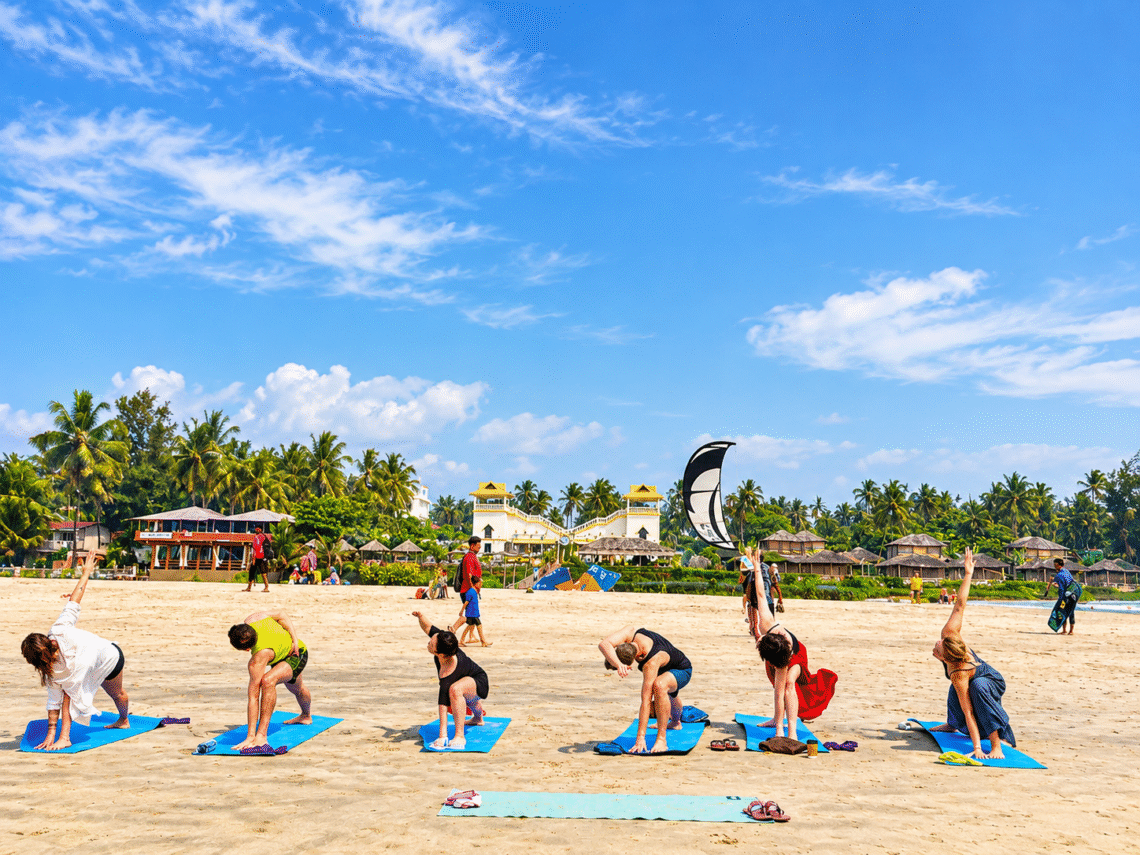
At Diksha Yoga School, our Goa program is a 23-day residential, multi-style training covering Hatha, Vinyasa and Ashtanga Yoga. It is suitable for beginner to intermediate students, taught in English, with private and shared accommodation.
This guide explains the real difference between Hatha and Vinyasa, and why learning both makes you a more capable teacher.
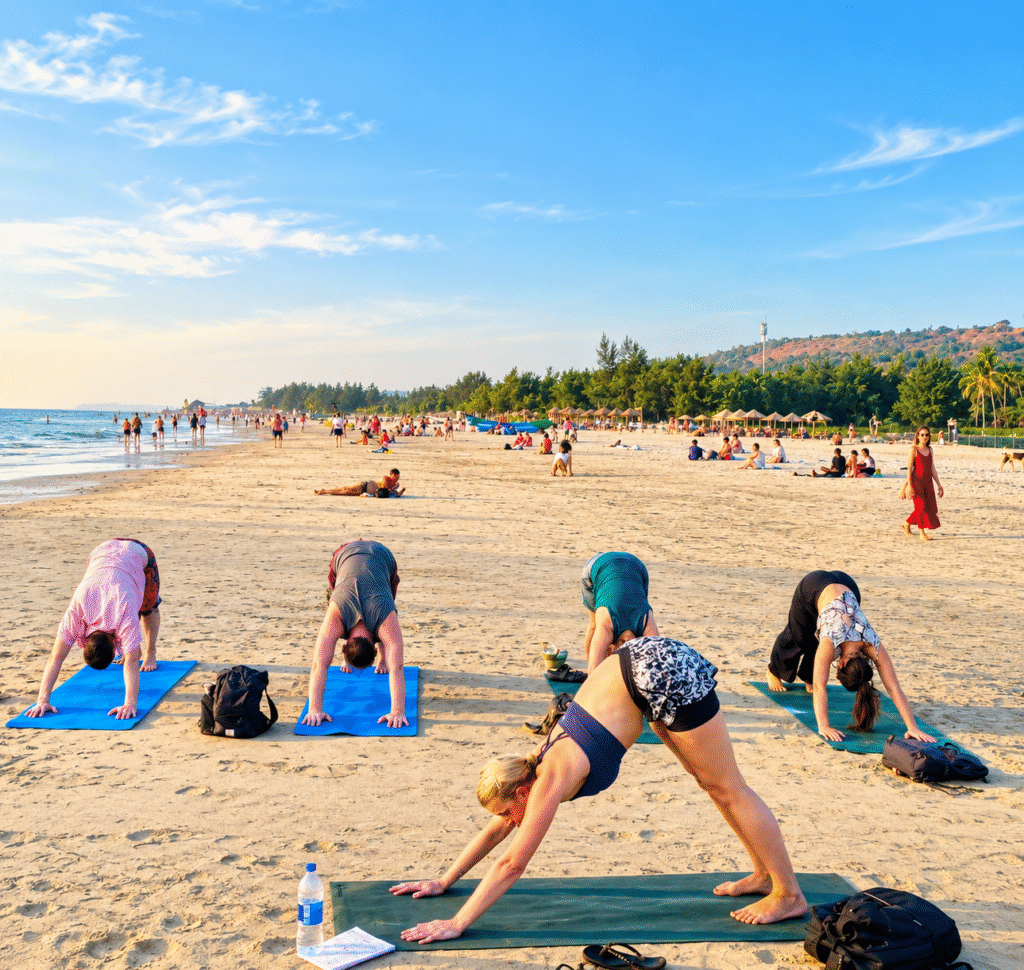
Table of Contents
At a Glance: What You’ll Learn
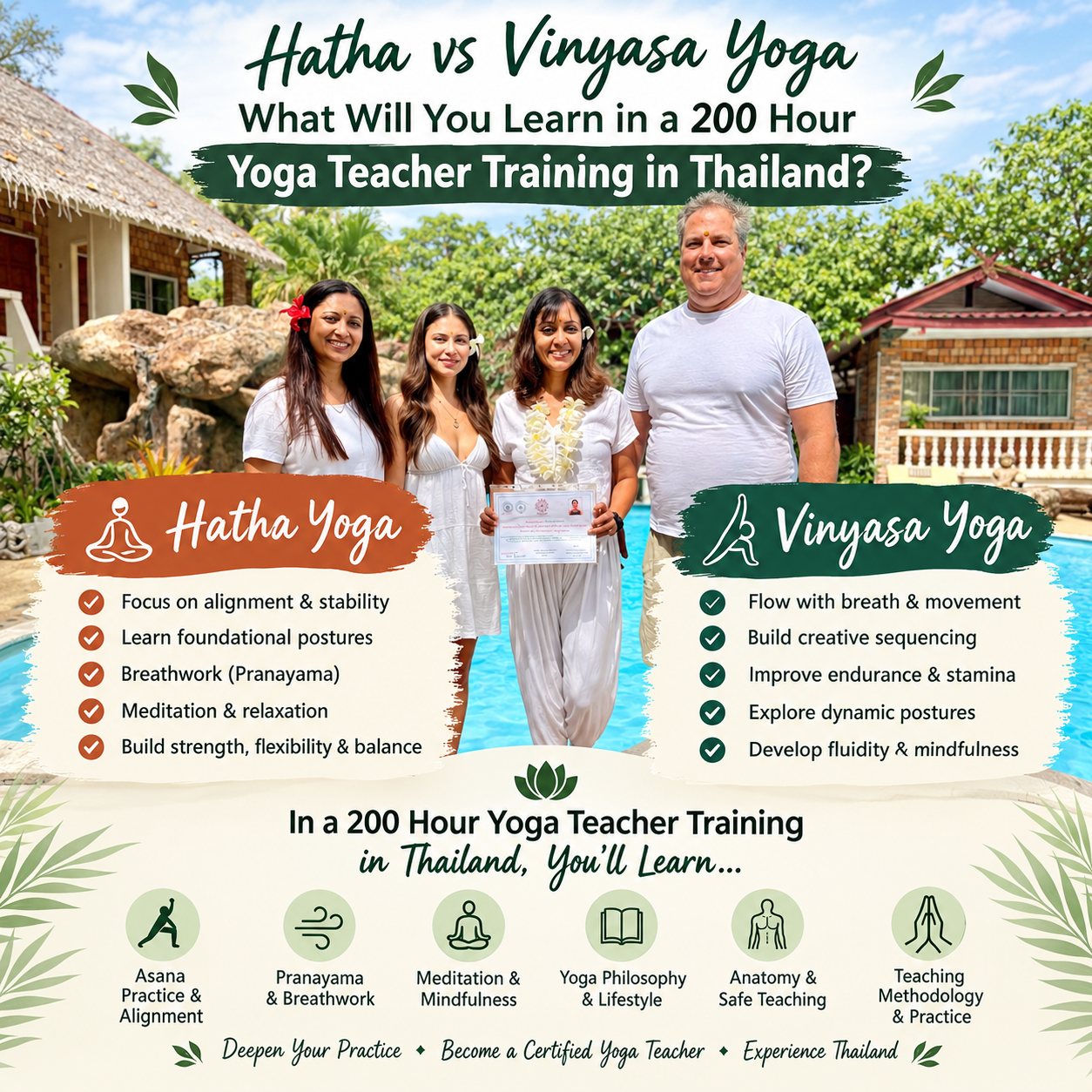
Hatha Yoga focuses on alignment, stability, mindful breathing and holding postures. Vinyasa emphasises breath-synchronised movement, transitions and creative sequencing. During the training you will study:
- Hatha Yoga: asanas, alignment, stability and mindful practice
- Vinyasa Yoga: breath-led movement, flow and sequencing
- Ashtanga Yoga: traditional, structured asana practice
- Pranayama: classical breathing techniques
- Meditation: concentration, awareness and inner balance
- Yoga Philosophy: Yoga Sutras, ethics and yogic lifestyle
- Anatomy & Physiology: how the body moves and how to practise safely
- Teaching Methodology: cueing, adjustments, sequencing and class planning
- Teaching Practice: leading real classes with feedback
Combining Hatha’s strong foundation with Vinyasa’s fluid movement gives you a balanced understanding of both practising and teaching yoga.
200 Hour Yoga Teacher Training in Goa: 2026–2027 Dates & Fees
| Batch | Course Dates | Duration | Private Room | Shared Room |
| November 2026 | 5 – 27 Nov 2026 | 23 days | €2,000 | €1,800 |
| December 2026 | 5 – 27 Dec 2026 | 23 days | €2,000 | €1,800 |
| January 2027 | 5 – 27 Jan 2027 | 23 days | €2,000 | €1,800 |
| February 2027 | 5 – 27 Feb 2027 | 23 days | €2,000 | €1,800 |
| March 2027 | 5 – 27 Mar 2027 | 23 days | €2,000 | €1,800 |
| April 2027 | 5 – 27 Apr 2027 | 23 days | €2,000 | €1,800 |
| May 2027 | 5 – 27 May 2027 | 23 days | €2,000 | €1,800 |
Early bird pricing:
| Accommodation | Regular Price | Early Bird Price |
| Private Room | €2,000 | From €1,900 |
| Shared Room | €1,800 | From €1,700 |
Early bird discount: up to €100 off, subject to availability and booking terms.
23 Days • 200 Hours • Goa, India • Certification on Completion
Yoga Alliance Registered School
Diksha Yoga School is a Yoga Alliance Registered Yoga School (RYS 200). When you complete the 200 Hour Yoga Teacher Training in Goa, you’ll be eligible to register with Yoga Alliance as a Registered Yoga Teacher (RYT 200), a credential recognised by studios, retreats and gyms around the world.
Verify our registration on Yoga Alliance → (link to your school’s Yoga Alliance directory page)
👉 View the full 200 Hour YTT Goa course | WhatsApp us to reserve your seat
What Is Hatha Yoga?
Hatha Yoga gives you time to explore each posture in depth: its alignment, stability, breath and the awareness it develops.
A Hatha practice typically includes:
- Foundations of yoga asana
- Alignment and safe movement
- Strength, stability and flexibility
- Breath awareness and mindful presence
- Modifications for different bodies
- Holding and exploring postures
For a future teacher, Hatha is essential because you learn to understand a posture before you try to teach it. You start asking the right questions:
- What is this posture doing?
- How should it be approached safely?
- How can it be modified?
- How can I explain it clearly to someone else?
That understanding becomes the backbone of your teaching.
What Is Vinyasa Flow?
Vinyasa Flow links movement with breath. Instead of practising each posture in isolation, the teacher builds a sequence where one posture flows into the next.
A Vinyasa class may include:
- Breath-led movement and Sun Salutations
- Standing and balancing sequences
- Hip-opening and strength-building work
- Smooth transitions
- Peak-pose preparation
- Theme-based sequences and cool-downs
For future teachers, Vinyasa develops the ability to design, teach and adapt a complete class. You learn that a good sequence is not just a collection of poses. Every posture has a reason for what comes before and after it.
Hatha vs Vinyasa: Quick Comparison
| Hatha Yoga | Vinyasa Flow |
| Focuses on individual postures | Focuses on connected sequences |
| Emphasises alignment and stability | Emphasises movement and breath |
| More time held in each posture | Continuous movement between postures |
| Builds a strong asana foundation | Develops sequencing and flow skills |
| Detailed posture awareness | Dynamic class design |
| Supports slower, mindful practice | Supports energetic practice |
| Teaches posture mechanics | Teaches creative sequencing |
So, which is better?
Neither. They teach different skills. Hatha helps you understand the posture. Vinyasa helps you turn postures into a purposeful practice. A teacher who knows both has more tools to work with every kind of student.
Why Learn Both Hatha and Vinyasa in One 200 Hour YTT?
Picture your future classes:
- A beginners’ group that needs slower instruction and time to understand alignment
- A stronger group that wants a dynamic flow
- A private student with limited mobility who needs modifications
- A retreat group expecting a creative, themed sequence
The more approaches you understand, the better you can adapt. That’s why a comprehensive 200-hour program shouldn’t just teach you more poses. It should teach you to:
Understand → Practise → Sequence → Explain → Adapt → Teach
The Full 200 Hour Yoga Teacher Training Curriculum
Hatha and Vinyasa are only two parts of the training. A strong 200 Hour YTT in Goa combines physical practice, traditional yogic knowledge and practical teaching skills.
1. Hatha Yoga
You learn to approach postures with awareness, not just flexibility. Topics include alignment, stability, strength, breath coordination, modifications and safe practice. The goal is to understand why a posture is practised and how to communicate it.
2. Vinyasa Flow
You learn to build sequences with purpose and progression:
Preparation → Development → Peak → Counterpose → Cool-Down → Relaxation
This skill is what turns a personal practice into real teaching ability.
3. Ashtanga Yoga
Ashtanga’s structured approach adds another traditional perspective, developing breath, discipline, concentration and an understanding of fixed sequencing. It shows that yoga can’t be reduced to a single style.
4. Pranayama
You explore the relationship between breath, concentration and awareness through practices such as Nadi Shodhana, Kapalabhati, Bhastrika and Ujjayi. Experiencing these yourself prepares you to guide others safely.
5. Meditation
Daily meditation builds concentration and gives you direct experience of yoga’s quieter dimensions. You can only teach meditation meaningfully once you’ve practised it yourself.
You study yoga beyond exercise: the Yoga Sutras, Yamas and Niyamas, karma and yogic lifestyle. The aim is not to memorise terms. It is to understand how yoga shapes the way you practise, think and live.
You don’t need to become a medical professional, but you do need to understand how the body moves. You’ll cover joint actions, key muscles, common limitations, modifications and injury-prevention principles.
8. Alignment & Adjustments
You learn to observe how students move, spot when someone needs a modification, and offer adjustments appropriately. Good teaching helps students practise intelligently rather than forcing a “perfect” shape.
9. Sequencing
You learn to build classes that make sense from start to finish:
Centering → Breath → Warm-Up → Preparation → Main Practice → Peak Pose → Counterposes → Cool-Down → Savasana
You’ll design classes for beginners, mixed levels, private students, dynamic and slow practices, and specific themes.
10. Teaching Methodology & Practice
This is where knowledge becomes teaching. You practise verbal cueing, demonstration, voice and communication, observation, class management and real teaching with feedback. You leave ready to stand in front of a class with clarity and confidence.
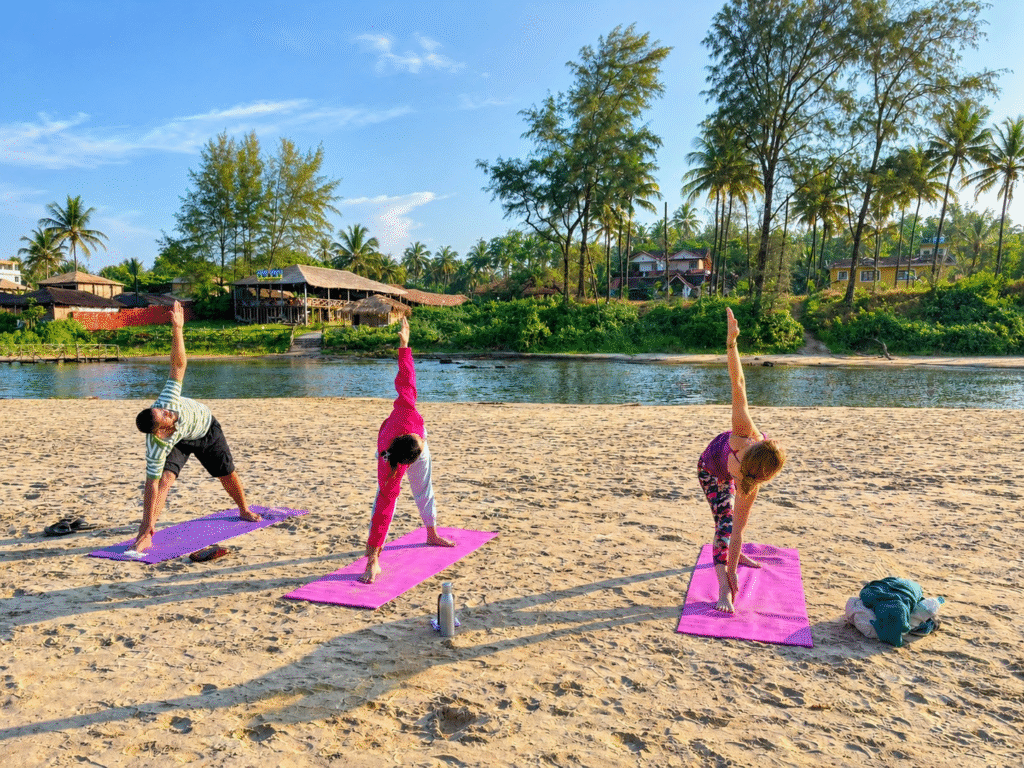
What Does a Typical Day of Yoga Teacher Training in Goa Look Like?
Morning
Meditation, pranayama and chanting → Hatha or Vinyasa asana practice → Breakfast
Late morning
Teaching methodology → Alignment and adjustments → Yoga philosophy
Afternoon
Lunch → Anatomy and physiology → Asana or teaching practice
Evening
Meditation → Dinner → Self-study and reflection
The schedule varies slightly by day and teacher. A residential training is far more than a few hours of asana. You are learning to live, practise, study and teach yoga.
Practising Yoga vs Teaching Yoga: What’s the Difference?
You may already know how to do Warrior II. But can you teach it to ten people with different bodies and experience levels? Can you explain:
- Where the feet go and how the knees align?
- What the student should feel?
- How to modify the pose?
- How to transition into the next posture?
- What to offer someone who can’t reach the full expression?
That is the difference between doing yoga and teaching it, and it is exactly what a strong 200-hour training develops.
Is Hatha or Vinyasa Better for Beginners?
You don’t need to be an advanced practitioner to join. Our Goa 200-hour course is designed for beginner to intermediate students. Hatha’s slower pace helps you build foundations, while Vinyasa is introduced progressively.
What matters more than flexibility:
- Willingness to learn
- Consistent practice
- Openness to feedback
- Commitment and curiosity
- Respect for the practice
You don’t need arm balances, deep backbends or advanced inversions before you start.
Can you teach both styles after training?
Yes. Your training gives you a foundation, not a fixed label. Graduates go on to teach Hatha, Vinyasa, beginners’ classes, private sessions, retreats, meditation, breathwork, online classes and wellness programs. Many combine styles depending on who they’re teaching.
Why Choose Goa for Your 200 Hour Yoga Teacher Training?
Teacher training is immersive, so your environment matters. Goa brings together Indian yoga tradition, coastal surroundings and an international community of students. You wake, practise, study, eat and rest in one place with your classmates, which makes focused learning much easier.
A beautiful location should never be your only reason to choose a school, though. Curriculum, teachers, teaching practice, accommodation, meals, student support and certification deserve equal attention.
📖 Related: Why Arambol, Goa Is a Great Place for Yoga Teacher Training
How to Choose the Right 200 Hour YTT in Goa
Ask these questions before you book any school:
- Does the curriculum go beyond asana? Look for anatomy, philosophy, pranayama, meditation and teaching methodology.
- Will I actually practise teaching? You need real teaching experience, not only lectures.
- Who are the teachers? Check their experience, qualifications and teaching approach.
- Is it right for my level? Beginners shouldn’t feel they must already know everything.
- What’s included in the price? Confirm accommodation, meals, materials, airport assistance and certification.
- Is the school registered with Yoga Alliance? A Yoga Alliance RYS 200 lets you register as an RYT 200 after graduation. Diksha Yoga School is a registered RYS 200, and you can verify any school on the Yoga Alliance website.
- Will I get personal guidance? Smaller groups make feedback and questions easier.
What’s Included in the 200 Hour YTT in Goa
| Detail | Information |
| Duration | 23 days, residential |
| Level | Beginner to intermediate |
| Styles | Hatha, Vinyasa, Ashtanga |
| Language | English |
| Accommodation | Private or shared room |
| Meals | Three vegetarian/yogic meals daily |
| Materials | Course manual and study materials |
| Extras | Excursions |
| Accreditation | Yoga Alliance Registered Yoga School (RYS 200) |
| Certification | Yoga Alliance-recognised 200 Hour certificate; graduates can register as RYT 200 |
Having everything in one package lets you focus fully on your studies instead of daily logistics. Dates, fees and availability can change, so please confirm your batch before booking.
Who is this training for?
This course suits you if you want to become a yoga teacher, deepen your own practice, learn Hatha, Vinyasa and Ashtanga, study philosophy and anatomy, build teaching confidence, or join an international yoga community. You don’t need to know exactly where your teaching path will lead. That often becomes clear during the training itself.
Is a 200 Hour YTT in Goa worth it?
For most students, the real value isn’t the certificate. It’s the shift from yoga practitioner → yoga student → yoga teacher. If you want to understand yoga more deeply, learn to teach, and commit a few focused weeks to study, a comprehensive 200-hour program may be your right next step.
Frequently Asked Questions
Is Hatha or Vinyasa better for a 200-hour yoga teacher training?
Neither is universally better. Hatha builds a strong foundation in posture, alignment and awareness, while Vinyasa develops movement, breath coordination and sequencing. Learning both gives you a broader teaching foundation.
Can beginners join a 200 Hour Yoga Teacher Training in Goa?
Yes. Diksha Yoga School’s Goa training is designed for beginner to intermediate practitioners.
Will I learn both Hatha and Vinyasa?
Yes. The program is multi-style and covers Hatha, Vinyasa and Ashtanga Yoga.
How long is the 200 Hour Yoga Teacher Training in Goa?
It is a 23-day residential program.
Do I need to be flexible to join?
No. Advanced flexibility isn’t required. You’ll learn safe movement, alignment and modifications suited to your body.
Can I teach yoga after a 200-hour training?
A 200-hour program gives you foundational knowledge and practical teaching skills. Requirements to teach professionally depend on the country, studio or organisation where you plan to work.
How much does the 200 Hour YTT in Goa cost?
Fees are €1,800 for a shared room and €2,000 for a private room, with early bird prices from €1,700 and €1,900.
Is Diksha Yoga School registered with Yoga Alliance?
Yes. Diksha Yoga School is a Yoga Alliance Registered Yoga School (RYS 200). Graduates of the 200 Hour Yoga Teacher Training in Goa are eligible to register as RYT 200.
Will my 200 Hour certificate be recognised internationally?
Yoga Alliance is the most widely recognised yoga teacher registry worldwide. Requirements still vary by country and employer, so check local rules where you plan to teach.
What should I look for when choosing a school in Goa?
Curriculum, teacher experience, teaching practice, student support, accommodation, meals, certification, group size, location and exactly what the fee includes. Don’t choose on photos or price alone.
Is residential yoga teacher training worth it?
For students who want immersion, residential training makes it easier to keep a consistent routine, focus on study and connect with an international group of practitioners.
Student Reviews
⭐⭐⭐⭐⭐ Jasmine St Cliere | Jan 2018
“My teacher training with Diksha Yoga was one of the best things in my life. Amazing course, amazing experience in an amazing place. I made a yoga family for life! I left not wanting to leave, but feeling amazing and excited to teach and share the new skills I had gained. If you have Yogini Manisha teaching on your course, you are very lucky, as she is the best.”
⭐⭐⭐⭐⭐ Célina Schimanski | May 2016
“Namaste Diksha Yoga Team, I miss all of you very much! I can’t thank you enough for showing me my way to self-realisation and leading me to the beautiful path of yoga. I appreciate all your time, effort and patience. I had the most amazing and special time of my life with you. Love you all, Yogini Manisha, Yogi Abhay, Vinod Vitkar! Namaste!”
Start Your 200 Hour Yoga Teacher Training in Goa
Choosing a teacher training is a bigger decision than choosing between two styles. You’re choosing how you want to learn, who will guide you, and where you’ll spend several weeks developing your practice and teaching skills.
At Diksha Yoga School in Goa, our 23-day residential training brings together Hatha, Vinyasa, Ashtanga, pranayama, meditation, philosophy, anatomy, alignment and teaching methodology in one complete, multi-style program.
👉 Check dates & reserve your seat | WhatsApp us
Your yoga journey begins with learning. Your teaching journey begins with understanding.
About the Author
Yogini Manisha is the founder and lead teacher of Diksha Yoga School, a Yoga Alliance Registered Yoga School. She is a Yoga Alliance E-RYT 500 with 16 years of teaching experience and has trained 2,300+ students from 80+ countries in Goa, Sri Lanka and Thailand.
She specialises in Hatha Yoga, Vinyasa Flow, pranayama, meditation and yoga philosophy. Her teaching combines traditional yogic knowledge with practical methodology, helping students build a strong personal practice and the confidence to teach.