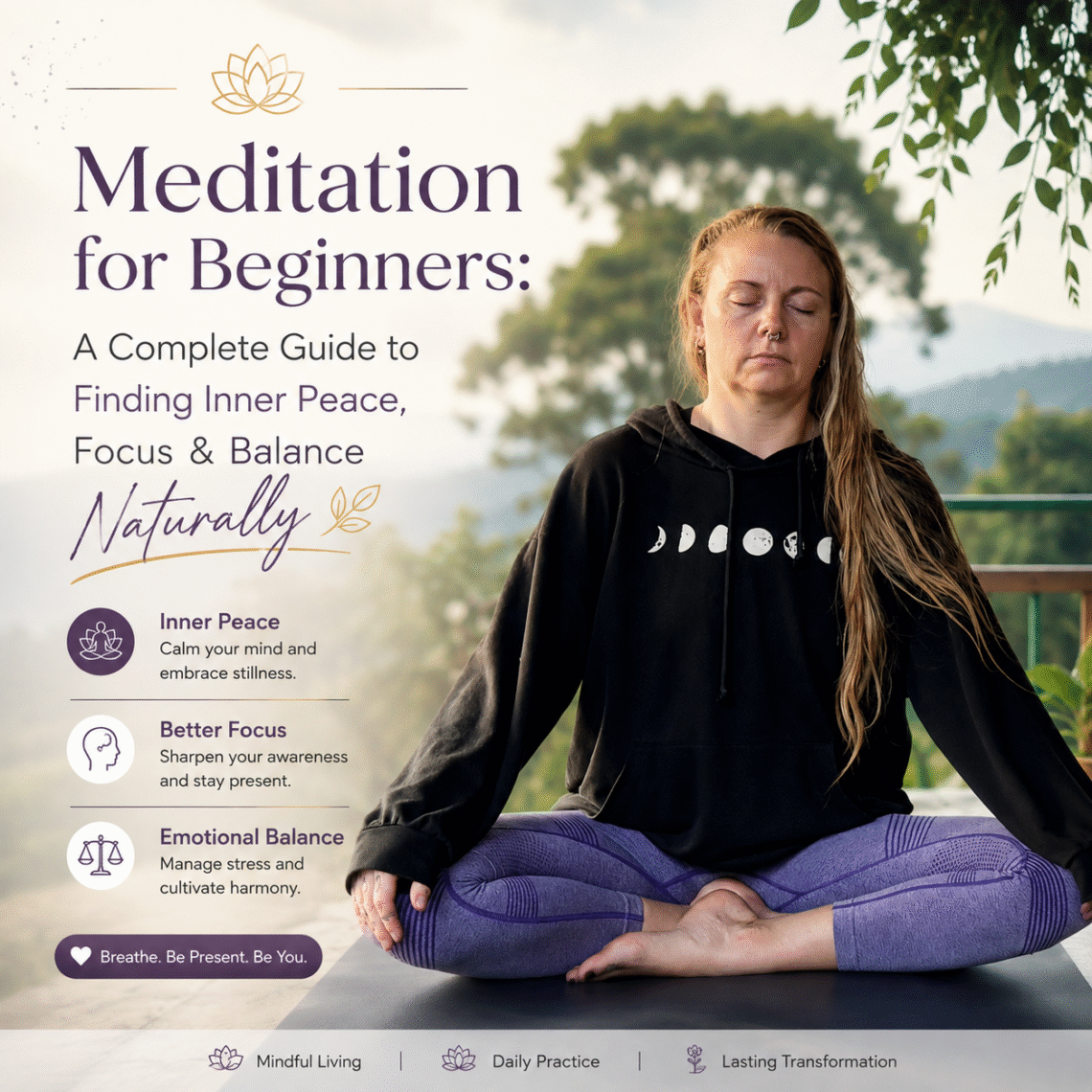
“The mind is like the ocean. When the surface is restless, it becomes difficult to see clearly. As the waves settle, everything beneath becomes visible.”
Meditation for Beginners Complete Guide,If you’ve ever tried to meditate and found yourself thinking about work, family, tomorrow’s plans, or even what you’re going to eat later, you’re not alone.
Almost every beginner experiences this.
Many people believe Meditation for Beginners Complete Guide means completely emptying the mind or stopping every thought. They sit quietly for a few minutes, notice their mind wandering, and immediately conclude, “I’m not good at meditation.”
The truth is much kinder.
Meditation for Beginners Complete Guide is not about having no thoughts. It is about changing your relationship with those thoughts.
Imagine sitting beside a river. Leaves float past on the surface of the water. You don’t need to jump into the river and chase every leaf. You simply watch them pass.
Thoughts work the same way.
Meditation for Beginners Complete Guide teaches us to observe our thoughts instead of becoming carried away by them.
This simple shift can transform the way we experience stress, emotions, relationships, and everyday life.
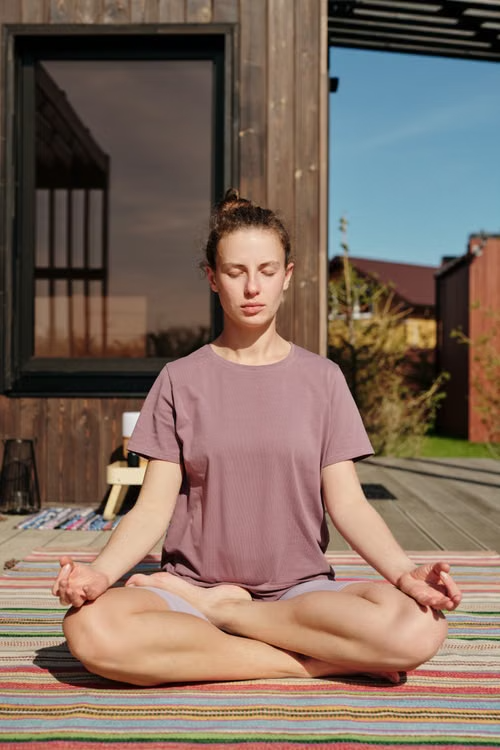
Table of Contents
Why More People Are Turning to Meditation Today
Modern life is faster than ever before.
Our mornings often begin with checking our phones instead of checking in with ourselves. Emails, social media notifications, deadlines, family responsibilities, and endless information compete for our attention from the moment we wake up until we finally fall asleep.
Even during quiet moments, the mind often continues racing.
Many people experience:
- Difficulty concentrating
- Mental fatigue
- Poor sleep
- Constant overthinking
- Anxiety and emotional overwhelm
- Feeling disconnected from themselves
We spend so much time doing that we rarely give ourselves permission to simply be.
Meditation for Beginners Complete Guide offers that opportunity.
It isn’t about escaping the world or avoiding responsibilities. Instead, it helps you meet life with greater clarity, patience, and awareness.
For just a few minutes each day, you allow your mind to slow down, your breath to deepen, and your attention to return to the present moment.
Over time, these few minutes can begin to influence the other twenty-three hours of your day.
What Is Meditation?
The word meditation is often used to describe many different practices, but at its heart, Meditation for Beginners Complete Guide is the practice of cultivating awareness.
Rather than trying to control every thought, Meditation for Beginners Complete Guide invites you to notice your inner experience with curiosity and kindness.
In traditional yoga, Meditation for Beginners Complete Guide is much more than a relaxation technique.
It is a path toward understanding yourself more deeply.
Through regular practice, you begin to recognize:
- how your mind responds to stress,
- how emotions arise and fade,
- how habits shape your daily life,
- and how awareness creates space for wiser choices.
Meditation for Beginners Complete Guide isn’t about becoming someone new.
It’s about becoming more fully present with who you already are.
Meditation in the Yogic Tradition
Meditation for Beginners Complete Guide has been practiced for thousands of years in India as an essential part of yoga.
In the Eight Limbs of Yoga described by the sage Patanjali, Meditation for Beginners Complete Guide is not the starting point—it is the natural unfolding of a balanced yoga practice.
The journey traditionally flows through:
- Ethical living (Yama)
- Personal discipline (Niyama)
- Physical postures (Asana)
- Breath regulation (Pranayama)
- Sense withdrawal (Pratyahara)
- Concentration (Dharana)
- Meditation for Beginners Complete Guide (Dhyana)
- Deep absorption (Samadhi)
Each step supports the next.
This is one reason Meditation for Beginners Complete Guide often feels easier after practicing yoga postures and Pranayama. As the body becomes more relaxed and the breath more balanced, the mind naturally becomes quieter.
At Diksha Yoga School, Meditation for Beginners Complete Guide is never taught in isolation. It is integrated with movement, conscious breathing, philosophy, and mindful living, creating a holistic experience that supports lasting personal growth.
What the Ancient Yoga Texts Teach Us About Meditation
Meditation for Beginners Complete Guide is not a modern wellness trend.
For thousands of years, it has been at the heart of yogic philosophy, guiding people toward greater awareness, inner peace, and self-discovery. Long before Meditation for Beginners Complete Guide apps and online courses existed, India’s ancient yoga masters documented practical teachings that continue to inspire practitioners around the world.
Although these classical texts were written centuries ago, their wisdom remains remarkably relevant today. They remind us that Meditation for Beginners Complete Guide is not about escaping life—it’s about learning to experience life with greater clarity and awareness.
Let’s explore three of the most influential yogic texts and what they teach beginners about meditation.
Patanjali’s Yoga Sutras: The Journey Toward a Peaceful Mind
Written more than 2,000 years ago, Patanjali’s Yoga Sutras is one of the most respected texts in the history of yoga.
Rather than focusing only on physical postures, Patanjali explains how yoga helps quiet the fluctuations of the mind.
One of the most well-known teachings states:
“Yoga is the stilling of the fluctuations of the mind.” (Yoga Sutras 1.2)
This doesn’t mean the mind must become completely empty.
Instead, it reminds us that through regular practice, we gradually become less controlled by constant mental chatter.
Every time you gently bring your attention back to your breath during Meditation for Beginners Complete Guide , you are practicing this timeless teaching.
For beginners, this is an important reminder:
You don’t need to stop thinking.
You simply learn not to follow every thought.
Hatha Yoga Pradipika: Preparing the Body and Breath
The Hatha Yoga Pradipika, written in the 15th century, explains that Meditation for Beginners Complete Guide becomes easier when the body and breath are prepared first.
This is why traditional yoga includes:
- Asana (physical postures)
- Pranayama (breath regulation)
- Meditation for Beginners Complete Guide (Dhyana)
Rather than treating these as separate practices, the text presents them as parts of one complete journey.
When the body feels relaxed and the breath becomes steady, the mind naturally becomes calmer.
This is one reason Meditation for Beginners Complete Guide often feels more comfortable after practicing yoga and Pranayama.
At Diksha Yoga School, students experience this progression every day. Yoga postures prepare the body, conscious breathing settles the nervous system, and Meditation for Beginners Complete Guide becomes a natural continuation rather than a separate exercise.
The Bhagavad Gita: Finding Stillness in Everyday Life
The Bhagavad Gita offers a beautiful reminder that Meditation for Beginners Complete Guide isn’t only for caves, monasteries, or moments of complete silence.
It teaches that true yoga is about maintaining balance while living fully in the world.
One passage describes the ideal meditator as someone who practices with moderation and balance—not through extremes.
This wisdom is especially valuable for beginners.
You don’t need to meditate perfectly.
You don’t need hours of free time.
A few mindful minutes each day, practiced consistently, can become the foundation of lasting inner peace.
The Bhagavad Gita encourages us to approach Meditation for Beginners Complete Guide with patience, discipline, and compassion rather than pressure or self-judgment.
Ancient Wisdom for Modern Life
Although these texts were written centuries apart, they share a common message:
- A peaceful mind develops through regular practice.
- Breath and body prepare the mind for meditation.
- Balance is more valuable than perfection.
- Meditation for Beginners Complete Guide is a lifelong journey, not a destination.
These teachings continue to guide yoga practitioners around the world because they address something timeless—the human mind.
Whether you are taking your very first Meditation for Beginners Complete Guide class or joining a Yoga Teacher Training at Diksha Yoga School in Koh Samui (Thailand), Bali (Indonesia), Goa (India), or Galle (Sri Lanka), these ancient principles remain as relevant today as they were thousands of years ago.
Every time you sit quietly, observe your breath, and gently return your attention to the present moment, you are participating in a tradition that has been passed from teacher to student for generations.
Meditation for Beginners Complete Guide is not about becoming perfect.
It is about becoming present.
Meditation vs. Mindfulness: What’s the Difference?
These two words are often used interchangeably, but they are not exactly the same.
Meditation for Beginners Complete Guide is a dedicated practice where you intentionally set aside time to cultivate awareness, concentration, or inner stillness.
You might sit quietly, observe your breath, repeat a mantra, or focus on a specific point of attention.
Mindfulness is the quality of awareness that you bring into everyday life.
You can practice mindfulness while:
- drinking your morning tea,
- walking in nature,
- listening to a friend,
- preparing a meal,
- or washing the dishes.
In simple terms:
Meditation is something you practice.
Mindfulness is something you live.
The beautiful thing is that a regular Meditation for Beginners Complete Guide practice naturally strengthens mindfulness throughout the rest of your day.
Why Meditation for Beginners Complete Guide Feels Difficult at First
One of the most common questions beginners ask is:
“Why does my mind become even busier when I try to meditate?”
The answer is surprisingly simple.
Your mind has always been busy.
Meditation for Beginners Complete Guide doesn’t create more thoughts—it simply allows you to notice them.
Imagine entering a quiet room after spending hours in a noisy city.
At first, you begin hearing sounds you never noticed before: the ticking of a clock, birds outside the window, your own breathing.
The sounds were always there.
The silence simply made you aware of them.
Meditation for Beginners Complete Guide works in much the same way.
As external distractions become quieter, your inner world becomes easier to observe.
This awareness is not failure.
It is the beginning of the practice.
The Science Behind Meditation
Ancient yogis understood the value of Meditation for Beginners Complete Guide through direct experience.
Today, modern science continues to explore many of its effects.
Research suggests that regular meditation may help support:
- improved attention and focus,
- healthier responses to stress,
- emotional regulation,
- better sleep quality,
- greater self-awareness,
- and overall mental well-being.
While Meditation for Beginners Complete Guide is not a cure for life’s challenges, it can become a valuable practice that supports both physical and emotional health when approached consistently.
Traditional yoga and modern science meet in a simple truth:
When the mind becomes calmer, we often experience life with greater clarity.
Who Can Practice Meditation?
One of the greatest misconceptions about Meditation for Beginners Complete Guide is that it is only for monks, spiritual seekers, or experienced yoga practitioners.
The truth is much simpler.
Meditation is for anyone willing to pause.
You don’t need:
- a perfectly quiet room,
- years of yoga experience,
- complete flexibility,
- or hours of free time.
Whether you’re a student, a parent, a business owner, a healthcare professional, or someone simply looking for a little more peace in daily life, Meditation for Beginners Complete Guide can be adapted to your individual needs.
There is no “perfect” meditator.
There are only people who continue returning to the practice.
Beginning Your Journey with Confidence
Every Meditation for Beginners Complete Guide journey begins with a single moment of stillness.
Not because your life suddenly becomes free of challenges.
Not because your thoughts disappear.
But because you choose to meet yourself with awareness instead of rushing through another day on autopilot.
At Diksha Yoga School, students from around the world discover that Meditation for Beginners Complete Guide is not about escaping reality—it is about learning to experience reality with greater presence, compassion, and balance.
Whether you join us in Koh Samui (Thailand), Bali (Indonesia), Goa (India), or Galle (Sri Lanka), meditation is woven naturally into daily yoga practice, Pranayama, philosophy, and mindful living.
In the next part of this guide, we’ll explore the life-changing benefits of Meditation for Beginners Complete Guide, combining ancient yogic wisdom with modern scientific understanding to help you discover why millions of people continue to make meditation part of their everyday lives.
The Transformative Benefits of Meditation: Why Millions of People Choose to Practice Every Day
“The greatest gift of Meditation for Beginners Complete Guide isn’t escaping life—it’s learning how to experience life with greater awareness.”
When people first begin meditating, they often hope for one specific outcome.
Some want to reduce stress.
Others are looking for better sleep.
Many hope to improve concentration, manage anxiety, or simply find a few peaceful moments in an increasingly busy world.
While these are wonderful reasons to begin, the benefits of meditation often extend far beyond our initial expectations.
Like planting a seed, Meditation for Beginners Complete Guide creates changes that may seem subtle at first. You might notice yourself becoming a little more patient during a difficult conversation, sleeping more deeply, or feeling less overwhelmed by everyday challenges. Over weeks and months of consistent practice, these small shifts begin to influence every aspect of your life.
This is why meditation has remained at the heart of yogic traditions for thousands of years. It doesn’t promise perfection. Instead, it helps you build a healthier relationship with your thoughts, emotions, and experiences.
Let’s explore how regular Meditation for Beginners Complete Guide can support your body, mind, and overall well-being.
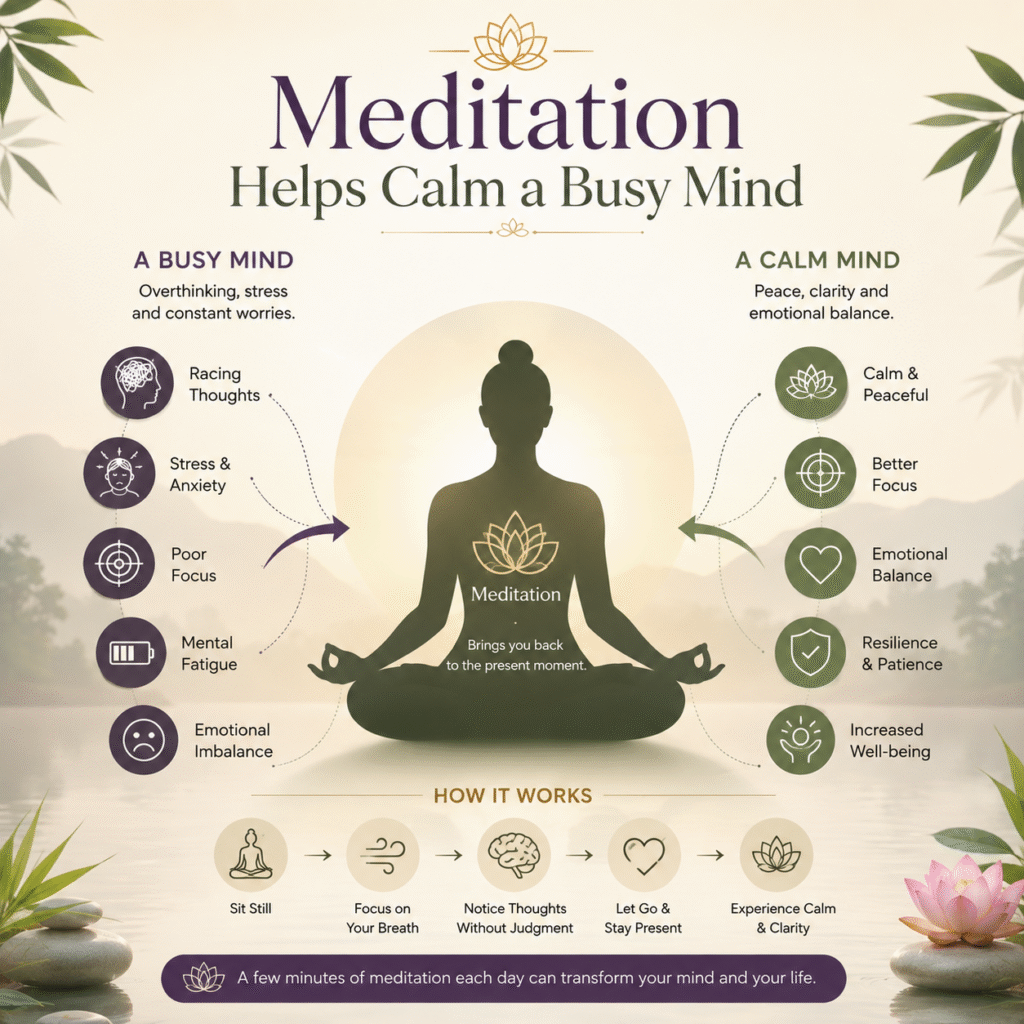
1. Meditation Helps Calm a Busy Mind
Our minds are constantly processing information.
From the moment we wake up until we fall asleep, we’re planning, remembering, worrying, solving problems, and reacting to countless situations.
Meditation for Beginners Complete Guide offers something many of us rarely experience—a pause.
When you sit quietly and gently return your attention to the breath, you begin creating space between yourself and the endless stream of thoughts.
Over time, many people notice:
- fewer racing thoughts,
- improved mental clarity,
- greater emotional balance,
- and an increased ability to stay present.
Your thoughts may not disappear, but they gradually lose their ability to control your attention.
2. Reduces Stress Naturally
Stress is a normal part of life.
However, when the body remains in a constant state of tension, it becomes difficult to relax, sleep well, or think clearly.
Meditation for Beginners Complete Guide encourages the body to shift from a state of constant alertness toward one of rest and restoration.
Many beginners describe the experience as feeling as though they have pressed a “pause button” on the mental noise of everyday life.
Rather than trying to eliminate stress completely, Meditation for Beginners Complete Guide helps you respond to it with greater calm and awareness.
This simple change can make even challenging situations feel more manageable.
3. Improves Focus and Concentration
Have you ever started reading a page only to realize you don’t remember a single sentence?
Distraction has become one of the greatest challenges of modern life.
Meditation for Beginners Complete Guide is like exercise for your attention.
Each time your mind wanders and you gently bring it back to your breath, you strengthen your ability to concentrate.
This practice gradually carries over into daily life.
You may find yourself:
- listening more attentively,
- completing tasks with fewer distractions,
- making thoughtful decisions,
- and feeling less mentally scattered.
Presence becomes a habit rather than an occasional experience.
4. Encourages Emotional Balance
Emotions are a natural part of being human.
Meditation for Beginners Complete Guide doesn’t remove sadness, frustration, excitement, or fear.
Instead, it changes the way we relate to these emotions.
Rather than reacting immediately, we begin observing our emotional experiences with greater curiosity.
This creates space.
And in that space lies choice.
Instead of reacting automatically, we learn to respond more thoughtfully.
Many students at Diksha Yoga School discover that this increased awareness supports healthier relationships—not only with others, but also with themselves.
5. Supports Better Sleep
A restless mind often creates restless nights.
Many people carry the weight of unfinished conversations, future plans, and daily worries into bed.
Meditation gently encourages the nervous system to slow down.
As the body relaxes and the breath becomes softer, it becomes easier to transition into restful sleep.
Even a short Meditation for Beginners Complete Guide before bedtime can become a meaningful evening ritual that prepares both the body and mind for deep rest.
6. Develops Greater Self-Awareness
Perhaps the most profound benefit of Meditation for Beginners Complete Guide is learning to understand yourself more deeply.
Most of us spend our lives observing the world around us.
Meditation for Beginners Complete Guide invites us to observe the world within.
Through regular practice, you begin noticing:
- recurring thought patterns,
- emotional habits,
- unconscious reactions,
- personal strengths,
- and areas where growth is possible.
This awareness becomes the foundation for lasting personal transformation.
7. Strengthens Compassion and Patience
Meditation for Beginners Complete Guide often begins as a personal practice, but its effects naturally extend into our relationships.
As we become more patient with ourselves, we often become more patient with others.
Simple moments begin to change.
You listen more carefully.
You speak with greater kindness.
You react less impulsively.
Compassion becomes less of an idea and more of a lived experience.
8. Creates a Stronger Connection Between Body and Mind
Many people move through the day without truly noticing how their body feels.
Meditation gently reconnects awareness with physical experience.
You may begin noticing:
- where you hold tension,
- how emotions influence your breathing,
- how posture affects your mood,
- and how relaxation feels in your body.
This deeper awareness often supports healthier choices both on and off the yoga mat.
9. Complements Your Yoga Practice
In traditional yoga, Meditation for Beginners Complete Guide is not separate from movement—it completes it.
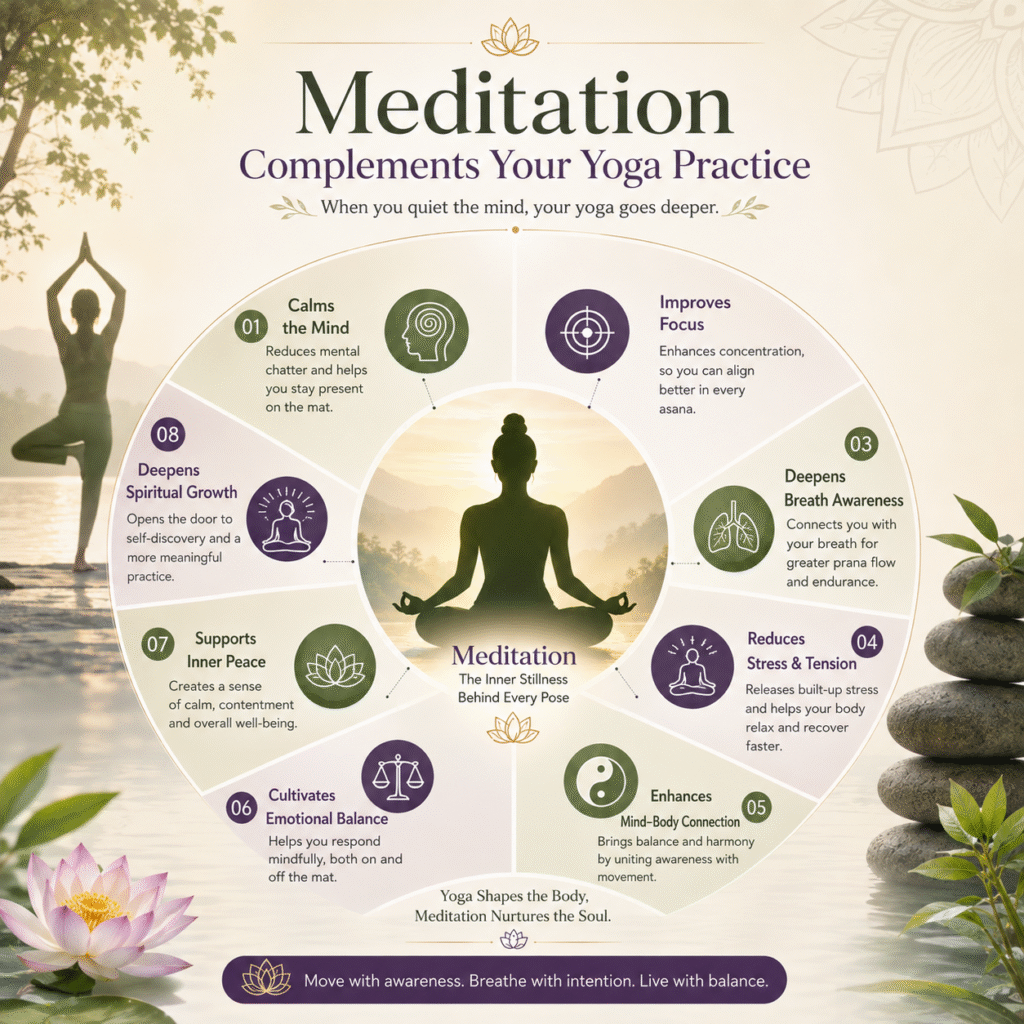
Yoga postures prepare the body.
Pranayama prepares the breath.
Meditation prepares the mind.
Together, these practices create a balanced approach to physical, mental, and emotional well-being.
At Diksha Yoga School, Meditation for Beginners Complete Guide is naturally integrated into daily Yoga Teacher Training programs, helping students experience yoga as a complete lifestyle rather than simply a physical exercise.
10. Encourages Mindful Living Beyond Meditation
The true purpose of Meditation for Beginners Complete Guide isn’t limited to the moments you spend sitting quietly.
Its real value appears during ordinary moments of everyday life.
You pause before reacting.
You breathe before responding.
You notice beauty more often.
You become fully present during conversations.
Gradually, mindfulness begins accompanying you throughout the day.
Meditation for Beginners Complete Guide doesn’t separate you from life.
It helps you participate in life more fully.
What Changes Can Beginners Expect?
Every person’s journey is unique.
Some people notice positive changes after only a few sessions.
For others, the transformation unfolds gradually over weeks or months.
There is no correct timeline.
Rather than chasing dramatic experiences, allow yourself to appreciate the quieter changes:
- feeling slightly calmer,
- breathing more deeply,
- sleeping a little better,
- responding more patiently,
- smiling more often,
- or simply feeling more present.
These small shifts often become the foundation for profound personal growth.
Meditation Is a Practice of Returning
One of the most beautiful lessons Meditation for Beginners Complete Guide teaches is that you never truly “fail.”
Every time your attention wanders…
Every time you notice your thoughts…
Every time you gently return your focus…
You are practicing meditation.
The return is the practice.
Not perfection.
Not silence.
Not emptying the mind.
Simply returning.
Again and again.
With kindness.
With patience.
With awareness.
The Journey Continues
Understanding the benefits of meditation is inspiring.
Experiencing them for yourself is something entirely different.
In the next part of this guide, we’ll explore how to meditate step by step, discover several beginner-friendly meditation techniques, learn how to create a simple daily routine, and overcome the common challenges that almost every beginner encounters.
Whether you have five minutes or thirty, you’ll discover that Meditation for Beginners Complete Guide doesn’t require a perfect environment—it simply asks you to begin with the next conscious breath and an open mind.
How to Meditate for Beginners: A Step-by-Step Guide to Starting Your Meditation Practice
“Meditation isn’t about becoming a different person. It’s about becoming more aware of the person you already are.”
After learning what Meditation for Beginners Complete Guide is and understanding its many benefits, the next question naturally arises:
“How do I actually meditate?”
This is where many beginners feel uncertain.
Some believe they must sit completely still for an hour.
Others think they need to stop every thought that enters their mind.
Some worry they’re “doing it wrong” after only a few minutes.
The truth is beautifully simple.
Meditation for Beginners Complete Guide doesn’t require perfection.
It doesn’t require a special talent.
It doesn’t even require complete silence.
It simply asks you to be present.
Like learning to ride a bicycle or play a musical instrument, meditation becomes easier through gentle, consistent practice rather than force or frustration.
At Diksha Yoga School, students are always reminded of one important principle:
Consistency is more powerful than intensity.
Practicing for ten mindful minutes every day is far more beneficial than meditating for one hour once a month.
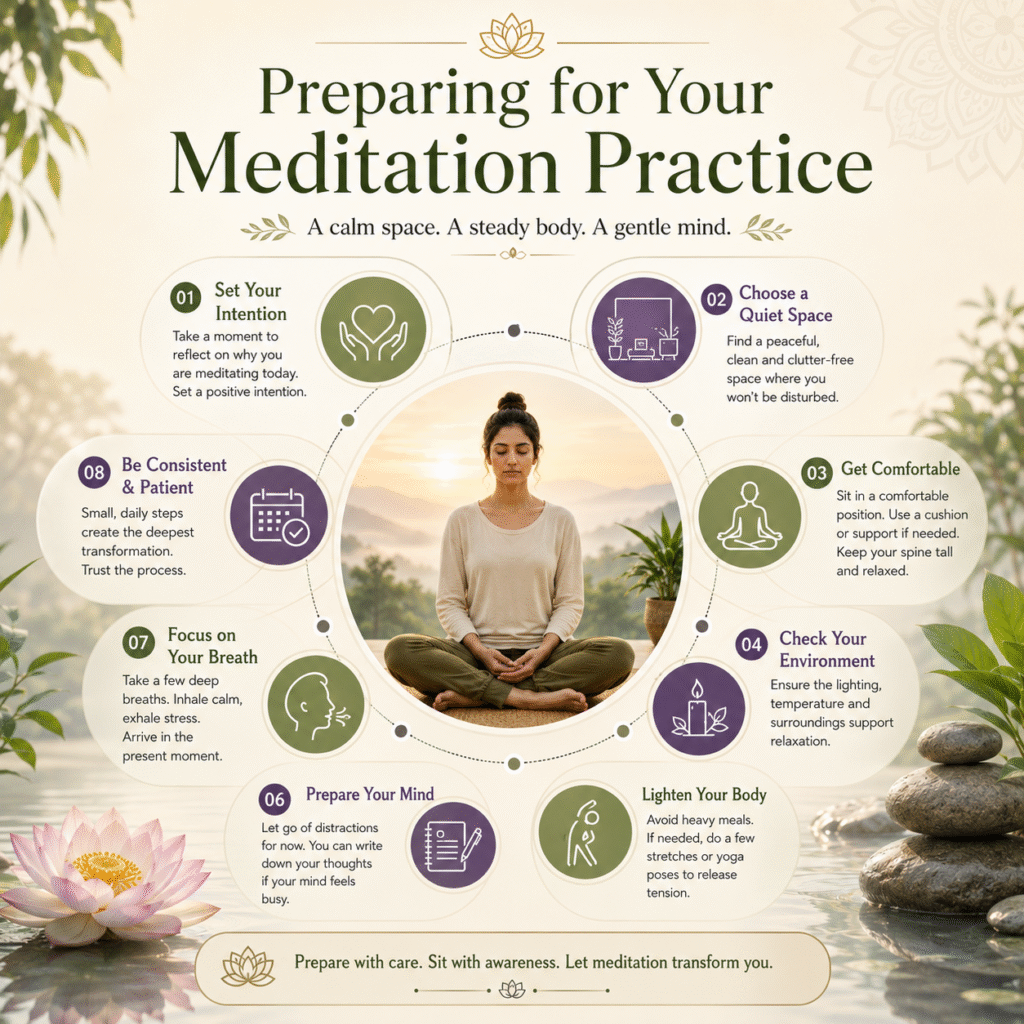
Preparing for Your Meditation Practice
Before you begin, create an environment that supports stillness and comfort.
You don’t need a dedicated Meditation for Beginners Complete Guide room or expensive equipment.
A simple, quiet corner where you feel relaxed is enough.
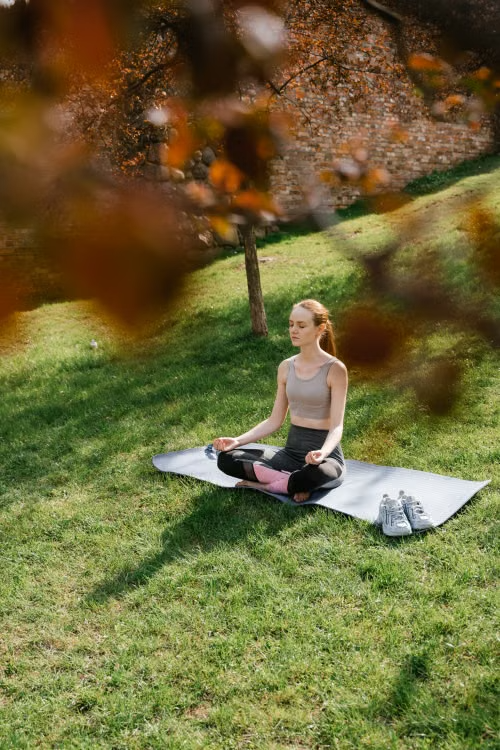
Choose a Comfortable Space
Look for a place where you’re unlikely to be interrupted.
This might be:
- A quiet room in your home
- A peaceful balcony
- A garden
- A beach at sunrise
- A calm corner of your yoga studio
The goal isn’t to find the perfect location.
It’s to create a space where you can gently turn your attention inward.
Choose the Right Time
Although meditation can be practiced at any time, certain moments naturally support a calmer mind.
Many practitioners enjoy meditating:
- Early in the morning before checking their phone
- After practicing yoga or Pranayama
- During a quiet lunch break
- Before going to sleep
Morning meditation often helps establish a positive tone for the day.
Evening meditation can help release mental tension before rest.
Choose the time that fits your lifestyle rather than trying to follow someone else’s routine.
The best Meditation for Beginners Complete Guide practice is the one you actually maintain.
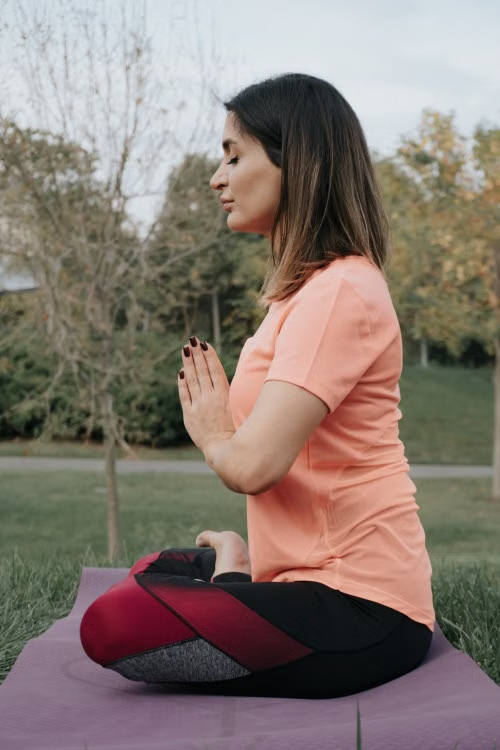
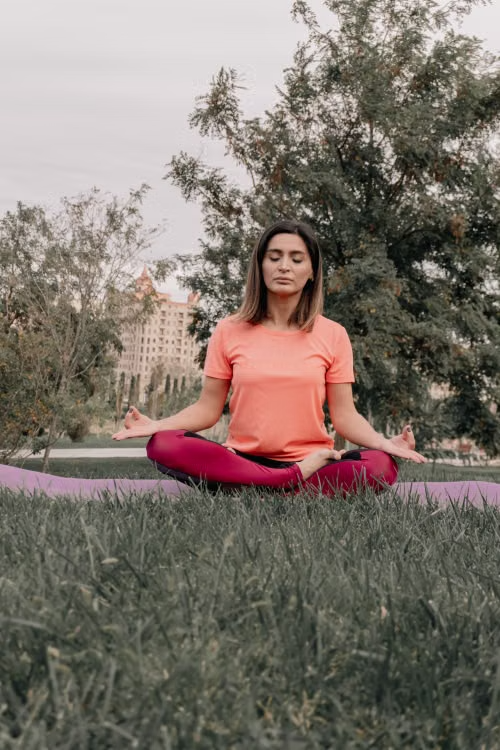
Find a Comfortable Sitting Position
One of the biggest myths is that Meditation for Beginners Complete Guide must be practiced in a perfect lotus position.
Comfort is far more important than appearance.
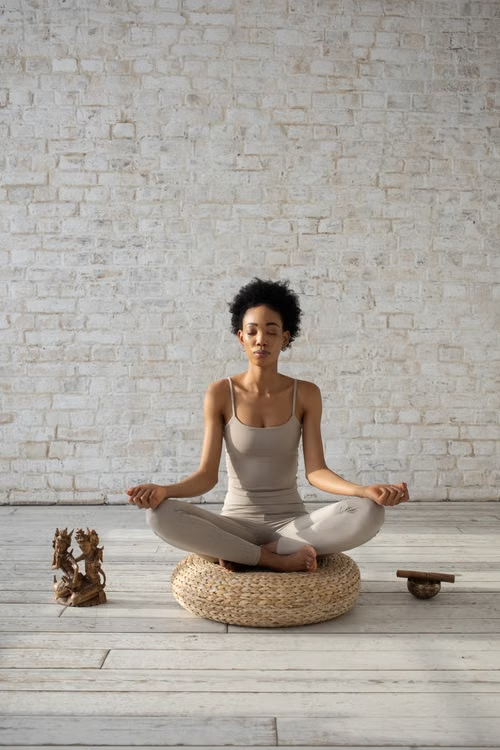
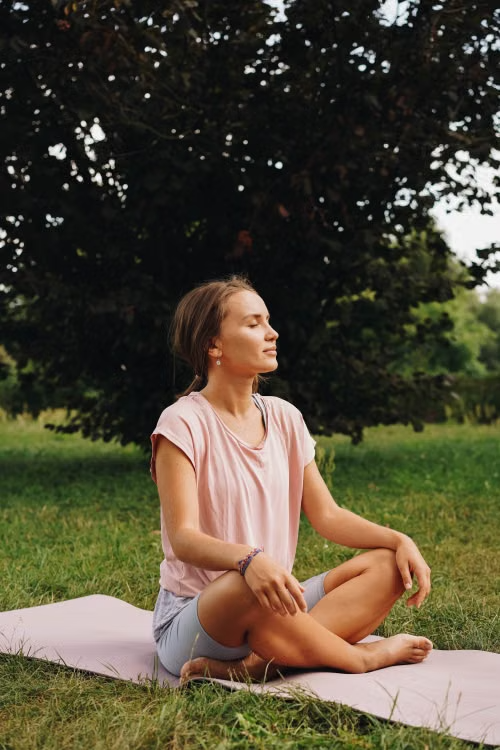
You may sit:
- Cross-legged on a yoga mat
- On a Meditation for Beginners Complete Guide cushion
- On a folded blanket
- On a chair with both feet resting comfortably on the floor
Allow your spine to be naturally upright.
Relax your shoulders.
Rest your hands gently on your knees or in your lap.
Imagine the crown of your head gently lifting toward the sky while the rest of your body softens.
A relaxed posture encourages relaxed breathing.
Step 1: Close Your Eyes and Arrive
Take a moment to simply arrive.
Close your eyes if that feels comfortable.
Notice your surroundings.
Feel the ground supporting your body.
Become aware of the natural rhythm of your breath.
There is nothing to change.
Nothing to achieve.
Simply notice.
This moment marks the beginning of your practice.
Step 2: Bring Awareness to Your Breath
The breath is one of the most accessible Meditation for Beginners Complete Guide anchors because it is always with you.
Begin observing:
- The coolness of the inhale
- The warmth of the exhale
- The gentle movement of your abdomen
- The rise and fall of your chest
Avoid trying to control your breathing.
Allow it to remain natural.
Your only task is to observe.
Step 3: Notice When Your Mind Wanders
This step surprises many beginners.
Your mind will wander.
That isn’t a mistake.
It’s part of being human.
You may suddenly remember:
- A conversation from yesterday
- Your shopping list
- An upcoming meeting
- A childhood memory
The moment you notice your attention has drifted, gently guide it back to your breath.
No frustration.
No self-criticism.
Just return.
Every return strengthens your awareness.
Step 4: Finish with Gratitude
After five or ten minutes, don’t rush to stand up.
Take one final deep breath.
Notice how your body feels.
Observe your mental state.
Open your eyes slowly.
Carry this sense of awareness into the rest of your day.
Meditation for Beginners Complete Guide doesn’t end when you open your eyes.
It continues in how you live.
| Meditation Type | Difficulty | Best For | Time Needed |
| Breath Awareness | Beginner | Focus & Calm | 5–10 min |
| Body Scan | Beginner | Relaxation | 10–15 min |
| Mantra Meditation | Beginner | Concentration | 10 min |
| Loving-Kindness | Beginner | Compassion | 10–15 min |
| Guided Meditation | Beginner | First-Time Practice | 5–20 min |
Beginner-Friendly Meditation Techniques
There are many forms of Meditation for Beginners Complete Guide, but beginners don’t need to learn them all at once.
Start with one simple practice and allow your confidence to grow naturally.
1. Breath Awareness Meditation
This is often the easiest Meditation for Beginners Complete Guide for beginners.
Simply observe your natural breathing.
Whenever your attention wanders, gently return to the breath.
Best For
- Complete beginners
- Stress relief
- Daily practice
2. Body Scan Meditation
Instead of focusing on the breath, gently move your attention through different parts of your body.
Notice areas of tension without trying to change them.
This practice encourages relaxation and greater body awareness.
Best For
- Evening meditation
- Better sleep
- Relaxation
Silently repeat a calming word or traditional mantra.
The repetition helps anchor attention whenever the mind becomes distracted.
Best For
- Concentration
- Mental clarity
- Developing focus
4. Loving-Kindness Meditation
Bring to mind feelings of kindness and compassion.
Begin by offering gentle wishes to yourself.
Gradually extend those wishes to loved ones, acquaintances, and eventually all living beings.
Best For
- Emotional healing
- Compassion
- Reducing anger
Rather than practicing alone, follow the voice of an experienced teacher.
Guided Meditation for Beginners Complete Guide are especially helpful during the early stages of learning.
Many beginners find this approach comforting because they receive gentle instructions throughout the practice.
How Long Should Beginners Meditate?
One of the biggest misconceptions is that Meditation for Beginners Complete Guide must last an hour to be effective.
It doesn’t.
A simple progression works beautifully.
| Experience | Daily Practice |
| Week 1 | 5 minutes |
| Week 2 | 8 minutes |
| Week 3 | 10 minutes |
| Week 4 | 15–20 minutes |
Consistency matters far more than duration.
Common Mistakes Beginners Make
Learning meditation is like learning any new skill.
Mistakes are part of the journey.
Trying Too Hard
Meditation isn’t something you force.
Relax.
Observe.
Return.
Expecting a Completely Quiet Mind
Thoughts are natural.
Success isn’t measured by having fewer thoughts.
It’s measured by becoming aware of them.
Judging Yourself
Some sessions feel peaceful.
Others feel restless.
Both are valuable.
Every meditation teaches something.
Sitting Uncomfortably
Pain distracts attention.
Choose comfort over appearance.
A chair is perfectly acceptable.
Being Inconsistent
Meditating for five minutes every day is more beneficial than meditating once every few weeks.
Create a habit before increasing the duration.
A Simple 15-Minute Daily Meditation Routine
If you’re unsure where to begin, try this gentle routine.
Minute 1–2
Sit quietly and observe your natural breathing.
Minute 3–7
Practice Breath Awareness Meditation.
Whenever your attention wanders, return gently to the breath.
Minute 8–12
Continue with a Body Scan Meditation, relaxing your face, shoulders, chest, abdomen, legs, and feet.
Minute 13–15
Sit quietly in silence.
Observe how you feel.
Finish with one deep breath and a moment of gratitude.
Meditation Is About Returning
Every experienced meditator has faced distraction.
Every teacher has experienced restlessness.
The difference is not perfection.
The difference is returning.
Returning to the breath.
Returning to awareness.
Returning to the present moment.
Again and again.
With patience.
With kindness.
With compassion.
This gentle act of returning becomes one of the most powerful lessons meditation can teach.
Your Journey Is Just Beginning
Learning how to meditate is only the first step.
As your practice deepens, you may discover that meditation becomes more than a daily habit—it becomes a way of experiencing life with greater clarity, presence, and balance.
In the final part of this guide, we’ll explore common myths about meditation, answer the questions beginners ask most often, introduce a simple 30-day meditation challenge, and discover how meditation is integrated into the Yoga Teacher Training programs at Diksha Yoga School in Thailand, Bali, Goa, and Sri Lanka.
Meditation Myths, a 30-Day Beginner Challenge & Continuing Your Journey
“Meditation doesn’t ask you to become someone else. It gently invites you to come home to yourself.”
By now, you’ve learned what meditation is, why it has been practiced for thousands of years, its remarkable benefits, and how to begin your own practice.
But before you continue your meditation journey, it’s important to clear away a few common misconceptions that often discourage beginners.
Many people give up on meditation not because it doesn’t work—but because they believe they’re doing it incorrectly.
Let’s change that.
7 Common Meditation Myths Every Beginner Should Know
Myth 1: “I Have to Stop Thinking”
This is perhaps the biggest misunderstanding about meditation.
Your mind is designed to think.
Meditation isn’t about eliminating thoughts.
It’s about becoming aware of them without getting carried away.
If thoughts arise during your practice, congratulations—you have a normal human mind.
Simply notice them and gently return to your breath.
Myth 2: “I Don’t Have Enough Time”
Many people imagine they need an hour every day.
You don’t.
Five to ten minutes of consistent practice can be far more valuable than one long session each month.
Meditation isn’t measured by length.
It’s measured by consistency.
Myth 3: “I’m Not Spiritual Enough”
Meditation welcomes everyone.
Whether you’re interested in personal growth, stress management, improved focus, or traditional yoga, meditation can become part of your daily life regardless of your background or beliefs.
Myth 4: “I’m Bad at Meditation“
There is no perfect meditation session.
Some days your mind feels peaceful.
Other days it feels busy.
Both experiences are valuable.
Every time you notice your attention wandering and gently bring it back, you’re practicing meditation successfully.
Myth 5: “Meditation Is Only for Relaxation”
Relaxation is certainly one benefit.
But meditation offers much more.
It develops awareness.
It strengthens concentration.
It supports emotional balance.
It encourages wiser responses to life’s challenges.
Relaxation is only the beginning.
Myth 6: “I Need Complete Silence”
Perfect silence isn’t necessary.
Life is naturally full of sounds.
Instead of resisting them, meditation teaches us to notice them without becoming distracted.
With practice, even everyday sounds become part of the experience rather than interruptions.
Myth 7: “Results Should Be Immediate”
Meditation isn’t a quick fix.
It is a lifelong practice.
Like learning yoga, playing an instrument, or growing a garden, meaningful change develops through patience and consistency.
Trust the process.
Your 30-Day Beginner Meditation Challenge
Rather than trying to meditate perfectly, commit to simply showing up.
This challenge gradually builds confidence without feeling overwhelming.
Week 1 – Learning to Pause
Daily Practice: 5 Minutes
Practice:
- 2 minutes of natural breathing
- 3 minutes of Breath Awareness Meditation
Goal:
Become familiar with sitting quietly without judging yourself.
Week 2 – Building Focus
Daily Practice: 10 Minutes
Practice:
- Breath Awareness
- Gentle Body Scan Meditation
Goal:
Develop concentration while relaxing the body.
Week 3 – Deepening Awareness
Daily Practice: 15 Minutes
Practice:
- Breath Awareness
- Mantra Meditation
- Silent Observation
Goal:
Notice thoughts without following them.
Week 4 – Creating a Daily Habit
Daily Practice: 20 Minutes
Practice:
- Breath Awareness
- Body Scan
- Loving-Kindness Meditation
- Silent Meditation
Goal:
Meditation becomes part of your lifestyle rather than another task on your to-do list.
Daily Meditation Tracker
| Day | Completed | Mood | Energy | Focus |
| 1 | ☐ | |||
| 2 | ☐ | |||
| 3 | ☐ | |||
| 4 | ☐ | |||
| 5 | ☐ | |||
| … | … | … | … | … |
| 30 | ☐ |
Celebrate progress rather than perfection.
Every day you return to your practice is a success.
Weekly Reflection Journal
At the end of each week, take five quiet minutes to reflect.
Week 1
- What did I notice about my thoughts?
- What felt easiest?
- What challenged me most?
Week 2
- Am I becoming more comfortable sitting quietly?
- Have I noticed changes in my breathing?
- How do I feel after meditation?
Week 3
- Am I reacting differently to stressful situations?
- Has my concentration improved?
- What positive changes have surprised me?
Week 4
- Which meditation technique do I enjoy most?
- What have I learned about myself?
- How will I continue my meditation practice beyond these 30 days?
Writing your reflections helps you recognize progress that might otherwise go unnoticed.
Common Challenges Beginners Face
Every meditator experiences obstacles.
These are not signs that you’re failing—they’re opportunities to learn.
“I Keep Getting Distracted.”
That’s normal.
The practice is returning.
Not avoiding distraction.
“I Feel Restless.”
Your body and mind are adjusting to stillness.
Shorter sessions often help during the beginning.
“I Missed Several Days.”
Simply begin again.
Meditation doesn’t require perfection.
Every day offers a fresh opportunity.
“I’m Not Sure If It’s Working.”
Many benefits appear gradually.
Notice the small changes:
- feeling calmer,
- listening more carefully,
- sleeping better,
- responding more patiently.
These quiet improvements often become the greatest transformations.
Tips for Building a Lifelong Meditation Practice
Small habits create lasting change.
Try these simple strategies:
- Meditate at the same time every day.
- Begin with five minutes.
- Turn off phone notifications.
- Practice after yoga or Pranayama.
- Keep a meditation journal.
- Celebrate consistency rather than duration.
- Be patient with yourself.
Remember:
A missed day doesn’t erase your progress.
Returning to your practice is what matters.
Meditation in Yoga Teacher Training
Meditation is one of the pillars of authentic yoga education.
At Diksha Yoga School, students don’t simply learn meditation techniques.
They experience meditation as part of a complete yogic lifestyle.
Throughout our Yoga Teacher Training programs, meditation is integrated with:
- Traditional Hatha Yoga
- Vinyasa Flow
- Pranayama
- Yoga Philosophy
- Mindfulness
- Relaxation practices
- Teaching methodology
Whether you study in Koh Samui (Thailand), Bali (Indonesia), Goa (India), or Galle (Sri Lanka), meditation becomes a daily practice that supports not only your yoga journey but also your personal growth.
Many students arrive believing meditation is difficult.
They leave with the confidence to continue practicing long after returning home.
Final Thoughts
Meditation isn’t about escaping your thoughts.
It isn’t about becoming someone different.
It isn’t about achieving perfection.
Meditation is the simple practice of meeting yourself with awareness.
Some days your mind will be quiet.
Other days it will feel busy.
Both days are part of the journey.
The most important step isn’t meditating perfectly.
It’s choosing to return.
Again.
And again.
Every breath brings a new beginning.
Every moment offers another opportunity to be present.
At Diksha Yoga School, we’ve seen students from every walk of life discover that meditation has the power to create lasting change—not by transforming who they are, but by helping them reconnect with who they have always been.
Whether your journey leads you to Thailand, Bali, Goa, or Sri Lanka, remember that the greatest teacher you will ever meet is the quiet awareness already within you.
Take one slow breath.
Close your eyes.
Your meditation journey begins now.
Frequently Asked Questions (FAQs)
1. How do I start meditating as a beginner?
The best way to begin is by keeping it simple. Find a quiet place, sit comfortably, and spend five to ten minutes focusing on your natural breath. Don’t worry if your mind wanders—that’s completely normal. Every time you gently return your attention to your breath, you’re practicing meditation.
2. How long should beginners meditate each day?
If you’re new to meditation, start with just 5–10 minutes a day. As you become more comfortable, gradually increase your practice to 15–20 minutes. Consistency is more important than duration.
3. Is it normal to think during meditation?
Yes, absolutely. Meditation is not about stopping your thoughts. It’s about noticing them without getting carried away. Even experienced meditators have thoughts—the difference is that they gently return their attention to the present moment.
4. What is the best meditation technique for beginners?
Breath Awareness Meditation is one of the easiest and most effective techniques for beginners. Simply observe your natural breathing and gently bring your attention back whenever your mind wanders. Guided meditation and Body Scan Meditation are also excellent starting points.
5. Should I meditate before or after yoga?
Both are beneficial, but traditional yoga recommends practicing meditation after yoga postures (Asana) and Pranayama. A relaxed body and steady breath make it easier to sit comfortably and focus the mind.
6. Can meditation help with stress and anxiety?
Many people find that regular meditation helps them feel calmer, more focused, and better able to manage everyday stress. While meditation is not a replacement for professional medical or mental health care, it can be a valuable practice that supports overall emotional well-being.
7. Do I need a teacher to learn meditation?
You can certainly begin your meditation journey on your own. However, learning with an experienced teacher can help you develop proper techniques, build confidence, and deepen your understanding of traditional meditation practices.
8. Can I meditate while sitting on a chair?
Yes. Meditation is about awareness, not achieving a particular posture. If sitting cross-legged feels uncomfortable, you can comfortably meditate on a chair with your feet flat on the floor and your spine naturally upright.
9. What should I do if I miss a day?
Simply begin again the next day. Meditation is a lifelong practice, and missing one session doesn’t erase your progress. Returning with patience and consistency is what truly matters.
10. Where can I learn traditional meditation in a supportive environment?
If you’d like to deepen your practice, Diksha Yoga School offers meditation as an integral part of its Yoga Teacher Training programs and wellness retreats in Koh Samui (Thailand), Bali (Indonesia), Goa (India), and Galle (Sri Lanka). Students learn meditation alongside Hatha Yoga, Pranayama, Yoga Philosophy, and mindful living through daily guided practice.
Student Experience
★★★★★ “Meditation Changed My Perspective, Not Just My Practice” — Sarah M., Canada
“Before joining Diksha Yoga School, I thought meditation meant trying to stop every thought in my mind. During the training, I discovered that meditation is about observing thoughts with kindness rather than fighting them. The daily guidance, Pranayama sessions, and supportive teachers helped me build a practice that I still follow every morning. I left feeling calmer, more focused, and far more connected to myself than when I arrived.”
★★★★★ “I Finally Found a Meditation Practice That Felt Natural” — Marco L., Italy
“I had tried meditation apps before, but I always gave up after a few days because I thought I was doing it wrong. At Diksha Yoga School, the teachers explained meditation in such a simple and practical way that everything finally made sense. Learning yoga, breathing practices, and meditation together made the experience feel complete. The peaceful environment and personal guidance gave me the confidence to continue meditating long after I returned home.”