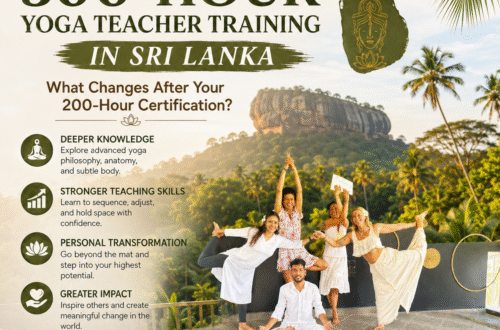
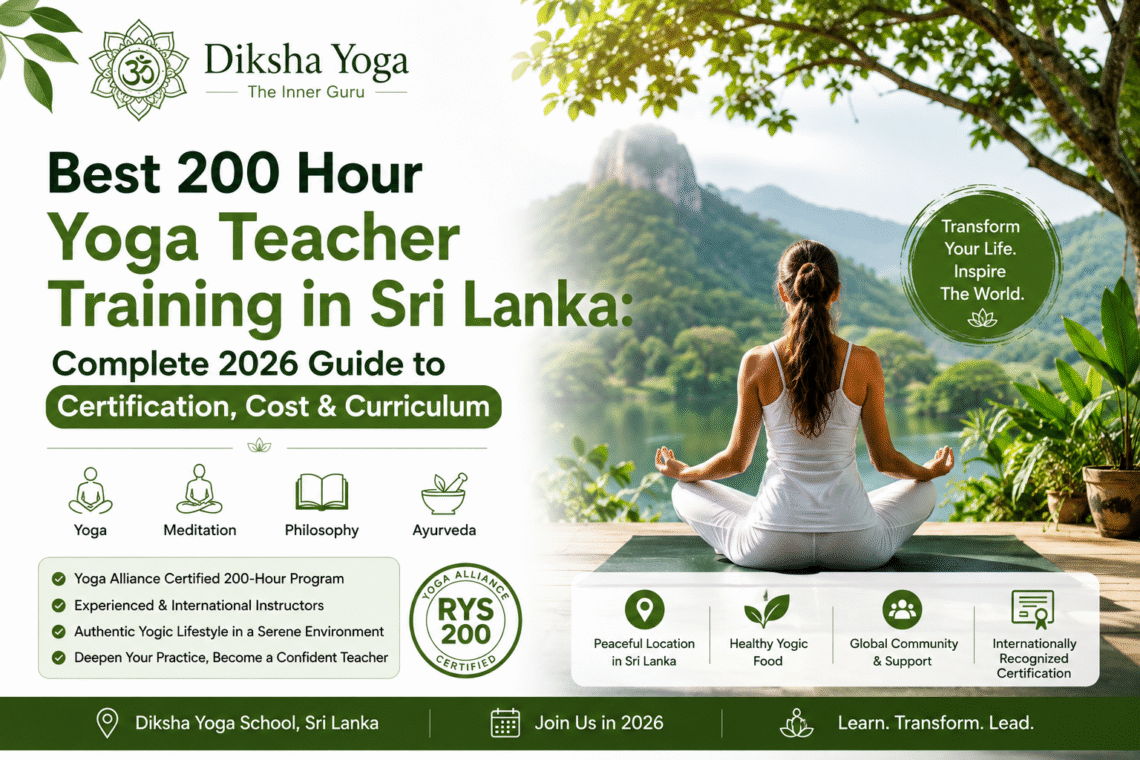
Choosing a yoga teacher training, Best 200 Hour Yoga TTC in Sri Lanka is not a decision that should be made only by looking at a photograph, a price or a beautiful location.
A 200-hour yoga teacher training is a commitment of time, energy and attention. For several weeks, yoga becomes part of your daily life not simply something you practice for an hour and then return to your normal routine.
And when that experience takes place in Sri Lanka, the environment itself can become part of the journey.
The island offers a unique combination of tropical nature, traditional culture, coastal landscapes and a slower rhythm of life. For students coming from busy cities and demanding professional routines, that change can create the space needed to focus more deeply on yoga.
But choosing the right 200 Hour Yoga Teacher Training in Sri Lanka requires looking beyond the destination.
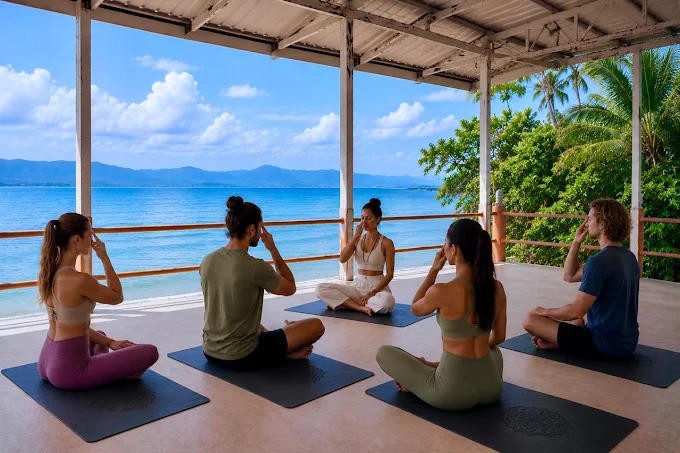
Table of Contents
You need to understand the teachers.
The curriculum.
The teaching methodology.
The certification.
The accommodation.
The food.
The actual daily schedule.
And, perhaps most importantly, what you will genuinely learn during those 200 hours.
This complete 2026 guide explains what to look for, what the training involves, how much a residential course can cost, what certification means, whether beginners can join and what makes a meaningful yoga teacher training experience.
Why Choose Sri Lanka for a 200 Hour Yoga Teacher Training?
Sri Lanka offers something different from many conventional teacher-training destinations.
It is not only a place where you can attend yoga classes.
It is a country where nature, spirituality, traditional culture and everyday life can naturally become part of the experience.
For an international student, that can make a residential training feel less like attending a course abroad and more like stepping into a completely different rhythm of life.
You may begin the morning with yoga practice.
Later, you study anatomy or philosophy.
You share a meal with students from different countries.
You practice teaching.
Then, after the day’s learning is complete, there is time to breathe, reflect and experience your surroundings.
That continuity matters.
A teacher training becomes much more powerful when the learning does not stop when the classroom ends.
Why South Sri Lanka?
For students considering a 200 Hour Yoga Teacher Training in Galle, Sri Lanka, the southern part of the island offers a particularly attractive environment.
Diksha Yoga School’s current 200-hour program is based in Galle, South Sri Lanka, and is designed as a residential 23-day training.
Galle offers a combination of coastal surroundings, tropical nature and access to Sri Lanka’s cultural and historical attractions.
It is very different from studying yoga in a large urban environment.
Instead of spending your entire day surrounded by traffic, office buildings and the pressure of city life, you have the opportunity to create a much simpler routine.
Practice.
Study.
Eat.
Rest.
Reflect.
Practice again.
That simplicity is one of the reasons residential yoga training can have such a lasting effect.
What Is a 200 Hour Yoga Teacher Training?
A 200-hour yoga teacher training is generally considered a foundational level of professional yoga education.
But the number “200” can sometimes create a misleading impression.
Two schools can both offer a 200-hour program while providing very different educational experiences.
One may focus heavily on physical postures.
Another may place greater emphasis on philosophy.
Another may concentrate on Vinyasa sequencing.
Another may combine traditional yoga with anatomy and modern teaching methodology.
So the important question is not simply:
“Is it 200 hours?”
The better question is:
“What happens during those 200 hours?”
A strong training should help you understand yoga from multiple perspectives.
You should learn how to practice.
You should learn why practices are performed.
You should understand how to communicate them.
And you should gradually develop the ability to guide another person safely and confidently.
What Do You Actually Learn?
A comprehensive 200 Hour Yoga Teacher Training in Sri Lanka can include several interconnected areas of study.
At Diksha Yoga School, the current course information includes Hatha Yoga, Ashtanga, Vinyasa Flow, pranayama, meditation, yoga philosophy, anatomy, alignment and teaching methodology.
These subjects are not simply boxes to tick.
They support one another.
For example:
Anatomy helps you understand movement.
Alignment helps you apply that understanding.
Pranayama develops awareness of breath.
Meditation develops concentration.
Philosophy provides a deeper context for the practice.
Teaching methodology helps you communicate what you have learned.
The goal is to bring these areas together into a coherent understanding of yoga.
Traditional Yoga Meets Modern Teaching
One of the biggest questions to ask when choosing a Yoga Teacher Training in Sri Lanka is how the school balances tradition with modern education.
Yoga has an ancient history.
At the same time, today’s yoga teacher works with students from very different physical, cultural and educational backgrounds.
A teacher therefore needs both respect for the tradition and the ability to communicate clearly in a modern classroom.
Diksha Yoga School describes its 200-hour program as combining traditional yogic teachings with modern teaching methodology, while maintaining a focus on personal attention and small-group learning.
This balance is important.
Tradition gives yoga depth.
Modern teaching methodology helps students communicate that knowledge responsibly.
Hatha, Vinyasa and Ashtanga: Why Learn More Than One Approach?
A multi-style curriculum can help future teachers understand that yoga does not have to look exactly the same in every class.
Hatha provides a foundation for understanding postures, breath, awareness and alignment.
Students can develop a more conscious relationship with their physical practice rather than simply moving from one pose to another.
Vinyasa introduces the relationship between breath and movement.
For future teachers, it also introduces sequencing.
You begin learning how one posture can prepare the body for another and how a class can have a logical beginning, middle and conclusion.
Ashtanga Foundations
Ashtanga introduces a more structured approach to practice, breath and sequencing.
Learning from different approaches allows students to develop a broader understanding of yoga without needing to force themselves into a single style.
Pranayama: The Breath Is Part of the Practice
Yoga is not only about what the body can do.
Breath is central to the practice.
During teacher training, students can explore traditional pranayama techniques and begin understanding how breath, attention and practice interact.
Depending on the curriculum, practices can include:
- Nadi Shodhana
- Kapalabhati
- Bhastrika
- Ujjayi
- Sheetali
- Sheetkari
Students may also study traditional bandhas such as:
- Mula Bandha
- Uddiyana Bandha
- Jalandhara Bandha
The goal is not simply to memorize names.
It is to understand the principles and develop a respectful, informed personal practice.
Meditation and the Inner Dimension of Yoga
Asana is visible.
Meditation is not.
That difference is important.
A photograph can show someone performing a yoga posture.
It cannot show the quality of their attention.
A 200-hour training gives students the opportunity to explore meditation as part of the broader yogic path.
Practices can include concentration, meditation, mantra, Japa and Yoga Nidra.
For some students, this becomes the most unexpected part of the entire course.
They arrive wanting to improve their physical practice.
They leave with a greater understanding of stillness.
Yoga Philosophy: Why It Matters to a Teacher
A yoga teacher should understand that yoga is much more than a modern exercise system.
Philosophy provides context.
During a comprehensive teacher training, students can explore foundational ideas associated with:
- Patanjali’s Yoga Sutras
- The Eight Limbs of Yoga
- Bhagavad Gita
- Hatha Yoga traditions
- Chakras
- Koshas
- Mudras
- Bandhas
- Yogic lifestyle
The purpose is not to memorize Sanskrit terminology for an examination.
The deeper purpose is to understand the ideas behind the practices.
When a teacher understands why something is taught, rather than simply copying what another teacher does, their teaching becomes more authentic.
Anatomy and Alignment
Every student who walks into a yoga class has a different body.
Different proportions.
Different mobility.
Different strengths.
Different limitations.
Different histories.
That is why anatomy is an essential part of a serious 200 Hour Yoga Teacher Training.
Students learn how movement relates to the human body and how alignment can be approached intelligently rather than mechanically.
A good teacher does not try to force every student into an identical shape.
A good teacher observes.
They listen.
They offer appropriate options.
And they understand that the purpose of yoga is not to make every body look the same.
Teaching Methodology: The Transition From Student to Teacher
There is a major difference between knowing how to perform a yoga pose and knowing how to teach it.
You might know exactly where your own foot should go.
But can you explain it clearly to a beginner?
Can you demonstrate it?
Can you offer an easier variation?
Can you observe whether the student understands?
Can you maintain awareness of the whole room while teaching?
This is where teaching methodology becomes essential.
Students can develop skills in:
- Sequencing
- Verbal cueing
- Demonstration
- Voice projection
- Class planning
- Teaching presence
- Observation
- Modifications
- Adjustments
- Student communication
- Giving and receiving feedback
These skills turn personal knowledge into teachable knowledge.
A 200-Hour Training Is Not Just About Becoming a Teacher
This is an important distinction.
Not every student joins a 200 Hour Yoga Teacher Training in Sri Lanka because they immediately want to teach professionally.
Some want to deepen their own practice.
Some are considering a career change.
Some want to understand yoga more deeply.
Some want to combine yoga with wellness, retreats or other professional work.
And some simply feel that yoga has become an important part of their lives and want to explore it more seriously.
All of these motivations can be valid.
The training can become a professional foundation while also being a deeply personal experience.
What Makes a Residential Training Different?
Online education has made yoga knowledge more accessible than ever.
You can watch a class from almost anywhere.
You can study philosophy from your laptop.
You can learn anatomy through online courses.
So why travel to Sri Lanka for a residential 200 Hour Yoga TTC?
Because immersion changes the learning experience.
You are not squeezing yoga into an hour between work meetings.
For several weeks, yoga becomes part of your daily structure.
Your teachers are physically present.
Your classmates become part of your learning environment.
You practice teaching in person.
You receive immediate feedback.
You share meals.
You experience the discipline of a consistent routine.
That is difficult to reproduce through an online course.
What You May Discover During the Journey
The most valuable changes are not always the ones you expect.
You may become more flexible.
You may become stronger.
But you may also become more patient.
More observant.
More comfortable with silence.
More aware of your breath.
More confident speaking in front of others.
More comfortable being a beginner.
And perhaps most importantly, you may discover that teaching yoga is less about showing people what you can do and more about helping them discover what they can experience.
That shift—from performance to awareness—is an important part of becoming a teacher.
Why Diksha Yoga School?
Diksha Yoga School’s Sri Lanka program is designed around a residential 23-day format in Galle and welcomes students at different levels of experience. Its current course information identifies Hatha, Ashtanga and Vinyasa Flow alongside pranayama, meditation, philosophy, anatomy, alignment and teaching methodology.
The school also emphasizes small groups and personal attention rather than treating teacher training as a purely certification-focused process.
That distinction matters.
A certificate can document that you completed a course.
It cannot replace the quality of the education you received.
The real value of teacher training is what you understand, what you can communicate and how your own practice develops during the process.
The Beginning of Your Yoga Teacher Journey
A 200-hour training does not make anyone a finished yoga teacher.
It gives you a foundation.
You continue learning through teaching.
Through personal practice.
Through observing other teachers.
Through studying.
Through working with different students.
And through remaining curious.
If you are looking for a 200 Hour Yoga Teacher Training in Sri Lanka in 2026, the right course should give you more than a certificate.
It should challenge you.
Support you.
Educate you.
And leave you with a deeper relationship with yoga than you had when you arrived.
Sri Lanka can provide the setting.
The training provides the foundation.
Your commitment creates the transformation.
Why Choose Galle for a 200 Hour Yoga Teacher Training?
When choosing a 200 Hour Yoga Teacher Training in Sri Lanka, the location should support the learning experience rather than simply look beautiful in photographs.
Galle, in southern Sri Lanka, offers a combination of tropical surroundings, coastal life and access to the cultural character of the island. Diksha Yoga School’s current 200-hour program is a 23-day residential training in Galle, with all levels welcome.
For an international student, that creates an opportunity to step away from the usual routine and dedicate several weeks to yoga.
You are not travelling to Sri Lanka simply to attend a class.
You are creating a temporary lifestyle around practice, study, reflection and community.
That distinction is important.
What Makes Galle Different From a Typical Yoga Holiday?
A yoga holiday can be relaxing.
A 200 Hour Yoga Teacher Training in Galle is different.
Your schedule has purpose.
You are learning how to understand the body.
You are studying yoga philosophy.
You are developing your personal practice.
You are learning to work with breath.
And gradually, you begin learning how to teach another person.
The tropical surroundings can provide a beautiful backdrop, but the education remains at the centre of the experience.
That is the difference between travelling for wellness and travelling to become a yoga teacher.
The Complete 200 Hour Yoga Teacher Training Curriculum
A strong 200-hour program should not be built around asana alone.
At Diksha Yoga School, the curriculum combines Hatha Yoga, Ashtanga Yoga, Vinyasa Flow, pranayama, meditation, yoga philosophy, anatomy, alignment and teaching methodology.
These subjects are designed to work together.
You learn the physical practice.
Then you learn how the body works.
You explore the breath.
You study the philosophy behind the tradition.
And eventually, you learn how to communicate your understanding to other people.
That progression is what turns a personal yoga practice into the foundation of teacher education.
Hatha Yoga: Building the Foundation
Traditional Hatha Yoga provides an important foundation for students beginning their teacher-training journey.
Rather than rushing from posture to posture, students learn to pay attention to:
- Alignment
- Breath
- Stability
- Awareness
- Mobility
- Concentration
- Mindful movement
This helps create a more conscious physical practice.
For a future teacher, that awareness is valuable because you eventually need to understand not only what a posture looks like, but what you are asking another person’s body to experience.
Vinyasa Flow: Learning the Art of Sequencing
Vinyasa Flow introduces a different relationship between breath and movement.
Instead of viewing postures as isolated exercises, students begin understanding how movements can be connected into a sequence.
This becomes especially important when learning to teach.
A good Vinyasa class needs more than a collection of attractive poses.
It needs a reason.
A beginning.
A progression.
A peak.
And a suitable closing.
Students therefore begin developing an understanding of intelligent yoga sequencing, rather than simply memorizing someone else’s class.
Ashtanga Foundations
Ashtanga provides another perspective on disciplined practice, breath, movement and sequencing.
Learning its foundations can help students understand how a structured practice develops over time.
It also teaches an important lesson for future teachers:
Consistency matters.
You do not become a better teacher by learning a new posture every day.
You become better by understanding the practice more deeply.
Pranayama: Understanding the Power of Breath
One of the strongest aspects of traditional yoga education is its emphasis on breath.
At Diksha Yoga School, the Sri Lanka program includes traditional pranayama practices such as Nadi Shodhana, Ujjayi, Bhastrika, Suryabhedi, Chandrabhedi, Bhramari, Sheetali and Sheetkari, alongside other yogic breathing practices.
Students can also explore traditional cleansing practices and related yogic techniques as part of the broader curriculum.
The important point is that pranayama should not be treated simply as a five-minute breathing exercise at the end of an asana class.
It has its own place within the yogic tradition.
Students learn to approach the breath with awareness, discipline and respect.
Meditation: Moving Beyond the Physical Practice
A yoga teacher training should give students time to explore what happens when the body becomes still.
Meditation can develop concentration, awareness and self-observation.
The Sri Lanka curriculum includes practices such as guided meditation, Trataka, Japa, Ajapa meditation, mantra chanting and other meditation approaches.
For some students, this is where yoga begins to feel completely different.
The practice becomes quieter.
There is less emphasis on how the body looks.
And more attention is given to what is happening within.
Yoga Philosophy: Understanding Why We Practice
Yoga philosophy gives context to everything else.
Without it, yoga can easily become reduced to physical exercise.
During the training, students explore subjects connected with:
Patanjali’s Yoga Sutras
An introduction to the Yoga Sutras and the ideas associated with Patanjali.
The Eight Limbs of Yoga
Understanding yoga as a broader path that extends beyond asana.
Chakras and Koshas
Exploring traditional yogic models of the human experience.
Mudras and Bandhas
Understanding traditional practices used alongside asana, pranayama and meditation.
Yogic Lifestyle
Considering how yoga can influence daily life rather than remaining something practiced only on a yoga mat.
These subjects help students understand the meaning behind the practice, rather than simply memorizing terminology.
Anatomy and Alignment: Learning to Teach Real Bodies
One of the biggest mistakes a new yoga teacher can make is assuming every student should look the same in a posture.
Human bodies are not identical.
Students have different:
- Bone structures
- Mobility
- Strength
- Proportions
- Previous injuries
- Movement patterns
- Experience levels
That is why anatomy and alignment are essential components of a serious 200 Hour Yoga Teacher Training.
Students learn how to observe movement and understand alignment in a way that supports safer, more intelligent practice.
The goal is not to force a student into a picture-perfect shape.
The goal is to help the student understand their own body.
Teaching Methodology: From Knowing Yoga to Teaching Yoga
This is where the journey changes.
You may know how to perform Warrior II.
But can you teach Warrior II to someone who has never practiced yoga before?
Can you explain the setup?
Can you demonstrate?
Can you observe?
Can you offer a modification?
Can you recognize when someone needs less intensity?
Can you keep the rest of the class engaged while helping one student?
These are teaching skills.
A comprehensive teacher-training program therefore needs practical methodology alongside theoretical knowledge.
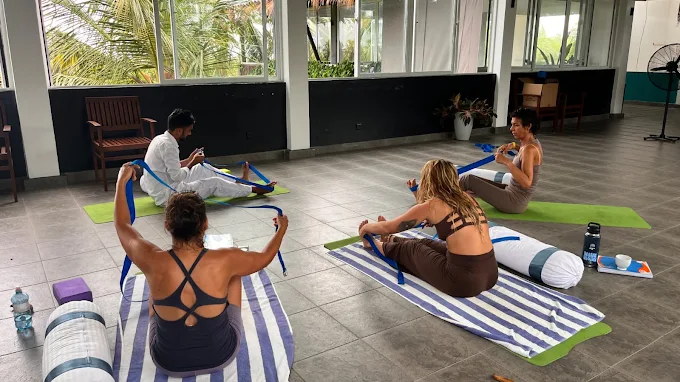
Students can develop skills in:
- Class planning
- Sequencing
- Verbal cueing
- Demonstration
- Voice projection
- Observation
- Alignment
- Modifications
- Adjustments
- Teaching presence
- Student communication
- Giving and receiving feedback
This is where a practitioner begins becoming a teacher.
Learning to Teach Safely
Teaching yoga comes with responsibility.
Students trust their teacher.
That means the teacher needs to understand their own limitations as well as those of their students.
A good training should encourage teachers to observe rather than assume.
Instead of saying:
“Everyone should go deeper.”
a thoughtful teacher asks:
“Is going deeper appropriate for this student today?”
That difference represents a major shift from performance-oriented yoga toward responsible teaching.
What Happens During Practical Teaching?
At some stage, every aspiring teacher has to stand in front of other people and teach.
It can be uncomfortable.
You suddenly become aware of your voice.
Your instructions.
Your timing.
Your memory.
Your body language.
But that discomfort is part of learning.
You practice.
You receive feedback.
You make changes.
Then you teach again.
This repeated process can be much more valuable than simply watching an instructor demonstrate a perfect class.
Because teaching is a skill.
And skills improve through practice.
A Typical Day During a Residential Training
The exact timetable can vary, but a residential 200-hour course generally follows a structured rhythm of practice, study and rest.
A day can include:
Morning:
Meditation, pranayama and asana practice.
Late morning:
Breakfast and personal time.
Midday:
Anatomy, philosophy or other theoretical subjects.
Afternoon:
Asana workshops, alignment and teaching methodology.
Later afternoon:
Teaching practice, sequencing or self-study.
Evening:
Meditation, mantra, reflection or other yogic practices.
The purpose of this structure is not to keep students busy every minute.
It is to create enough consistency for learning to become part of everyday life.
Why Small Groups Can Make a Difference
A teacher training is not the same as watching an online video.
Students need to be seen.
They need opportunities to ask questions.
They need feedback.
They need correction when appropriate.
They need encouragement when they lose confidence.
Diksha Yoga School states that its Sri Lanka program keeps groups small to provide personal attention and direct interaction with teachers.
This is particularly important during teaching practice.
You are not simply completing hours.
You are developing a skill.
What You Learn Outside the Classroom
Some of the most meaningful learning happens between scheduled sessions.
A conversation over breakfast.
A question after class.
Watching another student teach.
Discussing philosophy with a teacher.
Practicing a sequence again because something did not work the first time.
Sharing experiences with classmates.
Residential training creates many of these informal learning opportunities naturally.
You begin to understand that yoga education does not happen only when the teacher is standing at the front of the room.
The International Community
Students joining a Yoga Teacher Training in Sri Lanka often come from different countries and different backgrounds.
Some may already teach.
Some may have practiced yoga for years.
Others may be taking their first serious step toward becoming a teacher.
That diversity can strengthen the learning experience.
You learn that there is no single way to experience yoga.
Someone else’s question may make you understand a concept differently.
Someone else’s teaching style may inspire you.
Someone else’s struggle may remind you to be patient with your own.
By the end of the training, the people you arrived with as strangers may become an important part of your yoga journey.
What Happens When the Course Gets Difficult?
It is important to be realistic.
A 200-hour training is not a holiday with yoga added to it.
There will be early mornings.
There will be physically demanding practices.
There will be long periods of study.
There will be moments when your body feels tired.
There may be subjects you do not immediately understand.
And there may be days when standing in front of the class feels uncomfortable.
That is part of the process.
Growth does not always feel comfortable.
The purpose of a supportive training environment is not to remove every challenge.
It is to help you move through those challenges safely and intelligently.
By the End of Part 2, What Should You Understand?
A good 200 Hour Yoga Teacher Training in Sri Lanka should give you more than a collection of yoga poses.
You should begin understanding:
How to practice.
How to breathe.
How to observe.
How the body moves.
Why yoga developed the way it did.
How to build a class.
How to communicate clearly.
How to teach responsibly.
And perhaps most importantly:
How to continue learning after the course ends.
That is the foundation of a real yoga teacher.
What Is Daily Life Like During a 200 Hour Yoga Teacher Training in Sri Lanka?
One of the biggest differences between a normal yoga course and a residential 200 Hour Yoga Teacher Training in Sri Lanka is that yoga becomes part of your daily routine.
You are not simply arriving for a 60-minute class and then going back to work.
For several weeks, your days revolve around practice, study, meals, teaching practice, reflection and rest.
That immersion can be challenging at first.
But it is also what allows the different parts of the curriculum to start connecting.
You learn something in anatomy and notice it during asana practice.
You study pranayama and become more aware of your breathing.
You discuss philosophy and begin thinking about how it applies outside the yoga room.
You learn sequencing and then try to teach it.
Slowly, the course stops feeling like a collection of subjects.
It starts becoming one complete learning experience.
A Typical Day at a Residential Yoga Teacher Training
The exact schedule can vary depending on the training day and curriculum, but students should expect a structured daily routine.
A typical day may include:
Early Morning — Meditation & Pranayama
The day begins before the distractions of normal life take over.
Meditation and pranayama create an opportunity to become quiet and focused before beginning physical practice.
This is an important part of traditional yoga education.
The intention is not simply to “get a workout.”
It is to prepare the body, breath and mind for the day.
Morning — Asana Practice
The morning practice may include Hatha Yoga, Vinyasa Flow or other components of the curriculum.
Students work on:
- Alignment
- Breath awareness
- Stability
- Mobility
- Transitions
- Sequencing
- Concentration
The practice develops gradually as students become more familiar with the techniques.
Breakfast & Personal Time
After morning practice, students have time to eat and rest.
This space is important.
Teacher training can be intensive, and recovery is part of learning.
Late Morning / Afternoon — Theory
The academic side of the course can include:
- Anatomy
- Yoga philosophy
- Teaching methodology
- Alignment
- Pranayama theory
- Meditation
- Yogic lifestyle
This is where students begin understanding the why behind the practice.
Afternoon — Teaching Practice
Students gradually begin moving from learning to teaching.
They may practice:
- Giving instructions
- Demonstrating postures
- Sequencing
- Offering modifications
- Observing classmates
- Correcting communication
- Managing a class
This is often where confidence begins to grow.
Evening — Reflection & Yogic Practices
Evening sessions can include meditation, mantra, discussion, reflection or other practices depending on the day’s schedule.
Then comes rest.
Because the next morning begins again.
Why the Daily Routine Matters
It can be easy to underestimate the importance of routine.
Before arriving in Sri Lanka, your days may be filled with work, messages, meetings, traffic and responsibilities.
Then suddenly, your priorities become much simpler.
Practice.
Study.
Eat.
Rest.
Learn.
Reflect.
This simplicity allows students to pay attention to things that can easily disappear inside everyday life.
You begin noticing your breathing.
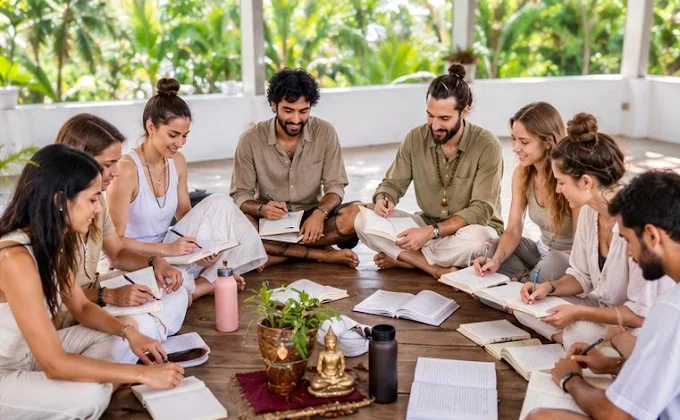
You notice how your body feels.
You become more aware of your thoughts.
You learn to listen.
And you start developing discipline without needing to force it.
The Residential Experience in Galle
Diksha Yoga School’s current Sri Lanka 200-hour program is a 23-day residential training in Galle, South Sri Lanka. The course package includes accommodation and meals, allowing students to live and study within the same training environment.
For an international student, having accommodation connected to the program can simplify the experience considerably.
You do not have to spend your morning travelling across town to reach your class.
You do not have to arrange a different hotel every few days.
And you can spend more of your energy on the actual training.
The residential environment also naturally creates community.
Your classmates are not people you see for one hour and then never meet again.
You share much of your daily experience.
What Is Accommodation Like?
Accommodation is an important part of comparing 200 Hour Yoga Teacher Training Sri Lanka fees.
A low course price does not necessarily mean a lower total cost if accommodation, meals and transportation are excluded.
When comparing programs, ask:
- What type of room is included?
- Is it private or shared?
- How many students share?
- Are meals included?
- Is Wi-Fi available?
- Is housekeeping provided?
- Is airport pickup included?
- Are there additional accommodation charges?
These questions can make the difference between an apparently inexpensive course and a genuinely good-value residential package.
Diksha Yoga School’s Sri Lanka program includes residential accommodation as part of the course package, with room options depending on the selected arrangement.
Food During the Training
Food becomes an important part of your experience when you practice several hours each day.
Diksha Yoga School includes three sattvic vegetarian meals per day in its Sri Lanka residential program.
The idea behind a sattvic approach is not simply to follow another restrictive diet.
It is to create a simple, nourishing food routine that complements the yogic lifestyle.
Students eat together.
Meals become a natural opportunity to talk, relax and connect with classmates.
For international students, it can also be an introduction to a different relationship with food and daily routine.
What Does Sattvic Food Mean?
In the yogic tradition, sattva is associated with qualities such as clarity, balance and harmony.
Sattvic food is traditionally associated with fresh, nourishing vegetarian foods prepared simply.
During an intensive teacher training, food can support the broader experience by providing regular meals rather than leaving students to organize their own diet around a demanding schedule.
The purpose is not perfection.
It is awareness.
Students begin noticing how different foods, meal timings and habits affect how they feel during practice.
Airport Pickup: Starting the Journey Without Stress
Arriving in another country can be one of the most stressful parts of travelling for a teacher training.
You may have travelled for many hours.
You have luggage.
You are tired.
And you may not know the local area.
Diksha Yoga School includes airport pickup in the Sri Lanka residential package.
This allows students to arrive and transition into the training environment without having to organize their first transportation independently.
Students should provide their flight information according to the school’s booking process so the transfer can be coordinated correctly.
Learning Beyond the Yoga Hall
A residential Yoga Teacher Training in Sri Lanka is not meant to be twenty-three days of sitting inside a classroom.
The environment outside the training space can also become part of the experience.
Sri Lanka offers beaches, tropical landscapes, wildlife, historic sites and a rich cultural environment.
When the course schedule permits, students can experience some of the surrounding area through included or organized excursions.
The purpose is balance.
You are studying intensively, but you are also experiencing the country you travelled so far to visit.
Why Excursions Matter
A teacher training is an intensive experience.
If every day consisted only of classes, the body and mind would eventually need a break.
Excursions create another type of learning.
You experience local surroundings.
You spend time with classmates outside the classroom.
You see another side of Sri Lanka.
And you return to training with a refreshed mind.
Diksha Yoga School’s current Sri Lanka program includes excursions as part of the residential experience.
These experiences should complement the training—not replace it.
The Social Side of a Yoga Teacher Training
Many students arrive in Sri Lanka alone.
That can feel intimidating before the course begins.
But residential training has a way of changing that quickly.
You begin with introductions.
Then you practice together.
You eat together.
You study together.
Someone struggles with a sequence.
Someone else helps.
Someone asks a question during philosophy class that everyone starts discussing.
A few days later, the people who were strangers become familiar faces.
By the end of the course, they may feel like a small yoga family.
This international community is one of the most memorable parts of teacher training for many students.
What Happens When You Start Teaching?
There is a moment during almost every teacher training when the student has to stop observing and start guiding.
You stand at the front.
Everyone looks at you.
And suddenly you realize:
Knowing yoga and teaching yoga are two different skills.
You might know the posture perfectly.
But teaching requires you to:
- Speak clearly
- Remember the sequence
- Observe the room
- Give useful instructions
- Adapt to different abilities
- Maintain awareness
- Manage time
- Create a safe learning environment
The first attempt may feel uncomfortable.
That is completely normal.
You are not expected to be perfect.
You are expected to practice.
From Nervous Beginner to More Confident Teacher
Teaching confidence usually develops gradually.
First, you might guide one posture.
Then a short sequence.
Then a section of a class.
Eventually, you may teach a complete sequence.
Each time, you receive feedback.
Maybe your instructions were too complicated.
Maybe your voice was too quiet.
Maybe your transitions were rushed.
Maybe you explained something beautifully.
The feedback gives you something specific to work on.
That is how confidence develops.
Not through pretending you are already an expert.
Through practice.
The Final Week Can Feel Very Different
The first week and the final week of a 200-hour training can feel like two completely different experiences.
At the beginning, students are learning names.
Learning the schedule.
Learning each other.
Learning the teachers.
Learning how intensive the course will be.
By the final week, students are usually much more familiar with the routine.
They understand the terminology.
They have practiced teaching.
They have experienced challenging days.
They have developed their own rhythm.
And suddenly, the end of the course begins to feel real.
That is when many students realize how much they have changed.
The Final Teaching Assessment
The exact assessment process depends on the school’s current course structure, but teacher training should ultimately require students to demonstrate that they can apply what they have learned.
This may involve teaching a class or sequence, demonstrating practical knowledge and showing understanding of the core subjects.
The important thing is not to perform a “perfect” class.
It is to demonstrate that you understand the fundamentals and can communicate them responsibly.
What Happens on the Final Day?
The final day is often a mixture of relief, pride and emotion.
You have spent weeks waking up with the same people.
You have practiced together.
You have studied together.
You have challenged yourselves.
Then suddenly, the course is finished.
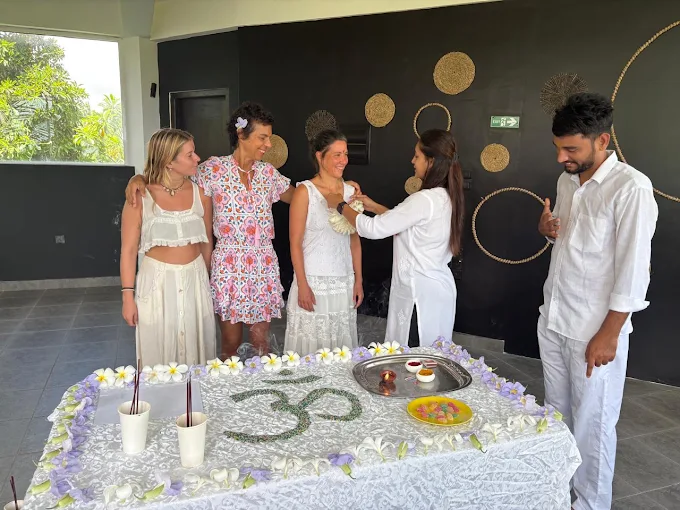
There may be a closing ceremony and presentation of certificates.
Diksha Yoga School’s Sri Lanka program includes a welcome and closing ceremony as part of the residential experience.
Photographs are taken.
Students celebrate.
Teachers give their final words.
And then everyone begins thinking about what comes next.
What Comes Next After Your 200-Hour Training?
Receiving a certificate does not mean your education is finished.
It means you now have a foundation.
You can begin teaching if that fits your goals and the applicable professional requirements.
You can continue your own practice.
You can study more anatomy.
You can explore meditation.
You can attend workshops.
You can eventually consider advanced training such as 300-hour or other specialized programs.
Or you may simply take what you learned back into your personal life.
There is no single correct path.
The Biggest Transformation May Not Be Physical
Students often arrive expecting to become stronger or more flexible.
Those changes can happen.
But the deeper transformation may be less visible.
You may become more patient.
More aware.
More comfortable with silence.
More confident.
More disciplined.
More willing to listen.
More accepting of your own limitations.
And more aware that yoga is not about creating a perfect body.
It is about developing a deeper relationship with yourself.
Why the Experience Continues After You Leave Sri Lanka
The real test of teacher training is not what happens on the final day.
It is what happens six months later.
Do you still practice?
Do you still remember the breath?
Do you still approach your students with curiosity?
Do you continue studying?
Do you remember that every student is different?
If the answer is yes, then the training has become more than a certificate.
It has become part of your life.
A 200-Hour Training Is an Investment in Yourself
The financial cost is only one part of the investment.
You are also giving:
23 days of your life.
Your attention.
Your energy.
Your willingness to learn.
Your courage to be a beginner.
That is why choosing a school should be taken seriously.
Look at the teachers.
Look at the curriculum.
Look at what is included.
Read the policies.
Ask questions.
And think about the kind of teacher—and person—you want to become.
Your Sri Lankan Yoga Journey
A 200 Hour Yoga Teacher Training in Sri Lanka can be many things at once.
It can be a professional foundation.
A personal challenge.
A cultural experience.
A deeper yoga practice.
A chance to meet people from around the world.
And perhaps a turning point in your life.
The destination gives you the setting.
The teachers give you guidance.
The practice gives you experience.
But the transformation comes from your willingness to show up every day.
Practice. Learn. Teach. Reflect. Begin again.
How Much Does a 200 Hour Yoga Teacher Training in Sri Lanka Cost?
One of the first questions almost every student asks is:
“How much does a 200 Hour Yoga Teacher Training in Sri Lanka cost?”
And it is a sensible question.
But comparing only the advertised course fee can be misleading.
Two schools may advertise similar prices while offering very different packages.
One may include accommodation, meals, airport transfer, course materials and excursions.
Another may charge separately for several of these.
So when comparing 200 Hour Yoga Teacher Training Sri Lanka fees, it is better to look at the total experience and what is actually included, rather than choosing the lowest number.
What Should You Look for in the Course Fee?
Before paying a deposit, check whether the price includes:
- Yoga teacher training
- Accommodation
- Daily meals
- Airport pickup
- Training manual
- Yoga Alliance certification, where applicable
- Practical teaching sessions
- Anatomy and philosophy classes
- Excursions
- Welcome ceremony
- Closing ceremony
- Taxes or other compulsory charges
This gives you a much more realistic picture of the actual cost.
What Is Included in Diksha Yoga School’s Sri Lanka Program?
Diksha Yoga School’s current 200-hour Sri Lanka program is structured as a 23-day residential training and includes accommodation, three vegetarian meals per day, airport pickup, training materials, excursions, ceremonies and certification upon successful completion.
That means students can organize much of their main training expense before travelling rather than having to arrange every element separately after arrival.
The exact room category and associated fee depend on the selected accommodation option, so students should confirm the current price before booking.
Accommodation: Private or Shared?
Accommodation is one of the biggest factors affecting the total cost of a residential yoga teacher training.
Some students prefer a private room because they want more personal space after an intensive training day.
Others prefer shared accommodation because it can be more economical and creates another opportunity to connect with classmates.
Neither option is automatically better.
It depends on your personality, budget and what you need during the training.
Private Accommodation
A private room can provide:
- More personal space
- Greater privacy
- Quiet time for reflection
- More control over your rest routine
This can be particularly valuable during an intensive training when you want somewhere quiet to recharge.
Shared Accommodation
Shared accommodation can provide:
- A lower overall course cost
- More social interaction
- A stronger sense of community
- An opportunity to build friendships with fellow students
For solo travellers, sharing can also make the first few days feel less unfamiliar.
Three Meals a Day
Food is not a small detail during an intensive yoga program.
You are practicing.
Studying.
Teaching.
Walking.
Thinking.
And repeating this routine day after day.
Having meals provided removes one more daily decision from your schedule.
Diksha Yoga School’s Sri Lanka program includes three vegetarian meals per day, described as sattvic meals.
This allows students to maintain a regular food routine throughout the training.
Why Vegetarian Food Is Common in Yoga Teacher Training
Many traditional yoga environments emphasize vegetarian food as part of a yogic lifestyle.
The purpose is not simply to follow a dietary rule.
It is connected with the traditional idea of supporting a lifestyle based on awareness, balance and moderation.
During teacher training, students also become more conscious of how food affects their energy, digestion and physical practice.
The experience can therefore become an opportunity to develop greater awareness around eating rather than simply following a temporary menu.
Airport Pickup
For international students, airport transportation is another expense that needs to be considered when comparing 200 Hour Yoga TTC Sri Lanka cost.
Diksha Yoga School includes airport pickup in the residential program.
This can make arrival considerably easier, particularly for someone visiting Sri Lanka for the first time.
After a long international journey, having a planned transfer means you can focus on reaching the training location rather than negotiating transportation immediately after landing.
Students should provide accurate flight information in advance according to the school’s booking procedure.
Training Manual and Learning Materials
A 200-hour training involves a large amount of information.
Students may study:
- Asana
- Pranayama
- Meditation
- Anatomy
- Philosophy
- Teaching methodology
- Alignment
- Sequencing
- Sanskrit terminology
- Yogic lifestyle
Having course material to refer back to after class is therefore valuable.
Diksha Yoga School includes a training manual as part of its Sri Lanka program.
A good manual should become more useful over time.
During the first week, you may simply use it to follow the curriculum.
Months later, you may return to a particular section when preparing a class or revisiting something you learned during training.
Yoga Alliance Certification
Certification is naturally one of the most important considerations for students researching a 200 Hour Yoga Teacher Training in Sri Lanka.
Diksha Yoga School’s Sri Lanka course information states that the program is registered with Yoga Alliance USA and that students receive certification upon successful completion.
However, students should understand what certification actually means.
A certificate is evidence that you completed the school’s required training.
The certificate itself does not make someone an experienced teacher.
The real value comes from the education behind it.
That is why curriculum, teachers, practical teaching experience and feedback are just as important as the certificate.
What Does Yoga Alliance Registration Mean?
For students planning to teach internationally, Yoga Alliance registration is often an important consideration when selecting a teacher-training school.
A registered school operates within the relevant Yoga Alliance framework for its registered program.
For students, this can provide a recognizable structure for foundational teacher training.
But it should still be one part of your decision.
Do not choose a school solely because it displays a registration logo.
Ask:
Who are the teachers?
What will I actually study?
How much teaching practice will I receive?
How much personal attention is available?
What happens if I struggle with something?
Those questions tell you much more about the quality of your education.
Excursions Included in the Experience
A residential training should have some space for students to experience Sri Lanka beyond the classroom.
Diksha Yoga School’s current program includes one or two excursions, allowing students to experience some of the surrounding environment and culture during the training.
These experiences are not the main reason to choose a teacher training.
They are a complement to it.
The priority remains the education.
But having opportunities to step away from the training schedule can help students recharge and create memorable experiences with their classmates.
Welcome and Closing Ceremonies
Beginning and ending a teacher training are meaningful moments.
The welcome ceremony creates an opportunity for students and teachers to come together at the beginning of the journey.
The closing ceremony marks the completion of the training and gives students a chance to reflect on what they have experienced.
Diksha Yoga School includes both welcome and closing ceremonies in its Sri Lanka program.
These moments may seem small compared with 200 hours of education, but they help give the training a sense of beginning, progression and completion.
What Costs Extra?
Even when accommodation and the main program are included, students should still plan a personal travel budget.
Possible additional expenses can include:
- International flights
- Travel insurance
- Visa or entry-related costs
- Personal shopping
- Additional drinks or snacks
- Laundry
- Personal transportation outside included transfers
- Optional activities
- Personal wellness treatments
- Additional nights before or after the course
Planning these expenses before travelling can make the entire experience much more comfortable.
Is a 200 Hour Yoga Teacher Training in Sri Lanka Worth the Cost?
That depends on what you are looking for.
If you are comparing only the cheapest advertised price, you may find lower-cost options.
But price alone does not tell you the value of a teacher training.
Consider what you are receiving for the investment:
23 days of structured education.
Residential accommodation.
Three meals every day.
Yoga practice.
Philosophy.
Anatomy.
Teaching methodology.
Practical teaching experience.
Training materials.
Airport pickup.
Excursions.
Certification.
A community of fellow students.
That is a much more meaningful way to evaluate value.
How to Compare Two Yoga Teacher Training Programs
Imagine two programs.
School A
Lower advertised price.
But:
- Accommodation is separate.
- Meals are separate.
- Airport transfer is separate.
- Training manual costs extra.
- Excursions are not included.
School B
Slightly higher advertised price.
But:
- Accommodation included.
- Three meals included.
- Airport pickup included.
- Training materials included.
- Excursions included.
- Certification included.
At first glance, School A appears cheaper.
After adding the additional expenses, that difference may disappear.
This is why students should compare the complete package, not just the headline price.
What Makes a Course Good Value?
Good value does not necessarily mean the cheapest course.
It means that the money you spend corresponds to the quality and completeness of the experience.
Look for:
Experienced teachers
Who actually teach and mentor students rather than simply appearing on the website.
A structured curriculum
One that covers both practical and theoretical aspects of yoga.
Small-group attention
So you have opportunities to ask questions and receive feedback.
Practical teaching
Because reading about teaching is not the same as teaching.
Residential support
Including suitable accommodation and meals.
Clear pricing
With no unexpected compulsory charges appearing after you arrive.
Transparent policies
So you understand deposits, cancellations and what happens if your travel plans change.
Questions to Ask Before Booking
Before sending your deposit for a 200 Hour Yoga Teacher Training in Sri Lanka, consider asking the school:
Who will teach the course?
How many students are in the group?
What is included in the price?
Is accommodation included?
Are all meals included?
Is airport pickup included?
What certification will I receive?
How much practical teaching will I do?
Are excursions included?
What happens if I need to change my dates?
Are there any additional compulsory costs?
A school that answers these questions clearly is giving you the information you need to make an informed decision.
Why Transparent Pricing Builds Trust
Nobody wants to arrive at a destination and discover unexpected charges.
For an international student, uncertainty can be particularly stressful.
Clear pricing therefore matters.
A good yoga school should explain what is included before the student makes a booking.
It should also make clear what is not included.
That transparency is part of a professional student experience.
The Real Investment: What You Take Home
At the end of the course, you take home more than a certificate.
You take home your training manual.
Your notes.
Your new understanding of yoga.
Your experience teaching.
Your memories of Sri Lanka.
The relationships you developed.
And a foundation that you can continue building on for years.
That is the real value of a 200 Hour Yoga Teacher Training in Sri Lanka.
Is Sri Lanka Good for Beginners?
Yes, a 200-hour training can be suitable for beginners when the program is designed to welcome students with different levels of experience.
Diksha Yoga School states that its Sri Lanka 200-hour program welcomes students from beginners through advanced practitioners.
However, being suitable for beginners does not mean the course will be easy.
A beginner should still expect:
- Regular physical practice
- Early mornings
- Study
- Memorization
- Philosophy
- Anatomy
- Teaching practice
- Self-discipline
You do not need to arrive as an advanced yogi.
You do need to arrive willing to learn.
The Best Way to Think About the Price
Instead of asking:
“What is the cheapest 200-hour yoga teacher training in Sri Lanka?”
ask:
“What will I receive for the total amount I am investing?”
That small change in the question can completely change how you compare schools.
The right training should provide a balance of:
Education + Experience + Support + Accommodation + Community + Certification.
And that is what makes the investment meaningful.
Ready to Compare Your Options?
If you are researching a 200 Hour Yoga Teacher Training in Sri Lanka for 2026, do not rush your decision.
Compare the curriculum.
Research the teachers.
Check what is included.
Look at the accommodation.
Understand the certification.
Read genuine student experiences.
And make sure the environment feels right for the kind of transformation you are seeking.
A good teacher training is not simply something you purchase.
It is an experience you commit yourself to.
Why Choose Diksha Yoga School for Your 200 Hour Yoga Teacher Training in Sri Lanka?
Choosing a yoga school is ultimately about more than location.
Sri Lanka can provide a beautiful environment. Galle can provide a peaceful setting. But the teacher, teaching approach, curriculum and student experience are what determine the quality of your training.
This is where researching the school itself becomes important.
Why Diksha Yoga School?
Diksha Yoga School was founded by Yogini Manisha, an experienced yoga teacher and mentor whose teaching is rooted in traditional yoga while also incorporating modern teaching methodology.
The school’s approach is not based simply on teaching students how to perform more advanced postures.
The emphasis is on understanding yoga from multiple dimensions:
Asana.
Philosophy.
Anatomy.
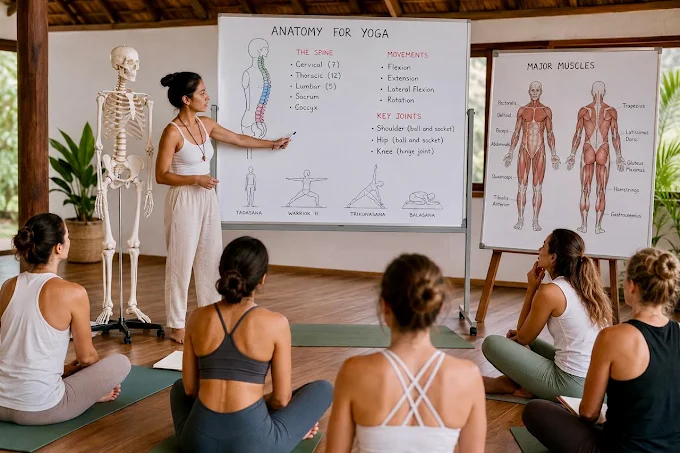
Alignment.
Teaching methodology.
And the relationship between all of them.
That broader approach is important for anyone considering a 200 Hour Yoga Teacher Training in Sri Lanka.
Learning From an Experienced Teacher
A yoga teacher training is only as valuable as the quality of teaching and mentorship behind it.
Yogini Manisha brings more than 16 years of experience in teaching, training and mentoring yoga practitioners, with a teaching philosophy developed through years of working with students from different backgrounds and levels.
Her approach emphasizes traditional Hatha Yoga, Vinyasa Flow, pranayama, meditation and yogic philosophy while paying close attention to alignment, awareness and the individual student’s learning process.
This creates a different kind of classroom.
The goal is not simply:
“Do the posture exactly like the teacher.”
Instead, students are encouraged to understand:
Why is this posture practiced?
What is happening in the body?
How does the breath influence the practice?
How could I explain this to another student?
What changes when a student’s body is different from mine?
These questions help develop independent teachers rather than students who simply copy movements.
Traditional Yoga With a Modern Teaching Approach
There is an important balance in teacher training.
Yoga has an ancient tradition that deserves respect.
At the same time, today’s yoga teacher works with students from many different cultures, ages, bodies and levels of experience.
A teacher therefore needs to understand tradition while also being able to communicate clearly in a modern classroom.
Diksha Yoga School’s approach brings these two perspectives together.
Students explore traditional yogic knowledge while developing practical skills such as:
- Clear verbal instruction
- Modern sequencing
- Anatomy awareness
- Alignment principles
- Class planning
- Teaching presence
- Student observation
- Modifications
- Practical teaching
The result is not simply knowledge that remains inside a textbook.
It is knowledge that students can gradually learn to communicate.
Small Groups and Personal Attention
One of the most important questions to ask before booking a 200 Hour Yoga TTC in Sri Lanka is:
How much individual attention will I actually receive?
A large class can make it difficult for teachers to notice every student’s movement, questions and challenges.
Diksha Yoga School emphasizes small-group learning and personal attention.
That matters particularly during:
- Asana practice
- Alignment workshops
- Anatomy
- Teaching practice
- Sequencing
- Practical assessments
When you are learning to teach, feedback is essential.
You need someone to tell you what worked.
You also need someone to tell you what needs improvement.
That is how teaching develops.
Why Personal Mentorship Matters
Everyone arrives at teacher training with a different background.
One student may have practiced yoga for ten years.
Another may have discovered yoga only recently.
Someone may be naturally flexible.
Another may have excellent strength but limited mobility.
Someone may be comfortable speaking in front of people.
Another may become nervous as soon as everyone looks at them.
A good teacher-training environment recognizes these differences.
Personal mentorship gives students space to ask questions, make mistakes and gradually develop their own strengths.
The objective is not to turn everyone into the same type of yoga teacher.
It is to help each student develop a strong foundation from which their own teaching voice can emerge.
What Makes a Good Yoga Teacher?
A good yoga teacher is not necessarily the person who can perform the most difficult posture.
Advanced asana ability can be impressive.
But teaching requires something different.
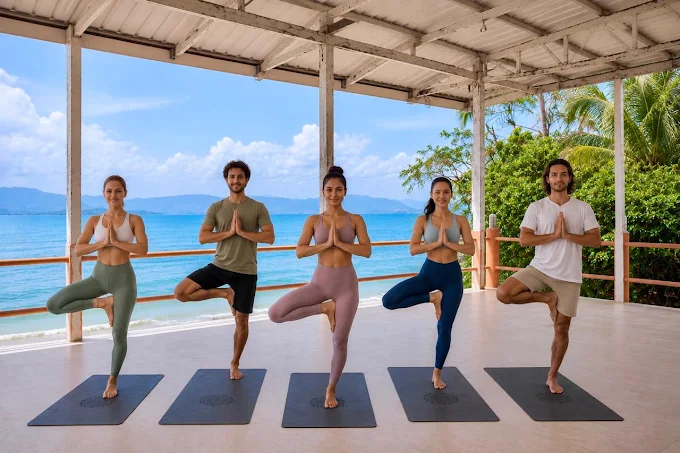
A good teacher needs to be able to:
Observe.
Listen.
Communicate.
Adapt.
Encourage.
Set appropriate boundaries.
Understand different bodies.
Create a supportive environment.
And remain a student themselves.
This is one of the central ideas behind meaningful teacher education.
You are not completing 200 hours so that you can say:
“I know everything about yoga.”
You complete them so you can begin the next stage of learning with a stronger foundation.
Who Is This 200 Hour Yoga Teacher Training For?
A residential 200 Hour Yoga Teacher Training in Sri Lanka can suit different types of students.
Complete Beginners
You do not necessarily need years of yoga experience to begin teacher training.
If you are genuinely interested in learning and prepared to practice consistently, a foundational course can provide the structure you need.
Experienced Yoga Practitioners
If you have practiced for years but never studied yoga systematically, teacher training can help connect many pieces that previously existed separately.
Aspiring Yoga Teachers
If your goal is to teach professionally, the course provides foundational knowledge in practice, philosophy, anatomy and teaching methodology.
Wellness Professionals
People working in wellness, fitness or related fields may find yoga education a valuable additional skill set.
People Seeking Personal Transformation
You do not have to become a professional teacher.
Some students undertake 200-hour training primarily because they want to understand themselves and their practice more deeply.
Can Beginners Really Handle 200 Hours?
This is one of the most common concerns.
The answer is that beginners can join a foundational program when they approach it with realistic expectations.
You do not need to be able to:
- Perform a handstand
- Touch your toes
- Do the splits
- Perform advanced backbends
- Teach a class before arriving
What you need is:
Commitment.
Curiosity.
Consistency.
Humility.
And a willingness to learn.
A teacher training is precisely where you are supposed to develop the knowledge you do not have yet.
What You Should NOT Expect
It is equally important to understand what a 200-hour course is not.
It is not a luxury holiday where yoga happens occasionally.
It is not a competition to see who is the most flexible.
It is not an opportunity to collect Instagram photographs of difficult postures.
And it is not a shortcut to becoming an expert overnight.
You will have early mornings.
You will study.
You will practice.
You will teach.
You will receive feedback.
You may feel tired.
You may question yourself.
And you will probably discover areas where you still have a lot to learn.
That is not failure.
That is education.
The Difference Between a Certificate and an Education
A certificate can prove that you completed a course.
Education changes what you understand.
This distinction is important when comparing 200 Hour Yoga Teacher Training Sri Lanka programs.
Ask yourself:
“If I removed the certificate from the equation, would I still want this education?”
If the answer is yes, you are probably looking at the right priorities.
The certificate is useful.
But the knowledge, experience and confidence you develop during those 200 hours are what remain with you.
Developing Your Own Teaching Voice
One of the goals of teacher training should be helping students discover how they want to teach.
You may eventually prefer:
- Traditional Hatha
- Vinyasa Flow
- Gentle yoga
- Meditation
- Breathwork
- Beginner classes
- Wellness retreats
- Private sessions
- Group classes
You do not have to decide everything during your first week.
The training gives you exposure.
Your experience afterward helps you discover your direction.
Yoga Is More Than Physical Practice
A student can become very good at performing asanas while still having a limited understanding of yoga.
That is why philosophy, meditation and pranayama matter.
They remind us that yoga has always included dimensions beyond physical movement.
A teacher who understands only the physical practice may be able to demonstrate.
A teacher who understands the broader tradition can begin to educate.
That is the distinction a comprehensive 200-hour education should aim to create.
The Importance of Self-Practice
You cannot teach something you are unwilling to practice yourself.
During teacher training, students develop their own daily discipline.
This is not about becoming perfect.
It is about experiencing the practice directly.
When you experience:
- Difficulty
- Progress
- Frustration
- Stillness
- Concentration
- Physical limitations
- Changes in breath
- Changes in awareness
you become better equipped to understand what your own future students may experience.
Your personal practice therefore becomes one of your greatest teaching resources.
What Makes the Experience Authentic?
Authenticity is not created by using Sanskrit words or decorating a yoga room with spiritual symbols.
It comes from how the practice is approached.
It means respecting the roots of yoga.
It means teaching what you understand.
It means being honest about what you do not know.
It means treating students as individuals.
And it means remembering that yoga is not a performance.
This philosophy is central to the kind of education Diksha Yoga School aims to provide.
Learning With Students From Around the World
One of the most valuable parts of international teacher training is the community.
Students can arrive from different countries, cultures and professional backgrounds.
Someone may have a completely different reason for joining than you.
Yet you are all practicing together.
That creates opportunities to learn not only from your teachers but also from one another.
You learn how different people experience the same posture.
You hear different perspectives during philosophy discussions.
You practice teaching with people whose bodies and learning styles are different from yours.
This can make you a more adaptable teacher.
What Students Should Look for Before Booking
Before choosing a 200 Hour Yoga Teacher Training in Sri Lanka, look beyond beautiful photographs.
Ask about:
Teachers
Who actually teaches the course?
Experience
How long have they been teaching?
Curriculum
Does the program cover more than asana?
Practical teaching
Will you actually teach during the course?
Group size
Will you receive personal feedback?
Accommodation
What exactly is included?
Food
Are meals provided?
Certification
What certificate will you receive?
Schedule
How intensive is the program?
Additional costs
Are there compulsory expenses beyond the advertised fee?
Student support
What happens if you have questions or difficulties?
These questions help separate a genuine educational experience from a course designed primarily around selling a certificate.
Why the Right Environment Matters
The environment in which you learn affects how you learn.
A supportive teacher.
A manageable group size.
A peaceful residential setting.
Nutritious meals.
Time for rest.
Opportunities for reflection.
And classmates who are sharing the same experience.
Together, these elements create an environment in which students can focus on learning.
Sri Lanka provides the broader setting.
Galle provides the local environment.
And the training itself provides the structure.
Your Journey Does Not End With the Certificate
The certificate is a milestone.
It is not the destination.
After completing your 200 Hour Yoga Teacher Training in Sri Lanka, you may begin teaching.
But you will continue learning from every class.
Every student.
Every mistake.
Every question.
Every workshop.
Every personal practice.
The best teachers never stop being students.
That mindset may be one of the most valuable things you can take home from Sri Lanka.
Why Choose Diksha Yoga School in Galle?
If you are looking for a 200 Hour Yoga Teacher Training in Galle, Sri Lanka, the decision should ultimately come down to whether the school’s teaching philosophy, curriculum and environment match your goals.
Diksha Yoga School brings together:
Experienced teaching and mentorship
Traditional yogic knowledge
Hatha, Vinyasa and Ashtanga foundations
Pranayama and meditation
Yoga philosophy
Anatomy and alignment
Teaching methodology
Practical teaching experience
Residential accommodation
Three daily vegetarian meals
Airport pickup
Training materials
Excursions
Certification
And, importantly, an environment designed to help students learn rather than simply complete hours.
The goal is not to produce students who can repeat a sequence.
It is to help students develop the understanding, awareness and teaching skills needed to begin their own path as yoga teachers.
Your 200-Hour Journey Begins With a Decision
You do not need to know everything before you arrive.
You do not need to be the most flexible person in the room.
You do not need to have your future mapped out.
You simply need to be willing to learn.
A 200-hour training can become the beginning of a completely new chapter.
For some, it becomes a teaching career.
For others, it becomes a deeper personal practice.
For many, it becomes both.
And sometimes the most important thing you take home from a yoga teacher training is not the certificate.
It is the person you become while earning it.
Frequently Asked Questions About 200 Hour Yoga Teacher Training in Sri Lanka
Is a 200 Hour Yoga Teacher Training in Sri Lanka suitable for beginners?
Yes. A foundational 200-hour program can be suitable for beginners as well as students with previous yoga experience.
You do not need to be able to perform advanced yoga poses before arriving.
What matters more is your willingness to practice consistently, study, listen to feedback and remain open to learning.
Diksha Yoga School’s current Sri Lanka program welcomes students from beginner through advanced levels.
How long is a 200-hour yoga teacher training in Sri Lanka?
The duration varies between schools.
Diksha Yoga School’s current Sri Lanka program is structured as a 23-day residential training.
The exact daily timetable can vary according to the training schedule, but students should expect regular asana practice, pranayama, meditation, theory classes and teaching methodology throughout the program
Where is Diksha Yoga School’s 200-hour training held in Sri Lanka?
The current program is based in Galle, South Sri Lanka.
This gives students the opportunity to combine an intensive residential yoga education with the experience of living in one of Sri Lanka’s most distinctive southern regions.
For students specifically searching for a 200 Hour Yoga Teacher Training in Galle, this location can be particularly relevant.
How much does 200 Hour Yoga Teacher Training in Sri Lanka cost?
The price depends on the school, accommodation type, course inclusions and training dates.
When comparing 200 Hour Yoga Teacher Training Sri Lanka fees, look at the complete package rather than only the advertised tuition.
Check whether the price includes:
- Accommodation
- Three meals
- Airport pickup
- Training materials
- Certification
- Excursions
- Taxes or compulsory charges
Diksha Yoga School offers different accommodation arrangements, so students should confirm the current fee for their preferred room and dates before booking.
Is accommodation included?
Yes.
Diksha Yoga School’s current Sri Lanka 200-hour program is residential and includes accommodation.
Students should confirm the available room category and current pricing when making their booking.
Are meals included?
Yes.
The residential package includes three vegetarian meals per day, following a sattvic approach.
This means students can maintain a regular meal routine throughout the intensive training rather than having to arrange food independently every day.
Is airport pickup included?
Yes.
Airport pickup is included in the current residential package.
Students should provide their confirmed flight details according to the school’s booking procedure so that the arrival transfer can be arranged.
Is Yoga Alliance certification included?
Diksha Yoga School’s current Sri Lanka program states that it is Yoga Alliance USA registered and that students receive certification after successfully completing the program.
Students interested in using the training toward their professional yoga-teaching pathway should also understand the difference between completing a registered training and obtaining any additional individual registration that may apply afterward.
What styles of yoga are taught?
The curriculum includes multiple approaches rather than focusing exclusively on one style.
Students can study:
- Traditional Hatha Yoga
- Vinyasa Flow
- Ashtanga foundations
- Pranayama
- Meditation
- Yoga philosophy
- Anatomy
- Alignment
- Teaching methodology
This multi-dimensional approach gives students a broader foundation from which to develop their own teaching style.
Will I learn how to teach yoga?
Yes.
Teaching methodology is an important component of the program.
Students can develop practical skills involving:
- Sequencing
- Verbal cueing
- Demonstration
- Alignment
- Modifications
- Observation
- Class planning
- Voice projection
- Teaching presence
The aim is to move beyond simply practicing yoga and begin learning how to communicate it effectively to other people.
Will I have to teach during the course?
Practical teaching is an important part of becoming a yoga teacher.
Students gradually receive opportunities to practice teaching, receive feedback and improve.
You are not expected to arrive already knowing how to teach.
That is one of the reasons you attend teacher training in the first place.
Do I need to be flexible to join?
No.
Flexibility is not a prerequisite for becoming a yoga teacher.
Yoga teacher training is not a competition to see who can bend the furthest.
Students have different bodies and different starting points.
What matters is learning how to practice intelligently and how to work appropriately with different students.
Can I join if I have never taught yoga before?
Yes.
A foundational 200-hour program is designed to provide the knowledge and practical foundation needed by aspiring teachers.
You do not need previous professional teaching experience.
You do need commitment and a willingness to participate fully.
Is the training physically difficult?
It can be challenging.
A 200-hour residential program involves regular physical practice as well as study.
You may experience tiredness, especially during the first part of the course.
However, the goal should not be to push your body beyond its limits.
Students should learn to recognize their own boundaries and practice with awareness.
What should I bring to a yoga teacher training in Sri Lanka?
Students should generally prepare comfortable yoga clothing, personal toiletries, suitable footwear, travel documents and any personal items they need during a multi-week stay.
It is also useful to bring a notebook because teacher training involves a large amount of information.
A reusable water bottle can also be practical during daily training.
The school should provide students with the specific packing and arrival information required for their particular course.
What is included in the Diksha Yoga School package?
The current Sri Lanka 200-hour program includes the core residential training together with:
Accommodation
Three vegetarian meals daily
Airport pickup
Training materials
Certification
Excursions
Welcome ceremony
Closing ceremony
Students should always confirm the current package and terms for their selected dates before making payment.
How Do I Choose the Right 200 Hour Yoga Teacher Training in Sri Lanka?
There are many schools and many different ways to approach teacher training.
Instead of asking only:
“Which school is the cheapest?”
consider these questions.
1. Who are the teachers?
Look beyond photographs.
Understand their experience, teaching background and approach.
2. What exactly is taught?
A serious 200-hour program should extend beyond physical postures.
3. How much practical teaching is included?
You need opportunities to actually teach, not simply watch.
4. How large is the group?
Smaller groups can allow more personal interaction and feedback.
5. What does the price include?
Accommodation and meals can significantly change the real cost.
6. Where is the training located?
Think about whether the environment suits the kind of experience you want.
7. What certification do you receive?
Understand exactly what the school provides and what it means.
8. What happens after graduation?
Consider whether the school provides guidance or continued learning opportunities.
10 Questions to Ask Before Booking
Before paying a deposit for your 200 Hour Yoga Teacher Training in Sri Lanka, ask:
- Who teaches the program?
- How many students are expected?
- What subjects are included?
- How much practical teaching will I do?
- Is accommodation included?
- Are three meals included?
- Is airport pickup included?
- What certification will I receive?
- Are there additional compulsory charges?
- What are the cancellation and booking terms?
A reputable school should be comfortable answering these questions clearly.
What Makes a Good 200 Hour Yoga Teacher Training?
A strong program should create balance between several elements.
Practice
You need enough time on the mat to develop your own experience.
Theory
You need to understand anatomy, philosophy and the principles behind the practices.
Teaching
You need to practice communicating what you know.
Feedback
You need experienced teachers who can help you improve.
Community
Learning alongside other students can become a major part of the experience.
Rest
Intensive training requires recovery.
Reflection
Yoga education should leave space for students to process what they are learning.
When these elements come together, the 200 hours become much more than a number.
200 Hour Yoga Teacher Training in Sri Lanka vs. a Regular Yoga Retreat
It is easy to confuse the two.
A yoga retreat is generally designed around relaxation, practice and wellness.
A teacher training has an educational purpose.
During a 200-hour course, you will study.
You will practice.
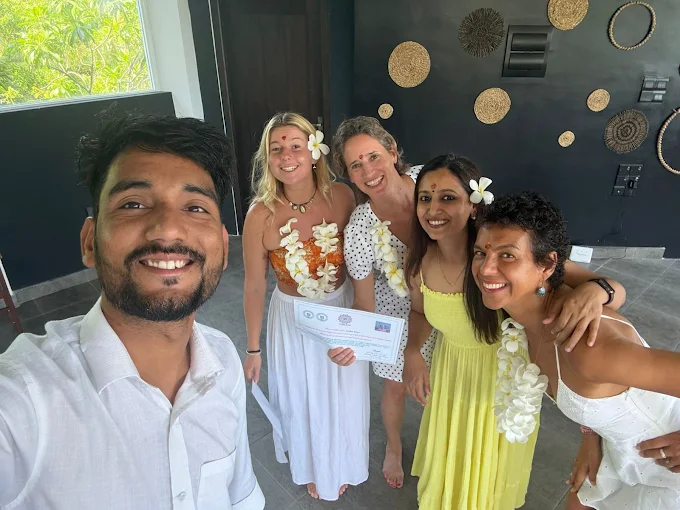
You will learn anatomy.
You will explore philosophy.
You will develop teaching skills.
You will receive feedback.
And you will be expected to participate consistently.
If you simply want a few days of relaxation, a retreat may be more appropriate.
If you want a structured foundation in yoga and potentially want to teach, a 200 Hour Yoga Teacher Training is a much deeper commitment.
Is a 200 Hour Yoga Teacher Training Worth Doing in Sri Lanka?
For the right student, it can be a life-changing experience.
But the value does not come simply from being in Sri Lanka.
It comes from the combination of:
A structured education
Experienced teachers
Immersive practice
A supportive community
A residential environment
Personal discipline
Time away from your normal routine
Sri Lanka provides the setting.
Your teachers provide guidance.
But your own commitment determines how much you take from the experience.
Why Choose Galle for Your Training?
If you want a balance between a serious residential education and the experience of being in southern Sri Lanka, Galle offers a compelling setting.
The region combines tropical surroundings, coastal culture and access to Sri Lanka’s broader heritage.
For students travelling internationally, that means your teacher training can also become an opportunity to experience another culture and way of life.
But the priority remains the yoga.
The destination should support the education—not distract from it.
Your 2026 Booking Checklist
Before confirming your place, make sure you have:
Course
☐ Confirmed the 200-hour curriculum
☐ Checked the training dates
☐ Confirmed the course duration
☐ Understood the daily schedule
Accommodation
☐ Selected private or shared accommodation
☐ Confirmed what is included
☐ Checked arrival and departure dates
Travel
☐ Checked passport validity
☐ Checked Sri Lanka entry requirements
☐ Booked flights
☐ Provided flight details for airport pickup
☐ Arranged travel insurance
Payment
☐ Confirmed the total course fee
☐ Understood the deposit requirement
☐ Checked payment methods
☐ Read cancellation terms
☐ Confirmed what happens if travel dates change
Training
☐ Confirmed certification details
☐ Checked what materials are provided
☐ Understood practical teaching requirements
☐ Prepared suitable clothing and personal items
Being prepared before arrival allows you to focus on what actually matters once training begins.
Is This the Right Journey for You?
Ask yourself a few simple questions.
Am I ready to commit several weeks to intensive learning?
Am I willing to practice even when I do not feel motivated?
Am I interested in yoga beyond physical postures?
Am I willing to receive feedback?
Am I comfortable being a beginner?
Do I want to understand yoga more deeply?
Could I see myself teaching in the future?
If most of your answers are yes, a 200-hour training may be the right next step.
Your Journey Starts Before You Arrive
The transformation does not begin on the first day of class.
It begins when you make the decision to step away from your usual routine and give yourself time to learn.
You arrive in Sri Lanka with questions.
You may arrive with uncertainty.
You may wonder whether you are flexible enough.
Whether you are experienced enough.
Whether you will be able to teach.
Then the training begins.
One practice at a time.
One lesson at a time.
One teaching attempt at a time.
And gradually, the uncertainty becomes understanding.
Begin Your 200 Hour Yoga Journey in Sri Lanka
A 200 Hour Yoga Teacher Training in Sri Lanka is an opportunity to study yoga in a completely immersive environment while experiencing the beauty and culture of the island.
At Diksha Yoga School in Galle, South Sri Lanka, the journey combines traditional yoga education with practical teacher training, residential accommodation and the support of an international student community.
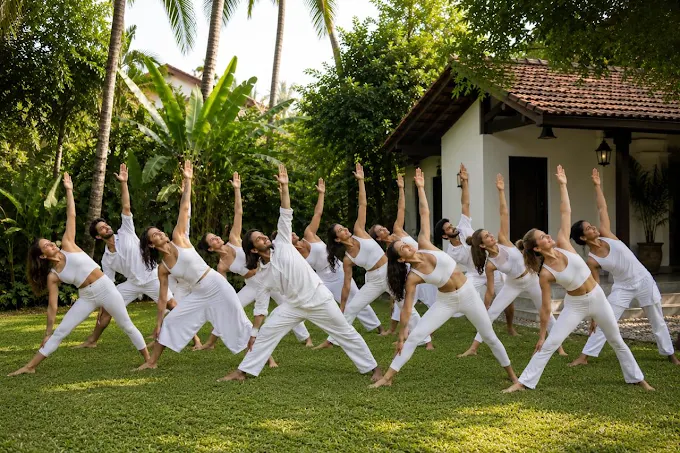
You will practice.
You will study.
You will teach.
You will make mistakes.
You will receive feedback.
You will grow.
And by the end, you will have more than a certificate.
You will have a foundation from which your own yoga journey can continue.
Ready to take the next step?
Explore the upcoming 200 Hour Yoga Teacher Training dates, fees and availability, choose the accommodation option that suits you, and contact Diksha Yoga School if you have questions before booking.
Your yoga teacher journey can begin in Sri Lanka.
Come to learn yoga. Leave with a deeper understanding of yourself