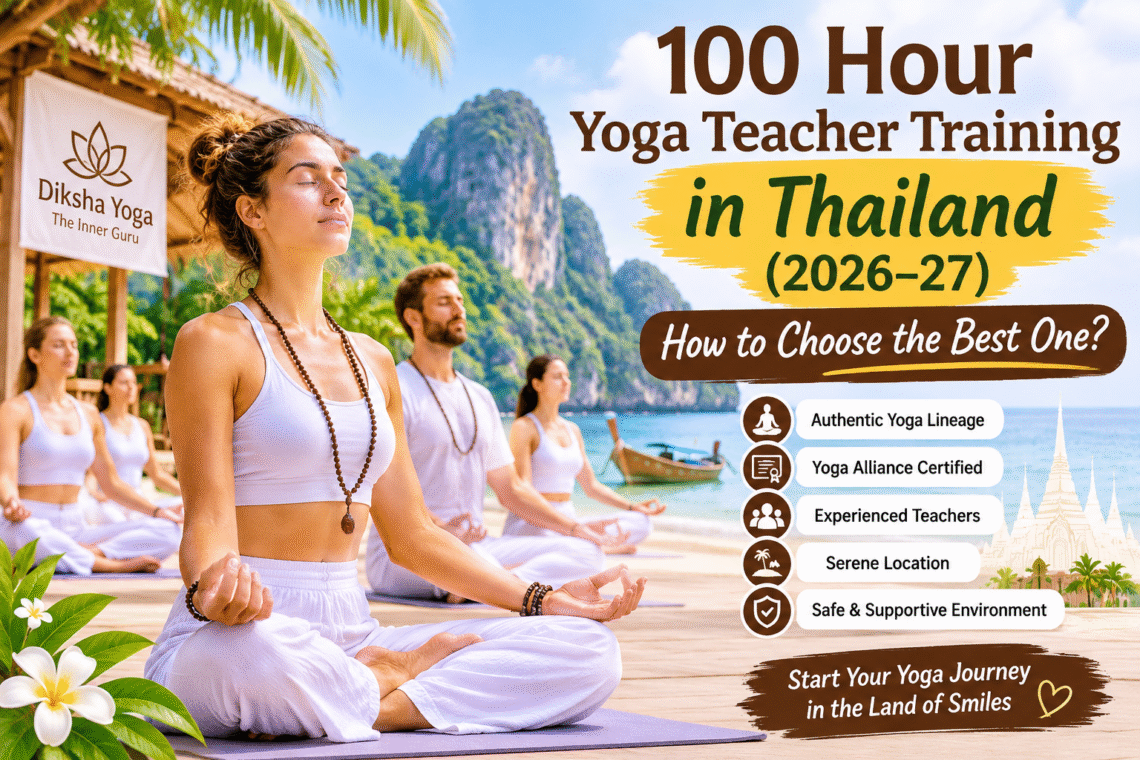
Looking for a 100 Hour Yoga Teacher Training in Thailand
Published By Miss Soniya Rangher
Choose the Best 100 Hour YTTC Thailand combines a Yoga Alliance Registered School, a small group, a syllabus that goes beyond asana, and the right island for the month you travel. That last point catches many students out: Thailand’s coasts have opposite rainy seasons.
Thailand hosts more 100 hour courses than almost anywhere in Asia, from Koh Samui and Koh Phangan to Phuket and Chiang Mai. Most listings promise the same beachfront shala and life-changing week. This guide, written by the teaching team at Diksha Yoga School, shows you what to check instead, which region suits your dates, the red flags to avoid and the questions to ask before you pay.
Table of Contents
At a glance: Diksha Yoga School’s 100 hour yoga teacher training in Thailand
- Where: Health Oasis Resort, Bang Por Beach, on the quiet north coast of Koh Samui
- Length: 11 days / 10 nights, 100 hours
- Group: small groups with personal feedback
- Fee: €1,400 twin shared or €1,800 private, with beachfront room and 2 sattvic vegetarian meals a day
- Next batch: 5–15 November 2026, then twice a month until May 2027
- Best weather: January to May batches
Check dates and reserve your place →
What a 100 hour yoga teacher training in Thailand is, and what it isn’t
A 100 hour yoga teacher training is a short, residential immersion, usually 10 to 14 days. It covers the same core subjects as a 200 hour course (asana, pranayama, meditation, philosophy, anatomy and teaching methodology) at roughly half the depth.
It is a good fit if you want to:
- Deepen your own practice in a structured way
- Find out whether teacher training suits you before committing to a full month
- Refresh your foundations as an existing teacher
- Add yoga, breathwork and meditation to a wellness or fitness career
Be clear about one thing before you book. Yoga Alliance registers teachers from the 200 hour level up. To register as an RYT 200, you must complete a full 200 hour training with one Registered Yoga School, and hours from separate trainings cannot be combined (Yoga Alliance).
So a 100 hour certificate from a Yoga Alliance Registered School shows you trained to a recognised standard. It does not, on its own, make you a Registered Yoga Teacher, whatever a listing implies.
100 hour vs 200 hour yoga teacher training: which should you book?
Choose the 100 hour course if you want depth and a taste of teaching in under two weeks. Choose the 200 hour course if you already know you want to teach professionally.
| 100 hour training | 200 hour training | |
| Length | 10–14 days | 3–4 weeks |
| Depth | Core subjects, foundation level | Core subjects in full, plus more teaching practice |
| Yoga Alliance RYT 200 | Not eligible on its own | Eligible after graduating from an RYS 200 |
| Fits Thailand’s 30-day visa exemption | Easily | Check the length; a 4-week course may not fit |
| Best for | Deepening practice, testing the path, refreshing as a teacher | Starting a teaching career |
Not sure yet? Many students take the 100 hours first, then return for our 200 hour yoga teacher training in Thailand once they know teaching is their path.
Where in Thailand? Match the region to your travel month
Pick your region by month, not by photos. Thailand’s two coasts have opposite rainy seasons, so the best place to train in February is not the best place in August.
| Region | Popular for yoga training | Driest months | Wettest months |
| Gulf islands | Koh Samui, Koh Phangan, Koh Tao | January to August | October to December, peaking in November |
| Andaman coast | Phuket, Krabi, Koh Lanta | November to April | May to October |
| The north | Chiang Mai, Pai | November to February | June to October |
Koh Samui‘s calendar is the opposite of Phuket’s (Zurich Kotak travel guide). That makes the Gulf islands the natural choice for spring and summer training, when the Andaman coast is in monsoon.
Why Koh Samui in particular? It is the most accessible of the Gulf islands, with its own airport, and quieter beaches on the north coast than the party-focused Koh Phangan. Rain in the wet months usually comes in heavy bursts rather than all day, and the island stays green and uncrowded.
How to choose a 100 hour yoga teacher training in Thailand: 8 things to compare
11. The school’s Yoga Alliance registration
Check that the school is a Yoga Alliance Registered Yoga School (RYS) and at which levels. A school registered at RYS 200 and RYS 300 has had its longer curricula reviewed, which says something about how its shorter courses are built. Search the school’s name in the Yoga Alliance directory rather than trusting a logo.
2. Who actually teaches you
A famous founder on the homepage does not always mean that person is in the shala. Ask who leads your batch and what their credentials are. E-RYT 500 is Yoga Alliance’s most senior teacher designation; YACEP means a teacher is approved to provide continuing education to other teachers.
3. Group size
In 11 days, personal feedback is what changes your practice. Ask for the maximum number of students as a number, not “small groups”.
4. A balanced syllabus
A good 100 hour course is more than two asana classes a day. Look for every core subject, taught daily:
- Hatha and Vinyasa practice, with alignment and adjustments
- Pranayama and cleansing practices (shatkarma)
- Meditation
- Yoga philosophy, including Patanjali’s Yoga Sutras
- Anatomy applied to real postures
- Teaching methodology and supervised teaching practice
5. A realistic daily schedule
Ask for the hour-by-hour timetable. You want early practice, structured study in the middle of the day, real rest in the afternoon heat and a day off each week.
6. The island and the season
Check which coast the school is on and what the weather is like during your batch (see the table above). Also check how you reach the venue: some islands need a flight plus a ferry.
7. What the fee really includes
Thai course fees vary a lot in what they cover. Confirm the number of meals a day, the room type, the manual, certification and whether airport or ferry transfers are included. Check the 100 hour yoga teacher training in Thailand for course details.
8. Fair booking terms
Good schools state in writing how much the deposit is, when the balance is due, whether the deposit is refundable and whether you can move to another date. Check the course schedule and fees before booking.
5 red flags to avoid when booking
Walk away, or at least ask harder questions, if you see any of these:
- “Teach internationally” after 100 hours. RYT registration starts at 200 hours from one school.
- No named teacher. If the school will not say who leads your batch, assume it changes.
- No group limit. “Small groups” without a number often means 20 or more.
- Party-island distractions sold as “community”. Check what is next door to the shala, especially around full moon dates.
- Pressure to pay in full now. Reputable schools take a deposit and give you the terms in writing.
10 questions to ask any school before you pay
Copy these into your first message to every school you are considering.
- Are you a Yoga Alliance Registered Yoga School, and at which levels?
- Who will lead my batch, and what are their credentials?
- What is the maximum number of students?
- Can you send the hour-by-hour daily schedule?
- Will I teach during the course and get feedback?
- How many meals a day are included?
- What type of room will I have, and is it shared?
- Are airport or ferry transfers included?
- How much is the deposit, and when is the balance due?
- What happens if I need to change my dates?
Your quick comparison checklist
Copy this table, fill in a column for each school you are considering, and the right choice usually becomes obvious.
| What to check | What good looks like | School A | School B |
| Registration | Yoga Alliance RYS, ideally at 200 and 300 levels | ||
| Lead teacher | Named, with E-RYT 500 or long teaching record | ||
| Group size | A stated maximum, ideally 10–12 | ||
| Syllabus | All six core subjects, taught daily | ||
| Teaching practice | You teach and receive feedback | ||
| Season | Dry season on that coast for your dates | ||
| Inclusions | Room, meals per day, manual, certificate, transfers | ||
| Booking terms | Deposit, balance date and date-change policy in writing |
Diksha Yoga School’s 100 hour yoga teacher training in Koh Samui: how it measures up
Our 11-day residential course runs at Health Oasis Resort on Bang Por Beach, on Koh Samui’s quiet north coast. Here is how it answers the checklist.
- Registration: Diksha Yoga School is a Yoga Alliance Registered Yoga School at RYS 200 and RYS 300.
- Lead teacher: Our founder, Yogini Manisha (E-RYT 500, YACEP), has taught for more than 16 years and guided over 23,000 students from more than 80 countries.
- Group size: Small groups, so every student gets direct guidance and individual feedback.
- Syllabus: Hatha Yoga, Ashtanga primary series with Sanskrit counts, Vinyasa Flow sequencing, Pranayama and Shatkarma, Meditation, Yoga Philosophy, Anatomy and Physiology, Alignment and Adjustment, Teaching Methodology and a teaching practicum.
- Setting: A beachfront resort, away from the busier east-coast towns, so your mornings start by the sea.
- Inclusions: Beachfront room, 2 sattvic vegetarian meals a day, the course manual, assessment and certificate, Wi-Fi and local excursions.

Our philosophy is simple. As Yogini Manisha puts it, flexible yoga teachers are easy to find; meditative, authentic ones are not. That is what these 11 days are designed to build.
Explore the 100-hour yoga teacher training in Thailand for course details and check the schedule and fees before booking.
More than classes
Alongside the daily timetable, the course includes experiences that make a Samui training feel different from a studio course:
- Full moon meditation
- A day of silence
- Kirtan nights
- Sound healing sessions
- Nature walks around the island
Fees
One fee covers training, accommodation and meals. It is the same for every batch.
| Room type | Course fee (EUR) |
| Twin shared room | €1,400 |
| Private room | €1,800 |
Which 2026–27 batch should you book?
Book January to May for Koh Samui’s driest, sunniest weather. November and early December batches fall in the island’s rainy season, which suits students who want the quietest, greenest weeks and don’t mind afternoon downpours. Every batch runs 11 days and 10 nights.
| Batch | Koh Samui weather | Good to know |
| 5–15 Nov 2026 | Rainy season, wettest month | Quietest weeks; practice continues under cover in the shala |
| 16–26 Nov 2026 | Rainy season | Green, uncrowded and peaceful |
| 5–15 Dec 2026 | Rain easing | Calmer weather returns before the holiday rush |
| 16–26 Dec 2026 | Start of dry season | Spend Christmas on the mat; high season begins |
| 5–15 Jan 2027 | Dry, cooler and sunny | Ideal weather; start the year with a practice reset |
| 16–26 Jan 2027 | Dry, cooler and sunny | Ideal weather; fills early |
| 5–15 Feb 2027 | Dry and sunny | One of the best months on the island |
| 16–26 Feb 2027 | Dry and sunny | One of the best months on the island |
| 5–15 Mar 2027 | Dry, getting warmer | Calm sea and long sunny days |
| 16–26 Mar 2027 | Dry and warm | Calm sea and long sunny days |
| 5–15 Apr 2027 | Hot and dry | Overlaps Songkran, the Thai New Year water festival (13–15 April) |
| 16–26 Apr 2027 | Hot and dry | Quieter after the festival |
| 5–15 May 2027 | Hot, mostly dry | Low season: calm, quiet island |
| 16–26 May 2027 | Hot, mostly dry | Low season: calm, quiet island |
While Phuket and Krabi are in monsoon from May, Koh Samui stays mostly dry, which makes our April and May batches a smart choice for summer travellers.
Getting to Koh Samui
There are two ways onto the island: fly straight in, or fly to the mainland and take the ferry across.
- Fastest: fly straight into Samui International Airport (USM), usually via Bangkok, then take a short taxi to Bang Por on the north coast. Direct flights to Samui typically cost more.
- Cheapest: fly to Surat Thani (URT) on the mainland, take a bus or van to Donsak Pier, then the ferry across to Samui. Allow most of a day.
Send us your flight details and we will help you plan the last leg to Health Oasis Resort.
Do you need a visa for Thailand?
For most students, no. The 11-day course fits comfortably within Thailand’s tourist visa exemption, but the rules changed in September 2026, so check before you fly.
- From 15 September 2026, Thailand ended its 60-day visa exemption. Nationals of 60 countries and territories, including India, Australia, the US, the UK and Canada, can now stay visa-free for up to 30 days (VisasNews). Check the official Royal Thai Embassy visa information for the updated rules.
- Some nationalities now need a visa that did not before. Check your passport against the official visa exemption list before you book flights. You can also check the Thailand e-Visa application website.
- Everyone must complete the free Thailand Digital Arrival Card (TDAC) online at tdac.immigration.go.th within 3 days before arrival.
What your trip really costs
Budget for the course fee plus flights, the transfer to Samui., insurance and one meal a day on your own.
| Item | Cost | Notes |
| Course fee | €1,400–€1,800 | Includes beachfront room and 2 vegetarian meals a day |
| Flights to Thailand | Varies | Depends on where you fly from and when you book |
| Transfer to Koh Samui | Varies | A domestic flight to USM costs more than the bus-and-ferry route via Surat Thani |
| Visa | Free for 60 nationalities | 30-day visa exemption; the TDAC arrival card is also free |
| Third meal of the day | Small | Local Thai food near Bang Por is inexpensive |
| Travel and medical insurance | Varies | Not included; strongly recommended |
How to book your place in 4 steps
- Choose your batch and room type from the tables above.
- Message us on WhatsApp or through the booking form to confirm availability.
- Pay your deposit to reserve your place in the 100 hour yoga teacher training in Thailand. We confirm the amount and balance date in writing.
- Get your arrival pack with course information, packing guidance and travel help for reaching Bang Por.
Places in each batch are limited, and January to March batches fill first.
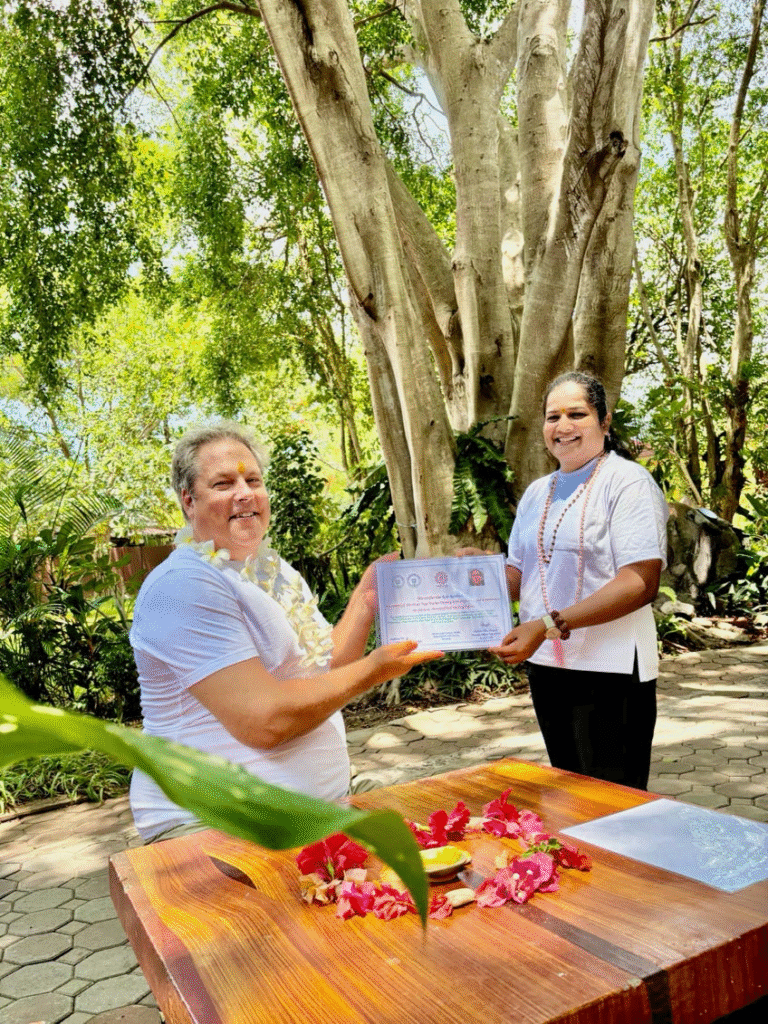
Kyle Raisbeck (USA 5th Aug 2026)
I came to the Diksha Yoga School to better understand what I thought yoga was. I learned how small my understanding was. They gave me the tools to improve my practice whenever I go. They will also support me in the future.
I don’t know if I will take a 300 hour course but if I do it will be with Diksha Yoga.
Frequently asked questions
Is a 100 hour yoga teacher training suitable for beginners?
Yes. You do not need to be advanced or flexible. You need a sincere interest in yoga and the willingness to take part fully for 11 days. The course builds your practice step by step.
Can I teach yoga after a 100 hour course?
You will understand how a class is planned and taught, and you will have practised teaching with feedback. To register with Yoga Alliance as an RYT 200, however, you need a full 200 hour training from one Registered Yoga School. Many students take the 100 hours first and continue to a 200 hour course afterwards.
How much does a 100 hour yoga teacher training in Thailand cost?
At Diksha Yoga School in Koh Samui the fee is €1,400 for a twin shared room or €1,800 for a private room, including accommodation and 2 vegetarian meals a day. Add flights, your transfer to the island and insurance for your total trip cost. Check the course schedule and fees for booking details.
When is the best time for yoga teacher training in Koh Samui?
January to August is Koh Samui’s driest period, and January to May covers our sunniest batches. October to December is the island’s rainy season, with November the wettest month.
Is Koh Samui or Phuket better for yoga teacher training?
It depends on your dates. Koh Samui is driest from January to August, while Phuket is driest from November to April. For spring and summer training, the Gulf side is usually the better choice.
How do I get to Koh Samui?
Fly directly to Samui International Airport (USM), or fly to Surat Thani (URT) and take the ferry from Donsak Pier. Health Oasis Resort is on Bang Por Beach on the north coast.
Do I need a visa for Thailand?
Since 15 September 2026, nationals of 60 countries, including India, Australia, the US, the UK and Canada, can stay visa-free for up to 30 days, which covers the 11-day course. Check the official Royal Thai Embassy visa information before travelling. Every visitor must also complete the free Thailand Digital Arrival Card (TDAC) online within 3 days before arrival.
What should I pack?
Light, breathable yoga clothes, a shawl for meditation, a refillable water bottle, reef-safe sunscreen, mosquito repellent, a light rain jacket for November and December batches, and a notebook. We send a full packing list with your arrival pack.
Ready to book your 100 hour yoga teacher training in Thailand?
The right training leaves you with a steadier practice, a real understanding of yoga beyond the poses and a clear answer about whether teaching is your path. Pick the coast that is dry for your dates, ask the 10 questions above and choose the school that answers them in writing.
If Diksha Yoga School ticks your boxes, our next Koh Samui batch starts on 5 November 2026, with sunny-season batches from January.
Contact Diksha Yoga School to check availability or message us on WhatsApp.
- Check dates and reserve: 100 hour yoga teacher training in Thailand
- Ask us anything on WhatsApp: +91 9130157393 or +91 8077952069
- Email: contactdikshayoga@gmail.com
Want the full certification? See our 200 hour yoga teacher training in Thailand. Short on time? Try our 50 hour yoga teacher training in Thailand. Prefer another destination? Compare our 100 hour yoga teacher training in Sri Lanka, or read more about training in Koh Samui.