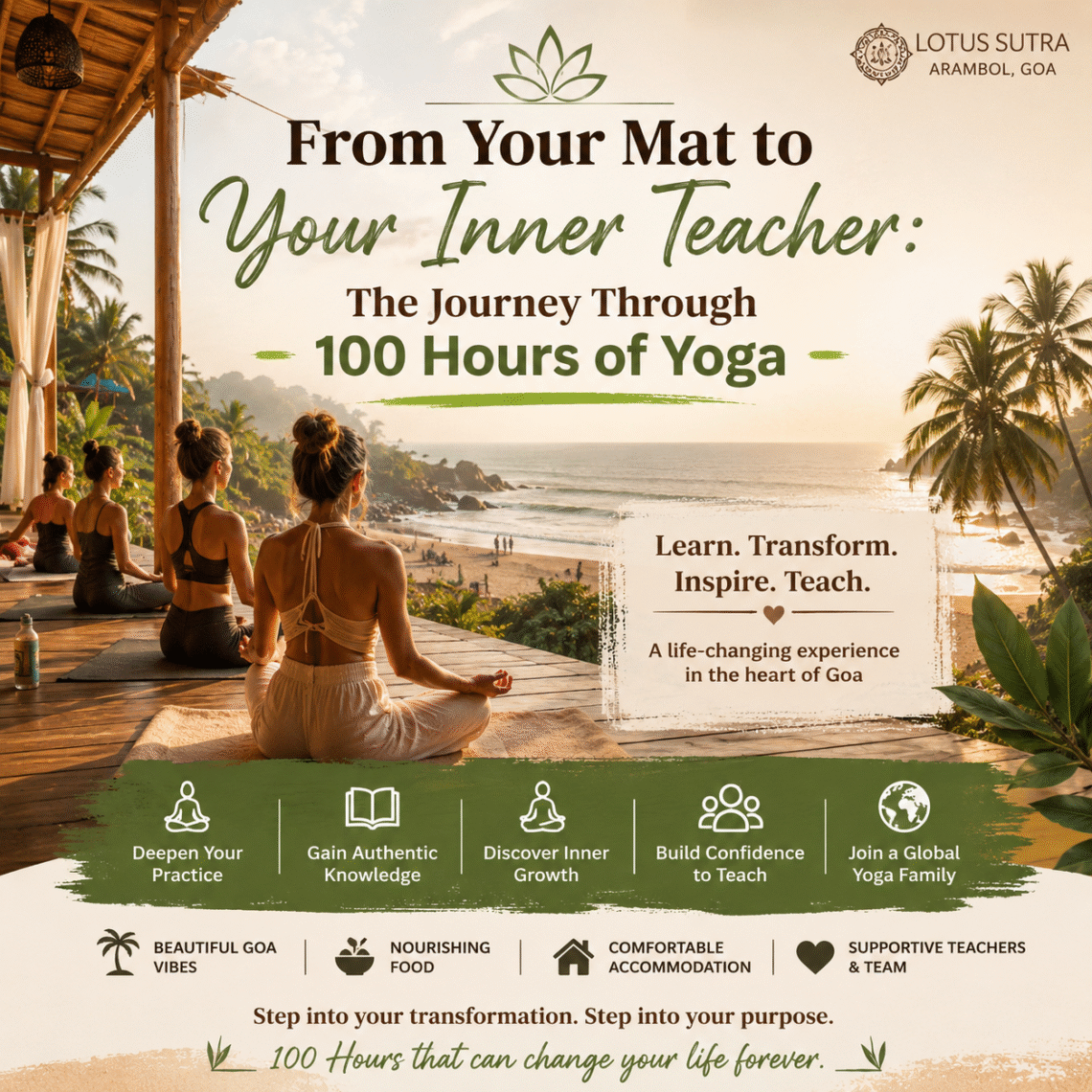
From Your Mat to Your Inner Teacher, There is a moment in every yoga journey when the question quietly changes.
In the beginning, you come to your mat because you want to practice better. You may want to understand an asana, improve your flexibility, breathe more consciously, or simply create a little more stillness in your life.
But with time, yoga begins to ask you a different question:
“What are you learning about yourself through your practice?”
A 100-hour yoga teacher training is not simply about learning more postures or collecting another certificate. It is an opportunity to step away from the noise of everyday life and give yourself the time and space to explore yoga more deeply.
At Diksha Yoga School, our 100-hour yoga teacher training in Goa is designed for students who want to deepen their personal practice, understand the foundations of yoga, and begin discovering what it truly means to share yoga with others.
Our training takes place at The Lotus Sutra in Arambol, Goa, close to the beach and within the unique atmosphere of North Goa. Here, the surroundings become part of the experience. There is time to practice, study, reflect, ask questions, connect with other practitioners, and simply slow down.
Because sometimes, what we need to understand yoga more deeply is not another class.
Upcoming 100 Hour Yoga Teacher Training Dates-11 Days
| Course Dates | Duration | Location | Early Bird Offer |
|---|---|---|---|
| 5 – 15 September 2026 | 11 Days | Lotus Sutra, Arambol, Goa | Euro100 OFF |
| 16 – 26 September 2026 | 11 Days | Lotus Sutra, Arambol, Goa | Euro100 OFF |
| 5 – 15 October 2026 | 11 Days | Lotus Sutra, Arambol, Goa | Euro100 OFF |
| 16 – 26 October 2026 | 11 Days | Lotus Sutra, Arambol, Goa | Euro100 OFF |
| 5 – 15 November 2026 | 11 Days | Lotus Sutra, Arambol, Goa | Euro100 OFF |
| 16 – 26 November 2026 | 11 Days | Lotus Sutra, Arambol, Goa | Euro100 OFF |
| 5 – 15 December 2026 | 11 Days | Lotus Sutra, Arambol, Goa | Euro100 OFF |
| 16 – 26 December 2026 | 11 Days | Lotus Sutra, Arambol, Goa | Euro100 OFF |
Early Bird Offer
Book 2 Months in Advance & Get Euro100 OFF
✨ Reserve your seat early and save Euro100 on your 100-Hour Yoga Teacher Training in Goa.
📍 Venue: Lotus Sutra, Arambol, Goa
⏳ Duration: 11 Days
🎓 Certification: Yoga Alliance
🎁 Early Bird: Euro100 OFF on bookings made 2 months in advance
WhatsApp: +91 9130157393 / +91 8077952069
Email: contactdikshayoga@gmail.com
Table of Contents
It is time.
Time to practice.
Time to listen.
Time to observe.
Time to question.
And time to discover the teacher that already exists within you.
When Yoga Becomes More Than a Physical Practice
When you first begin yoga, it is natural to measure progress through the body.
Can I hold the posture?
Can I go deeper?
Can I improve my balance?
Can I finally do that pose?
But dedicated study gradually changes the way you look at your practice.
You begin to notice your breath before your posture.
You become more interested in alignment than simply going deeper.
You start understanding why the same posture can feel completely different from one person to another.
You begin to recognize when the body needs effort and when it needs softness.
And slowly, something important happens.
Yoga becomes less about how the posture looks and more about how consciously you experience it.
That shift is one of the first steps from being a yoga practitioner toward becoming a yoga teacher.
You Don’t Become a Teacher by Learning More Poses
A common misconception is that becoming a yoga teacher means mastering hundreds of advanced asanas.
It doesn’t.
A meaningful yoga teacher training teaches you to understand the practice deeply enough to guide another person with clarity, awareness and care.
You learn to observe.
You learn to listen.
You learn how to communicate.
You learn how to adapt a practice to different bodies and different levels of experience.
You begin developing your voice, your presence and your confidence in front of others.
Most importantly, you begin to understand that teaching yoga is not about becoming a copy of the teacher who trained you.
The techniques can be learned.
The knowledge can be studied.
But your authentic teaching voice has to develop through your own experience.
That is why our 100-hour training is not only about what you learn during the course. It is also about who you begin to become through the process.
And that is where the real journey begins—from your mat to your inner teacher.
Part 2 — What Really Changes During 100 Hours of Training?
The number 100 can look simple on a course page.
But 100 hours of yoga training are much more than a number.
They are early mornings when you would rather stay in bed but choose to come to the mat. They are moments when a familiar posture suddenly feels completely different. They are questions you have never thought to ask before. They are conversations after class, quiet moments of reflection, challenging practices, unexpected breakthroughs and small changes that you may not notice until you return home.
A residential training gives you something that is increasingly difficult to find in everyday life:
uninterrupted time to learn.
Instead of attending one yoga class and immediately returning to work, emails, traffic and responsibilities, you become immersed in the practice.
You have time to experience the connection between what you study and what you practice.
You learn something in philosophy in the morning and may begin noticing it in your own life later that day.
You study alignment and then feel the difference in your own body during practice.
You learn about pranayama and begin noticing how your breath changes your concentration.
You explore meditation and discover that stillness is not always as easy—or as uncomfortable—as you imagined.
This is where learning becomes experience.
From Knowing the Asana to Understanding the Person
A yoga teacher doesn’t simply teach a posture.
A yoga teacher teaches people.
This distinction becomes increasingly important as your training develops.
Two students can stand in the same asana, follow the same instructions and have completely different needs.
One may need more stability.
Another may need less intensity.
Someone may be struggling with confidence.
Another may be pushing far beyond what their body needs.
Learning to recognize these differences is part of becoming a responsible teacher.
During your training, you begin moving away from the idea that there is one perfect version of a posture for everyone.
Instead, you start asking better questions:
Is this appropriate for this student?
Can I explain it more clearly?
Does this student need to go deeper—or perhaps step back?
What is the breath telling me?
How can I create a safer and more meaningful experience?
These questions are far more valuable than simply memorising the names of poses.
Your Practice Becomes More Conscious
Perhaps one of the most beautiful changes during an immersive training is that you start paying attention to things you previously overlooked.
The breath between movements.
The quality of your attention.
The difference between effort and strain.
The effect of a particular practice on your state of mind.
The way you speak to yourself when something feels difficult.
You begin to realize that yoga is not only something you do on a mat.
It is something you gradually learn to observe in yourself.
And this is where the deeper purpose of teacher training begins to reveal itself.
The Teacher Within Doesn’t Appear Overnight
You don’t suddenly wake up on Day 10 and become a completely different person.
Real growth is usually quieter than that.
It happens when you become a little more confident explaining a posture.
When you stop being afraid of making a mistake.
When you learn to listen before giving an instruction.
When you discover that your voice can become calm and steady.
When you understand that you don’t need to know everything to begin teaching—you need the humility to keep learning.
At Diksha Yoga School, we believe that a good teacher is also a lifelong student.
Your 100-hour journey is therefore not about reaching a final destination.
It is about building a foundation strong enough to continue growing long after you leave The Lotus Sutra in Arambol.
Part 3 — From Practicing Yoga to Learning How to Teach
For many students, one of the biggest discoveries during a 100-hour training is that practicing yoga and teaching yoga are two different skills.
You may already know how to move through Sun Salutations. You may have practiced Hatha, Vinyasa or Ashtanga for years. You may even feel comfortable demonstrating many postures.
But when another person is standing in front of you, the question changes.
It is no longer:
“Can I do this posture?”
It becomes:
“Can I help someone else understand and experience it?”
That shift requires a different kind of awareness.
A Practitioner Looks at the Pose. A Teacher Learns to See the Person.
When you practice alone, your attention naturally goes inward. You notice your own body, breath, balance and limitations.
When you teach, your awareness has to expand.
You begin observing how another student is moving, breathing and responding to your instructions.
You learn that the same posture does not feel the same for every body.
One student may need a modification.
Another may need more stability.
Someone else may need encouragement to explore the posture.
And sometimes, the best teaching decision is simply to tell a student not to go deeper.
This is where anatomy, alignment and teaching methodology stop being theoretical subjects and become practical tools.
At Diksha Yoga School, our teaching approach combines traditional yogic practices with practical education in asana, alignment, adjustments, pranayama, meditation, philosophy, anatomy and teaching methodology. These areas are designed to help students understand not only what to teach, but also why and how to teach it responsibly.
The Difference You Begin to Notice
| Your Personal Practice | Your Development as a Teacher |
| “How can I improve this posture?” | “How can I help my student understand this posture?” |
| “How deep can I go?” | “Is this appropriate for this student?” |
| “What feels good in my body?” | “What might this student need?” |
| “Can I follow this sequence?” | “Why does this sequence make sense?” |
| “Can I demonstrate the pose?” | “Can I explain it clearly?” |
| “Can I practice consistently?” | “Can I create a safe, meaningful class?” |
This is one of the most important transitions in teacher training.
You stop seeing yoga only from the perspective of your own body and begin learning to see it through the experience of another person.
Learning to Teach Without Losing the Essence of Yoga
Yoga teacher training should not turn yoga into a collection of postures to memorize.
The physical practice is important, but traditional yoga has always been broader than asana.
At Diksha Yoga School, our approach includes Hatha Yoga, Ashtanga Vinyasa, Vinyasa Flow, Pranayama, Meditation, Yoga Philosophy, Anatomy, Alignment and Teaching Methodology. Our programs are designed around the idea that understanding yoga requires both practical experience and deeper study.
This is particularly important when you begin teaching.
A student may arrive wanting to become more flexible.
Another may be looking for strength.
Someone may simply need a quiet hour away from a stressful routine.
As a teacher, you cannot assume that everyone has the same reason for stepping onto the mat.
Your role is not to make everyone practice exactly like you.
Your role is to create the conditions in which each student can practice safely and consciously.
That requires knowledge—but it also requires observation, humility and patience.
Experience Matters When You Learn to Teach
There is a difference between reading about teaching and learning from someone who has spent years actually teaching people.
Yogini Manisha, the founder and lead teacher of Diksha Yoga School, has more than 16 years of experience in yoga teaching and education and has guided 23,000+ students through yoga teacher training and related programs, according to the school’s current published information. (Diksha Yoga)
That experience matters because teaching yoga involves far more than knowing the Sanskrit name of a posture.
Over years of working with students, a teacher encounters different bodies, different levels of experience, different learning styles and different challenges.
You learn that sometimes a student needs a technical explanation.
Sometimes they need a demonstration.
Sometimes they need a simpler instruction.
And sometimes they need you to stop talking and give them space to feel.
Those are lessons that develop through practice and observation, not simply through reading a textbook.
That is why we encourage students to ask questions during training rather than simply memorizing answers.
Why are we teaching this posture?
Why are we using this variation?
When should we modify it?
What should we observe in a student’s breath?
How can we make an instruction clearer?
The ability to ask these questions is itself part of becoming a better teacher.
Your Teaching Voice Begins to Appear
You will probably notice something unexpected during your training.
At the beginning, you may try to sound like your teacher.
You may repeat phrases you have heard.
You may worry about forgetting an instruction.
You may think that a “good yoga teacher” has to sound perfectly calm and know exactly what to say at every moment.
With practice, that usually begins to change.
You start finding your own voice.
You become less concerned with sounding perfect and more concerned with being present.
You learn that confidence does not mean pretending to know everything.
Real confidence can also mean saying:
“Let’s explore another variation.”
“If this doesn’t feel right for your body, please modify it.”
“Take your time.”
“Listen to your breath.”
These simple words can sometimes be more valuable than a complicated explanation.
The 100 Hours Are Not About Creating a Perfect Teacher
No responsible teacher training can make someone an expert in every aspect of yoga in 100 hours.
And that is not the purpose.
A meaningful 100-hour immersion should give you a stronger foundation, greater self-awareness and practical tools for continuing your education.
For some students, it becomes a deeper personal practice.
For others, it becomes a stepping stone toward a longer teacher-training pathway.
And for others, it is the beginning of discovering that teaching yoga is something they genuinely want to pursue.
The important thing is not to leave believing that you have learned everything.
It is to leave understanding how much there is still to explore.
That mindset is at the heart of becoming a lifelong student of yoga.
What You May Take Home Beyond the Certificate
After 100 hours of focused study, the most meaningful changes may not be visible in a photograph.
You may stand more confidently.
You may understand alignment more clearly.
You may breathe with greater awareness.
You may become more comfortable guiding a small group.
But you may also notice quieter changes:
You listen more carefully.
You become less impatient with your own limitations.
You notice your thoughts.
You understand your body differently.
You begin questioning habits rather than automatically repeating them.
And you start realizing that teaching yoga begins with continuing to practice yoga yourself.
That is why the journey from practitioner to teacher is not really about leaving one identity behind and adopting another.
It is about going deeper into the same practice.
You begin on the mat as a student.
Part 4 — When the Practice Becomes Your Own
There is a stage in yoga teacher training when something begins to change quietly.
At the beginning, you are learning from someone else.
You listen to your teacher’s instructions. You observe demonstrations. You take notes. You try to remember the sequence, the alignment points, the breathing techniques and the philosophy behind the practice.
But gradually, you stop simply collecting information.
You begin to experience it for yourself.
That is an important moment.
Because yoga teacher training is not meant to turn you into someone who can repeat everything a teacher has said. It should help you develop enough understanding to begin making thoughtful decisions within your own practice.
From Following Instructions to Understanding Why
Imagine you are guided into a standing posture.
In the beginning, you may simply hear:
Place your feet here.
Lift your arms.
Lengthen your spine.
Breathe.
With deeper study, you begin asking:
Why are we doing this?
What is the purpose of this alignment?
How does the breath influence the movement?
What changes when the student’s body is different from mine?
When should the posture be modified?
Those questions represent progress.
You are no longer just following instructions.
You are learning to understand the principles behind them.
That is one of the foundations of responsible yoga teaching.
Your Own Body Becomes One of Your First Teachers
One of the most valuable things you can bring into a teacher-training course is not flexibility, strength or years of experience.
It is curiosity about your own experience.
During an immersive training, you practice repeatedly. You notice what changes when you slow down. You notice how your breath behaves when you are tired. You notice where you habitually hold tension. You discover movements that feel natural and others that require patience.
These experiences matter because eventually, you will meet students who have their own strengths, limitations and histories.
You cannot understand every student’s body simply by reading anatomy.
But learning to observe your own body carefully can teach you how to observe without judgment.
That is an important skill for a teacher.
From “Perfect Pose” to Appropriate Practice
The longer you study yoga, the less interesting the idea of a single “perfect pose” becomes.
A photograph can show you what an asana looks like.
It cannot tell you what the person inside that posture is experiencing.
One student may be comfortable.
Another may be compensating.
One may need greater challenge.
Another may need to reduce intensity.
A good teacher learns to recognize that difference.
This is why alignment and safe practice are such important parts of teacher education. Diksha Yoga School’s published training approach combines traditional practices with alignment, anatomy and teaching methodology, alongside Hatha, Ashtanga, Vinyasa, pranayama, meditation and philosophy.
The goal is not to make every student look identical.

The goal is to help each student practice with greater awareness.
A Teacher’s Confidence Is Built Through Practice
Confidence is another thing that changes during 100 hours.
Not the loud kind.
Not the confidence of believing you already know everything.
A quieter confidence.
The confidence to stand in front of a group and speak clearly.
The confidence to demonstrate without worrying about being perfect.
The confidence to admit when you need to check something.
The confidence to modify your plan when your students need something different.
And the confidence to understand that you are still learning.
At Diksha Yoga School, the emphasis on small-group learning and personal guidance is intended to give students opportunities to ask questions, receive feedback and develop practical teaching skills rather than simply listen to lectures.
That practical element matters.
You learn teaching by teaching.
You discover what works when you explain something.
You discover what needs improvement when a student looks confused.
You learn how powerful a simple instruction can be.
And you learn that sometimes the best teaching happens when you say less and observe more.
The Influence of Your Teacher Matters Too
Yoga is traditionally passed through relationship—not simply through information.
The teacher you learn from inevitably influences how you understand the practice.
That is why experience matters.
Yogini Manisha, founder and lead teacher of Diksha Yoga School, brings more than 16 years of yoga teaching experience and the school states that she has guided 23,000+ students worldwide.
But experience alone is not the point.
What matters is what that experience allows a teacher to notice.
After years of working with students, teaching becomes less about giving the same instruction to everyone and more about understanding when, how and why an instruction should change.
That is the kind of observation a developing teacher needs to cultivate.
And it is something you begin practicing during your own training.
The Moment You Stop Trying to Teach Like Someone Else
Perhaps one of the most beautiful stages of teacher training comes when you stop trying to sound like your teacher.
You begin with imitation.
That is natural.
You borrow phrases.
You copy sequencing.
You remember the way your teacher demonstrated something.
But eventually, your own personality begins to appear.
Your own rhythm.
Your own way of explaining.
Your own understanding.
Your own relationship with yoga.
That does not mean abandoning tradition.
Quite the opposite.
The deeper your understanding of the tradition becomes, the more naturally you can express it in your own voice.
And this is where a 100-hour training can become much more than a short course.
It can become the beginning of your relationship with the teacher you are becoming.
A Small but Important Distinction
A certificate can tell someone that you completed a course.
Your teaching reveals whether you actually understood what you learned.
That is why we believe the real measure of a yoga teacher is not how many advanced poses they can demonstrate.
It is how responsibly they can guide another human being.
Can you observe?
Can you listen?
Can you adapt?
Can you explain?
Can you create space for another person’s experience?
Those are the qualities that gradually turn a yoga practitioner into a teacher.
And the journey does not happen in one dramatic moment.
It happens one practice, one breath, one question and one student at a time.
That is the journey from your mat to your inner teacher.
Part 5 — The Inner Teacher: What You Take Home After 100 Hours
A yoga teacher training ends on a particular day.
But the learning does not.
The final practice, the last teaching session and the certificate ceremony may mark the end of your time at The Lotus Sutra, Arambol Beach, but they do not mark the end of your relationship with yoga.
In many ways, they mark the beginning of a new one.
Because the real question after 100 hours is not:
“How much did I learn?”
It is:
“What will I do with what I learned?”
The Certificate Is a Milestone—Not the Whole Journey
A certificate can recognize that you completed a course.
But it cannot measure your curiosity, your discipline, your ability to listen or the way your understanding of yoga has changed.
At Diksha Yoga School, we see teacher training as a foundation for continued learning. The school’s mission is to preserve traditional yoga while combining it with modern teaching methods, personal development and practical education.
That distinction matters.
You may finish the 100 hours with a stronger understanding of Hatha Yoga, Vinyasa, Ashtanga foundations, pranayama, meditation, philosophy, anatomy and teaching methodology.
But your real education continues every time you step onto your mat.
Every time you teach a student.
Every time you encounter a question you cannot immediately answer.
Every time you discover something new about your own practice.
A good yoga teacher never really stops being a student.
What Can Change in 100 Hours?
The changes will be different for every person.
One student may discover confidence.
Another may rediscover discipline.
Someone may deepen a personal practice they had almost abandoned.
Another may realize, for the first time, that teaching yoga is something they genuinely want to pursue.
There is no single transformation that everyone is supposed to experience.
Instead, the training gives you an environment in which meaningful change can happen.
| Before the Training | After the Immersion |
| Practicing mainly for yourself | Beginning to understand how to guide others |
| Learning what a posture looks like | Understanding alignment and individual needs |
| Following instructions | Understanding the principles behind them |
| Practicing when convenient | Developing greater discipline and consistency |
| Seeing yoga mainly as asana | Exploring breath, meditation, philosophy and awareness |
| Looking for the “perfect” pose | Understanding that practice must respect the individual |
| Relying on your teacher’s voice | Beginning to discover your own teaching voice |
This is not about becoming a completely different person in 100 hours.
It is about becoming more conscious of the person who is already there.
You May Discover That Teaching Is Also a Form of Learning
One of the most unexpected lessons of becoming a teacher is that teaching forces you to understand your own practice more deeply.
When you explain an asana to another person, you suddenly notice details you had never considered.
When you teach pranayama, you become more attentive to your own breath.
When you guide meditation, you become more aware of your own relationship with silence.
When a student asks, “Why do we do it this way?”, you may discover that you have been practicing something for years without ever asking the question yourself.
That is not failure.
That is learning.
And it is one of the reasons teaching can become such a powerful continuation of personal practice.
Your First Class Doesn’t Have to Be Perfect
Many new teachers leave training believing they need to be perfect before they can teach.
You don’t.
Your first class may not sound exactly the way you imagined.
You may forget an instruction.
Your timing may need improvement.
You may discover that a sequence that looked beautiful on paper does not flow naturally when taught to real students.
That is normal.
Teaching is a skill developed through experience.
What matters is that you approach it responsibly.
Know what you are teaching.
Understand your limitations.
Continue studying.
Observe your students.
Ask for feedback.
And never stop improving.
At Diksha Yoga School, practical teaching methodology is included alongside the study of traditional yoga, with an emphasis on developing communication, sequencing and teaching confidence. This reflects a broader approach that combines traditional yogic knowledge with modern teaching methods.
Why Your Teacher Still Matters After You Leave
A good teacher does not create students who depend on them forever.
A good teacher helps students develop enough understanding and confidence to continue exploring for themselves.
This philosophy is particularly important to us because Diksha Yoga School grew from its roots in Goa into an international yoga community. The school was founded by Yogini Manisha, whose published profile describes more than 16 years of teaching experience and more than 23,000 students trained worldwide.
That experience has shaped an approach in which learning is not limited to demonstrating postures.
It is about encouraging students to observe, question, practice and understand.
Because eventually, the most important teacher you meet may not be standing at the front of the room.
It may be the quieter voice you begin hearing within yourself.
From Arambol to Wherever Your Yoga Takes You
Perhaps you arrive in Goa from another country with a suitcase, a yoga mat and a little uncertainty about what the next 11 days will bring.
You may not know the people sitting beside you.
You may not know whether you will enjoy every practice.
You may wonder whether you are ready to teach.
And that is okay.
You don’t need to arrive with all the answers.
Come ready to practice.
Come ready to learn.
Come ready to be challenged.
Come ready to ask questions.
And come ready to discover something about yourself that may not have been visible in your ordinary routine.
At The Lotus Sutra in Arambol Beach, the beach may be just a few steps away when the day’s training finishes. But the deeper journey happens on the mat, in the classroom, in conversations with your teachers and in the quiet moments between them.
That is where 100 hours become more than hours.
They become experience.
And experience, when reflected upon and practiced consistently, becomes understanding.
Your Journey Doesn’t End With 100 Hours
Perhaps the most honest way to describe a 100-hour yoga teacher training is this:
It doesn’t give you the final answer to what yoga is.
It gives you a deeper place from which to continue asking the question.
You may continue to a 200-hour teacher training.
You may deepen your personal practice.
You may begin teaching.
You may simply return home and live differently.
Whatever comes next, the hope is that you carry something more valuable than a certificate.
Carry the awareness.
Carry the discipline.
Carry the curiosity.
Carry the humility to remain a student.
And carry the understanding that yoga is not something you finish.
It is something you continue to live.
From Your Mat to Your Inner Teacher
You may arrive in Goa thinking you are coming to learn how to teach yoga.
You may leave understanding that teaching begins much earlier.
It begins with learning to listen to your own body.
To observe your breath.
To question your habits.
To understand the tradition.
To see another person without judgment.
And to share what you know without pretending to know everything.
That is the journey from your mat to your inner teacher.
And perhaps the most beautiful part is that the journey doesn’t end when you leave Arambol.
You simply take the practice with you.
Part 6 — Is a 100-Hour Yoga Teacher Training Right for You?
Not everyone comes to yoga teacher training for the same reason.
Some students arrive with years of practice behind them. Others are relatively new to yoga but feel a strong desire to understand it more deeply. Some want to explore teaching. Others simply want to step away from their usual routine and spend meaningful time learning, practicing and reconnecting with themselves.
You do not need to arrive at The Lotus Sutra in Arambol, Goa as an experienced yoga teacher.
You simply need to arrive with curiosity and a willingness to practice.
This Training May Be Right for You If…
You want to deepen your personal practice
Perhaps you have been practicing yoga for some time, but you feel that something is missing.
You know the postures, but you want to understand the principles behind them.
You practice pranayama, but want to understand it more systematically.
You enjoy meditation, but would like to explore different approaches.
A structured 100-hour immersion gives you the opportunity to move beyond occasional classes and experience yoga as a more complete discipline.
You are considering becoming a yoga teacher
A 100-hour training can be a valuable foundation for someone who wants to explore whether teaching yoga feels like the right path.
You begin experiencing the practical side of teaching:
- communicating instructions
- demonstrating asanas
- understanding alignment
- creating sequences
- observing students
- working with different levels
- developing your teaching voice
- receiving feedback
You also begin to discover something that cannot be decided simply by reading a course description:
Do I actually enjoy helping other people learn?
That discovery can be just as valuable as the knowledge itself.
You want an immersive experience rather than another weekly class
There is a significant difference between attending a yoga class once or twice a week and living within a structured yoga environment.
During an immersive training, yoga becomes part of your daily rhythm.
You wake up with the practice.
You study it.
You discuss it.
You experience it.
You reflect on it.
And then you return to the mat again.
That repetition creates an opportunity for understanding that is difficult to develop when yoga is squeezed into an already busy schedule.
What If You Are Not Flexible?
This is one of the most common concerns we hear from people considering teacher training.
“I’m not flexible enough.”
But flexibility is not the qualification for becoming a yoga teacher.
Yoga is not a competition to see who can move furthest.
In fact, a teacher who understands what it feels like to struggle with a posture may sometimes be better equipped to understand the concerns of a beginner than someone who has always found every posture easy.
Your body will have its own structure, history and limitations.
The purpose of training is not to force your body into someone else’s version of an asana.
It is to develop awareness, understanding and intelligent practice.
What If You Are Completely New to Teaching?
You are not expected to arrive knowing how to teach a class.
That is precisely what training is for.
You will make mistakes.
You may forget what you planned to say.
You may discover that an instruction sounded clear in your head but confused your students.
You may teach a sequence and realize afterwards that the transitions could have been better.
These experiences are not signs that you are failing.
They are part of learning.
The important thing is to receive feedback, reflect and try again.
A teacher develops through practice—not perfection.
Why Learn in Arambol, Goa?
Location matters when you are choosing an immersive training.
You will be spending many hours studying and practicing, so your surroundings inevitably become part of the experience.
Our training is held at The Lotus Sutra in Arambol, close to Arambol Beach in North Goa.
The environment offers a balance that many students look for when choosing a yoga destination: dedicated training time during the day, with the beach, nature and relaxed atmosphere of Arambol close by.
But the location is not the reason to choose a teacher training.
The teaching should be.
A beautiful beach can make a training memorable.
It cannot replace experienced teachers, a thoughtful curriculum, practical teaching experience and meaningful student support.
That is why we believe the decision should always begin with the quality of the education and then consider the environment around it.
Why Choose Diksha Yoga School?
Choosing a yoga school is a personal decision.
Before booking, we encourage students to look beyond photographs and promotional promises.
Ask about the teachers.
Look at their experience.
Understand the curriculum.
Check what is actually included.
Find out how much practical teaching experience you will receive.
And consider whether the school’s approach to yoga matches what you want to learn.
Diksha Yoga School was founded by Yogini Manisha, whose teaching journey spans more than 16 years. The school has also published a history of training students from more than 70 countries and more than 23,000 students worldwide. These figures are part of the school’s published profile and should be presented consistently across your website.
More importantly, our approach is built around the belief that yoga education should combine traditional knowledge with practical understanding.
You are not coming only to learn how to demonstrate an asana.
You are coming to understand the practice deeply enough to eventually guide another person with awareness and responsibility.
Before You Book: Ask Yourself These Questions
Before committing to any 100-hour yoga teacher training, take a moment to ask yourself:
Am I ready to practice consistently?
Am I willing to learn beyond physical asana?
Do I want to understand yoga philosophy, breathwork and meditation?
Am I open to receiving feedback?
Am I comfortable learning alongside people from different backgrounds and levels of experience?
Do I want to explore teaching, or simply deepen my own practice?
There is no right or wrong answer.
The important thing is knowing why you are coming.
When your reason is clear, the training becomes much more meaningful.
Your 100-Hour Journey Begins With One Decision
You don’t have to know exactly where yoga will take you.
You don’t have to already call yourself a teacher.
You don’t have to be the most flexible person in the room.
You simply need to be willing to begin.
For 11 days, you will have the opportunity to step away from your usual routine, practice with greater consistency, study the foundations of yoga and explore what it means to move from being a practitioner toward becoming a teacher.
And perhaps somewhere between the morning practice, the philosophy discussions, the teaching sessions and the quiet moments near Arambol Beach, you will discover that the teacher you were looking for was never entirely outside you.
It was waiting to be developed through your own practice.
Ready to Begin Your 100-Hour Journey?
If you are looking for a small-group, immersive 100-hour yoga teacher training in Goa that combines traditional yoga with practical teacher development, we invite you to explore the upcoming training at The Lotus Sutra, Arambol.
Come with your questions.
Come with your curiosity.
Come with your practice.
Leave with a stronger foundation, deeper understanding and a clearer sense of where your yoga journey can go next.
Part 7 — What Your 11 Days Can Look Like: Learning, Practicing & Living Yoga
A 100-hour training becomes meaningful when learning moves beyond the classroom.
You don’t simply attend a lecture, take notes and go back to your normal routine.
For 11 days, your practice becomes part of your daily rhythm.
At The Lotus Sutra in Arambol, Goa, the intention is to create an immersive environment where study, practice, rest and reflection have enough space to come together.
The exact schedule may vary according to the training group and teaching requirements, but the rhythm generally moves between asana practice, pranayama, meditation, philosophy, anatomy, teaching methodology and practical teaching.
And each part has a purpose.
Morning: Begin With Yourself
The day begins before the distractions of ordinary life take over.
Morning practice is not simply about getting the body moving.
It is an opportunity to observe yourself before the day becomes busy.
How does your body feel today?
Is your breath calm or restless?
Are you focused?
Are you tired?
Are you resisting something?
These small observations are part of the education.
A teacher who cannot observe their own practice can easily become too focused on telling others what to do.
So the first lesson of teaching is often simple:
Practice. Observe. Listen.
Asana: Understanding More Than the Shape
The physical practice gives you an opportunity to explore the body more intelligently.
Rather than simply asking students to reproduce a shape, we explore questions around:
- alignment
- stability
- mobility
- breath
- transitions
- modifications
- sequencing
- individual differences
This is where your own experience becomes valuable.
You begin noticing how one small adjustment can completely change a posture.
You learn that deeper does not automatically mean better.
You begin understanding why preparation matters.
And you start seeing the connection between one posture and the next.
The objective is not to create a room full of identical bodies.
It is to develop more conscious practitioners.
Pranayama: Learning to Listen to the Breath
For many students, pranayama becomes one of the most transformative parts of training.
The breath is always with us, but we often move through our days without truly noticing it.
Through guided practice, you begin observing how breathing patterns relate to attention, energy and state of mind.
You learn techniques systematically rather than treating pranayama as something added at the end of an asana class.
And gradually, the breath becomes less of a technique you perform and more of a tool you understand.
This matters as a future teacher because pranayama requires clarity and responsibility.
You need to understand what you are teaching, how you are teaching it and when a practice may need to be modified or approached differently.
Philosophy: Bringing Yoga Off the Mat
A teacher training that focuses only on physical practice misses a significant part of yoga.
Yoga philosophy gives you another way of looking at your practice and your life.
Through study and discussion, you may encounter ideas from traditional yogic texts and teachings and begin asking how they relate to modern life.
What does discipline actually mean?
What happens when we become attached to results?
How do we respond when something doesn’t go according to plan?
What does it mean to practice awareness outside the yoga room?
These aren’t questions with simple examination answers.
They are questions that can stay with you long after the training ends.
And that is precisely why philosophy matters.
It gives the practice somewhere to go when you leave the mat.
Anatomy: Understanding the Body You Are Teaching
You do not need to become a medical professional to become a responsible yoga teacher.
But you do need a basic understanding of the human body and how movement works.
Anatomy helps you understand why students may experience a posture differently.
It helps you recognize the importance of alignment, range of motion and individual structure.
Most importantly, it can help you move away from one-size-fits-all teaching.
Instead of thinking:
“Everyone should look like this.”
You begin thinking:
“How can I help this particular student practice appropriately?”
That is a much more useful question.
Afternoon: From Learning to Teaching
This is where the training begins to feel different.
At some point, you have to stop being only the student.
You have to stand up and teach.
You may feel nervous.
Your voice may shake.
You may forget something.
You may suddenly realize that explaining a posture is much harder than performing it.
And then you try again.
This is how teaching develops.
You learn to give instructions.
You practice sequencing.
You learn how to demonstrate.
You begin receiving feedback.
You observe what worked and what didn’t.
Then you adjust.
Teaching is not learned by watching someone else teach.
At some point, you have to experience it yourself.
Evening: Letting the Day Settle
One of the advantages of residential training is that the learning does not necessarily stop when the formal session finishes.
Sometimes it continues over dinner.
Sometimes during a conversation with another student.
Sometimes while walking near the beach.
And sometimes in complete silence.
After a full day of practice and study, the mind needs time to process.
You may suddenly understand something that seemed confusing in class.
You may realize that a question you had on the first day no longer matters.
Or you may discover a completely new question.
That is part of learning too.
11 Days Can Feel Short—and Still Be Significant
Eleven days will not make you an expert in every dimension of yoga.
No honest teacher should promise that.
What 11 days can provide is focused immersion.
Instead of spreading your learning across months of occasional classes, you have a concentrated period in which practice and study reinforce one another every day.
You experience the repetition.
You notice the progression.
You receive feedback.
You practice teaching.
You reflect.
And you begin connecting information that previously existed as separate pieces.
That is what makes an immersive 100-hour training different from simply completing 100 hours of scattered yoga classes.

From a Schedule to an Experience
When you look at a course timetable, you see hours.
When you live through it, you experience something different.
You experience the discipline of waking up for practice.
The humility of being a beginner again.
The challenge of teaching in front of others.
The joy of understanding something you struggled with yesterday.
The friendships formed between people who arrived from different parts of the world.
And the quiet moments when you realize that your relationship with yoga is changing.
That is why we don’t want you to remember your 100-hour training only as 11 days on a calendar.
We want you to remember it as the period when you gave yourself enough time to listen.
To your body.
To your breath.
To your teachers.
To the tradition.
And, eventually, to your own inner teacher.
A Note Before You Choose a Course
When comparing 100-hour yoga teacher trainings in Goa, don’t compare only the number of hours or the price.
Ask what those hours actually contain.
| Look Beyond the Number | Ask the School |
| “100 hours” | How are the hours structured? |
| Course syllabus | How much is practical teaching? |
| Certificate | What will I actually learn? |
| Location | Who will teach me? |
| Accommodation | How much personal guidance is provided? |
| Promotional promises | What experience does the teaching team bring? |
| Beautiful photographs | Will I have opportunities to practice teaching? |
The number 100 tells you how long the training is.
The quality of those 100 hours tells you what they can become.
Part 8 — What Makes a Meaningful 100-Hour Yoga Teacher Training?
Not every 100-hour yoga training is designed in the same way.
Two schools may advertise the same number of hours, yet the experience, teaching approach and depth of learning can be completely different.
That is why choosing a training should never be based only on the words “100 hours,” “Goa,” or “Yoga Teacher Training.”
The more important question is:
What will actually happen during those 100 hours?
Look Beyond the Certificate
A certificate can be an important part of completing a teacher-training program.
But before choosing a school, look deeper.
Who are the teachers?
How many years have they been teaching?
How much practical teaching will you experience?
Does the curriculum include more than asana?
Will you receive feedback?
Is there enough opportunity to ask questions?
Does the training encourage understanding, or mainly memorization?
These questions can tell you much more about a program than a promotional photograph ever will.
At Diksha Yoga School, our approach has developed through years of teaching and working with students from different countries and backgrounds. The school was founded by Yogini Manisha, whose published profile reflects more than 16 years of teaching experience and an international student community.
That experience influences something simple but important:
We don’t expect every student to learn in the same way.
What Should a Good 100-Hour Training Include?
A well-rounded foundation should give you exposure to different dimensions of yoga rather than focusing exclusively on physical postures.
| Area of Study | Why It Matters |
| Hatha Yoga | Builds a strong foundation in traditional asana practice |
| Vinyasa | Develops awareness of movement, breath and sequencing |
| Pranayama | Introduces conscious breathing and traditional breath practices |
| Meditation | Develops concentration, awareness and inner observation |
| Yoga Philosophy | Connects physical practice with the deeper teachings of yoga |
| Anatomy & Alignment | Helps you understand movement and individual differences |
| Teaching Methodology | Develops communication, sequencing and teaching confidence |
| Practical Teaching | Gives you the opportunity to experience teaching rather than only studying it |
The exact curriculum should always be checked against the school’s current course information, but these different areas illustrate an important principle:
Yoga education should have depth as well as breadth.
Small Groups Can Change the Learning Experience
Imagine two classrooms.
In the first, one teacher speaks to a very large group. You follow the practice, take notes and leave.
In the second, the teacher can actually see you.
They notice when your alignment changes.
They can answer your question.
They can give you feedback after your teaching practice.
You have the opportunity to participate rather than simply observe.
The difference can be significant.
For teacher training especially, personal attention matters because teaching is a practical skill.
You need opportunities to try.
You need opportunities to make mistakes.
And you need someone experienced enough to help you understand what happened.
That is why we value an environment where students can interact directly with their teachers and learn through practice, discussion and feedback.
Traditional Knowledge, Modern Understanding
Yoga has a long and rich history.
But students today also need to understand how to communicate and teach responsibly in a modern classroom.
This doesn’t mean replacing traditional yoga with modern trends.
It means learning how to preserve the essence of the practice while making your teaching clear, accessible and appropriate for the people in front of you.
For example, studying an ancient yogic concept is one thing.
Understanding how to explain that concept to a student who has never encountered it before is another.
Knowing the Sanskrit name of an asana is useful.
Understanding its purpose, observing the student’s movement and knowing how to offer an appropriate variation is much more useful.
Tradition gives you roots.
Understanding helps you teach from those roots.
That balance is an important part of our approach at Diksha Yoga School.
The Teacher Should Also Be a Student
One quality I would encourage every future yoga teacher to look for in a school is humility.
A teacher who presents themselves as having nothing left to learn may not be the teacher you want to learn from.
Yoga is too vast for that.
The strongest teachers continue to practice.
They continue studying.
They continue asking questions.
They continue refining how they communicate.
And they remain open to learning from their students as well.
This is one of the principles we want students to carry beyond their 100-hour training.
Be confident enough to teach.
Be humble enough to keep learning.
What You Should Feel When You Finish
There should not be pressure to leave your training feeling like a completely finished yoga teacher.
Instead, you should ideally leave with:
- a stronger personal practice
- a clearer understanding of yoga fundamentals
- greater awareness of your own body and breath
- a foundation in teaching methodology
- experience communicating with students
- more confidence on the mat
- a deeper appreciation of yoga philosophy
- greater respect for the responsibility of teaching
- and curiosity to continue learning
If those things begin developing during your 100 hours, the training has already done something meaningful.
Because the purpose of education is not to convince you that you know everything.
It is to give you a strong enough foundation to keep going.
Choosing the Right Training Is a Personal Decision
There is no single yoga school that is perfect for every person.
Someone may prefer a very large training environment.
Someone else may want a small group.
One student may be primarily interested in physical practice.
Another may be looking for philosophy and meditation.
Someone may want to begin teaching immediately.
Another may simply want to deepen their own relationship with yoga.
So before booking, ask yourself what you actually want from the experience.
Then look for a school whose teaching philosophy, curriculum, teachers and environment genuinely match those expectations.
If you are looking for an immersive experience in Goa where you can study, practice and live yoga close to Arambol Beach at The Lotus Sutra, our 100-hour training is designed to give you that space.
But don’t choose it simply because the location is beautiful.
Choose it if the way we teach resonates with the way you want to learn.
Your 100 Hours Should Leave You Wanting to Learn More
Perhaps that is the best sign of a meaningful teacher training.
Not that you finish thinking:
“Now I know everything.”
But that you finish thinking:
“Now I understand enough to want to explore further.”
You return home with a deeper practice.
You see familiar postures differently.
You listen to your breath more carefully.
You approach teaching with greater responsibility.
And you begin to understand that yoga is not a subject that can be completed in 100 hours.
Those hours simply open another door.
And what you discover after walking through that door is yours to explore.
Part 9 — A Teacher’s Journey Never Really Ends
There is a beautiful contradiction at the heart of becoming a yoga teacher.
You spend 100 hours learning so that one day you can teach others.
But the deeper you go, the more you realize that teaching does not make you less of a student. It makes you a more attentive one.
Every class teaches you something.
Every student brings a different question.
Every body responds differently.
Every day on the mat reveals something new.
And that is why we believe the journey of a yoga teacher should never be about reaching a point where you can say, “I know everything.”
It should be about developing the humility to keep learning.
What Years of Teaching Can Teach You
Yoga looks different when you have been teaching for years.
In the beginning, a teacher may focus heavily on getting the sequence right.
Later, you begin noticing the person in front of you more than the sequence itself.
You notice when a student’s breath becomes shallow.
You notice hesitation before a movement.
You notice when someone is pushing too hard.
You notice when a student needs encouragement—and when they simply need permission to rest.
These observations cannot be learned entirely from a book.
They develop through years of practice, teaching, listening and reflection.
That experience is an important part of the education we want students to receive at Diksha Yoga School.
Founded by Yogini Manisha, Diksha Yoga School has grown from its roots in Goa into an international yoga education community. Her published teaching profile reflects more than 16 years of experience in teaching, training and mentoring students.
The purpose of including this experience in our story is not to suggest that years alone make someone a great teacher.
They don’t.
Experience becomes valuable when it develops better observation, better communication, deeper understanding and greater responsibility toward students.
That is the kind of experience we want to pass forward.
What 16+ Years of Teaching Have Taught Me About New Yoga Teachers
By Yogini Manisha, Founder & Lead Teacher, Diksha Yoga School
After more than 16 years of teaching yoga, training teachers and working with students from different backgrounds and countries, I have learned that becoming a good yoga teacher has very little to do with being the most flexible person in the room.
I have met students who could perform advanced asanas beautifully but struggled when asked to explain a simple posture to a beginner.
I have also seen students who were initially nervous, physically less flexible and unsure of themselves slowly become thoughtful, observant and compassionate teachers.
That experience has changed the way I look at yoga teacher training.
A teacher is not created simply by learning more poses.
A teacher develops through practice, observation, humility, communication and the willingness to keep learning.
These are some of the lessons I wish every new yoga teacher could understand before stepping in front of their first class.
1. The Biggest Mistake Beginners Make Is Trying to Teach Too Much
When new teachers finish their training, they are often excited.
They have learned new asanas.
They have studied pranayama.
They have explored philosophy.
They have learned sequencing and teaching techniques.
Naturally, they want to share everything.
But one of the first lessons I try to give new teachers is:
You do not have to teach everything you know in one class.
A beginner does not need ten alignment instructions at once.
They do not need complicated Sanskrit terminology simply because you know it.
They do not need the most advanced variation of a posture.
They need to understand what you are asking them to do, why they are doing it and how to practice it with awareness.
Good teaching is not about showing students how much you know.
It is about helping students understand what they need to know.
That difference is subtle, but it can completely change the quality of a class.
2. Your Students May Struggle With Things You Never Expected
Every student arrives with a different body, personality, history and reason for practicing yoga.
Some students are naturally strong but have difficulty slowing down.
Some are flexible but lack stability.
Some understand movement quickly but struggle with concentration.
Some are physically capable but are afraid of making mistakes.
And some students may walk into their first class feeling uncomfortable simply because they have never felt confident in a yoga environment before.
As teachers, we cannot assume that everyone needs the same instruction.
This is why observation is so important.
Before trying to correct a student, learn to see them.
Watch their breath.
Watch how they enter a posture.
Notice whether they are rushing.
Notice whether they are holding tension.
Listen to the questions they ask.
Sometimes the student’s body tells you something before the student has the words to explain it.
Teaching begins with listening.
3. Flexibility Does Not Make You a Good Yoga Teacher
This is something I especially want new teachers to understand.
You do not have to be able to perform every advanced asana to become a good teacher.
Yoga is not a competition in flexibility.
In fact, being less naturally flexible can sometimes teach you valuable lessons about patience, modification and respecting individual limitations.
A teacher’s responsibility is not to make every student look like the teacher.
It is to help students develop a more conscious relationship with their own practice.
If one student can place their hands flat on the floor and another cannot, that does not automatically mean one is practicing correctly and the other is failing.
Their bodies are different.
Their histories are different.
Their ranges of motion are different.
Their practice needs may be different.
A good teacher learns to work with those differences rather than trying to erase them.
The goal is not to create identical bodies. The goal is to create more aware practitioners.
4. The Teachers I Remember Most Are Not Always the Ones Who Knew the Most
Knowledge matters.
A yoga teacher needs a strong foundation in the practices they teach.
But knowledge alone does not make someone an effective teacher.
Over the years, I have come to value qualities such as patience, presence, empathy, observation and humility just as much.
A naturally good teacher tends to notice when someone is confused.
They don’t become frustrated because a student didn’t understand the first explanation.
They are willing to explain something in another way.
They can admit when they don’t know an answer.
They remain curious.
They understand that every student is also a teacher in their own way.
This is why, during teacher training, I encourage students not to focus only on getting the “right answer.”
I want them to understand how to think as a teacher.
If you learn how to observe, question and adapt, you can continue developing throughout your teaching life.
5. Advanced Practitioners Sometimes Have to Learn How to Become Beginners Again
This can be difficult.
When someone has practiced yoga for many years, they may know their body very well.
They may be able to move into advanced postures with confidence.
But teaching a beginner requires a completely different perspective.
You have to remember what it feels like not to know.
Not to understand the terminology.
Not to know where your feet should go.
Not to understand why breathing matters.
Not to feel comfortable moving in front of other people.
This is why one of the most important abilities a teacher can develop is empathy for the beginner.
When you can remember what it felt like to ask your first question, struggle with your first posture or feel uncertain on the mat, you become better equipped to create a welcoming learning environment for someone else.
The teacher must be able to move between two perspectives:
“I know this practice.”
and
“I remember what it felt like not to know it.”
That second perspective is incredibly valuable.
6. Teaching International Students Has Taught Me to Listen Beyond Words
Over the years, teaching students from different countries has shown me how diverse a yoga classroom can be.
Students may come with different cultural backgrounds, different expectations and very different ideas about what yoga means.
Some may be completely new to traditional yoga.
Others may already have years of experience.
Some may communicate confidently.
Others may need more time to ask questions.
This has taught me that teaching is not simply about speaking clearly.
It is about making sure the other person has understood.
Sometimes that means demonstrating rather than explaining.
Sometimes it means using simpler language.
Sometimes it means checking in privately with a student.
And sometimes it means allowing a student enough time to process what you have said.
Teaching people from different backgrounds has made me more aware that yoga may come from an ancient tradition, but every student experiences that tradition through their own life.
A teacher needs to respect both.
7. You Don’t Need to Be Perfect to Start Teaching
This may be the lesson I most want new teachers to remember.
Many students complete teacher training and then hesitate to teach because they think:
“I’m not ready.”
“I don’t know enough.”
“There are so many teachers better than me.”
“What if I make a mistake?”
Of course, you should continue studying.
Of course, you should understand your limitations.
Of course, teaching comes with responsibility.
But waiting until you believe you know everything can mean waiting forever.
Your first class may not be perfect.
You may forget something.
Your sequence may need improvement.
Your instructions may not be as clear as you hoped.
That is part of becoming a teacher.
Teach.
Observe.
Reflect.
Learn.
Try again.
Your confidence will not come from convincing yourself that you are perfect.
It will come from knowing that you are willing to keep learning.
What I Wish Every New Yoga Teacher Understood
If I could give one piece of advice to every student beginning their journey toward teaching, it would be this:
Do not become so focused on being a teacher that you stop being a student.
Keep practicing.
Keep studying.
Keep asking questions.
Keep learning about the human body.
Keep exploring yoga philosophy.
Keep observing your own mind.
Keep listening to your students.
And never allow a certificate to convince you that your education is finished.
A 100-hour training can give you a valuable foundation.
It can give you tools.
It can give you confidence.
It can introduce you to teaching.
But your real education continues every time you step onto the mat and every time another student places their trust in you.
After 16+ years of teaching, I still consider myself a student of yoga.
And I believe that is exactly how it should be.
Because the moment we believe there is nothing more to learn, we stop growing.
The Teacher I Hope You Become
I don’t hope that every student who trains with us becomes the same kind of teacher.
I don’t want everyone to sound like me.
I don’t want everyone to teach exactly as I teach.
I want students to develop enough understanding to find their own authentic voice, while respecting the tradition from which they have learned.
I hope you become the kind of teacher who notices the quiet student.
The kind who does not judge someone because they cannot perform an advanced posture.
The kind who knows when to challenge and when to soften.
The kind who can say, “I don’t know, but I will find out.”
The kind who continues practicing when nobody is watching.
And above all, the kind of teacher who remembers what it felt like to be a student.
Because eventually, your students may forget the exact sequence you taught them.
They may forget the Sanskrit names.
They may forget which day they learned a particular posture.
But they are much more likely to remember how they felt in your class.
If they felt safe, respected, encouraged and genuinely seen, you have already given them something valuable.
That, to me, is where yoga teaching begins.
Not with the perfect pose.Aug,:
Not with the perfect voice.
Not with knowing everything.
But with the willingness to keep learning—and the humility to share what you have learned with another person.
— Yogini Manisha
Founder & Lead Teacher, Diksha Yoga School
The Teacher You Become Will Be Influenced by the Teacher You Choose
When you join a teacher training, you are not only learning a syllabus.
You are observing a teacher.
How they speak.
How they respond when someone struggles.
How they demonstrate.
How they correct.
How they handle questions.
How they create space for silence.
How they treat beginners.
You may remember some of the techniques you learn.
But you may remember even more strongly how your teacher made you feel while you were learning.
This is why choosing a yoga school is such a personal decision.
Before booking, don’t only ask:
“How many hours is the course?”
Ask:
“Who will be teaching me?”
“What experience do they bring?”
“Will they see me as an individual?”
“Will I have the opportunity to practice teaching?”
“Can I ask questions?”
“Does their philosophy of yoga match what I am looking for?”
These questions can help you choose a training based on education rather than marketing alone.
You Don’t Have to Become Someone Else to Become a Teacher
One of the most important lessons in teacher training is also one of the simplest:
You are not supposed to become your teacher.
Your teacher can give you knowledge.
They can demonstrate techniques.
They can challenge your assumptions.
They can help you develop confidence.
But eventually, you have to find your own relationship with the practice.
Your voice may be different.
Your teaching rhythm may be different.
Your students may be different.
Your way of explaining something may be different.
And that is okay.
The goal is not to create another version of the same teacher.
The goal is to help you become a responsible, authentic and continually learning yoga teacher.
The Inner Teacher Is Not a Magical Concept
The phrase “inner teacher” can sound abstract.
But it doesn’t have to be.
It can simply mean developing the ability to observe yourself honestly.
To notice when you are rushing.
To recognize when your ego wants to perform.
To understand when your body needs rest.
To question what you have been taught rather than accepting everything blindly.
To remain curious.
To listen before reacting.
And to make decisions with greater awareness.
These qualities are useful not only when you teach a yoga class.
They are useful when you return home to your ordinary life.
Because eventually, your students will leave the room.
The yoga mat will be rolled away.
The training schedule will end.
The beach at Arambol will become a memory.
And you will be back in your own environment, making your own choices.
That is when the deeper practice begins.
What We Hope You Carry Home From Arambol
When you leave The Lotus Sutra in Arambol, we hope you take more than photographs, friendships and a certificate with you.
Take the habit of observing your breath.
Take a more respectful relationship with your body.
Take the courage to teach without pretending to be perfect.
Take the discipline to continue practicing.
Take the curiosity to keep studying.
And take the understanding that yoga is not something you complete.
It is something you continue to discover.
Your 100-hour training may be only 11 days on the calendar.
But what those days give you can continue developing for years.
From Your Mat to Your Inner Teacher
Perhaps this is the real journey.
You arrive wanting to learn more about yoga.
You begin by learning the practices.
Then you begin understanding the principles behind them.
You learn to observe yourself.
You learn to observe others.
You begin teaching.
You make mistakes.
You receive feedback.
You try again.
Slowly, confidence replaces fear.
Understanding replaces memorization.
Awareness replaces performance.
And somewhere along the way, you realize:
The goal was never simply to become someone who teaches yoga.
The goal was to become someone who understands why they practice, why they teach and how they can continue learning.
That is the journey from your mat to your inner teacher.
And it doesn’t end after 100 hours.
It begins there.
Part 10 — Before You Book Your 100-Hour Yoga Journey
Choosing a yoga teacher training is not a decision you should make only because the photographs look beautiful or because the course has a convenient price.
You are choosing where you will spend your days, who you will learn from, how you will be challenged, and what kind of foundation you will carry into the next stage of your yoga journey.
So before you book a 100-hour yoga teacher training in Goa, take a little time to look beyond the brochure.
Ask What the 100 Hours Actually Contain
“100 hours” sounds impressive, but the number alone tells you very little.
Two programs can both offer 100 hours while providing completely different experiences.
One may focus heavily on physical practice.
Another may give equal importance to philosophy, pranayama, meditation, anatomy and teaching methodology.
One may provide very little opportunity to teach.
Another may encourage you to practice teaching throughout the training.
That is why it is worth asking:
How are the 100 hours divided?
How much practical teaching will I receive?
Will I get individual feedback?
Who are the teachers?
What happens if I am a complete beginner?
What exactly is included in the course fee?
These questions help you compare the quality of the learning experience, rather than simply comparing numbers.
A Simple Checklist Before Choosing a School
| What to Check | Why It Matters |
| Teacher experience | Your learning is shaped by the people guiding you |
| Course curriculum | A good foundation should go beyond asana |
| Teaching practice | Teaching is a practical skill |
| Class size | Smaller groups can allow more personal feedback |
| Yoga tradition | Understand the approach and philosophy of the school |
| Anatomy & alignment | Helps you develop safer, more informed teaching |
| Pranayama & meditation | Gives you a broader understanding of yoga |
| Accommodation & meals | Important for a residential immersion |
| Location | Your surroundings become part of the experience |
| Student support | Useful before, during and after the training |
| Certification | Understand exactly what certification you receive |
A beautiful location is a wonderful addition.
But it should never be the only reason you choose a school.
The teaching comes first.
Why Arambol Is Part of the Experience
Our 100-hour training is held at The Lotus Sutra in Arambol, Goa, close to Arambol Beach.
For many students, being near the sea creates a welcome contrast to the intensity of training.
The days can be focused and demanding.
The surroundings give you somewhere to breathe.
After studying philosophy or practicing teaching methodology, you can step outside and feel the atmosphere of Arambol.
After a morning practice, you can experience the slower rhythm of coastal Goa.
And sometimes, after a long day of learning, a simple walk near the beach gives the mind the space it needs to process everything.
But there is something important to remember:
You are not coming to Goa only for the beach.
You are coming to study yoga.
The beach is simply part of the environment in which that learning takes place.
What Makes the Diksha Approach Different?
There are many yoga schools in Goa, and each has its own teaching philosophy.
We don’t believe that one school is right for every student.
What we can explain clearly is what we value.
At Diksha Yoga School, our approach has been shaped by more than 16 years of teaching experience under Yogini Manisha, founder and lead teacher. The school has developed an international student community and states that it has trained more than 23,000 students worldwide. These are not simply numbers to place on a website; they represent years of working with real students, answering real questions and learning from different teaching situations.
Our focus is on helping students understand yoga rather than simply reproduce it.
That means exploring the relationship between:
Asana and awareness.
Breath and movement.
Philosophy and everyday life.
Knowledge and experience.
Practice and teaching.
We want students to leave with enough understanding to continue developing independently—not with the idea that a short training can make anyone an expert in yoga.
Is 100 Hours Enough?
This is perhaps one of the most important questions to answer honestly.
100 hours can be enough to create a meaningful foundation.
But 100 hours cannot teach you everything there is to know about yoga.
And it shouldn’t pretend to.
Yoga is a vast tradition.
Teaching is a lifelong skill.
Your education continues through personal practice, further study, teaching experience, workshops, mentorship and, most importantly, your willingness to remain curious.
For some students, 100 hours will be a deep personal immersion.
For others, it may be the first step toward longer teacher training.
For someone who has never considered teaching before, it may be the experience that answers an important question:
“Is this a path I genuinely want to follow?”
There is value in all three.
What Happens After You Leave Goa?
Eventually, the training ends.
The last class finishes.
The certificate is handed over.
You say goodbye to the people you practiced with.
You pack your belongings.
And you leave Arambol.
But your yoga journey doesn’t have to end there.
You may return to your existing practice with a completely different understanding.
You may begin teaching friends or small groups.
You may continue toward a longer teacher-training program.
You may discover a deeper interest in meditation, pranayama or philosophy.
Or you may simply begin bringing more awareness into the ordinary parts of your life.
There is no single correct outcome.
The important thing is that the training gives you a foundation from which you can choose your next step consciously.
Your Reason for Coming Matters
Before you book, finish this sentence honestly:
“I want to join a 100-hour yoga training because…”
Maybe your answer is:
I want to deepen my practice.
I want to understand traditional yoga.
I want to explore teaching.
I want to challenge myself.
I need time away from my normal routine.
I want to reconnect with myself.
There is no wrong answer.
But knowing your reason can help you choose the right course and make much more of the experience once you arrive.
Because when you know why you are coming, the 100 hours stop being just a course.
They become a personal journey.
Your Place on the Mat Is Waiting
You don’t need to arrive as an expert.
You don’t need to be extremely flexible.
You don’t need years of teaching experience.
You don’t need to know exactly what your future will look like.
You simply need a willingness to practice, learn and remain open.
At Diksha Yoga School, The Lotus Sutra, Arambol Beach, Goa, we invite you to step away from your usual routine for 11 days and give yourself the time to explore yoga more deeply.
Come to learn.
Come to practice.
Come to question.
Come to listen.
And perhaps, somewhere between the first morning practice and the final teaching session, you will discover that you were not simply learning how to teach yoga.
You were learning how to listen to your own inner teacher.
Begin Your 100-Hour Journey in Goa
If you feel that this is the right time to deepen your practice, explore teaching and experience an immersive yoga education in Goa, explore our upcoming 100-Hour Yoga Teacher Training at The Lotus Sutra, Arambol.
Your journey does not have to begin when you feel completely ready.
It can begin when you decide to take the first step.
Part 11 — Frequently Asked Questions About 100-Hour Yoga Teacher Training in Goa
Before joining a 100-hour yoga teacher training, it is natural to have questions.
You may wonder whether you are experienced enough, whether you need to be flexible, what you will actually study, or whether 100 hours can genuinely make a difference.
Here are some of the questions students commonly consider before beginning their journey.
Can beginners join a 100-hour yoga teacher training in Goa?
Yes. A 100-hour training can be suitable for students who want to deepen their understanding of yoga and for practitioners who are beginning to explore teaching.
You do not need to arrive as an advanced practitioner.
What matters more is your willingness to practice consistently, listen to your teachers and remain open to learning.
Every student arrives with a different body, background and level of experience. A good training environment should allow you to develop from your own starting point rather than comparing yourself with the person next to you.
Do I need to be flexible to join?
No.
Flexibility is not a requirement for becoming a yoga teacher.
Yoga is not a competition to see who can achieve the deepest posture. Your body has its own structure, history and limitations.
During training, you learn to work with your body intelligently rather than forcing it to reproduce someone else’s shape.
In fact, understanding your own limitations can help you become more empathetic toward students who are also beginning their yoga journey.
What will I learn during 100 hours?
A well-rounded 100-hour training should introduce you to several dimensions of yoga rather than focusing only on physical postures.
Depending on the school’s curriculum, this can include:
- Hatha Yoga
- Vinyasa practice
- Ashtanga foundations
- Pranayama
- Meditation
- Yoga philosophy
- Anatomy and alignment
- Teaching methodology
- Sequencing
- Demonstration and communication
- Practical teaching experience
The purpose is not simply to give you more information.
It is to help you connect what you study with what you experience on the mat.
Can I teach yoga after completing 100 hours?
This is an important question, and the answer depends on your goals and the certification requirements applicable to the type of teaching you want to pursue.
A 100-hour program should be understood as a foundation, not as the complete education required for every teaching pathway.
If your long-term goal is to establish yourself professionally as a yoga teacher, you may want to continue with a more comprehensive teacher-training program and gain additional teaching experience.
Your 100 hours can be an opportunity to discover whether teaching genuinely feels like the right direction for you.
How is 100-hour training different from attending regular yoga classes?
A regular yoga class generally gives you the opportunity to practice.
Teacher training asks you to understand the practice from several different perspectives.
You don’t simply practice an asana.
You begin asking:
Why are we practicing it?
How should it be taught?
How might different students experience it?
What should a teacher observe?
How can the practice be modified?
That shift—from experiencing yoga primarily as a student to beginning to understand it as a teacher—is one of the central differences.
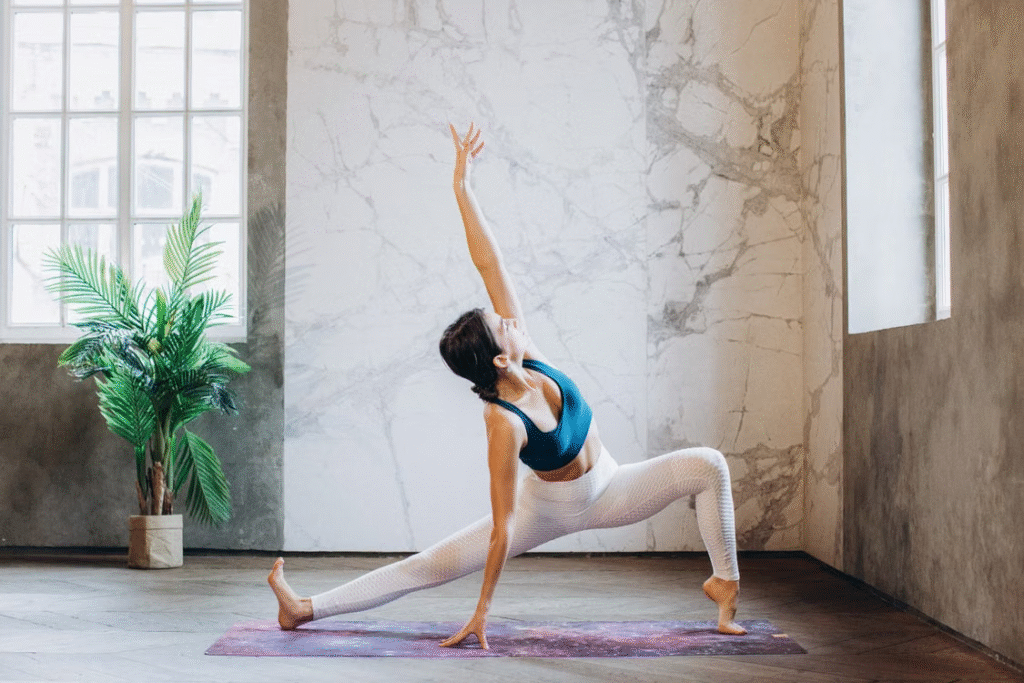
Why choose a residential training in Arambol, Goa?
Immersion creates a different rhythm of learning.
Instead of fitting yoga into an already busy day, you spend a concentrated period practicing, studying, reflecting and interacting with other practitioners.
Our training takes place at The Lotus Sutra in Arambol, close to Arambol Beach.
The location provides a peaceful coastal environment around the training, but the real value of the experience comes from the combination of teaching, practice, study and time for reflection.
The beach is part of the setting.
The learning is the heart of the experience.
How do I choose the right 100-hour yoga teacher training?
Look beyond photographs and promotional language.
Before booking, investigate:
- Who teaches the course?
- What is their teaching experience?
- What exactly is included in the curriculum?
- How much practical teaching is provided?
- Will you receive personal feedback?
- What yoga traditions are taught?
- Is anatomy and alignment included?
- Are pranayama and meditation part of the program?
- What accommodation and meals are included?
- What certification will you receive?
- What do previous students say about their experience?
Most importantly, ask yourself whether the school’s teaching philosophy matches your own reasons for joining.




The right school is not necessarily the one making the biggest promises.
It is the one whose approach feels right for the way you want to learn.
What should I expect emotionally during the 11 days?
Not every day will feel the same.
There may be mornings when you feel energized and inspired.
There may also be days when you feel tired, challenged or uncertain.
That is normal.
Immersive learning takes you out of your familiar routine. You may discover habits you had never noticed before. You may question assumptions about your practice. You may experience moments of confidence followed by moments of doubt.
None of this means that something is going wrong.
Learning often feels uncomfortable before it becomes clear.
Give yourself permission to experience the process rather than expecting every day to feel perfect.
What happens after completing the training?
That depends on you.
You may return home and deepen your personal practice.
You may begin exploring teaching.
You may continue into a longer yoga teacher-training program.
You may develop a particular interest in pranayama, meditation, philosophy or another area of yoga.
Or you may simply find that you approach your everyday life with greater awareness.
There is no single outcome that defines a successful training.
The real measure is whether the experience gives you a stronger foundation from which to continue.
One Final Question: Are You Ready to Begin?
You may still have questions.
You may feel excited and nervous at the same time.
You may wonder whether you are experienced enough.
You may even wonder whether you are ready to call yourself a yoga teacher.
You don’t have to have all the answers before you arrive.
Come ready to learn.
Come ready to practice.
Come ready to listen.
Come ready to question.
And allow the 100 hours to unfold one day at a time.
At Diksha Yoga School, The Lotus Sutra, Arambol Beach, Goa, the intention is not simply to help you complete a course.
It is to create the space for you to deepen your practice, understand yoga more clearly and begin discovering your own relationship with teaching.
Your first step may simply be stepping onto the mat.
The rest of the journey unfolds from there.
Part 12 — What Students Say About the Diksha Experience
A yoga teacher training is difficult to describe completely from a course page.
You can explain the curriculum.
You can describe the location.
You can list the subjects.
But the experience itself is something students understand best after they have lived it.
Here are a few reflections from students who have trained with Diksha Yoga School.
“It will influence my path a lot.”
“I’ve learnt so much, not only asanas but more important, about what yoga means and how it will positively impact my life. You can really tell that the Diksha Yoga crew loves what they do and the teachers are amazing.”
— Leigh Hughes, 200-Hour Yoga Teacher Training student
This is exactly the kind of distinction we hope students experience: yoga becoming more than a collection of physical postures.
“I left… feeling so amazing in myself.”
“My teacher training with Diksha Yoga was one of the best things in my life. Amazing course, amazing experience in an amazing place… I left, not wanting to leave, but feeling so amazing in myself and excited to teach and share the new skills I had gained from the course.”
— Jasmine St Cliere
For us, the most meaningful part of this reflection is not simply that the student enjoyed the course.
It is that she left feeling ready to share what she had learned.
“A beautiful experience of life and transformation.”
“A team of yogi and Yoginis are very professional, caring… and especially passionate… The setting was very nice. Very good meal and nice staff. Beautiful meeting in the training.”
— Sabrina Coqk
These experiences are a reminder that a residential yoga training is not only about what happens inside the classroom.
It is also about the people you meet, the conversations you have, the environment you share and the memories you carry home.
Your 100 Hours Begin With a Decision
Perhaps you have been thinking about yoga teacher training for months.
Perhaps you have practiced for years but never felt ready to take the next step.
Perhaps you are simply curious about what could happen if you gave yourself 11 days to slow down, study deeply and live closer to your practice.
You don’t need to know exactly where the journey will take you.
You only need to decide whether you are ready to begin.
At Diksha Yoga School, our 100-hour yoga journey in Goa takes place at The Lotus Sutra, close to Arambol Beach, where you can step away from your usual routine and dedicate meaningful time to practice, study and self-discovery.
Come to Goa to Learn More Than Yoga
Practice the asanas.
Understand the breath.
Explore meditation.
Study the philosophy.
Understand the body.
Practice teaching.
Find your voice.
And begin listening to your inner teacher.
Your 100 hours are not about becoming perfect.
They are about becoming more aware, more confident and more deeply connected to your practice.
Ready to Begin Your Journey?
Explore our upcoming 100-Hour Yoga Teacher Training in Goa and discover what 11 days of immersive practice and study can bring to your yoga journey.
Diksha Yoga School
The Lotus Sutra • Arambol Beach • Goa, India
Your journey from practitioner to teacher begins with one step onto the mat.
Explore the 100-Hour Yoga Teacher Training